Showing posts with label Dinghy History. Show all posts

Monday, December 30, 2019

The Toronto Dinghy


Several years ago I was working on a sailing history project on the Genesee Dinghy, one of the earliest North American racing dinghies. It never got farther than a couple of chapters. Last week a canoe sailing historian contacted me with a question and I dug out the first chapter, "The Toronto Dinghy", which detailed the precursor to the Genesee Dinghy, the two Toronto dinghies introduced at the end of the 19th century. I reproduce a PDF of the first chapter here for the few Earwigoagin readers who are interested in early North American small boat history.

(As always, use the pop-out icon, top right, to open the PDF in another tab for printing or download.)


The George Aykroyd 14 footer would become the turn-of-the-century L.S.S.A. restricted 14-footer class.

And more L.S.S.A 14 history from the CBIFDA blog.

Thursday, April 18, 2019

The Group Boat Building Phenonema of the 1960's and the We-sort


Michael Storer mentioned in his history of the Oz Goose box boat that the ongoing group building effort in the Philippines became a key contributor to getting a good size fleet of Oz Goose's going in an area not known to be a yachting center. This reminded me how community group building in the 1960's (particularly in the U.S.A) played a huge role in the emerging popularity of the small sailing dinghy. All sorts of local chined plywood classes, Dusters, Rhode Bantams, El Toros ... were built over the winter, by groups of mostly Dad's, led by one or two experienced woodworkers, the rest following along. Usually ten or so dinghies with all the sailing bits and pieces were banged out, the hulls chosen by lot to be taken home to be painted and fitted out. This was before stitch and glue construction so most construction required a mold, which would be taken out of storage the next winter for a different group. Several winters of building would give a large and active fleet for summer training and racing.

Below is an article by Ed Perry from a 1964 issue of One-Design and Offshore Yachtsman about a community group build of the Blue Jay, the 13 foot Sparkman and Stephens junior trainer. Use the pop-out icon in the top-right to put the article in another tab on the browser for easier reading.


The 12' We-sort, a jaunty, flat-bottom, plywood skiff with sloop rig, was our local 1960's class. The We-sort was group built in the various communities that border the Severn River, just above Annapolis. It came out of the Indian Landing Boat Club that sat at the headwaters of the Severn River.
"Will Jacobs, caretaker of the Indian Landing Boat Club property for many years had several rowboats he rented out to locals. His boats rowed easily and were simple to build. The form had been worked up by Willie’s ancestors, Algonquin Indians, who were also responsible for the name of the area. The Indian tribe referred to themselves as We-Sorts and everyone else as They-Sorts. It seemed fitting to name the sailing/rowing skiff the We-Sort. Led by William Sands, who drew up the plans and added the sailing bits, the sailboats were built by club members in basements, garages, and in some cases living rooms. The We-Sort was a perfect fit for youngsters. It was very stable, which made the young sailors comfortable to be out on the water. By 1961, thirteen of he We-Sorts had been built."
The one-page informational blurb on the We-sort:


Tom Price, artist, learned to sail in a We-sort and drew this pencil sketch of a racing group going upwind.

Tom Price, pencil

Alan Dove has put up a couple of posts about the We-sort and I have pulled the following photos from his site.

Dennis Buckley

Dennis Buckley

From the One-Design and Offshore Yachtsman, January, 1967 class review guide:


CBMM, Chesapeake Maritime Museum over at St. Michaels, did a group build of We-sort's. They used the fleet for a summer training program for a couple of years but I think they now only have plastic boats for sail training.

Addendum: Pete Lesher, chief curator, fills us in on the history of the We-sorts at the Chesapeake Bay Maritime Museum. (Pulled from the comments.)
"Chesapeake Bay Maritime Museum's fleet of 6 We-Sorts was constructed in the late 1980s after We-Sort #2, Wee Lass, was donated to the museum. They were used for 15 years or so in the museum's summer sailing camp. At one point, a couple of the hulls were damaged in a fire in off-season storage, and at least two replacement hulls were built. When the We-Sorts were worn out from hard use, the museum considered a replacement fleet, but the sailing instructor at the time led the museum to instead acquire a fleet of plastic JY-15s. Some of the We-Sorts were sold, but one or two still remain, their rigs long gone, as rowing craft in the museum's summer boat livery. The youth sailing camp has been discontinued."

Wesort dinghy, WeSort skiff.

Sunday, October 8, 2017

A Cricket Dinghy Uncovered!

I have written about the Cricket dinghy, one of North America's first dinghy classes. I had despaired of ever seeing one in the flesh but, in wandering the docks this weekend at the Mid-Atlantic Small Craft Festival, my mouth dropped open; there she was, floating peacefully tied up to the dock, an old timey Cricket! Turns out that Richard Scofield, assistant curator at the Chesapeake Bay Maritime Museum, had found one "upriver" as he said (I assume he meant the Miles River). It had been in one family for years and was outfitted with an outboard motor with which they puttered about the river. The bow had been bashed in. Richard purchased her because he found her a pretty dinghy and being, at one time, head of the boat shop, did a top-notch restoration. He also did some research which will allow me to update what is known about the Cricket.

The Cricket tied up at the dock. Not much is known about her origin. The name on the transom is Jiminy Cricket.


This Cricket is planked which does indicate a pre WWII build time.


Underway. A sprit rig with a club at the clew. A large, low aspect ratio cat-rig with no battens. This one looks to have a lower freeboard than some of the later Miami Yacht Club Crickets.


A very sharp bow. I can see how the Cricket could have influenced the Classic Moth Cates design which also has a very sharp bow.


The Cricket led the Saturday sailboat race at MASCF for a long time, finally finishing third to a C. Lowndes Johnson 18 footer and a Thistle.


I've had this file photo from the Baltimore Sun sitting on my computer for a while now, classified "mysterious dinghy." After looking at Scofield's Cricket at MASCF I can now positively identify the photo as another Cricket. Most likely the photo was taken in the 1950's.


Sunday, June 4, 2017

Header Photo: Monotype de Chatou


The previous header photo was of Louis Pillon and his restored Monotype de Chatou. The Monotype de Chatou was a French follow-on to the American Lark scow, the Lark being originally introduced to France as the Monotype de Dinard. Designed in 1901 by Francois Texier, the Monotype de Chatou featured soft bilges rather than the boxy, chine shape of the Lark and the wide scow bow of the Lark was pinched in. The Monotype de Chatou was France's first popular dinghy with over 100 being built.

The drawing below is from the Wikipedia entry on the Monotype de Chatou.


A photo of the three of the original French build of the American Lark scow, the Monotype de Dinard.


Chatou was a western suburb of Paris, fronting the Seine River. There was a yacht club on the narrow island where the fleet of  Monotype de Chatou's were moored. From Google Maps.


In 1906, the French painter, Maurice de Vlamink, painted this scene (in the style of Van Gogh). Painted from the vantage point of Île de Chatou, it is likely the moored sailboat was a stylized Monotype de Chatou.


A rescue performed by a Monotype de Chatou. I'm not sure if the swamped vessel is another Monotype de Chatou. If this was a romantic Sunday sail, I would bet the lady being dragged over the gunwhale by the rescuers didn't bargain on being completely soaked by this mis-adventure.


Wednesday, December 28, 2016

Love, Sex and the Development of the Small, Recreational Boat


My good friend, Tom Price, sent along this 1904 cover illustration from Puck magazine (don't comment about the steering - realism is not the point of this painting). This cheesecake magazine cover is a good segue into a blog topic I've kept on the back-burner for a while; how romance and sex in late 19th century and early 20th century, that ever-present animal sex drive that spans all human history, pushed forward the design of recreational small boats.

The late 19th century was marked by increased urbanization, this combined with chaste Victorian mores on dating, left city couples with a suffocating romantic environment.  Enter the small craft, first the canoe, then the rowboat (and in Europe, the punt). Entrepreneurs set up boat rentals in city parks, along languid rivers, in protected bays. Boat-builders were re-designing the more utilitarian working hull shapes to accommodate neophyte boaters (but ardent couples). Canoes became wider, rowboats became shorter and more intimate. In this era, long before mass boat ownership, the boat rental business was hammering out the sizes that work for recreational small boats.


Article on canoes and love by Hunter Oatman-Stanford.

Marine historian John Summer organized a show at the Canadian Canoe Museum on love and canoes, featuring postcards he had collected over the years.


From a French postcard, a longer, rather skinny sharpie rowboat set up for two couples.


"Madame" a French rowboat from the 1880's (not sure if this is a reproduction or restoration) shows how the size had shrunk in this "courting" rowboat to somewhere around 4 meters, ideal for an intimate outing for one couple.


A risque postcard (for that time) of "Canoedling". With the lean of this canoe, the illustrator has subtly shown how tricky romance in a canoe could be.


From a postcard, a fleet of identical rowboats; Rod and Gun Club, Omaha, Nebraska. In what seems to be subliminal advertising, all the comely young women are manning the oars in this photo.


Tuesday, December 6, 2016

Saturday, October 15, 2016

505 Classic Moth


Continuing with the 505 theme, the image above is one that ever-vigilant Neil Kennedy plucked from the Web. It is buried deep within a very interesting article on 505 designer John Westell, written by British historian David Henshall, found on the Yachts and Yachting website. The image is the lines drawing, the waterlines and buttocks of a Classic Moth that John Westell designed on his 505 theme. (No date is given for the design but it would be safe to assume sometime in the 1960's.)

I initially thought this design would not have met the 1 inch (25mm) hollow rule the class had in the 1960's (and a rule that our modern Classic Moth class still retains) but on second look it seems that John Westell did meet the rule (the rule applies aft of the daggerboard trunk and John did reduce the gunwhale flare to what looks to be legal limits in the back of this Moth).

Speed-wise this design does not offer any advantages to our current Gen 1 race-horses (the Shelley, the Europe, the Cates) but for someone who wanted to build a lovely mini-505 and race Classic Moths, this would be a very interesting and welcome addition to our polyglot group.


Thursday, July 21, 2016

Bogie Sails, Bacall Bails


Found this photo on page 72 of the February 1948 issue of Motor Boating. The caption says:
"Bogart sails, Bacall bails: one of the film colony who really sails becasue he loves it. Humphrey Bogart both headed the rules protest board and tillered Slugger to finish somewhere in the Balboa dinghy fleet. Here Bogey's wife, Betty (Laureen Bacall)(sp?), performs as a good crew should, bailing Slugger out.

I'll always appreciate the artwork you'll find on the covers of these old magazines.


TOH to Google for their continuing effort at digitizing these old magazines.

Saturday, July 9, 2016

New Blog on Small Boat History

Australian Chris Thompson, who wrote an excellent, unpublished history of dinghy racing back around year 2000, has decided to put his extensive research up on a blog. I think his intention is to eventually publish, either digitally or in book form, but, for now, the posts on his blog are very informative for that small cadre who study small boat sailing history.

Best to start with the Introduction to SailCraftblog and follow the links from there.


Monday, June 27, 2016

Monotype de Nogent-Joinville

Bertrand Warion sent along some photos he took of the "Voiles des Boucles de la Marne" (rough translation - sailboats of the Loops of the Marne, a reference to the rough S shape of the Marne River on the southeastern suburbs of Paris). The "Voiles des Boucles de la Marne" was a small gathering, this past May, of traditional French small sailboats that were sailed on the rivers around Paris during the late 19th and early 20th centuries. Of interest was the plywood reproduction of the 1903 French 5.5 meter sailing dinghy, "Le Monotype de Nogent-Joinville".

The Monotype de Nogent-Joinville was drawn up by Ernest Binet, following the detailed input of Albert Glandaz and was a product of a push by Parisian sailors, as they entered the twentieth century, to develop small one-design sailboats for racing (the French word "monotype", in this case, can be translated to mean one-design).

The Monotype de Nogent-Joinville at the dock. Behind her is the Monotype de Chatou, the scow type which had appeared on the French rivers several years earlier in 1901.

Bertrand Warion

The Monotype de Nogent-Joinville has a deep vee hull. For river sailing, the wetted surface is much reduced compared to the flat Monotype de Chatou but the Monotype de Chatou would remain more popular, with around 140 being built compared to around 20 for the Monotype de Nogent-Joinville.

Bertrand Warion

Historian Louis Pillon put together the lines of the Monotoype de Nogent-Joinville from a magazine article of that period. The Monotype de Nogent-Joinville was a sloop, had a low slung gunter rig, the main had three full length battens. It is a rig that the French designers copied, according to Louis Pillon, from the English designer Linton Hope. This reproduction was built by volunteers at Sequana, the French nautical historical society, under the direction of Bertrand Chazarenc.

Louis Pillon

Out sailing; the Monotype de Nogent-Joinville drifting ahead of Louis Pillon's Monotype de Chatou. According to Bertrand, the Monotype de Chatou has bamboo spars!

Bertrand Warion

Another photo from the dock. In the foreground, with the cool wishbone-type split tiller, is Bertand Warion's Sharpie 9m2, a flat-bottomed, canoe-like French singlehander that was designed in 1937.


Bertrand Warion

A contemporary postcard, early 1900's, with a Monotype de Nogent-Joinville sharing the river with various Sunday leisure rowboats.


I have gleaned all of the history from Louis Pillon's articles which I found online.

Saturday, October 31, 2015

Miami Yacht Club, Florida - Late 1940's

History is marked by "flowering" time periods, a confluence of time, location and people that melds in a dynamism that creates something interesting and different. (Some of these periods have enormous influence on world history, Paris in the 19th century springs to mind; a center of radicalism in mid-century, a center of frenetic artistic bounty in the late century.)  Such was the case with small boat sailing out of Miami during the post-WWII years. A combination of professional builders and amateur tinkerers pushed the development of three small boat classes, two of them local. However, in this history, the two local Miami classes, the Suicide and the Cricket, "flowered" and then disappeared, their effect negligible on the later history of small boat sailing . The long, lean, Suicide dinghy with the wishbone rig was the fastest sailing class in the U.S immediately after WWII. The Cricket was an all-out racing cat-boat with a wishbone rig and a sliding seat. (The Mothboat was the third class - what we call the Classic Moth today.) Miami Yacht Club on the causeway was the focal point for racing these unique craft.

In search of more archival material on the Suicide and Cricket class in Miami, I turned to George A of Mid-Atlantic Musings. George has a vast collection of Mothboat historical material including the Miami period. Sure enough, George was able to produce the Walter Dietel album. Walter was a German immigrant who designed and built his own Mothboats and Suicides in Miami after WWII.

Photos from the album are featured below. Some of the photos are from the Miami Y.C and some, I think, are from the Coconut Grove Sailing Club.

A Cricket coming at the camera with a Suicide in the background.

Walter Dietel Album

A Cricket on a trailer with Mothboats launching.

Walter Dietel Album

A Cricket and a Suicide. I think this is the race committee boat that is throwing them a line. (See photo below.)

Walter Dietel Album

Three Crickets. This may be a start, or possibly a leeward rounding - hard to tell. You can definitely see the sliding seat in use on the leftmost Cricket.

Walter Dietel Album

Jerry Gwynn's champion Suicide Joker.
Walter Dietel Album

A Suicide kicking it up on a reach.

Walter Dietel Album

On the launching beach, a mixture of Suicides, Crickets, Mothboats and what looks to be a Whitman EZ-build chine decked canoe (International Canoe) with most likely Lou Whitman himself standing over it.

Walter Dietel Album

The peanut gallery, in rapt attention to the racing, consigned to a log on the beach, .

Walter Dietel Album

Walter Dietel, from whose photo album these images were taken, with his home-built, amateur designed Mothboat.

Walter Dietel Album


Sunday, October 4, 2015

The Florida Cricket Class - A Missing Link?

The Cricket class was a 15 foot, chined, V-shaped, catboat with sprit rig and club clew. The class died out in the early 1960's. By that time the Cricket fleet was only found at the Miami Yacht Club and, given the small numbers at the demise, it is today, a forgotten class. But in digging through U.S. sailing history more comes out about the Cricket.

The Cricket class was designed sometime during the 1890's, in or around Atlantic City N.J, where it became extremely popular. Reports indicate hundreds were built and about one hundred were racing out of Atlantic City in 1900. It was, as far as I can determine, the earliest example of a chined, V-shaped sailing dinghy in the United States. More about the early development of the Cricket class (who was the designer? what prompted the design? when did the class die out in Atlantic City?)  has been hard to come by.

In the 1920's, when Northerners began to flock to the remote, but bucolic winter paradise that was Florida, the Cricket class was also exported in numbers from the New Jersey shores. It was reported that twenty five Crickets were shipped to southern Florida with most of them destroyed in the hurricane of 1926. The  Cricket class would rebuild in Miami and would form the core of the Southern Florida Sailing Association (later the Miami Yacht Club) when it was organized in 1928. The Cricket would become the boat to beat in the free-for-all under 150 sq. foot (sail area) class.

When, in 1931, Bill Crosby designed the Snipe for the Florida West Coast Racing Association's free-for-all Trailer class, he must have been mindful that his Snipe would initially be compared against the Cricket class, at least in Florida. Between the two, the hull design similarities are striking. It does seem that Crosby started designing his Snipe using the Cricket as a baseline and then added user-friendly features (a sloop rig with a high boom being the most notable one). The Snipe went on to international fame, the Cricket, to oblivion.

Some photos:

A smattering of classic Florida sailing dinghies; on the left, the Optimist Pram, behind the Pram, a Mothboat, in the center, a Cricket, with the other Cricket, bow on, in the foreground. Behind the Cricket is a Southwester class, designed by Bob Halsey.


Crickets launching at Miami Yacht Club, late 1950's.


Crickets going upwind. In all three of the ones in view in this photo the crew are hiking using skinny hiking boards.


The closest we have to a set of lines for the Cricket was this one-design commissioned by St. Petersburg Yacht Club as featured in The Rudder, 1919. The lines look very close to a copy of the Cricket although the length for this one-design is a foot longer than the Cricket.


Turns out that the Atlantic City Library has Cricket plans. Here is a smaller scanned version.


Monday, July 13, 2015

Kaagweek, 75 Years Ago

Kaagweek and Sneekweek are the two big sailing regatta weeks in The Netherlands. Kaagweek occurs first, somewhere around the middle of July. I came across this historically interesting video of Kaagweek filmed in 1940, seventy five years ago.

Unfortunately the video settings restricts embedding on Earwigoagin, Click here to view the video.

After viewing this video several times, thinking about it and researching, I've come to the conclusion this sailing regatta video offers up so many layers of meaning and so many unanswered questions, it ranks as the most fascinating sailing video I've viewed

My first viewings of this video took in the pastoral beauty, the windmills, the myriad of, now traditional, Dutch classes heeling gracefully as they race their way up the small fingers formed by the dike systems, the spectators dining at the water's edge, the formal race committee attire, the pretty women walking the dock, ogled by young sailors. People are having fun, which is the whole point of a sailing week. The soundtrack of wistful swing tunes from that era adds to this period piece.

It was then I realized that the 1940 Kaagweek took place two months after the Nazi's had overrun Holland. This Kaagweek was taking place in occupied Holland. Kaag looks to be about 15 km. from Rotterdam and during the invasion, the Nazi Luftwaffe had completely leveled the center of Rotterdam.


The 1940 Kaagweek must have been held with the Nazi's approval. The question becomes whether this video was put together as Nazi propaganda to show that "normalcy" had returned to occupied Holland, or whether it was filmed surreptitiously as a home movie by a Dutch videographer. The production values suggests it may have been Nazi propaganda. Of note is at the 8:21 mark of the video, there is a stern-faced spectator wearing the Jewish star.


Reader WaveDancer disagrees with my assessment that the video was Nazi propaganda. I've dragged his comment over to the main post:
"I doubt that this video was German propaganda. After the surrender of The Netherlands, it took some time for the German occupation to show its true Nazi colors. PS: Whereas de Kaag is definitely in Holland, Sneek is not! The country should be referred to as The Netherlands. Wavedancer (who was born there, just around that time)"


Wikipedia states that 205,000 civilians would die in the occupation of Holland with 1/2 of that number being Dutch Jews who died in the Holocaust. Many of those young sailors shown in the video would be forced to labor in German factories during the war. I'm not sure how many sailing regattas were still held in Western Europe during the summer of 1940 but by 1941, sailboat racing had ceased (with the exception of the Nantais Moth, which the Nazis and the French Vichy government allowed to be built during the war).

July 10, 2015 also marks the 75th anniversary of beginning of the Battle of Britain, the approximate 2 month air battle where the Nazi Luftwaffe came within a sliver of destroying the British RAF. That the Nazi's didn't break the RAF would mark one of the turning points of  World War II. Goering and the Luftwaffe would then turn in September of 1940 to bombing the British cities in an attempt to force capitulation.

One of the mysteries of my life is how my loving mother, with her parents and siblings, endured the chaos, death, and destruction of the London blitz, and later the V-1 doodlebug, and V-2 rocket attacks. I never detected any true bitterness from her. She still maintains the attitude of always looking forward, never looking back - probably a residue of that British "stiff upper lip".  The courage it took to maintain day-to-day living under such conditions still amazes me.

Sunday, March 29, 2015

More Aluminum Sailing Dinghies

In response to my post about the aluminum Gouget Moth, several readers sent in some aluminum sailing dinghies they have come across.

Australian "R.L". sent two photos of a welded aluminum version of the Australian 11' Aquanaut Dinghy, masterfully crafted.


Mike Scott owned a prototype De Havilland 12' aluminum dinghy during his time in Australia. His story:
"I'm not sure who designed that alum dinghy I had, could well have been built as a prototype for the Vagabond, and therefore designed by Alan Payne. They maybe figured that alum was not the best way to go and so built the 3 class boats in glass. The 16ft Corsair is still going strong all over Oz, but the 12ft Vagabond and 10ft Gipsy seem to have faded. When I worked at Miller and Whitworth (Bob Miller and Craig Whitworth, sailmakers, Flying Dutchmen champs, and of course the legendary Bob Miller (aka Ben Lexcen). They became the agents for the 3 classes, and we would place an advertisement in the local paper for 'Free Sailboat rides', and we would take out prospective customers and then try to sell them a boat....was a fun job, but didn't get to see my kids much....that was 1966. Check out De Havilland Marine. I also worked there - that was where this boat came from. I bought it for 'scrap value', one of the perks of the job, I guess. In those days I was an accountant - ha...!
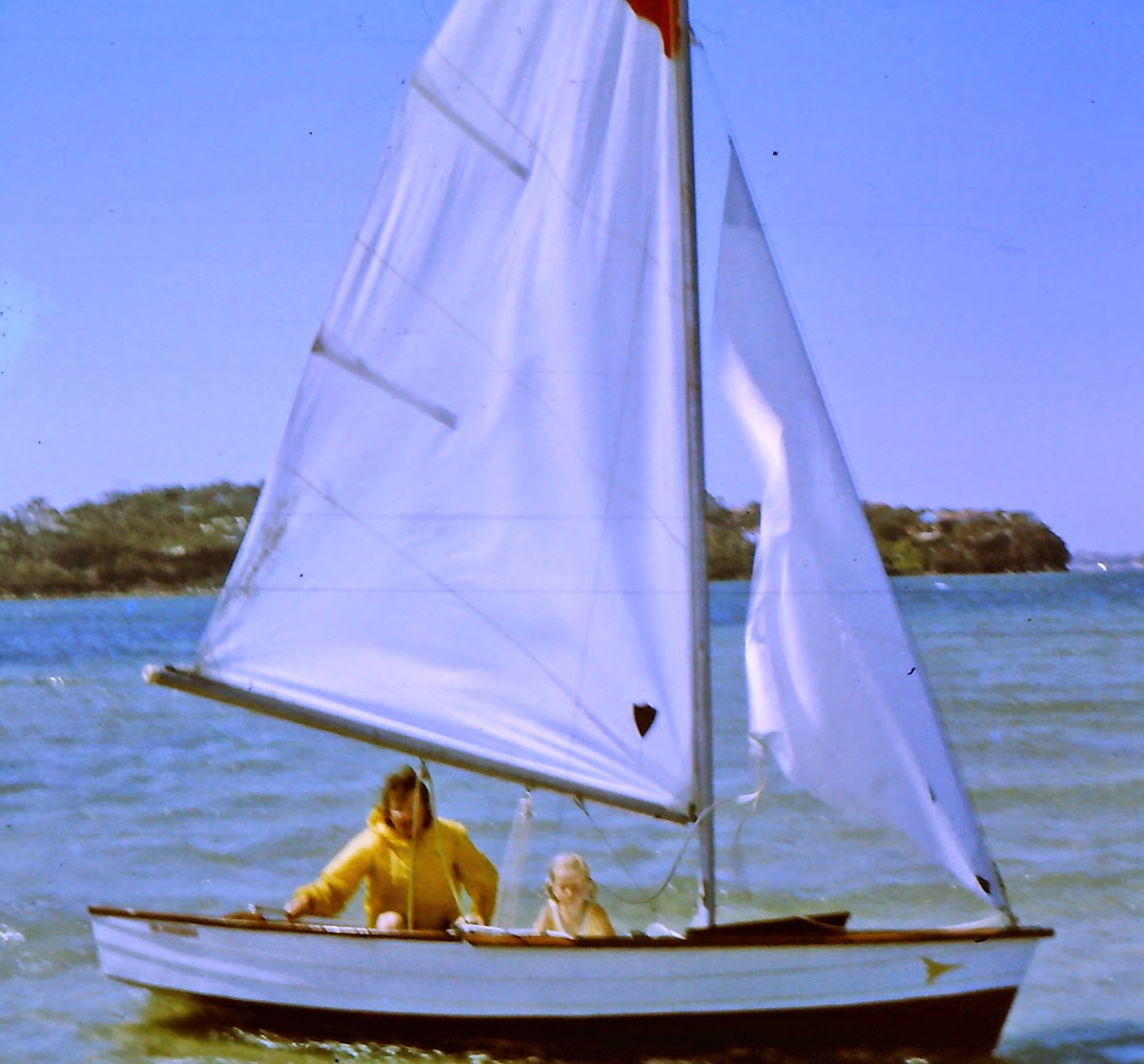

In the U.S, Grumman remains the most famous firm for their line of aluminum small boats and canoes but their most enduring aluminum sailboat is their dink, much sought after by the cruising crowd.


Tom Price pointed out that Grumman, in the late 1960's, built a 15' racing dinghy, called the "Flyer." Tom came across it at a Baltimore Boat Show. It doesn't appear many were made as this is the only image I could dig up about this dinghy on the InterWebs.


And finally, the aluminum sailboat I came across at Bobby Muller's yard? After digging around it appears it was the Pelican class, a 12 footer design by Philip Rhodes, of which over a thousand were built by the Aluminum Company of Canada - Alcan. More info about the Pelican can be found at this blog post here.

A nice roomy 12 footer.


A video walk-around of a Pelican.