Showing posts with label Micro Dinghy. Show all posts

Monday, January 18, 2021

Header Photo: Peanut Class, Arnold Johnson, and Boat-Tinkerers


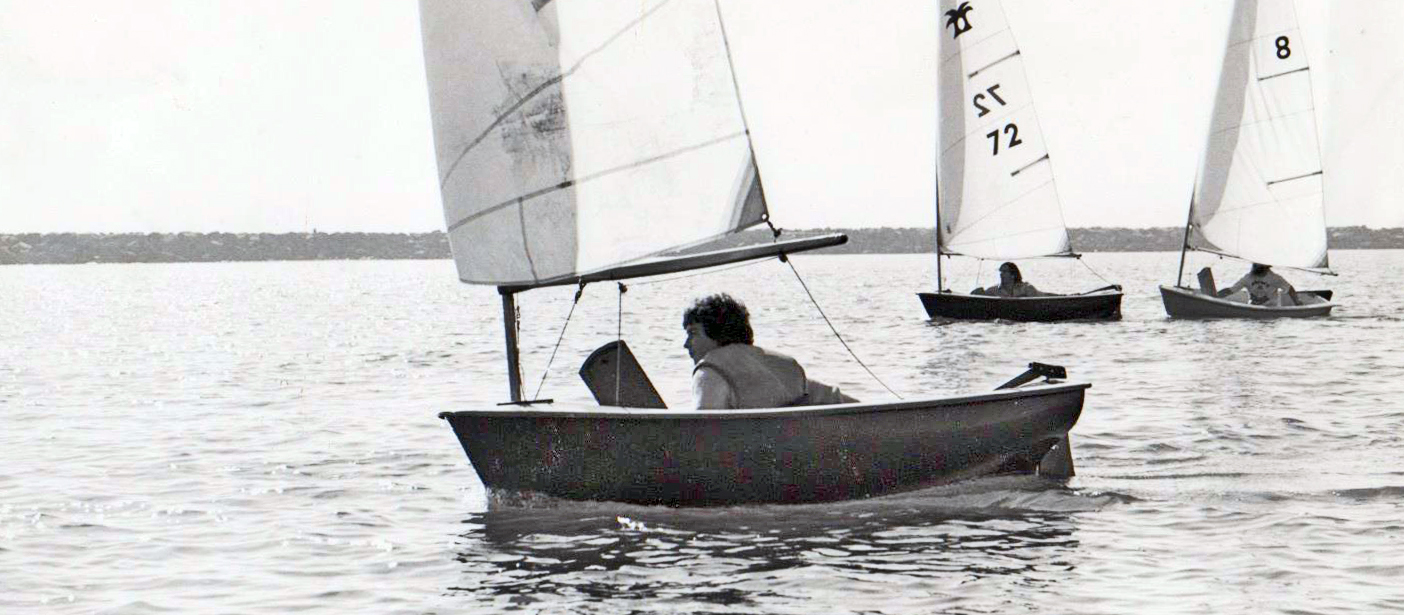
The previous header photo is of the Peanut class singlehander (in this case Peanut #1, Charlie Brown), a plywood DIY dinghy designed by Arnold Johnson in West Islip New York. The class grew to around around 400 and then faded in the 1970's. There is a nascent effort, led by Jeff Moses, to restart the class. I've been posting about the Peanut over here.

The designer of the Peanut, Arnold Johnson, represents the engineer boat-tinkerer, a group that was especially prevalent during the 1960's in the United States. Phillip Johnson, Arnold's son, shares some biographical history of his father, and, as a homage to that era of the 1960's engineer/boat-tinkerer, I re-post it here.
"My dad went to Brown University (born in Hamden CT) and worked at Grumman Aircraft in Bethpage NY while we lived on Long Island. He was an aeronautical engineer and did a lot of wind tunnel work on airplane wing design. After Grumman, he worked at Sanders in Nashua NH for a few years then worked for Boeing and Lockheed and then at Northwind energy designing windmill turbines. He was also an avid photographer, something he passed on to all four of his children. He died in 1993 of colon cancer. He built several Peanuts (#1 and #2) and bought #7 for me and experimented on that boat the most. We raced the Peanuts, the Skylark and later on an Aquarius 23 in the Great South Bay area."
A list of Arnold Johnson's projects:

  • 1957 - Designed and built a 14' (4.26 meter) modified scow, sloop rigged.
  • 1960 - Designed and built Skylark I, at 20.5' planing sloop.
  • 1961 - Designed and built a keel with trim-tab for Skylark I. Had boundary layer trips and vortex generators. Later on this heavier keel was modified to a 90 lb retractable keel.
  • 1962 - Designed and built the 9.5' (2.9 meter) Peanut singlehander
  • 1968 - Redesigned the Narrasketuck sloop for construction in plywood.
  • 1970 - Designed a 38' trimaran ketch.
Arnold Johnson rigging and sailing a Peanut.


Arnold Johnson's Skylark I, a 20.5' (6.25 meter) 6mm plywood sloop which he constantly modified and raced handicap in a high performance division on the Great South Bay.


Tuesday, November 24, 2020

Header Photo: Jester Dink Racing; Jester Designer/Bulider Identified


Before reading further I suggest you refer to this post for background.


The previous header photo features 8 foot Jester dink racing on Santa Cruz harbor. I particularly like the bare feet draped over the leeward side, a throwback to when I was a young kid and spent my entire summer barefoot.

Now to the other Jester class, the twelve foot, sloop rigged daysailor. In the previous post I couldn't find anything about the origins of this class on the Internet. Now thanks to reader Bob Fujita, the mystery is solved. From Bob's comment on the previous post:

"The Jester was designed and built by Cleveland, OH Sailboat dealer Jack Butte. Jack sold primarily one design daysailers, and saw an opportunity to use the influence of the Thistle, Flying Scot, and Rhodes Bantam to design a 12’ dinghy. My parents sailed with Jack Butte at Edgewater Yacht Club, and I sailed with his daughter as part of the junior sailing program"
Bob sends along advertising brochures for the Jester, listing Glas-Tec Enterprises as the builder. 


A primo-condition Jester 12 footer somewhere in the Midwest. Nothing racy here, just a capable daysailor with high freeboard and bench seats.


Sunday, February 2, 2020

Update on the California Jester Dinghy


Xenon Herrmann sent along an update to history of the Santa Cruz Jester Dinghy. It looks like the Jester was based on an earlier "East Coast Dinghy."
"I own an ancient 8' plastic-classic sailing dinghy which I believe is the "generic East Coast dinghy" upon which the Jester was based (according to Skip Allen quoted in the July 2018 Latitude 38 article on Made In Santa Cruz Race Week It came with a stainless steel tube at the bow which I figured was more than a fishing rod holder based on the El Toro rudder and gudgeons on the stern which came along with it. The previous owner used it as a rowboat, but I built a conservative lateen rig and a leeboard; it has no daggerboard slot. Much of the wood was rotten, which I've replaced. Since taking the photo showing the sail, I've made a taller mast for it and have begun experimenting with adding sail area, though even with the 30 sq. ft. sail shown it will sail in glassy conditions. It is an absolute joy to sail.
Xenon sent along two photos:


The original stainless steel mast tube.


Wednesday, October 16, 2019

The Jester Dinghy: The Known and the Unknown

Of late, I've been inexorably sucked into a tale of the two Jester Dinghies, one known, one unknown.


The known Jester:

When doing a Google search, the Jester Dinghy that pops up is a 8' dink designed by Santa Cruz ULDB designer George Olson, and built by Ron Moore in the 1970's. The Jesters raced out of the Santa Cruz, harbor; a cramped short harbor, the shoreline packed full of boats and docks, the north harbor and south harbor split by a bridge. The Jester has the reputation as one of the scariest boats to sail in a breeze, probably because the short hull features the fine ends of a rowing dink combined with a large, high aspect ratio rig, stepped right at the bow. This must amp up the bow-down power downwind to uncontrollable levels. Reference this quote from Latitude 38 magazine, July 2018, page 86:
"Skip [Allan] says the only way to jibe [a Jester] when it's windy is, "You run it into the beach, turn it around, and hop back in."
Although I've passed through Santa Cruz a couple of times in my travels, I have never seen this Jester in the flesh.

The previous header photo, plucked from the Internet, shows Jesters racing in an expansive body of water; which is obviously not the Santa Cruz harbor. You can make out the very fine, wineglass transom which suggests the Jester was more designed for rowing than sailing.


Racing in the Santa Cruz Harbor. If the sail numbers are correct, it looks like the class made it to 200 boats.


I do like the stylized logo of this Jester.


Famed naval architect, Paul Bieker, (International 14 boffin with success in that class rivaling fellow North American Bruce Kirby) put together a modified Jester for his son. (It appears the molds for the Jester have ended up in Northwest Washington State.) He has designed a gaff rig for his Jester, similar to the one he introduced on his high performance PT Dinghy, a Tasar-killer 14 foot design.


Paul had a sail made out of Tyvek which lasted a good five years.


The Santa Cruz Jester based on a generic East Coast Dinghy?


The unknown Jester:

The last two years, on my walkabouts around my hometown of Annapolis, I had noticed a mystery dinghy tied up to the floating dock of St. John's College. It obviously was a main and jib dinghy, the length was shorter than 14 feet (4.26 meters), the design had high freeboard and she was very simply rigged. Despite staring at it for a while, I could not ID this class. I shrugged. One of those unknowns.

But it was not to be left at that. Over the summer, my good friend Mike Waters, became the latest St. John's sailing coach/boatshop manager. I gave him a hand at an Intro to Sailing event he ran at the beginning of the school year. I was taking groups out in this very same dinghy I had been pondering over. It was slow but commodious for it's size with some nice bench seats. It was then I learned that this dinghy that had been donated to the St. John's program was a different Jester class dinghy; American built, but otherwise origins unknown.

Since then Mike has hauled the Jester out to have the bottom scraped of a healthy growth of barnacles and to get some paint on her. With the hull flipped over, the hull design is very interesting; a flat bottom forward with a circular transom. This is definitely not a rerun design of Uffa Fox's formulaic deep forefoot with straight flat aft sections.

Mike with the sanded Jester on the trailer.


Flat U-sections forward. Max rocker amidships. The little data we were to glean from the Internet has the Jester at 12 foot (3.6 meters) length and 5 foot (1.5 meters) beam. Both Mike and I feel the Jester has potential in a college program like St. John's (where racing isn't the priority and the waters on College Creek are very cramped.). We are just wondering who designed her and who built her. (Again, the Internet seems to point to Ohio, but who knows.)


The Jester logo on the sail.


The rudder has the more modern rectangular shape. We are guessing a 1970's build time frame for the St. John's Jester. Anyone that has come across this Jester class in their sailing lifetime, please leave a comment.


Mike Waters in front of the St. John's boat house doors. The college has a sizeable fleet of crew shells as well as sailboats.


Bingo, We now have the designer of the St. John's Jester Dinghy. From a comment:
The Jester was designed and built by Cleveland, OH Sailboat dealer Jack Butte. Jack sold primarily one design daysailers, and saw an opportunity to use the influence of the Thistle, Flying Scot, and Rhodes Bantam to design a 12’ dinghy... My parents sailed with Jack Butte at Edgewater Yacht Club, and I sailed with his daughter as part of the junior sailing program


Monday, February 19, 2018

Northbridge Junior; A Japanese Build

I wrote about Frank Bethwaite's plywood junior scow, the Northbridge Junior, as part of a post on the sit-on-top dinghies. Last fall I came across some photos on the Web of a new Northbridge Junior built for a Japanese junior. The blogmeister, being one that feels we should encourage junior sailors in home-built dinghies, offers up the photos of the first day launching:


Two sheets of Northbridge Junior plans:

Sheet 1:


Sheet 2:


Sunday, October 22, 2017

Don Betts: A Micro Catboat Design: The "PeaCat"

From the very large (Silent Maid) to the micro; a 7' by 4'6" (2.13 meters by 1.37 meters) catboat. In the early 1990's, Brooklyn NYC artist Don Betts designed a very small catboat; the PeaCat. Despite the tiny size of PeaCat, I always thought Don did a good job at replicating a catboat design. I never saw a PeaCat in person but, from the following photos, at least two were built. It is unclear if anymore were built. The hulls were built using stressed plywood.

The boating magazine "messing about in BOATS" had two articles on the PeaCat. Several of these photos were scanned from an article in the February 15, 1992 issue of "messing about in BOATS."


messing about in BOATS
Carrying capacity; one adult or four small kids.

messing about in BOATS

Don Betts didn't skimp on the rig for PeaCat.
messing about in BOATS


messing about in BOATS

Don took one of the unfinished hulls and treated it as a hanging sculpture for a photo shoot. You can see the bend-em-up shape in this photo.

messing about in BOATS

Nice high, catboat coamings provides some measure of dryness for this tiny sailboat. I'm not sure how the tiller arrangement worked.

messing about in BOATS


messing about in BOATS


Designer Don Betts sent along this email, March 2018, filling in the details of the Pea Cat.
"I built the two of these little boats. I wanted little sailboats to keep on the beach. After building long thin boats that seemed to take a lot of walking up and back thought it would be fun to build something that could be built standing in place and spinning the boat around. The first boat has a centerboard, the second an off centerboard through the rail outside the coaming. The hulls are 1/8 plywood 4 ounce glass inside and out and both serviceable after more than 25 years of abuse and neglect. Fitted with oarlocks they have made ok dinghies, easy to carry up the stony beaches. The rigs haven’t aged as well. The drawings from Glen L Designs inspired the curve of the bow blending into a hard chines, The first boat has the chine up to the bow, but I realized each side could be cut from a single sheet of plywood. So redrew the pattern to form the shape from cutting the wedge shape to form the chine. There are patterns that I’ve sent to a few people that asked. The boats were a lot of fun but had some quirks that made me reluctant to share the design.
  1. With the sail up they were unstable in the water until the crew was aboard
  2. there seemed to be a speed limitation to a seven foot boat of that shape, going downwind against the tide the boats would sail themselves deep but not easily buck a current.
"The sailing pictures don’t tell the whole story, the boats were used mostly with two adults and a child, With two adults and both children the Pea Cats did not sail so well. Some of the memorable sails were out on the Hudson up near the Tappan Zee, and the East Passage of Narragansett Bay to watch the sailboat races. We knew the skippers of a few of the Herreshoff S boats and would sail out and along their courses close enough to wave. And they made good boats to sail the couple of miles around to the anchorage to see what boats were there for the evening. A more recent project has been a Providence River Boat, about the size and rig of Newport photographer Edwards Smith’s Kingfisher with the retractable bowsprit like his and the Button Swan in Chapelles American Small Sailing Craft.


Click here for a writeup on another micro catboat, the Bolger Queen Mab.

Sunday, May 1, 2016

The Pipsqueak - A 5-Footer from the Douglas Fir Association

When I wrote about my El Toro sailing days I recounted a same-age compatriot from the community accompanying me, as I learned to sail, in his six-foot sailboat. I decided, using my faded memory, to see if the InterWebs would offer up any clues as to the identity of this tiny sailing dinghy and, sure enough, I came up with a good candidate, the Pipsqueak design by John Burroughs. The design was sponsored by the Douglas Fir Association and plans were cheaply obtained. The Pipsqueak was even smaller than I remembered it, a five-footer instead of a six-footer.

I found some photos that were put up by the Tacoma Public Library. It is indeed a very small sailing dinghy, but a very good size to tow behind a bicycle as my friend would do.

Tacoma Public Library

Tacoma Public Library

Tacoma Public Library

The May 1956 issue of Life magazine had a one-page spread on the Pipsqueak.


My recollection is the Pipsqueak was very slow compared to the El Toro (my word! - the sail looks to be made from some sort of colorful domestic fabric; dress? sheets? table-spread?), but my friend had a lot of fun with her, though mostly paddling her. I must say that I have never since seen a sailing dinghy towed behind a bicycle.


Saturday, April 16, 2016

Header Photo: The El Toro dinghy


The previous header photo was of two El Toro dinghies racing. The El Toro is a 8' (2.438 meter) V-shaped, single chine, transom bowed dink, one of the many variations of the 1939 MacGregor Sabot design. Here is the entry for the El Toro in the annual class review issue of One-Design and Offshore Yachtsman magazine, circa mid 1960's.


I learned to sail in an El Toro. My family moved to Maryland in the early 1960's and we bought a house in a community with a beach and small boat launching. My Dad decided we should learn to sail and for some reason he decided our first boat was going to be the diminuative El Toro, a glass version built in California and sold by a local sailboat dealer. Initially it was my Dad, my brother and I taking it out on Sappington's Creek; learning by doing. My Dad eventually decided the El Toro was too small and bought a 16 foot Rebel sailboat for family sailing. My brother just wasn't into sailing as I was. Through attrition, the El Toro became my personal watercraft, the gateway to endless summer adventures on the Severn River. I have written about some of my experiences in my El Toro dink in this previous post and also this post.

One of my most vivid memories was the first time I capsized the El Toro. As we were learning to sail the El Toro out of Severndale Beach, many times we were also accompanied by two other small wooden sailboats sporting novice sailors; a Wee-Sort 11 footer with jib and an even smaller 6 foot dinghy sailed by a friend who was the same age as me. The 6 foot sailboat was built by the father who also ingeniously made a small trailer for the boat that could be towed behind a bicycle (our community beach was about 1/2 mile and across a busy road from the community).

The day I capsized, both the 6 footer and I, in my El Toro, were sailing just off the community beach. The wind was swirly and gusty and I was dumping the main and rather fearfully watching the gunwhale ship water. Suddenly the 6 footer capsized and there was much shouted instructions from the adults on the dock. Eventually a rowboat was commandeered to traverse the 30 yards to help my friend. I, my ego near bursting, was congratulating myself on handling conditions my friend obviously found too overwhelming, when, wham!, over I went as well. I remember the initial shock and surprise to find myself swimming alongside the sail but then my book-learning kicked in. Per my readings, I had to get on the daggerboard and lever the sailboat back upright. That I did, after some time since I was a scrawny kid, and the El Toro came up, mostly filled with water (this El Toro just had a small bow tank and a small stern tank for flotation). I slithered into the water-logged cockpit, was able to bail some water out and then creep toward shore. I can't remember if I took the mainsail down and paddled in or if I was able to sail in. Either way, I was back on the shore and the adults didn't have to come out to get me.

That was the green light. That capsize and successful self-rescue replaced fear with self-confidence. I was now set to go beyond the creek and to places far into the river.

Tuesday, April 12, 2016

"Kid Simple": A Design Cartoon for a Junior Mess-About boat

Every so often I sit down and sketch up a design I think would be cool to build. I posted this previously with a rough idea I had if you redesigned an Australian Six Footer and made it into a very tiny singlehander.

Below is a sketch of a very simple junior boat based on a punt/barge type, the bottom being essentially three flats. You could build it out of 6mm plywood with some stringers, or some rough lumber, cross planked, as they did in days of olde. You could put all your framing/cleats on the outside of the side panels as Bolger did on some of his QD (quick and dirty) boats - or not.

I call this design "Kid Simple". I originally designed it to be a good rowing boat (there is supposed to be a thwart just aft of the daggerboard case to sit on for rowing) and then added a sailing rig based on the sprit rig of the Optimist. I started off large and then made it smaller (the original length being 10 1/2 feet and then shortened it to 9.9 feet length, by shortening the bow flat - I'll let the reader do the metric conversions). It has a healthy skeg to help in tracking when rowing and I would envision a large rudder close to the Opti in size.

Here are two JPEG's. Dimensions in feet, tenths of feet, or sometimes inches. Again you can use the pop-out icon in the top right of the drawings to open in an another tab to print.

The first sheet has the original idea with modifications noted.


The second sheet has a modified sheer and length and includes the rig.


Friday, December 4, 2015

OD-OY Review: The Peanut Dinghy


Update, March 12, 2020. Class reforming. From Jeff Moses:
"I was just able to obtain 2 Peanuts from The Augusta Sailing Club! I will be taking lines off these boats and restoring both of them. I will be offering plans, kits and complete boats to new members. We will be hosting a National Championship in 2021. You can reach me at the US Peanut Class Association, Jeff Moses, President, 490 N. Stewart St., North Liberty, Iowa 52317. Jmoses9967 (with our good friends over here at) gmail.com and 319 530 9967."
December 2020 - Jeff is going to set up a Facebook Group. More details to come.


Ah! Memories of teenage lust ..... for a boat.

Around the age of 12, I learned to sail on an El Toro and shortly after, started to learn to race as a crew on an International 14. I became obsessed with sailing and, sometime in the 1960's, when the annual class review of the One-Design and Offshore Yachtsman came out, I spied this blurb on the Peanut class and fell in love.

Slightly longer than my El Toro and much racier, I dreamed of owning this beauty. I sent away to the class secretary and got one or two mimeographed sheets with some grainy photos in the return post. I could have bought some plans but, I was, at that time, inept with the basic hand tools and my dad wasn't much better. The money I saved from my lawn cutting jobs was to be used for other purposes.

When I was in my twenties, in a short foray in the Finn dinghy, I sailed a regatta out of Sayville, New York, just up the road from the Peanut Class home port of West Islip. My teenage obsession had long passed and I never thought of making a quick 10 mile (16km) side-trip to see if I could find a Peanut dinghy in the flesh.

In the ensuing years, despite inquiries to any Long Island sailor who has crossed my path, not one person has come forward as knowing anything of the the Peanut dinghy of West Islip, let alone have I been able to find a person who has seen one. It seems to be a class that appeared and disappeared very quickly, leaving not much trace.

But it still remains, to me, as one of those warm, fuzzy memories of early teenage years


Addendum January 2019: An ad for a fiberglass Peanut from Yacht Racing, February 1972.


Addendum January 2020: In an email, Jeff Moses adds to the history of the Peanut dinghy.
"Arnold R. JOHNSON and his wife Lydia lived in Westo (revive the t!) Islip. She was the class secretary. Plans were $8.50. Fleets raced in the Nationals at West Islip YC and Babylon YC. Arnold worked at Grumman as an engineer. We had a fleet here in Iowa. Bernie Kuse, a professor at ISU in Ames, built several. I owned two. Fleets were in Florida also. Several hundred boats were built.
Jeff is looking for plans for the Peanut. If you know of the whereabouts of such plans, leave a comment.

Jeff also sent along photos of a Peanut that was in a Long Island Museum. I didn't realize the Peanut was a double bottom dinghy. (It wasn't, at least initially... The original design was a single bottom hull.)


Addendum December 2020: Phil Johnson, son of Arnold Johnson, contacted me and supplied more history of the Peanut class, including photos and the background of his father. A fascinating man. (More of that later.) Phil's recollections of the Peanut:
"My memories of the Peanut were that it was versatile but you needed time to understand how your weight placement in the boat affected its performance. Once you became ‘one’ with the boat (and learned how to hike out properly on the rail), it wanted to go fast but you always had to be prepared for that sudden gust that would tip you over. It could beat the crap out of anything upwind and was pretty easy to get up on a plane while reaching. We raced against a lot of Sunfish/Sailfish back then and we would fall behind on downwind legs and always catch them upwind. They were a lot of fun to race as a class! As a trainer, my dad used the ‘Junior’ rig and a weighted centerboard for stability – as I said, versatile."
Here are two photos of the West Islip fleet back in the Peanut's heyday.


Update December 12, 2020: In a comment I moved over to the main post, Roger Errington adds more to the history of the Peanut Class.
"I learned to sail on [a Peanut] as a kid... My dad got the plans and built a Peanut for me. Must have been the mid 60s. I raced it out of the Otsego Sailing Club on Lake Otsego in upstate New York. Also sailed in the National Championships a couple of times in West Islip. So we knew the designer, Arnold Johnson, pretty well. The Johnsons left Long Island and moved to New Hampshire at some point. I remember some of the other sailors - Lou Jones and Axel Paulsen - believe they were TWA pilots and friends of the Johnsons. My boat has been sitting in a friend's barn in Massachusetts for years. It was a great boat to learn how to sail in. Pretty tender. You had to stay on your toes in gusty conditions or it was easily capsized. One comment about some of the photos: the boat didn't initially have a double bottom. It was a good addition given how wet the boat was and how often it went over."

Ed. Note: There is also a Norwegian Peanut sailing dink which was hot-molded and imported into the U.S during the 1960's - another instance of a class sharing a name.

Sunday, January 18, 2015

Aussie 6-Footer as a Classic Singlehander?

Australian 6-Foot skiff.

A couple of years ago it occurred to me that, if you reworked the massive rig downwards, the Aussie Historical 6-Footer skiff, would make a crazy, traditional singlehander. To that end I sketched out a cut-down sail plan which I present here.

As always, use the pop-out icon on the top-right hand to open the drawing in another tab.


Australian Historical Skiff

Tuesday, December 9, 2014

Header Photo: "Wee Georgie" Aussie Historical 6-Foot Skiff

Australian Historical Skiff


Bruce Stannard

The previous header photo was of the "Wee Georgie" a 1988 reproduction of the Aussie 6-Footer Historical Skiff Class. Aussie Robert Tearne built her and she is shown on the dock sporting her light-air rig with a boom at least over 2 times the length of the boat and a bowsprit approximately 10 feet long (3.19 meter). Talk about being over-canvassed. The 6-footer class takes the cake for being the craziest of the crazies!

There is a second reproduction Aussie 6-Footer, the Balmain Bug, built by Ian Smith in 1994. Balmain Bug has been sailed regularly since about 2015.

The history of the Aussie 6-Footers, quoting from the seminal book on the history of the Aussie skiffs, Bluewater Bushman by Bruce Stannard [1981];
"It is believed they were first built at Balmain in the 1890's and although they were first conceived as children's boats, there is no doubt that they demanded the strength of three men who were courageous, good swimmers and had the strength and agility of circus acrobats...They carried a staggering 1000 square feet of sail including a main, jib, topsail, spinnaker, ringtail, and even a watersail. [Mike Scott, over in comments, defines watersail as..."hung below the main boom to catch that extra drop of wind.....almost drooping in the water....hence the name....!] With so much sail up and so little to support it, it is hardly surprising that the 6-footers spent a lot of time "in the gutter"....
The class peaked during the early 1900's, attracting numbers because it was the cheapest way to go racing. Here are some photos of the early 6-footers sailing around 100 years ago. [Found on the Net]


The original crews sailed the 6-footers upwind with the bowsprit plowing a furrow in the water; probably the only way they could balance the whole package upwind.


Now for photos of the modern 1994 Smith reproduction 6-footer. A picture of the "Bug" off-the-wind in a fresh breeze, shortly after being launched. Looks like the crew is trying to get to the back of the bus when reaching but, alas, there is no back of the bus.


After ten years out of the water, the "Bug" was relaunched in October for this year's Balmain Regatta.

A quote from crew Campbell Reid:
"Even though she is based on a design close to a century old you can see how for their time these boats were pretty high tech...She will bury her bow in the blink of an eye but we were impressed at how seaworthy she was and were really happy that we could get upwind pretty well. In the six foot division of the historic skiff fleet at the regatta we think we are a serious threat.

 The precarious crew position Campbell Reid finds himself on the foredeck/bow may be the most comfortable one in drifting conditions. [The next two photos pulled from the Balmain Sailing Club website.]


Stick two grown men into a 6-footer and the scale becomes obvious. A 6-footer becomes a true "micro" dinghy.


The obligatory GoPro video shoot from this years relaunch. The bowsprit is so long it gives a perspective of a much larger dinghy. The 6-footers, like her bigger historical cousins, sported canvas lee cloths in a vain attempt to keep the water on the outside


A more recent 2015 video of the Bug including flying a good size spinnaker without driving her under. (Came pretty darn close though!)


And the videos keep on coming. A 2017 video of the Balmain Bug.