Showing posts with label Australian Historical Skiffs. Show all posts

Saturday, September 19, 2020

Header Photo: Alruth Stacking Out


The Australian Historical 18's are just so damn photogenic, they keep cycling through my header photos.

Sailing Dinghy Restorations during the Pandemic


It seems the Covid Pandemic has driven the older dinghy guys into the shop, particularly the Antipodeans who have been busy restoring 60 year old scow Moths and Australian 14-footers.


And this old skiff as well.


Monday, September 30, 2019

Header Photo: Vintage Aussie 18; Leeward Gunwhale Close to Gone


This one has been up for a while. A great photo of Avalon looking to cross the threshold of no return. The "Open Boat" forum on FB continuously posts great vintage photos of the Eighteen's; enough quantity I could keep using them as header photos for Earwigoagin over the next year.

Sunday, January 13, 2019

Historical 18-footers: December 2018 Race

It's always fun to watch video of the Historical 18-footers as they bash their way around Sydney Harbor in a good breeze.


Sunday, November 11, 2018

Aussie 18-foot skiff: Vintage Photos


Some great vintage photos of the Aussie 18 have been filtering out at regular intervals from The Open Boat on Facebook. I'm reposting a couple on Earwigoagin.


Monday, February 19, 2018

Gwen 12 - 1971 Plans

Back in October, 1971, I wrote about the plywood, 12' two man Australian speedster, the Gwen 12, I mentioned I had in my possession a set of double bottom plans from the 1970's, courtesy of Aussie Andrew Chapman. I present them below. As always it is best to view this PDF file in another tab; click the arrow icon on the top right of the view box.


I think if I was to build a Gwen 12 in the U.S.A. I would glom a 420 rig onto the hull, particularly the non-class legal fat-head main that the collegiate programs seem to be now favoring.

TOH to Andrew Chapman for sending these along.

Tuesday, January 16, 2018

Articles from Nedslocker: Aussie Plywood, Frame and Stringer Construction

Over the past year Neil Kennedy had been digging into his vast archive of magazine articles and sending them along to Earwigoagin. These two articles about the introduction of the plywood frame and stringer construction in the 16 footers I find particularly interesting. The 16-footers may be considered the baby brother to the 18-footers but, as Neil points out, in the late 1950's and 1960's they were developing faster than the 18-footers. The Australians (in the 16-footers, the Western Australians) were the leaders in pushing lightweight frame and stringer construction for their performance classes.


Even back in 1959 the plywood they used for the 16-footers was 4 mm., which is really light for what is essentially an open boat. As a comparison, most plywood International 14's of the 1960's (there weren't many - most were cold molded designs) used 6 mm. On Evelyn, the 16-footer, I count twelve stringers over the hull bottom (plus the center plank).


You see a similar surfeit of fore-aft stringers in "Vitamin C", one of the last plywood champion 12 foot Cherubs of the early 1970's.

Photo courtesy of Andrew Chapman

"Vitamin C" on a ripping tight spinnaker reach.

Photo courtesy of Andrew Chapman


Saturday, January 13, 2018

Moth 90th Anniversary: 2018 Australian Classic Wooden Dinghy Regatta

The Australian Moth will be the featured class at this year's Classic Wooden Dinghy Regatta hosted by the South Gippsland Yacht Club. 2018 marks the 90th anniversary of Len Morris introducing his Inverloch 11' scow.  Several years later Len would change the name and logo of his scow when he came across the Rudder article on the Crosby Skimmer Moth. Len's scow became the first of the development Australian Moth class. (The Australian Moth class - actually Antipodean Moth class as New Zealand also had an active class organization - would feature a taller, high aspect rig compared to the U.S. and European Moth and would be mostly scow designs - the two different Moth rules would amalgamate into an International Rule Moth in 1969 .)

The South Gippsland Classic Wooden Dinghy Regatta is over the Australia Day Weekend (Jan 26 - 28). As a kid I was always salivating over the hot-rod Australian plywood dinghies of the 1960's and I always look forward eagerly to see what sailing dinghy restorations and replications the Aussies have unearthed, to be displayed and sailed on the Inverloch Inlet on Australia Day Weekend.

My report on the scow Moths in the 2016 Classic Wooden Dinghy Regatta.

Earwigoagin reports on the South Gippsland Classic Wooden Dinghy Regatta.

Drift Media has put together a Moth video preview for the 2018 Regatta


Inverloch Classic Wooden Dinghy Regatta 2018- 90 years of the Moth from drift media on Vimeo.


Wednesday, October 25, 2017

Ian Oughtred on Building a Gwen 12

Famous classic boat designer, Ian Oughtred, got his start in the sporty Australian Gwen 12, a single trapeze, DIY plywood, double hander. He was class champion sometime in the 1960's. Andrew Chapman has been feeding me some Gwen 12 material including this article by Ian Oughtred on building the Gwen 12. This looks to be from Seacraft issue of boat plans.

The Gwen 12 was designed by Australian Charlie Cunningham in 1948 as one of the first stressed ply dinghies. Like most Australian designed plywood dinghies, the Gwen 12 was extremely popular in the 1950's, 60's,  and 70's but died out in the 1980's. Below is the cover of the May 1958 Seacraft issue with what almost looks like a colored post card of the Gwen 12.


Here is the article by Ian in PDF format. Click here for 1971 plans for a double-bottom version of the Gwen 12.


Two restored Gwen 12's showed up at the South Gippsland Y.C. Australian Classic Wooden Dinghy Regatta in 2017.

Wednesday, October 11, 2017

Header Photos: Australian Historical 18-Footers Rigging

The previous two header photos celebrated the Australian Historical 18-Footers. The first photo shows the rigging lawn of Sydney Flying Squadron, Australia, and the second photo shows the three visiting Historical 18-Footers rigging on Bembe Beach in Annapolis, Maryland.


Saturday, October 7, 2017

More Photos of the Australian Historical 18-Footers

These couple of photos should wrap up my posts on the Australian Historical 18-footer visit to Annapolis.

The 1932 reproduction Aberdare rolled on her side. You can make out the moderate V section shape which is not too dissimilar to the section shape of the 1870 Sandbaggers (though every thing else on the hull shape is completely different).


Australia IV before the mast went up. The reproduction 18-footers are cold molded in plywood with an outer layer of cedar. The originals were built single planked, bent nailed into interior seam stringers (batten seam construction). The reproduction hulls weigh around 270 kg (600 lbs.), which seems to be about 100 kg less than the original hulls.


The daggerboards are simple metal plates.


The two architects of the Australian Historical 18-footer visit; Lee Tawney of the National Sailing Hall of Fame and Ian Smith of the Historical 18-footer organization. Ian Smith has written a book on the old Australian 18-footers; half the book is a history, the other half a construction primer on how they were built. The blogmeister bought the book and can vouch that "The Open Boat" is well worth adding to your yachting book collection.


Masts are raised on a tabernacle which makes it a simple task. The reproduction 18-footers have aluminum spars. The amount of old and new that is allowed on the reproduction 18-footers is arrived at by consensus among the fleet. One thing is clear, these vintage reproductions are not babied, either on the beach or on the water.


Saturday, September 30, 2017

Transom Shapes on the Australian Historical 18's

The three reproduction Australian 18-footers that made the trip to Annapolis represent the design evolution of the 18-footers from pre-war WWII to post-war WWII. Following are photos of the transom shapes of Aberdare (1932),  Alruth (1943), and Australia IV (1946).

Aberdare was one of the early ones to straighten out the hollow garboards of the wineglass transoms typical of the 18-footers at the beginning of the 20th century. She still sports a very fine transom compared to the fat, flat ones of the modern skiffs.


Alruth started flattening the transom shape (though still very Vee'd). Note the raised lee-cloth which are raised most anytime the historical 18's are afloat to keep the briny sea from swamping these beasts.


Australia IV has a transom shape similar to a typical pre-war Uffa Fox International 14 though the shapes were developed independently.


In what seems a reversal of modern sailing design theory, the very fine-transomed Abedare is currently the fastest of the historical 18's, though many knowledgeable observers credit this to a very accomplished crew of Abedare, led by John "Woodie" Winning.

Wednesday, September 20, 2017

Historical 18-footers on American shores - Photos by Bob Ames

As mentioned in a previous post, three Australian Historical 18-footers were in Annapolis this past week to race against each other as well as the National Sailing Hall of Fame's two sandbaggers.

The 18-footers launched off of Bembe Beach, hosted through the courtesy of the Annapolis Sailing School.

Bob Ames got to be one of the guest crew for one of the race days and sends along these photos he took of the three 18-footers rigging and launching from Bembe Beach.

Bob Ames


Bob Ames


Bob Ames


Bob Ames


Bob Ames


Bob Ames


Tuesday, September 5, 2017

Australian 12-Foot Cadet Junior Trainer

Nope, I'm not posting about the Jack Holt designed, 3.2 meter, 10.5 foot junior dinghy, popular internationally. This is the Australian 12-foot Cadet, a lapstrake open dinghy, designed in the 1920's and still used as a junior trainer by the Royal Brighton Yacht Club in Melbourne, Australia. The 12-foot Cadet, definitely an anachronism in this modern age, is still used by the RBYC and seems very much at home in the big wind and big water of Port Phillip Bay.

A vintage restored Cadet Dinghy. Sporting a skeg and gently swooping sheer, you couldn't get any more classic lines for an old traditional dinghy, .


Big winds, big waves, spinnaker pulling. The juniors sail them three up and the modern ones are fiberglass with aluminum masts. These dinghies do sport big rigs and a jib that hangs off a bowsprit, both are hallmarks of vintage Australian dinghies.


Thursday, August 17, 2017

Sandbagger and Historical Aussie 18 Annapolis Week - Tentative Schedule


I just got off the phone with my friend Tom Price, who is one of the organizers of the Sandbagger and Historical Aussie 18 Annapolis Week sponsored by the National Sailing Hall of Fame. He gave me a tentative schedule which I will update when I get more information.

Sept 11 - unpacking of Aussie 18's
Sept 12 - rigging of Aussie 18's, Annapolis City Dock
Sept 13 - Race 1 Sandbaggers/Aussie 18's, 1 pm.
Sept 14 - Race 2 Sandbaggers/Aussie 18's, 1 pm
Sept 15 - Race 3 Sandbaggers/Aussie 18's, 1 pm
Sept 16 - Layday - Registration for the Classic Wooden Boat Regatta
Sept 17 - Classic Wooden Boat Regatta Race

Type and format of the racing is up in the air, but given the size of the boats the course will be of some length. Ian Smith, historian of the Historical Aussie 18's, is scheduled to give a talk at some point.

The focal point will be Annapolis City Dock and the NSHOF cottage.

Aussie Historical 18 foot videos here, here, here,
and here.


Historical sketch of a Sandbagger.


Post about the Sandbaggers.

Sunday, May 21, 2017

Rainbow Scow Plans

The Australian Rainbow scow was a simple flat-bottomed, main and jib scow most popular around the Melbourne area; a DIY plywood design, typical of post WWII classes. These plans popped up on the Internet so I'll share them on this blog.

As always, use the pop-out icon on the top right to open this in another tab in your browser


Other Earwigoagin posts on the Rainbow Scow.

Wednesday, April 12, 2017

Header Photo: Dave Porter and crew in the Wooden 18-Footer "Aussie"


Sea Spray Annual

In response to the photo of the extreme hiking on a scow Moth, Kiwi Neil Kennedy sent along the previous header photo of extreme trapezing on an Aussie 18-footer. No idea on the date but my guess is sometime during the 1970's. From the photo caption:
"Most dynamic skipper in eighteens today is without doubt Dave Porter in "Aussie". Here he is demonstrating his extreme trapeze style in which he actually looks ahead underneath his crewmen, Bob Moore and Ted Griffiths. "Aussie" in the past year has chalked up a remarkable series of wins, among them the NSW state title, and second in the Australian title to "Travelodge" (Bob Holmes).

Neil Kennedy fleshes out the history of Dave Porter and "Aussie".
"Aussie was a 1970/71 season Sydney 18 and the first three handed 18 which finally led to the demise in Sydney of the four handers that had dominated the 18's from 63 onwards.

"She was designed by NZ amateur designer John Chapple who was a very successful 12ft skiff sailor and featured a high aspect ratio rig with a short footed jib. She quite straight fore and aft [ed. note: i.e. rocker] but with slack saucer like sections from midships which made her very quick but equally slippery down wind and especially gybing. That season was very much a crossroads design with the Hugh Cook designed Travelodge being the latest refinement of the Sydney four handers, and the powerful Wille B design leading that theme, while in NZ the first really successful Bruce Farr Miss UEB showed a taste of what was to come in the next four years, when Bruce dominated the class. That whole period is a great story in itself.


The Aussies are coming! To Annapolis....

In somewhat related news, the National Sailing Hall of Fame made the announcement that a contingent of Classic Australian 18-Footers is making a trip to Annapolis for the Classic Wooden Boat Regatta. Date is Sept 15-17, 2017. From the NSHOF announcement:
"The "Classic" is an informal opportunity for boats of all different sizes and designs to compete together in a low-key race against other wooden vessels. The event has grown each year, with boats ranging in size from 8-feet to 65-feet and traveling from as far away as Canada to participate. That record will be broken this year, when sailors from the Sydney Flying Squadron, Australia's oldest open boat sailing club, will be visiting Annapolis to participate using their own fleet of historical 18-foot skiffs, which they are shipping here from Australia specifically for this event.

18-foot skiffs, considered by many to be the fastest class of sailing skiffs, began racing on Australia's Sydney Harbor in 1892 and later in New Zealand. Called "Aussie 18s" by their owners, the skiffs will be dockside for public viewing on Friday and Saturday, September 15-16, along with the many other participating classic boats.

"We are very excited to have the 18-footers from Australia here for the Classic Race," said Maria Museler, the event's volunteer organizer. "Anyone who loves wooden sailboats won't want to miss this great opportunity to meet with wooden sailboat owners, take part in a fun race, and show off your classically designed sailboat for everyone in Annapolis, Maryland."


Wowee! HotDawg! Sandbaggers and Classic 18-Footers together. Two over-canvassed, over-crewed vintage battlewagons. Should be quite a sight on Annapolis Harbor.

Thursday, March 2, 2017

2017 Australian Classic Wooden Dinghy Regatta - More Photos

ICWDR

I covered the Australian Sailfish class at the Inverloch 2017 Classic Wooden Dinghy Regatta and this is the second post of that regatta to cover some of the other vintage dinghy classes that made an appearance. Attendance was close to fifty dinghies which was a record for this, still young, event. Many of these dinghies were also featured in photos from previous Classic Wooden Dinghy Regattas.

A nice shot of the Classic dinghies on the beach. A scow Moth and and yellow-sailed Impulse are in the foreground. The blue and white sail is an Australian Sailfish.

Tim Wilson

Another beach shot with the Mirror dinghies and their distinctive red sails to the fore.

Tim Wilson

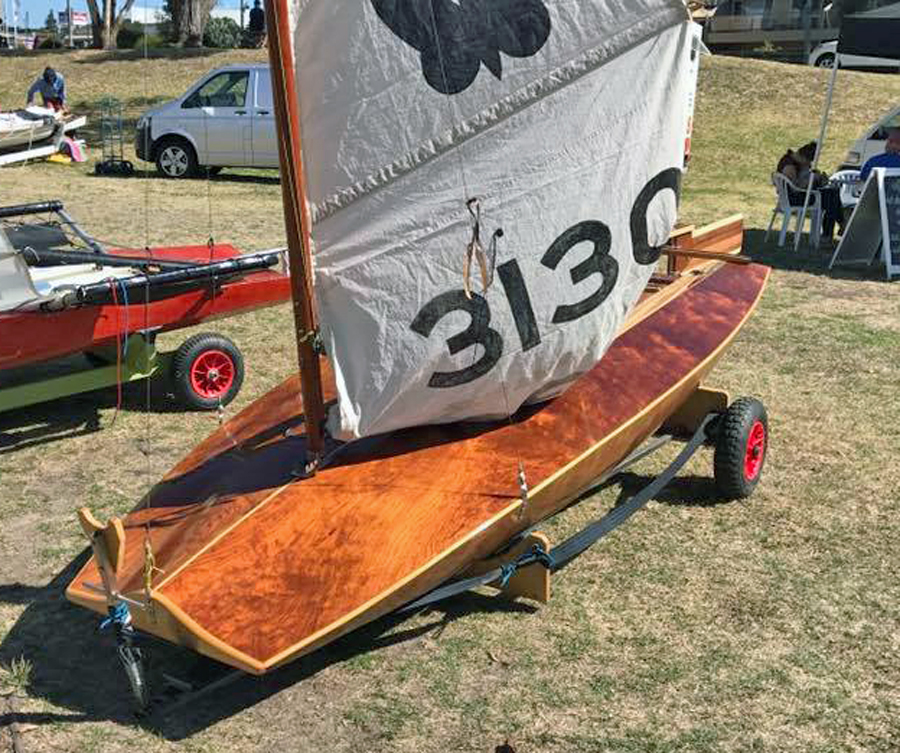
Australian scow Moth number 3130 is a Cole mouldie (wingless) design from the 1960's. This scow was painstakingly restored by Phil Johnson who had to reglue many of the veneers.

David French

This is an Aquanaut class dinghy sailed by Graeme Cox. The dinghy is around the Mirror length, 10 feet, main and jib sporting a single-chine, plywood shape. (I think it was designed for stitch and glue.) Earwigoagin has posted about an aluminium Aquanuat. I'll see if I can find out more about this design.

Tim Wilson

The Gwen 12 was a 12-foot single-trapeze design by Charles Cunningham. The class had large fleets in Australia up to about 1980 and the boat was known to be a heavy-air flyer. Two restored Gwen 12's showed up at Inverloch. (I think Earwigoagin correspondent, Andrew Chapman, is in number 2555.)


The beautiful cold-molded Aussie 16-foot skiff. Owned by Frank Raisin, this skiff was professionally refurbished.

Tim Wilson

This looks to be a double-bottom Gwen 12 (yet to be confirmed).


Another winged Aussie scow Moth.

Tim Wilson

Two of the larger three-man vintage dinghies crossing tacks; the cold-molded Aussie 16-foot skiff and the chined Olympic 12m2 Sharpie.


At the end of the racing, the dinghies transition from the beach to the "glade", a grassy area where spectators can look without getting their sandals gritty and the judges peruse for "Concours de elegance" awards.

Tim Wilson


The Australian Classic Wooden Dinghy Regatta is hosted by the South Gippsland Y.C.

Saturday, July 9, 2016

New Blog on Small Boat History

Australian Chris Thompson, who wrote an excellent, unpublished history of dinghy racing back around year 2000, has decided to put his extensive research up on a blog. I think his intention is to eventually publish, either digitally or in book form, but, for now, the posts on his blog are very informative for that small cadre who study small boat sailing history.

Best to start with the Introduction to SailCraftblog and follow the links from there.