The English organization, Classic, Vintage, Racing Dinghy Association, CVRDA, held their first regatta of the season at Hunts SC. Photos were posted on Facebook by Nikky Evans. I've taken the classes that I'm interested in; Classic Moth, Minisail, and reposted them here.
A yellow Skol design Classic Moth - I think sailed by Richard Woods. It looks like Richard is using a heavy air sail given the short foot length of the sail.
Nikky Evans
Nikky Evans
Nikky Evans
The English pretty much invented the clinker (lapstrake) built small sailing boat. Here is an pretty 12 foot Sea Ranger, found mostly at Gunfleet SC. (Geez!, the Brits have the best sailing club names!)
Nikky Evans
A Minisail. An Ian Proctor designed scow; the precursor to the Topper. Sailed by a fellow named Steve. It looks like Steve glommed a Laser Radial rig onto the Minisail.
Frenchman Bertrand Warion has provided plenty of copy for the Earwigoagin blog. This is a photo of some of his fleet sitting in the reeds. Peychot is Bertrand's own design; the small plywood cruiser in the middle of the group. Bertrand designed "Peychot" (little fish) several years ago with a mixture of some old and some new. "Peychot" was launched in 2013. Bertrand writes:
Very proud to see "Peychot" on the front page. The photo was taken during the launching days on the Lake Sanguinet. The one on the left is my one design, then the "bac à voiles", next is a little classic dinghy from a friend.
Peter Kellog, owner of the sandbaggers Bull and Bear, brought his reproduction of the 1924 Sweisguth catboat, Silent Maid, to Annapolis to compete in the 2017 National Sailing Hall of Fame Classic Wooden Sailboat Rendezvous. Unless you see this catboat in person, it is really hard to fathom how big, how massive, the mainsail Silent Maid sets. I took several photos of Silent Maid before and just after the start of this pursuit race. Silent Maid went on to win the race.
Before WWII, Silent Maid was the biggest of the cruising catboats competing in New Jersey waters.
The previous header photo was of the fleet of 12' Snowbird dinghies making their way upwind in the "Flight of the Snowbirds", a one-race tour around Newport, California harbor. Held in August, the race usually attracted over 100 Snowbirds with the record topping out at 167 Snowbirds in 1957. Over the Snowbird history, the class issued more than 500 numbers but, being primarily a junior boat, died out in the late 1960's as yacht clubs turned to smaller, lighter boats for their junior programs.
The Snowbird first appeared as plans in the 1921 "The Rudder" magazine and by 1923 they were being built in Newport as a junior boat. Designed by Willis Reid, the Snowbird remains the only American designed sailing dinghy to be used in the Olympics, selected as the Olympic monotype for the 1932 Los Angeles Olympics.
Featuring a V-shaped chine hull, from this angle the Snowbird bow and chine looks similar to the latter designed Danish OK Dinghy, though the Snowbird is a much wider, stable boat than the OK Dinghy.
Hugh R. McMillan Photographs - UCI Libraries
Raced single or two-up in the "Flight" we see, in this photo, a wide range of crews, from juniors, to couples, and all-women.
Hugh R. McMillan Photographs - UCI Libraries
For a 12 foot boat, this is a very big mainsail, well-suited to the lighter airs of Newport Harbor.
The previous header photo was of a Blue Jay drifting during the 2014 "Polly's Folly" regatta on Lake Megunticook, Maine. Two of the "Free-for-Alls" that I listed were cancelled this year; Polly's Folly because of a conflict with a Laser regatta, and the MASCF at the Chesapeake Maritime Museum because of Hurricane Joaquin lurking offshore during the first weekend in October.
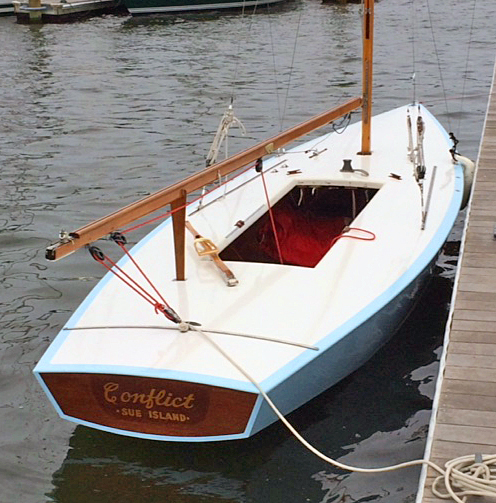
"We launched at AYC on Saturday but it was too rough in the City Dock basin for us so we hauled out again. On Sunday we relaunched and raced. It was a very nice day contrary to predictions, never getting over 15. "Conflict" (and John Sherwood - both classics) did well despite using our 1963 sails (because of their cool yellow color). Keith Donald won with his fully modern wood Star and we were second beating Elliott and # 177 "Trout". Nothing broke and we felt quite comfortable. I did the clinging vine style hiking and it suited the placement of cleats and winch perfectly. It was all reaching so the Stars didn't shine overall ( we were the last start ) but it was a real blast.
Tom Price's restored 1959 Lippincott Star at the AYC dock.
"A piece of furniture" we would often say as we eyeballed those McCutcheon or Souter built Classic International 14 dinghies, cold-molded in mahogany, glowing with multi-coats of varnish, all joints carefully crafted, beautiful wood everywhere. I was reminded of superior dinghy craftsmanship when I came across this stunning photo of the interior of the most recent addition to the historical Australian 18 foot skiff fleet, the reproduction Myra Too.
Myra Too was built in 2013 by Bob McLeod to reconstructed lines (by Australian National Maritime Museum curator, David Payne) of the 1951 championship winner. Myra Too was originally built and raced by Aussie legend, Billy Barnett. To build the reproduction hull, Bob McLeod used silver ash and, in the inner and outer layers of the hull, Queensland red cedar (the outer layers used rare, full-length pieces estimated to be between 400 to 600 years old).
From YouTube comes what, at first view, looks to be a typical mast-head GoPro video -- this of the historical 18 footer Yendys going around the course, However, with the historical 18 footers nothing is typical. Of interest to me was the spinnaker set starting at about 1:50 into the video. It takes four crew members to get the mammoth spinnaker pole out onto the mast, three of them heave-ho pushing and a fourth slotting the multi-piece pole together as it goes out. Once out, this long, long spinnaker pole then wags all over the place as they go downwind. These pre WWII 18's were heavy dinghies with lots of crew and this video shows that they pushed a lot of water around as they bashed around the race-course.
The history of Yendys from the Australian National Maritime Museum blog.
"A rival of Britannia, Yendys was built in 1925 by Charlie Hayes for Norm Blackman. This big hull is also built in the traditional heavy scantlings, but it illustrates an early piece of innovation, its transom bow. Hayes had another legend working for him at the time, Charlie Peel, who had been successful with transom bows on 14-foot skiffs in Victoria. As well, the 1920s was the time when the Restricted 21s showed how fast a lighter-keel boat could go, and Hayes and Peel were in the thick of this class too. Out comes Yendys, with its sawn-off profile and veed bow shapes, a sort of restricted-class yacht crossed with a skiff and with the bow overhang squared off. Despite the odd mix it went pretty well too, but although another two snub-nosers were built in that time, the idea did not catch on. It did show there was room to move in the rules, though, and the Queenslanders took on both innovation and the establishment at the same time."
A couple of years ago it occurred to me that, if you reworked the massive rig downwards, the Aussie Historical 6-Footer skiff, would make a crazy, traditional singlehander. To that end I sketched out a cut-down sail plan which I present here.
As always, use the pop-out icon on the top-right hand to open the drawing in another tab.
Back in 2011 I covered the start of the inaugural Elf Classic Yacht Race run in June from Annapolis, across the Chesapeake Bay to the always popular Eastern Shore harbor of St. Michaels. The centerpiece of the race and the race's namesake is the restored 1888 Lawley topsail cutter, the Elf. I didn't catch the start of this year's race but in addition to Elf and the participation of the two reproduction Sandbaggers, based in Annapolis, a very brave Log Canoe crew ventured way, way out of their traditional confines of Eastern Shore river racing and dared the Bay crossing as well.
I came across this very good video documenting the 2014, Elf Classic Race.
As I mentioned in my original post about the 1897 Lark scow, Bill Kerr redrew the plans for the Erieau Y.C. fleet in 1963. All the new Lark builds at Erieau Y.C. follow his plans. Peter Gilbert from the Erieau fleet has kindly sent along the Kerr plans. I chunked them into two PDF files; an instruction manual PDF and a drawing PDF. Note: Click here for the 1940 Rudder plans.
The instruction booklet: (Click on the upward pointing arrow "pop-out" icon on the top right of the menu bar to open the PDF in another tab. From that tab you will be able to print or download the PDF.)
The Bill Kerr drawings including sections: (Again, use the pop-out icon to open in another tab.)
The previous header photo was of the "Wee Georgie" a 1988 reproduction of the Aussie 6-Footer Historical Skiff Class. Aussie Robert Tearne built her and she is shown on the dock sporting her light-air rig with a boom at least over 2 times the length of the boat and a bowsprit approximately 10 feet long (3.19 meter). Talk about being over-canvassed. The 6-footer class takes the cake for being the craziest of the crazies!
There is a second reproduction Aussie 6-Footer, the Balmain Bug, built by Ian Smith in 1994. Balmain Bug has been sailed regularly since about 2015.
The history of the Aussie 6-Footers, quoting from the seminal book on the history of the Aussie skiffs, Bluewater Bushman by Bruce Stannard [1981];
"It is believed they were first built at Balmain in the 1890's and although they were first conceived as children's boats, there is no doubt that they demanded the strength of three men who were courageous, good swimmers and had the strength and agility of circus acrobats...They carried a staggering 1000 square feet of sail including a main, jib, topsail, spinnaker, ringtail, and even a watersail. [Mike Scott, over in comments, defines watersail as..."hung below the main boom to catch that extra drop of wind.....almost drooping in the water....hence the name....!] With so much sail up and so little to support it, it is hardly surprising that the 6-footers spent a lot of time "in the gutter"....
The class peaked during the early 1900's, attracting numbers because it was the cheapest way to go racing. Here are some photos of the early 6-footers sailing around 100 years ago. [Found on the Net]
The original crews sailed the 6-footers upwind with the bowsprit plowing a furrow in the water; probably the only way they could balance the whole package upwind.
Now for photos of the modern 1994 Smith reproduction 6-footer. A picture of the "Bug" off-the-wind in a fresh breeze, shortly after being launched. Looks like the crew is trying to get to the back of the bus when reaching but, alas, there is no back of the bus.
After ten years out of the water, the "Bug" was relaunched in October for this year's Balmain Regatta.
A quote from crew Campbell Reid:
"Even though she is based on a design close to a century old you can see how for their time these boats were pretty high tech...She will bury her bow in the blink of an eye but we were impressed at how seaworthy she was and were really happy that we could get upwind pretty well. In the six foot division of the historic skiff fleet at the regatta we think we are a serious threat.
The precarious crew position Campbell Reid finds himself on the foredeck/bow may be the most comfortable one in drifting conditions. [The next two photos pulled from the Balmain Sailing Club website.]
Stick two grown men into a 6-footer and the scale becomes obvious. A 6-footer becomes a true "micro" dinghy.
The obligatory GoPro video shoot from this years relaunch. The bowsprit is so long it gives a perspective of a much larger dinghy. The 6-footers, like her bigger historical cousins, sported canvas lee cloths in a vain attempt to keep the water on the outside
A more recent 2015 video of the Bug including flying a good size spinnaker without driving her under. (Came pretty darn close though!)
And the videos keep on coming. A 2017 video of the Balmain Bug.
In the early 1900's, St. Regis Lake was the summer destination for many of New York City's upper-upper crust as the New York Times reported in this 1902 piece.
"The month, of August in the Adirondacks opens with all the camps occupied, with possibly a few exceptions, and in those instances preparations are hastened to have everything in readiness for the coming in the near future of those who are to occupy them. Of camp life in the Adirondacks this season it may be said that it is the most fashionable of years, for the Vanderbilts, the Rockefellers, the Reids, the Morgans, the Blaines, the McCormicks, the Stokeses, the Mortons, and many others are in their camps, some of which are new and others of which were enlarged and extended In anticipation of entertaining many friends during August and September. This, together with the number and class of the applicants who have reserved apartments at Paul Smith's for August and September indicates that the St. Regis Chain of Lakes will he the rendezvous of many persons distinguished in the financial and business worlds; as well as the social world.
Wow! I feel good when I can use a couple of acronyms in a post title - goes to my head with visions of a job writing headlines for the Washington Post. One or two of my astute readers may have picked up that I haven't been sailing my Classic Moth this summer. A certain summertime ennui had taken over which made it difficult to find the time to finish some repairs I had started on my Maser (they are more-or-less done now... now being October). To get out on the water I had to make do with sailing OPB's (Other People's Boats), all of them (gasp!) keelboats.
In the middle of September, rather than attend the Classic Moth Nationals, I called up my good buddy Tom Price about the availability of a ride for the NSHOF (National Sailing Hall of Fame) race around Annapolis harbor that is part of the NSHOF's Classic Wooden Sailboat Rendezvous. As it turned out, Tom had been given the very pretty L. Francis Herreshoff, canoe-stern, Rozinante design, Honalee, owned by Paul Miller, for the race (Paul was the Race Officer for the race). He needed a foredeck crew, not really my bailiwick since I am somewhat keelboat challenged, but I jumped at the chance anyway.
The actual race, scheduled as three laps around the Annapolis outer harbor became a light air slog. The problem I had on the foredeck was trying to cleat everything off on the two horn cleats on the mast, especially when we had the spinnaker up. Eventually Tom pointed out there were two other cam cleats on the mast that had escaped my notice. This helped partially cleaning up the rat's nest of ropes I had created at the base of the mast; a pile of halyards, and topping lift, and downhaul . We finished third in our division, beaten by the two, very quick, wooden Stars. Mercifully the race was shortened after one lap.
Some photos - mostly mine except where noted:
Sandbagger Bull.
An Ed Cutts design that was sailed by an all-woman crew. Another design with a pretty sheer line. Ed operated out of Oxford Maryland.
A wooden Snipe, one of three dinghies competing.
Skipper Tom surrounded by all that varnish on Honalee.
A photo of a L.Francis Herreshoff Rozinante. This one is not Honalee but one that Tom came across in Maine that has a shorter coach roof than Honalee.
This photo of Honalee racing the 2014 NSHOF race was taken by Captain Ken of the schooner Woodwindwhich I have lifted from his blog post on the 2014 NSHOF race. I am relaxing next to the mast after successfully jibing the pole and sorting out the halyards.
In my travels around the Net I've grabbed photos that interest me here and there. Every once in a while I'll repost. This black and white photo of the Classic 12 sq. meter Sharpie, the Olympic double-hander of 1956, is one of my favorites. I got it from a Brazilian blogger that was on the blog list of Doryman, but doesn't seem to be on his blog list now. I assume the photo is from the late 1950's - early 1960's (new information says it was actually taken in the 1970's - see below), especially given the split tiller in use which was also popular on Classic Moth's from that time fame. The 12 sq. m. Sharpie is sailing on a large freshwater lagoon behind an ocean barrier island, Lagoa dos Patos - Duck Lagoon, in Southern Brazil. The two names I have attached to the photo are Gabriel Gonzales and Nelson Piccolo, who I assume are the sailors. If I had a larger resolution image this one would definitely be framed and sitting on a wall in my house.
I would be interested in further attribution of the photographer because it is a great sailing photo.
Gustavo Pacheo added this comment on the photo (July 29, 2015) which I've dragged over to the main post. Thanks Gustavo!
"I think it was last year that I [saw] this great picture at the Veleiros do Sul web site. The helsman in the picture is Nelson Piccolo, and this picture is from the 70´s. We had discussed this picture in our [Facebook] group - Velejadores de Classicos - It is a great picture. Perfect light, enough action, it [is] like a poem. The contact [for] Nelson Piccolo [is] his sail loft Piccolo Sails: contato@piccolosails.com.br .. Fair winds !"
From Forest and Stream, June 30, 1894. The La Gloria model is what "small boat" sailing was considered back then. (There was also the "canoemen" with their tiny cockleshells and piles of canvas - but they were a special breed - still are.)
From a 1925 edition of the Toronto Star newspaper. This image was lifted from the Classic International-14 blog. These gentlemen were racing the L.S.S.A 14, the precursor to the International 14 in Canada.
I have referred to myself as a wood butcher in my boatbuilding endeavors; with some truth. My work is never pretty and it is good that it is on such a small scale. Some might say it is quick and dirty, but then again, my boatbuilding is never quick. Let's reframe my boatbuilding process as slow and, when complete, functional.
I do, however, enjoy watching videos of true craftsman restoring or building wooden boats. This one is particularly fascinating to watch. Mario Scuderi is a transplanted Italian in New Zealand, restoring the old New Zealand yachts, particularly the ones by the Logan's and Bailey's. Enjoy his quiet and understated explanation of what he does and why he does it in our mass-produced world.
Brit sailing writer and marine historian, David Henshall, has written an article for Yachts and Yachting online about the state of classic dinghy racing in the U.K. About 2/3's the way into the article, David gives a nod to our Classic Moth scene in the U.S. (as well as the International 14 and 505).
This probably relates to those Australian readers of Earwigoagin but for those who got a quick sneak preview of the video of the Australian Wooden Dinghy Regatta, we could tell it was entertaining, informative, and very professionally done. Well worth the money if you have an interest in classic sailing dinghies.The video is now available as a DVD or download over here, courtesy of Drift Media.
Bald but my eyebrows are growing at a prolific rate. Sailed Windmills and Y-Flyers in the 1960's. Founded Miami University (OH) sailing team. Sailed International 14's and Lasers in the 1970's. Sailed International Canoes in the 1980's to mid 1990's. Sailed Classic Moths since 2002. Enjoy boatbuilding though I'm very, very slow at it (the Internet doesn't help matters). Name in real life: Rod Mincher
After choosing this username (Tweezer is the name of my Classic Moth), further research on the Internet turned up that Tweezerman is a corporate name for a line of pedicure products. Let me emphasize that I do not work for, nor endorse these products.