Showing posts with label Small Boat History. Show all posts

Thursday, August 13, 2020

Worthington Whittredge: Three Boats


In the history of recreational small boats the written record before 1870 is almost nonexistent. Before the U.S. Civil War (1860-1865), one is forced to look at art to get a feeling what was going on with recreational boating. The above sketch was done by Worthington Whittredge. Worthington Whittredge was a painter famous for his beach scenes around the Rhode Island coast. This pencil and watercolor sketch was done in 1856 and shows recreational small boats, presumably parked on a beach. The center boat shows a flat-bottom, pram bow boat with three rowing stations. The right boat, drawn with bow only, seems to be the same type as the middle one. I'm not sure this boat type has been documented, at least there is no match when I thumb through my copy of the Mystic Seaport small boat collection. It seems a combination flat-iron skiff with punt/scow bow features and flared topsides of the dory thrown in as well.

The left boat is definitely home-built. I'm guessing the design brief called for getting one person out in what was rough water (hence the high freeboard) to go fishing . The boat had to fit the lumber available which meant it had to be short (maybe 8 feet max?). It comes equipped with a paddle but I imagine the high freeboard and flat bottom did not help it track straight at all!


It occurred to me after I posted this that these row boats of 1856 shared some of the design lineage with my Kid Simple idea, which took the hull shape from the St. Michael's scow.


Update 8/17. John Watkins commented, "Looks a little bit like the chalk barge in Architectura Navalis Mercatoria, a book which has been reprinted about once a generation since the 1760s." With that hint, off I went to the Internet and found this image: 


There are some similarities though the sheer line on the American model has a higher stern and lower bow. As I was thinking about it, even though the American rowboat has three rowing stations, this craft most likely had only two rowers, the forward rower had a choice of station depending on sea-state.

The image was culled from this Finnish website where the designer, Pieni Ekstack, has made a nifty 2.3 meter plywood rowboat, a shorter dink, very roughly based on this 1760's design.


John Watkins writes to tell me I didn't find the correct image for the Chalk Barge online. Here is the correct image he sent me. Much heavier displacement which makes sense if it was designed to carry cargo. If I'm reading the hull lines correctly it seems to have an enormous skeg. And the leeboard doesn't extend far enough below the hull. Very odd.


Sunday, June 4, 2017

Header Photo: Monotype de Chatou


The previous header photo was of Louis Pillon and his restored Monotype de Chatou. The Monotype de Chatou was a French follow-on to the American Lark scow, the Lark being originally introduced to France as the Monotype de Dinard. Designed in 1901 by Francois Texier, the Monotype de Chatou featured soft bilges rather than the boxy, chine shape of the Lark and the wide scow bow of the Lark was pinched in. The Monotype de Chatou was France's first popular dinghy with over 100 being built.

The drawing below is from the Wikipedia entry on the Monotype de Chatou.


A photo of the three of the original French build of the American Lark scow, the Monotype de Dinard.


Chatou was a western suburb of Paris, fronting the Seine River. There was a yacht club on the narrow island where the fleet of  Monotype de Chatou's were moored. From Google Maps.


In 1906, the French painter, Maurice de Vlamink, painted this scene (in the style of Van Gogh). Painted from the vantage point of Île de Chatou, it is likely the moored sailboat was a stylized Monotype de Chatou.


A rescue performed by a Monotype de Chatou. I'm not sure if the swamped vessel is another Monotype de Chatou. If this was a romantic Sunday sail, I would bet the lady being dragged over the gunwhale by the rescuers didn't bargain on being completely soaked by this mis-adventure.


Saturday, April 29, 2017

A Racing Scow in 1871? In Sydney?

I've stated on this blog that I believe that Thomas Clapham invented the racing scow out of Roslyn, New York in 1890. Just recently I came across, courtesy of the Aussie Open Boat page on Facebook, a reprint of the Illustrated Sydney News drawing of the 1871 Sydney Anniversary Regatta. Much to my surprise, front and center in this drawing there is a cat-rigged craft with some features of a scow-ish type bow, some 20 years before Thomas Clapham's Bouncer scow. There is no evidence from the top-down view that this early Sydney sailing craft had a scow hull shape; it is just as likely that the hull had conventional sections and a keel, but this does show that unconventional "pumpkin seed" sailing craft were present at the very beginning of the small recreational sailboat.

John Watkins has written that there was an East River (New York City) sailing scow that was raced post Civil War but I have yet to come across visual evidence (prints, drawings) of that scow clas.

The Illustrated Sydney News print.


A zoomed-in image of this unique Sydney sailboat.


Wednesday, December 28, 2016

Love, Sex and the Development of the Small, Recreational Boat


My good friend, Tom Price, sent along this 1904 cover illustration from Puck magazine (don't comment about the steering - realism is not the point of this painting). This cheesecake magazine cover is a good segue into a blog topic I've kept on the back-burner for a while; how romance and sex in late 19th century and early 20th century, that ever-present animal sex drive that spans all human history, pushed forward the design of recreational small boats.

The late 19th century was marked by increased urbanization, this combined with chaste Victorian mores on dating, left city couples with a suffocating romantic environment.  Enter the small craft, first the canoe, then the rowboat (and in Europe, the punt). Entrepreneurs set up boat rentals in city parks, along languid rivers, in protected bays. Boat-builders were re-designing the more utilitarian working hull shapes to accommodate neophyte boaters (but ardent couples). Canoes became wider, rowboats became shorter and more intimate. In this era, long before mass boat ownership, the boat rental business was hammering out the sizes that work for recreational small boats.


Article on canoes and love by Hunter Oatman-Stanford.

Marine historian John Summer organized a show at the Canadian Canoe Museum on love and canoes, featuring postcards he had collected over the years.


From a French postcard, a longer, rather skinny sharpie rowboat set up for two couples.


"Madame" a French rowboat from the 1880's (not sure if this is a reproduction or restoration) shows how the size had shrunk in this "courting" rowboat to somewhere around 4 meters, ideal for an intimate outing for one couple.


A risque postcard (for that time) of "Canoedling". With the lean of this canoe, the illustrator has subtly shown how tricky romance in a canoe could be.


From a postcard, a fleet of identical rowboats; Rod and Gun Club, Omaha, Nebraska. In what seems to be subliminal advertising, all the comely young women are manning the oars in this photo.


Saturday, July 9, 2016

New Blog on Small Boat History

Australian Chris Thompson, who wrote an excellent, unpublished history of dinghy racing back around year 2000, has decided to put his extensive research up on a blog. I think his intention is to eventually publish, either digitally or in book form, but, for now, the posts on his blog are very informative for that small cadre who study small boat sailing history.

Best to start with the Introduction to SailCraftblog and follow the links from there.


Monday, June 27, 2016

Monotype de Nogent-Joinville

Bertrand Warion sent along some photos he took of the "Voiles des Boucles de la Marne" (rough translation - sailboats of the Loops of the Marne, a reference to the rough S shape of the Marne River on the southeastern suburbs of Paris). The "Voiles des Boucles de la Marne" was a small gathering, this past May, of traditional French small sailboats that were sailed on the rivers around Paris during the late 19th and early 20th centuries. Of interest was the plywood reproduction of the 1903 French 5.5 meter sailing dinghy, "Le Monotype de Nogent-Joinville".

The Monotype de Nogent-Joinville was drawn up by Ernest Binet, following the detailed input of Albert Glandaz and was a product of a push by Parisian sailors, as they entered the twentieth century, to develop small one-design sailboats for racing (the French word "monotype", in this case, can be translated to mean one-design).

The Monotype de Nogent-Joinville at the dock. Behind her is the Monotype de Chatou, the scow type which had appeared on the French rivers several years earlier in 1901.

Bertrand Warion

The Monotype de Nogent-Joinville has a deep vee hull. For river sailing, the wetted surface is much reduced compared to the flat Monotype de Chatou but the Monotype de Chatou would remain more popular, with around 140 being built compared to around 20 for the Monotype de Nogent-Joinville.

Bertrand Warion

Historian Louis Pillon put together the lines of the Monotoype de Nogent-Joinville from a magazine article of that period. The Monotype de Nogent-Joinville was a sloop, had a low slung gunter rig, the main had three full length battens. It is a rig that the French designers copied, according to Louis Pillon, from the English designer Linton Hope. This reproduction was built by volunteers at Sequana, the French nautical historical society, under the direction of Bertrand Chazarenc.

Louis Pillon

Out sailing; the Monotype de Nogent-Joinville drifting ahead of Louis Pillon's Monotype de Chatou. According to Bertrand, the Monotype de Chatou has bamboo spars!

Bertrand Warion

Another photo from the dock. In the foreground, with the cool wishbone-type split tiller, is Bertand Warion's Sharpie 9m2, a flat-bottomed, canoe-like French singlehander that was designed in 1937.


Bertrand Warion

A contemporary postcard, early 1900's, with a Monotype de Nogent-Joinville sharing the river with various Sunday leisure rowboats.


I have gleaned all of the history from Louis Pillon's articles which I found online.

Thursday, January 28, 2016

Monday, January 11, 2016

Peter Gilbert's Lark Scow Goes Racing

Peter Gilbert, who, in previous posts, Earwigoagin documented his build of the Lark scow, sends along a video of the new Lark in the water and racing at Erieau Y.C. The season for Pinky Too was up and down, a not unfamiliar scenario for a new racing craft. From Peter...
"The racing season was mixed. I had very high expectations and Pinky Too was finished and polished very well. Unfortunately I didn’t take into account the difference in weight relative to the standing rigging. This led to an entire season of tuning and adjusting. Adding to the frustration was Pinky Too’s performance during certain points of sail. She was untouchable at times but I could not point with the rest of the fleet. As a result the races were filled with both hope and despair. I’m also a little rusty…..
It is heartwarming to see a new one of these pre-1900 designs hit the water.


The history of the Lark Scow.

Friday, January 8, 2016

Sutton Manor, New Rochelle - "America's Sailing Community"

My hometown, Annapolis, has the slogan "America's Sailing Capital" whereas Newport, Rhode Island, long-time home of the America's Cup, about 640 km (400 miles) north of Annapolis, goes one better with their slogan "The Sailing Capital of the World". Notwithstanding the competing Chamber of Commerce hype of these two East Coast sailing towns, there is one community that, between the war years of WWI and WWII, could rightly maintain they were America's Sailing Community.

Sutton Manor, of New Rochelle, New York was a 50 house bedroom community of New York City that began development in 1914. The community butted up to Long Island Sound and the harbor of Echo Bay that included Tank Island, Harrison Island and Echo Island. There were three active yacht clubs, all predating 1900, within several miles of the community; the Huguenot Yacht Club, The New Rochelle Yacht Club (now defunct, located in Echo Bay on Harrison Island) and the Larchmont Yacht Club. The names of some of America's most distinguished yachtsmen made Sutton Manor home:


Also, two prominent sailors featured in the Earwigoagin historical archives; Larry Huntington and Harry Hall, owned houses in Sutton Manor.

To take a stroll through Sutton Manor during the 1920's and 1930's, one could, every couple of hundred steps or so, have a very interesting conversation about boats and sailing.


Thursday, November 5, 2015

The Archipelago Rally Uncovers another Gem: The International 12

Last year's Archipelago Rally uncovered a historical gem with the entry of Yarrow Thorne's Crosby Skimmer Moth. This year, another historical rarity made an appearance at the Archipelago Rally; Woody Underwood's International 12. (this is the American International 12, not to be confused with the lapstrake, George Cockshott 12' Dinghy, which is also sometime referred to as the International 12 and popular in Europe.) The International 12 was the first sailing dinghy to be built using hot molded veneers held under pressure in an autoclave, a building method that allowed mass production of a very strong, lightweight monocoque wood hull. It was a very revolutionary technology but also a temporary technology as fiberglass construction of boats came to the fore in the late 1950's, early 1960's. Thousands of wood boats were built post WWII using hot molded, autoclave construction. Most were small outboard runabouts but some are the familiar sailboats of today including the Fairey Marine and USOD International 14's, Thistles, Luder 16's, Fireflys, Jet 14's, and Jollyboat.

Woody Underwood's International 12 appears to be one of the first in the production run. Woody comments:
"My father bought this boat (# 31) in 1940, and it could be the first boat I ever sailed in. He was away in the service after that, and the boat was washed off its float in Padanaram in Hurricane Carol, ending up in the bushes 2 miles away. About 1960, we put in an Interclub mast, and I have sailed the boat on and off since then. Condition is good, albeit dried out.

Woody and Josie Whoolam sailing in the 2015 Archipelago Rally. Woody has retained the natural mahogany veneer look on the outside of the hull.

Photo from Rufus Van Gruisen

The International 12 was designed by International 14 designer, Harry Hall, who lived in New Rochelle, New York.

Photo from Woody Underwood

The first hot molded boats had very little internal structure - a feature designed to show off the strength of the new construction. The lack of ribs and stringers was a source of amazement to most.

Photo from Woody Underwood
The wood International 12 was also used by the U.S. Coast Guard Academy for their sail training and dinghy racing program.

Photo from Woody Underwood

Ernest Ratsey sailing the International 12 prototype in the summer of 1940.

The Rudder, October 1940


On a slightly different topic but still about the 2015 Archipelago Rally:

One cannot wrap up the 2015 Archipelago Rally without featuring the latest video report from the Tuthill Sisters. Last year, in the 2014 Rally, the younger sister had to become a human sidestay when the mast on their dinghy started falling over. This year the duo rolled out a Sailfish for the race, a choice that looked like a safe bet compared to their previous rickety dinghy and the slow - slow Snark, but the Sailfish has no cockpit and, sometime during the race the older sister ended up in the drink (she kept filming though).


Thursday, August 20, 2015

The Larken Klasse: Another Modified Lark Scow Resurrected

As mentioned in my post on the Lark Scow - The Laser of the 1900's, Thomas Day of The Rudder magazine encouraged the home-builders of the Lark to be inventive; there was no strong concept of one-design strictness at this genesis of small sailboat development. So builders strayed from the plans, building Larks with yachty looking counter sterns, with cuddy cabins, longer and shorter Larks and they gleefully sent reports of their modifications into The Rudder and Thomas Day published them.

In 1903, in The Netherlands, W. Beekhuis, owner of the boat building yard "Navis" te Loosdrecht, built a small Lark, only 3.6 meters long (11.8 feet). He built them from the time period 1903-1905 but it is unclear how many he actually produced.

The 1903 Beekhuis Mini-Lark


In 1919, A Van Gool, from the northern coastal district of Friesland, The Netherlands, built a Beekhuis type Lark with additional modifications. Having traveled to America and observed American sailboats, Van Gool borrowed the Star type keel and grafted it on the Beekhuis Lark scow hull. He made the hull longer, 4 meters (13.1 feet). He replaced the squat gaff rig with a taller gunter rig. This Larken Klasse would become very popular in Friesland and Twente during the 1920's and 1930's.

The Van Gool/Friesland Larken


In 1934, Romke Vries designed an even higher aspect, full battened gunter rig for the Larken Klasse. By the end of the 1930's the more modern O-Jolle singlehander centerboarder was cutting into the Larken Klasse numbers and, as the Finn dinghy and OK dinghy were introduced after World War II, the class continued to lose popularity. In 1965, the class made its last appearance at Sneekweek, seemingly destined to fade into obscurity.

That is until 2004 where a group of Larken Klasse enthusiasts banded together to start restoring the old Larkens and build new ones. In the short span of 11 years they have built the class up to where they are now getting a vibrant 20+ turnout at the major regattas. An amazing resurrection of a true classic!

The newer Larkens have adopted a more modern keel with a separate rudder. The lead ballast is 34 kg.


The present day Larken Klasse on a reach (Anyone know who the photographer is?)


A vintage photo of a happy Larken skipper.


At this years Sneekweek regatta, artist and small boat racing enthusiast, Jan Tekstra decided to jump into a different class each day and record his race on a GoPro. This is his Larken segment.


Acknowledgement: All of the history of the Larken Klasse was taken from this article by J.K Kuipers


As I was tossing this post around my brain, the German Segel Reporter beat me to it by about two weeks and brought out Michael Kunst's post on the Larken Klasse.

Monday, July 13, 2015

Kaagweek, 75 Years Ago

Kaagweek and Sneekweek are the two big sailing regatta weeks in The Netherlands. Kaagweek occurs first, somewhere around the middle of July. I came across this historically interesting video of Kaagweek filmed in 1940, seventy five years ago.

Unfortunately the video settings restricts embedding on Earwigoagin, Click here to view the video.

After viewing this video several times, thinking about it and researching, I've come to the conclusion this sailing regatta video offers up so many layers of meaning and so many unanswered questions, it ranks as the most fascinating sailing video I've viewed

My first viewings of this video took in the pastoral beauty, the windmills, the myriad of, now traditional, Dutch classes heeling gracefully as they race their way up the small fingers formed by the dike systems, the spectators dining at the water's edge, the formal race committee attire, the pretty women walking the dock, ogled by young sailors. People are having fun, which is the whole point of a sailing week. The soundtrack of wistful swing tunes from that era adds to this period piece.

It was then I realized that the 1940 Kaagweek took place two months after the Nazi's had overrun Holland. This Kaagweek was taking place in occupied Holland. Kaag looks to be about 15 km. from Rotterdam and during the invasion, the Nazi Luftwaffe had completely leveled the center of Rotterdam.


The 1940 Kaagweek must have been held with the Nazi's approval. The question becomes whether this video was put together as Nazi propaganda to show that "normalcy" had returned to occupied Holland, or whether it was filmed surreptitiously as a home movie by a Dutch videographer. The production values suggests it may have been Nazi propaganda. Of note is at the 8:21 mark of the video, there is a stern-faced spectator wearing the Jewish star.


Reader WaveDancer disagrees with my assessment that the video was Nazi propaganda. I've dragged his comment over to the main post:
"I doubt that this video was German propaganda. After the surrender of The Netherlands, it took some time for the German occupation to show its true Nazi colors. PS: Whereas de Kaag is definitely in Holland, Sneek is not! The country should be referred to as The Netherlands. Wavedancer (who was born there, just around that time)"


Wikipedia states that 205,000 civilians would die in the occupation of Holland with 1/2 of that number being Dutch Jews who died in the Holocaust. Many of those young sailors shown in the video would be forced to labor in German factories during the war. I'm not sure how many sailing regattas were still held in Western Europe during the summer of 1940 but by 1941, sailboat racing had ceased (with the exception of the Nantais Moth, which the Nazis and the French Vichy government allowed to be built during the war).

July 10, 2015 also marks the 75th anniversary of beginning of the Battle of Britain, the approximate 2 month air battle where the Nazi Luftwaffe came within a sliver of destroying the British RAF. That the Nazi's didn't break the RAF would mark one of the turning points of  World War II. Goering and the Luftwaffe would then turn in September of 1940 to bombing the British cities in an attempt to force capitulation.

One of the mysteries of my life is how my loving mother, with her parents and siblings, endured the chaos, death, and destruction of the London blitz, and later the V-1 doodlebug, and V-2 rocket attacks. I never detected any true bitterness from her. She still maintains the attitude of always looking forward, never looking back - probably a residue of that British "stiff upper lip".  The courage it took to maintain day-to-day living under such conditions still amazes me.

Sunday, June 28, 2015

Larry Huntington, his 1895 scow "Question", and the first Seawanhaka Cup competition

I've bracketed the 1890's in several posts tracing the history of the development of the racing scow. In 1890, at the beginning of the decade, Thomas Clapham introduced the first racing scow, Bouncer. At the end of the 1890's, Thomas Day and The Rudder magazine introduced the scow to the workingman sailor, with the publication of easy-build scow plans; first the 16' Lark cat-rigged scow designed by C.G. Davis in 1898 and, shortly after, the Swallow, a 24' main and jib scow designed by C.M. Mower and Larry Huntington. In 1895, in the middle of this decade, the first International Seawanhaka Cup commenced competition and over the next ten years, in this yearly pressure cooker of constant design development to win the cup, this odd-ball type, this "barn door" of a boat, dominated the racing and forever carved out a niche in the yachting scene that flourishes up to the present day.

In 1895, Larry Huntington, a twenty eight year old boatbuilder out of New Rochelle, New York, would enter his simple, crude-looking scow Question, in the trials for the U.S. contender to race Britain in the first competition for the Seawanhaka Cup . Although Huntington didn't win (W.P. Stephens in his conventional centerboard design Ethelwynn would win the trials and then successfully defeat Englishman William Brand racing another heavier, conventional centerboarder, Spruce IV to secure the first Cup win for the U.S.), Huntington demonstrated, during the 1895 season and during the Seawanhaka trials, that the scow was dominant in any breeze. Huntington re-emphasized what Thomas Clapham had proved five years earlier with his Bouncer, the scow was an ingenious rule-beater racing under a Seawanhaka Rule that penalized waterline length.

In a controversial move, Larry Huntington, with his brother Lev steering, shadow raced Question against Ethelwynn and Spruce IV in race four of the Seawanhaka Cup. There was a good breeze and Question handily out-distanced both of the actual competitors in the cup. W.P Stephens, with some justification, later complained about this stunt in Forest and Stream but the die had been cast. Observers at the Seawanhaka Cup, including the Royal St. Lawrence Y.C., took note and the next year all the top contenders had scow types including U.S designer Clinton Crane and the  Canadian design, engineering, and sailing genius, Herrick Duggan. Herrick Duggan, representing the Montreal club, Royal St. Lawrence Y.C., would come to dominate the cup competition in his scow designs over the next six years.

Larry Huntington would continue to design a series of well regarded scows for the Seawanahaka Cup competition both for him and his brother, and for other customers, though none of his designs were able to win the trials to represent the U.S. in the Cup competition.

Not surprisingly, in today's yachting history, Larry Huntington is best known, not for his scows, but for designing and building the offshore keelboat, Tamerlane, to win the first Bermuda race in 1906 (he designed and built two out of the three original competitors in 1906, the other Huntington design being Gauntlet).

A photo of Larry Huntington from Yachting magazine.


The half-rater Question as sketched by C.G. Davis. By 1905 Question had been converted to a motorboat with a boxy cabin-top (top right of sketch).

Larry Huntington estimated his cost for getting the simple chined Question built and in the water at $245 (he charged his labor at normal shipwright wages). The Rudder magazine figured this was 1/6 the cost of the other Cup racers.


Paprika was Larry Huntington's refined scow design as a follow-on from Question. Built for the 1896 Seawanhaka Cup trials, the hull was round-bilged


Below are the lines to the mysterious American scow, Maika Maili, that was imported into New Zealand in the mid 1890's and formed the basis for the New Zealand famous Patiki class. There is a very strong resemblance to Huntington's Paprika design but, at the present time, I can find no confirmation that Huntington exported one of his scows to New Zealand


Monday, January 5, 2015

Lark Scow Plans: Instructions and Drawings by William Kerr, 1963

As I mentioned in my original post about the 1897 Lark scow, Bill Kerr redrew the plans for the Erieau Y.C. fleet in 1963. All the new Lark builds at Erieau Y.C. follow his plans. Peter Gilbert from the Erieau fleet has kindly sent along the Kerr plans. I chunked them into two PDF files; an instruction manual PDF and a drawing PDF.

Note: Click here for the 1940 Rudder plans.


The instruction booklet: (Click on the upward pointing arrow "pop-out" icon on the top right of the menu bar to open the PDF in another tab. From that tab you will be able to print or download the PDF.)


The Bill Kerr drawings including sections: (Again, use the pop-out icon to open in another tab.)


For Rudder's second DIY scow, the Swallow, click here.

Sunday, November 2, 2014

Some Idem Photos from Andre Cloutier

Andre Cloutier over at the Ravenwood blog took some fetching photos of the Idem class sloop Elfmere when he was attending the Wooden Heritage Canoe Association Assembly on Lower St. Regis Lake. His original post of the WHCA gathering can be found here.

I have posted before on Earwigoagin about the Crane designed Idem class sloops where I provided more details about one of America's oldest racing classes.


In the early 1900's, St. Regis Lake was the summer destination for many of New York City's upper-upper crust as the New York Times reported in this 1902 piece.
"The month, of August in the Adirondacks opens with all the camps occupied, with possibly a few exceptions, and in those instances preparations are hastened to have everything in readiness for the coming in the near future of those who are to occupy them. Of camp life in the Adirondacks this season it may be said that it is the most fashionable of years, for the Vanderbilts, the Rockefellers, the Reids, the Morgans, the Blaines, the McCormicks, the Stokeses, the Mortons, and many others are in their camps, some of which are new and others of which were enlarged and extended In anticipation of entertaining many friends during August and September. This, together with the number and class of the applicants who have reserved apartments at Paul Smith's for August and September indicates that the St. Regis Chain of Lakes will he the rendezvous of many persons distinguished in the financial and business worlds; as well as the social world.

More of the interesting history of the St. Regis Yacht Club can be found over at their Wiki page.

And here is a particularly well-done drone video of the Wooden Canoe Heritage Association showing the stunning beauty of the lake region.


Wooden Canoe Heritage Association 2014 Assembly from Above the World Films on Vimeo.


Monday, July 28, 2014

The Lark Scow; the Laser of the early 1900's

Note:


In the winter of 1897 - 1898, American C.G. Davis designed and built a 16-foot chined scow for his own use. It was a simple build for that time, the hull copying the shallow arc bottom of the Clapham designed Bouncer (a designer Davis highly respected). Davis claims he designed the Lark scow as a general daysailor but, in 1898, he raced his newly built scow in the fifteen-foot class in several Long Island regattas and won. Sensing a great deal of interest in his little scow, Davis, at the time the design editor of The Rudder, printed the plans over three issues in the fall of 1898. The response was enormous and readership in The Rudder exploded. When you tap into a successful market, you keep going and The Rudder started a How-To series of cloth bound boat plans offering several different boats with the plans for the Lark advertised as "How to Build the Racer".

In the early 1900's the Lark scow was built everywhere, worldwide. Fifteen Larks were built at the Yokohama Y.C. Builders built to plans and those who couldn't help themselves built smaller Larks, bigger Larks, Larks with counter sterns. By the 1920's Lark fleets in the U.S. seemed to be concentrated around the Great Lakes. By the 1930's the Lark was disappearing as Crosby, a later editor at The Rudder, in 1931/32 introduced his own small sailboat design, the home-build V-shaped centerboarder, the 15- foot Snipe. The Rudder republished the plans for Lark in 1940 but by then, on the eve of World War II, the Lark was now in competition with several popular chined centerboarders available in the United States; the aforementioned Snipe,  as well as the Comet, Moth, and Lightning classes.

As far as I can determine, there is one Lark fleet remaining in the world (there are two Lark variants still going - I'll cover those further down this post). Rondeau Bay in Ontario, Canada (just across Lake Erie from Toledo, Ohio), specifically Erieau Y.C., has a fleet of about a dozen. The Lark fleet on Rondeau Bay got going in the 1930's.
From a comment by Don Weir on the Rondeau Lark builders: "I am proud to say my grandfather Fred "Pop" Weir and my Uncle Al built the fleet of them in Rondeau. I first learned to sail in one of them."
The Lark fleet at Erineau YC bucked the gradual extinction of the Lark by achieving its greatest popularity after World War II. In 1972 between 30-50 Larks were racing on Rondeau Bay. In 1963 Bill Kerr produced plans to build the Lark in plywood and the current fleet in Erieau Y.C has a combination of some new builds as well as restorations. They still retain the traditional wooden spars and have made the rig a gunter rig compared to the original gaff rig.

Lark variants still going strong are the Larken Klasse of The Netherlands, specifically Friesland, and the Monotype de Chatou of France. The Larken Klasse is a smaller Lark, a 13-footer singlehander with keel, a design that came out at the beginning of the 1920's. The Larken Klasse is the most popular of any Lark type today, the class experiencing a resurgence with upwards of 20+ attending regattas. The Larken Klasse sports a full battened, gunter rig that Manfred Curry popularized in the 1930's.

The Monotype de Chatou was a French variant that combined the Lark with the Linton Hope Sorceress design and was built at the beginning of the early 1900's. It is hard to see a direct connection to the Lark when looking at photos of the Monotype de Chatou as it appears to be round-bilged like the Linton Hope Sorceress and not hard-chined as is the Lark. Those still sailing, as far as I can determine, are restorations.


This ad comes from a 1901 issue of The Rudder. The plans for the Lark were so successful that The Rudder began a very popular How-To series at the turn of the century. They would also add another scow, the Mower designed 24 foot Swallow scow, the plans first published in the magazine and then a cloth bound How-To book.


A Erieau Y.C Lark. Nice varnish job on the deck! The fleet retains the wood spars. (Doug Kerr and crew in Sandhopper)


The Erieau Lark sports a gunter rig (the original plans called for a gaff). It still has a big mainsail for a 16 footer. (Stephanie Pirscher and Louise Marshall in Hangover)


One can get an inkling on the shape of the arc-bottom design from the shape of the transom. (Tug Worst, Jeff Graham and Jack Graham in Boweevil)


Compared to the original plans the Erieau Larks have elongated the cockpit (made the back deck shorter) and have changed the rudder design to improve handling. (John and Mackenzie Graham in Pinky II)


A photo of a the shorter Friesland;Larken Klasse stuffing her bow into a wave.


A photo of the French Monotype de Chatou. The dimensions are the same as the Lark scow but the design is round bilged and doesn't have a scow bow. Photo by Pascale Guittonneau.


Click here for the Swallow scow, The Rudder magazines second DIY scow. Plans came out in 1899.

Monday, May 26, 2014

Thomas Clapham: The Genius Who Invented the Racing Scow

This is a glorious age to be poking around sailing history. Google's drive to digitize the world libraries has made it easier to settle in front of your computer and become transported back to another age. And in doing so I have realized how some history has not made it into the present age, or somehow has become distorted with time ---- see my post about who really designed the Star class keelboat.

This is the case with Thomas Clapham, a designer and boatbuilder from the 1870's to early 1900's out of Roslyn, Long Island . Primarily due to the writings of Reuel Parker, a highly regarded designer and boatbuilder of classic cruising yachts, Thomas Clapham has not been completely forgotten in our time. Thomas Clapham is recognized today as the one who developed the cruising sharpie. Last year Reuel Parker wrote an excellent post about Thomas Clapham and his sharpies for Woodenboat online. What has gone missing in our current sailing history is recognition that Thomas Clapham designed the first racing scow.

Thomas Clapham figured out that the lowly scow, the ferry-boat and barge since Colonial times, the 16-wheeler of coastal trade, was the perfect rule-beater for the Seawanhaka Rule, a rating rule for sailboats that had come into usage in the early 1880's. The Seawanhaka Rule was a simple measurement rule; it measured waterline length and sail area and nothing else. If you had a shorter waterline you could carry more sail area for your measured rating than someone with a longer waterline. It is not clear how Clapham figured out all the benefits of the scow shape under the Seawanhaka Rule (a short measured waterline but long sailing waterlines when heeled, more power to handle the sail area as the center of buoyancy shifts to leeward when heeled) but he followed his instincts and, in the spring of 1890, built a 17' scow he was to sail singlehandedly (as he enjoyed doing), the Bouncer.

Clapham introduced his new creation for the cruise of the Corinthian Navy (a loose collection of what seems to be anti-establishment yacht club types throughout New York City and Long Island Sound) at the beginning of the summer of 1890 . The derision heaped upon Clapham was predictable as he sailed up in this strange, blunt, flat, low-freeboard, ugly, angular sailboat. "Barn door", "Pumpkin Seed", "A Cut-Down Bathtub". But on the last day of the cruise, a jaunt over to Glen Cove, this little scow outdistanced everyone, finishing with just one boat in sight. That Clapham was able to beat much longer keel boats with massive sail plans astonished everyone. The racing scow type was here to stay.

In the spring of 1891, the Bouncer type had become a large part of Clapham's boatbuilding production with five on order. For 1891, Clapham had also designed a longer cruising Bouncer, a scow on which he had grafted a bubble type cabin-top. This he named the Chippewa model.

Starting in 1895, in the white-hot competition for the Seawanhaka Cup, the racing scow would be refined in a design competition between Canadian Herrick Duggan and a host of East Coast designers (including Clapham, Crane, Huntington, Cox, Mower and Herreshoff).

Here are the lines of the first scow, Bouncer, as published in the December, 1938 issue of Yachting magazine (the article written by his son, G. Griffin Clapham). The Bouncer has more of an arc-bottom than is seen in modern day scows but is a scow nonetheless


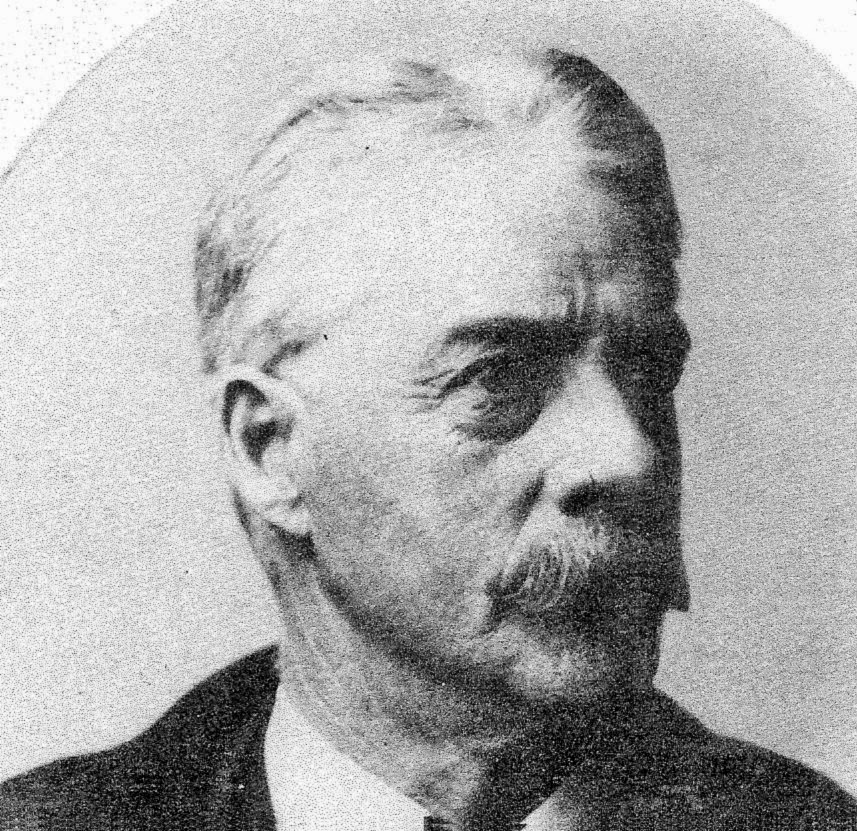
Thomas Clapham portrait.


In the third issue of Rudder magazine, C.G. Davis sketched Clapham's Bouncer and Germania (this highlighted two very different approaches to speed in small 1890's sailing craft with Germania being a narrow canoe-type that most likely represented the 88-class St. Lawrence racing skiff) . The first Bouncer had Clapham's favored Roslyn yawl rig though Clapham did build a second, longer Bouncer type in 1890, named Watermelon, with a sloop rig.

Reuel Parker wrapped up his post about Thomas Clapham with this statement;
"I think Thomas Clapham, right along with Nathanial Greene Herreshoff and Ralph Munroe, must share the title of “Father of the Modern American yacht”.
Let me add that Thomas Clapham was the also the father of the racing scow.


Click here for a post on Larry Huntington, whose scow Question got the scows going as the go-to design in the Seawanhaka Cup, starting in the mid 1890's.