Showing posts with label Laser. Show all posts

Sunday, February 9, 2020

Header Photo: RS Aero Start


The past header photo I decided to give some love to one of the new crop of singlehanders; the RS Aero. The header photo, lifted from the InterWebs a couple of years ago, features a start in Seattle when they were sharing the line with some Lasers. Now that the new singlehanders have been out for a while, I'm not in the loop as to how the new classes are doing vis-a-vis the Laser. I haven't seen any real movement in Annapolis away from the Laser. If anyone knows the photographer let me know. I always like to have an attribution for a photo. Feel free to comment.


Sunday, January 5, 2020

Winners of the America's Teacup Regatta

In my post about The Playboy Bunny, I mentioned that 2020 is the 50th anniversary of the America's Teacup trials on Lake Geneva, Wisconsin. Here, from the OD-OY article on the regatta, are the winners from the various divisions racing in the Teacup. Only two of these classes (the Laser and the Hobie) would make a big impact on worldwide sailing.


Sunday, March 31, 2019

Header Photo: Laser blown over


I think this is the first time in my blogging history that I have put up some random header photo and it turned out that it presaged a momentous news announcement - in this case the International Laser Class Association announcing that Laser Performance Europe was in violation of contract and couldn't build any more class legal Lasers. The Laser class, after suffering several years of legal wrangling over who owned the class, now seems set for another round of lawsuits. A shame. If you can stomach online forums with their endless drivel (and occasional nugget of wisdom), click here to go to Sailing Anarchy's thread.

And from the Earwigoagin archives, here is the blogmeister in a bit of a pickle with his Maser, Starkers.


Saturday, March 23, 2019

Commentary: Olympic Equipment Trials - Singlehanded Dinghy


I've put the header photo of the Laser being blown over as a sort of tongue-in-cheek; I've always been joshing the Laser class; great boat that the Laser is. In the beginning of March, World Sailing ran a week long trials in Valencia, Spain to ostensibly select the singlehander dinghy for the Paris games in 2024. (I say ostensibly because politics always intervene, see my post on the Contender.) This could mark the end of the Laser in the Olympics (and then, perhaps not). Three newish classes were invited; the RS Aero, the Devoti D-Zero, the Melges 14. The Laser was also invited but kept ashore for the final day. Conditions were varied enough during the trials with the exception of a real blow. All three trialists represent modern dinghy thinking; low rocker hulls, flattish transoms, high aspect sails, and, (bullshit opinion alert!, since the blogmeister was nowhere near being present at the trials) during the week, there probably wasn't a huge difference in performance from class to class. So we await the report of the selection committee; which, if truth be told, probably doesn't have a lot of weight when the Annual Meeting of World Sailing convenes in November. Like any political body, behind the scenes maneuvering and lobbying will win the day.

I've come around, slowly, to the idea that Olympic classes should be elite dinghies, not popular world wide classes. This is the way the 49'er has evolved. It is a very difficult boat to race and only the Olympic sailors race this class. (One of these days I might re-tell the tale of Macy Nelson, who decided as an amateur, to race his 49'er in the Miami, Florida, World Sailing event.) My idea of the elite Olympic hiking singlehander is a version of the RS300. Olympic racing and the rest-of-us racing are two different concepts. Let the Olympic sailors have their own singlehanders and to us, the amateurs, leave us be, enjoyably racing our Retro singlehanders (long live our Retro singlehanders!), or our Laser's, or our RS Aero's, or D-Zero's, or Melges 14's. It's time to stop pretending these two, very different versions of our sport should be sharing the same classes.

I should mention that I know Dina Kowalyshyn, an Annapolitan, who was the head of the selection committee. Her husband was an International 14 crew during my era in International 14's; he is known by the 14'ers of that time as "Easy Bob". I ran into Dina at my normal Saturday breakfast joint about six months ago. She was breakfasting with Lorie Stout and we had a interesting conversation about where community sailing was going in Annapolis (or not going as it was determined).


Update: May 4, 2019: The World Sailing committee released their recommendations; either the Laser or the RS Aero is fit for Olympic competition. The Melges 14 was too big of a boat and the D-Zero had too fine a bow - not enough buoyancy for the trialists.

Saturday, November 5, 2016

Small Boat Sailing: Whither the Millennials?

As I mentioned in the previous post, the Millennials (ages 19 - 35 in 2016) are slowly turning the U.S. on their head. Specifically, they don't seem to be into owning big stuff. In the previous post I mentioned the Millennials are more apt to be in an apartment than a single family house with yard. They are not into cars like the previous generations. (WaPo had an interesting article about the hot-rod hobby turning definitely greybeard.) They are more urban than suburban and seem to embrace living small. Many reasons have been offered up for this cultural shift: the crushing burden of student debt in the U.S. has left the Millennial generation cash poor, and/or the Millennial generation is much more conscious of their environmental impact...

This past summer I had an interesting conversation with Mike O'Connor of the Larchmont YC V-15 fleet where he indicated that sailing dinghy ownership by Millennials was also down, particularly in the racing dinghies. He attributed this to several factors.

Burnout. Modern junior racing and college racing programs are high intensity sports. When a young sailor is subjected to eight to ten years of year round training, they are ready, upon graduation, to do something else for fun. If they do want to race, they want to show up on the dock with a life-jacket and race a boat they don't own.

Local focus. There is not the desire to travel long distances, boat in tow or car-topped, to support a class regatta. Travelling with your own sailboat to race against like sailboats is seen as more hassle than fun. (There is sometimes a fair amount of large stuff you need to own to travel, a large car, a trailer and you do burn a fair amount of greenhouse gasses for your weekend enjoyment.)

What would this trend mean in the future? An increase in community sailing programs with community owned boats? Yacht clubs forced to finance their own club-owned sailing fleet? A focus on local fleets and not so much on a national class? I'm not sure but I think the current popularity of the super-portable, easy to store, easy to rent, stand-up-paddleboards (SUP's) may be a harbinger of a future shift on how we approach dinghy sailing and racing.


Sunday, August 21, 2016

House Chores

I was vacuuming one of the side bedrooms in our house and came across two small pieces of paper on the floor. In picking them up, I discovered they weren't scrap paper but thumbnail prints (most likely cut out from a contact sheet) of the blogmeister sailing his Laser out of SSA (Annapolis) back in the 1970's. They must have fallen from some book I had re-shelved. I don't know who took the photos. (Warning! Blogmeister with hair and beard)

It looks like it was a gusty northwester as I was sailing upwind towards the U.S. Naval Academy.


Nobody had invented flat leg hiking yet!


From the Earwigoagin archives; a few of the Laser posts featuring the blogmeister.


Sunday, May 15, 2016

Ian Bruce - A Lifetime of Experiments and Achievements in Sailing

Ian Bruce's memorial was early May at Royal St. Lawrence Y.C. I knew Ian, mostly through a work connection, but we also bonded over a love of the now Classic International 14 (although Ian had retired from 14's when I was racing them). In the late 1970's I saw him about twice a year when he was in Annapolis, and in the later years I touched base when he was up for the Annapolis Sailboat Show. Most of what has been written about Ian centers on the Laser; "Father of the Laser" being the typical moniker bestowed on Ian, but the Laser was only one part of what Ian, the designer, and Ian, the engineer worked at throughout his career.

Ian embraced emerging technologies to make the Laser a true one-design.

When Ian sold a bucketful of Laser's at the first New York Boat Show, he knew he had a winner but he wasn't satisfied. Ian set to work to make this class a true one-design, in every aspect. He wrote a very detailed construction manual so there was no leeway on how international manufacturers were to build the Laser (and this construction manual seems to be the only recognized IP in the current dispute between Bruce Kirby and Laser Performance). Ian didn't like the variation in the Laser sails so he, Steve Haarstick, and Jack Lynch formed Chesapeake Cutters, which was the first company to computer cut sails (using the Gerber Cutter and this is where I come in; I was production manager of the cutter operation). Ian didn't like the variation in the wood blades for the Laser so he developed, with an English company, a method to make them from expanded, self-skinning urethane foam using bronze molds with steel rods as reinforcement. When it came to making parts for the Laser more reproducible consistently, Ian was an early adopter of emerging technologies. The current term, SMOD, Single Manufacturer One-Design, came well after introduction of the Laser but credit to Ian Bruce in his drive to keep seeking out and then implementing the manufacturing technology needed to achieve identical dinghies.

Ian was a project guy.

Ian was happiest when he was up to his elbows in a project and the projects he chose were usually pushing the limits. In the 1970's nobody had built a production two-man dinghy at 64 kg (140 lbs.) in glass; the lightest dinghy going before the Tasar was around 90 kg. (The Tasar was designed from the Aussie NS-14 which was built in plywood at that time.) Ian went with full foam core and light skins, a relatively new technology, to achieve the very lightweight Tasar. When Ian did a keelboat, the Laser 28, he decided to build it using resin infusion (which uses a vacuum to pull the resin through the cloth) in order to have a tighter control over the laminate. Problem was, at that time, no one had done a part as big as a 28-foot boat using resin infusion. The last time I saw Ian, in 2012, he had his latest project, an all-electric runabout that he was aiming to get to 30 knots. Ian was more than a boat-builder, even more than an industrial designer, he was, using U.K slang, a true "boffin".

After the Laser, Ian set the lofty goal to bring high performance dinghies to the World.

Once Ian had set the Laser onto the path for international success, he set out with another goal, to introduce the World to the Antipodean high-performance dinghy. Ian felt that the North American and English dinghy classes, compared to the Australian and New Zealand dinghies, were too heavy and too slow. So he partnered, first with Australian designer Frank Bethwaite to produce the Tasar and the Laser II, and then with New Zealander Bruce Farr to produce the Laser 28 and the singlehander MegaByte. Having a conversation with Ian Bruce in the late 1970's you knew you were in the presence of a true believer in the Australian/New Zealand lightweight, overpowered dinghy. Did he succeed? Yes and no. Certainly the classes mentioned, the Tasar, Laser II, Laser 28, and Megabyte never gained traction as big international classes with staying power but, by bringing the Antipodean designers, and their boats front and center to the sailboat world, Ian paved the way for Bethwaite Olympic class, the 49'er and helped push the International 14 into the Aussie skiff camp. In many ways the current crop of lightweight singlehanders coming to market, the RS Aero, the D Zero, the Melges 14 and others owe a large debt to Ian Bruce's pioneering efforts to introduce these type of dinghies 40 years ago.

Mention must be made of two other people that were an integral partners in Ian's success; Ward McKimm, the "money man" who had complete faith in Ian Bruce and was a major force behind the scenes, and Peter Bjorn, the "right-hand man" who was with Ian through both Laser Performance days and the Byte days.

And then there is an entire history of early Ian Bruce and the International 14's but that needs to be told in another post.


Saturday, November 28, 2015

Not Turkey Carving; but Laser Carving

We American's are just finishing up our Thanksgiving feast weekend, Roast, baked, or fried turkey is the centerpiece and carving the turkey into white or dark meat pieces is all part of the tradition (and then add the gravy, stuffing, oyster or regular, mashed sweet or white potatoes, cornbread, vegetable casseroles of all sorts ..... well, you get the idea).

Segue into a sailing theme, in this case Olympic sailors carving their Lasers downwind. (Carving, in this case, a maritime definition borrowed from the surfers and meaning the radical changes in direction to stay on a wave.)

And surprise, surprise, an American in the lead in this one!


Friday, October 23, 2015

Swedish September

Martin Rutgersson, Laser Sailor from Stenungsund, Sweden (just above Gothenberg on the west coast), sent along a video of him doing some bombing around in a Laser in September. Apparently fall twilight in Sweden lasts between 2-3 hours and sailing in this muted light is an entirely different sensory experience. From Martin's email:
"To sail in the beautiful long sunsets we have here in Sweden this time of the year is just marvelous.


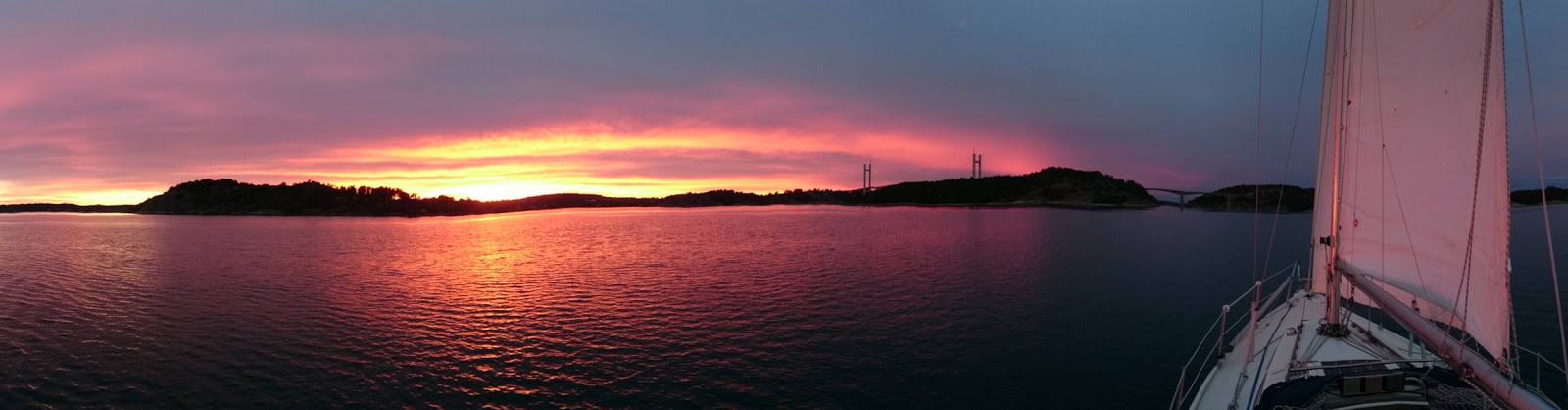
Martin also sent along this spectacular sunset photo.


Martin Rutgersson

I was under the impression that Stenungsund was a Swedish backwater until I went poking around the Internet and discovered that Stenengsund is the focal point for the Tjörn Runt, a 50 km race. round Tjörn Island, held in August that attracts 1000 sailboats of all types, from all-out multihulls and carbon monohulls to the mom and pop cruiser  Evidently this race is also popular with spectators as there are parts of the course where the sailboats must navigate narrow inlets; short tacking among crowded groups and sometimes crashing into the shore. A short video advertising the 2014 race:


Martin has also put together a stunning slideshow of his photos taken during the 2013 Tjörn Runt.

Tuesday, August 18, 2015

L'Opti or the Laser 3.3

I don't know how I missed this but several years ago, sailing coach Dan Brandt at Richmond Yacht Club introduced a Laser with an Opti rig. I would imagine Richmond Yacht Club, being just off to one side of the very windy and choppy Berkeley Circle on San Francisco Bay, would find a very depowered Laser of great use for their junior sailors. Come to think of it, at this time in my life, this is just my speed for racing a Laser in anything over twenty knots.


More info on the L'Opti can be found here.

Also, at about the same time the L'Opti came out (2011) there was, that year, another performance rig introduced for a Laser.

Thursday, May 21, 2015

An ad on this blog?

Well sort of... I thought this video put out by Vaavud, a company the sells anemometers for smart phones, is worthy of a repost, particularly since it has two Lasers bombing back and forth. Unfortunately, I'm a fossil; I only own a flip-phone and have resisted carrying any smart technology. I have no knowledge of the performance of the Vaavud anemometer. My experience with hand-held anemometers, when using them on race committee to determine whether we have the required 4 knots wind speed to race, is they are somewhat dicey in their accuracy at low wind speeds. Maybe some of those technically hooked-in with modern devices could comment on the smart phone anemometers.


Sailing with Vaavud from Vaavud on Vimeo.


Thursday, April 30, 2015

Of the Laser Borg

Many years ago; my one and only Laser - sail no. 549.

Photo: Ellie Martin


Saturday, April 25, 2015

Header Photo: Sabre Dinghy and the Return of the Retro Singlehanders


The previous header photo is of Aussie Matt Kiely sailing the Australian singlehander Sabre class dinghy. The photo was lifted from the South Gippsland Y.C.Facebook page.

Probably the major trend in dinghy racing over the last 30 or so years has been the growth of singlehanded racing at the expense of doublehanded or triplehanded classes. And the trend since the millenium has been the explosive comeback of  what I call the retro hiking singlehanders; those other singlehanded classes designed before, or around the date of the introduction of the Laser (1969). For the most part, these classes are not international (excepting the OK Dinghy and Europe Dinghy); they are popular country-by-country or region, and they attract fleets of thirty, forty or more boats at major championships. They have a builder or two turning out modern hulls, some have carbon masts, many have aluminum. They seem to fill a need in the marketplace that the Laser does not.

I have compiled a list of retro singlehanders. I have excluded the Olympic Finn - 1949 (which has a huge Masters scene) and singlehanders with hiking assists (trapeze, sliding seat). Feel free to add your thoughts about this list in the comments section. (Before the Sunfish sailors jump all over me for excluding the Sunfish from the list - let me state the Sunfish has maintained high levels of popularity in parts of North America and parts of South America for many, many years - I don't see a comeback in popularity - they just maintained it.):
Despite the recent introduction of the "modern" RS Aero, or Devoti D-Zero, with lightweight hulls, mylar sails (correction - the Aero has dacron sails), carbon rigs, it seems the singlehanded market is marching in the other direction. (I must admit the North American market is an anomaly here with not a lot of singlehanded classes under the Laser - still king by a long-shot-, and the Sunfish - a solid runner-up, The other singlehanded classes in North America - like my Classic Moth - are mustering small numbers...Oops! I forgot about the MC scow, now very popular in the U.S.)


Sunday, July 6, 2014

A Cautionary Tale of Ultralightweight Production Dinghies

I have been keeping up with Tillerman's excellent posts about his new love, the RS Aero singlehander. RS intends to build the Aero hull to a 30 kg. (66 lbs.) hull weight. This is a very, very ambitious target for a production dinghy. When I read of such super-lightweight numbers for the hull, especially for a dinghy designed for mass-market appeal, it reminds me of a cautionary tale from my days as a young blood, not quite 40 years ago.

In the 1970's Ian Bruce followed up the Laser with the two man Tasar, a very early, ambitious attempt to reset dinghy technology. The Tasar, designed by Frank Bethwaite, was a larger version of the Northbridge Senior, a 14' two person hiking development class in Australia. The NS 14 was built at that time, in plywood to 100 lbs hull weight. Ian and Frank figured they could build the larger Tasar to 140 lbs. hull weight in foam/glass, a good 50 lbs. lighter than the Windmill class, which, here in the United States, we considered lightweight. The prototype Tasar, which I got to sail, was beautifully built in Montreal using Kevlar skins over foam core and polyester resin. Testing of the prototype showed no problems.

However, when Performance Sailcraft switched the Tasar to the production phase, economics dictated that the Kevlar skins be jettisoned and very thin glass skins substituted to keep the hull weight at 140 lbs.. When the first production boats came out, it quickly became obvious that the thin glass skins had nowhere near the dent resistance of the prototype's Kevlar skins. Treating early production Tasars over the space of several months with, what we considered normal Laser-type usage in the seventies, (dollies were mostly non-existent) quarter size dents appeared over the bottom of the production Tasar hull, giving the hull an appearance of surviving a hailstorm. Occasionally a stray protruding nail head on a dock would actually puncture the outer skin. This fragility would doom the Tasar in North America. It would not be another best-seller for Performance Sailcraft. In his next attempt at the market, Ian Bruce stepped back and did a more Laser-like two-hander, the Laser II.

Granted, in forty years, today's material technologies for building production dinghies have improved and RS is using all the modern wrinkles to create the Aero. Epoxy resin is better than polyester. There are better fabrics. Still, thin outer skins over foam construction are more damage prone. Two or three years ago I was on the lawn at West River Sailing Club at the end of a day of racing. The A-Cat catamarans (which use similar thin skin construction to keep weight to a minimum - though they use carbon skins throughout) had been racing and I watched a fellow maneuver his A around the various boats strewn on the lawn to reach the water hose at the side of the club. In the process of turning, he smacked one of his hulls against the corner of the club house, leaving a nice dent about 6 inches from the transom. To an A-Cat skipper, this type of damage is part and parcel of owning a very lightweight, very high-performance sailboat. I'm not sure, given the intended market RS has envisioned for the Aero, that this constant danger of small contact becoming a visual blemish, lump, dent, or hollow on the hull is what an RS Aero skipper is buying into. It will be interesting to see how the introduction of the RS Aero plays out. And, I will be the first to admit, many times my predictions have been wrong.

Click here for some previous Earwigoagin posts that have featured the Tasar.

Click here for some previous Earwigoagin posts that have featured the RS Aero.

Tuesday, March 4, 2014

AH-WOOGA! AH-WOOGA! Laser Market Sector under attack!

Given the current uncertainty in who has the right to produce the Laser, combined with the feeling that it's time to modernize the mass-market hiking singlehander, two manufacturers unveiled hiking singlehanders (RS Aero and the Devotti D-Zero) smack-dab in the Laser size range during the U.K dinghy show this past weekend. Both are considerably lighter than the Laser with a more "modern" hull shape. I have my opinions about whether one of these two will eventually achieve the Laser mantle in the future - I'll save that for a future post. First, as a background, let me direct you to Tillerman's more detailed post on the RS Aero. For the rest of the post I'll let the readers of Earwigoagin absorb the design concepts as explained by the designers/builders behind these two new dinghies, as voiced in YouTube interviews during the dinghy show.

First the RS Aero design team:

Hmmm! Well, that video disappeared from public consumption after one day. Oops! No it hasn't, it's back again. TOH to the chaps at Yachts and Yachting.


And Dan Holman, designer of the Devotti D-Zero, courtesy of the RYA roving reporter:


Another recent singlehander around the same size of the Laser, though not designed with the upper end performance criteria of the RS Aero or Devotti D-Zero, here is my post on the Australian GO 4.8 singlehander.

Thursday, January 2, 2014

Frankenboat: Laser-To-?? - I'll let You Figure it Out

I admit when I clicked on this video I had no idea where this fellow was going with this Frankenboat/Laser hull project. I won't spoil the surprise (it certainly involved a  lot of wood!).


Other Earwigoagin Laser- to-Frankenboat posts:
  1. The New Laser Sail
  2. The Maser

Monday, June 17, 2013

How many races can you get in a day?

I finally got on the water the weekend of June 8,9, not sailing mind you, but as Vice Chair of Severn Sailing Association's Spring Series for Lasers and a Vanguard 15 invitational. Winds were light, very shifty on Saturday (up to 40 degrees which makes it tough for the RC folks, as soon as we shifted the weather mark the wind was somewhere else). Sunday was a light breeze, steady this time out of the North with lots of motorboat chop.

The racing format was intercollegiate short course with races timed around 20 minutes in length and starts ran with the 3 minute sound system. Most of the race committee felt pretty chuffed that we had succeeded in getting 18 races off for the three fleets in about 2 and 1/2 hours. I, who have volunteered over at the Naval Academy dinghy regattas, chimed in to say that getting 60 races a day was no big deal for the collegiate crowd. We had Ramsay Key on board the Sunday, an intercollegiate All-American in 1998, sailing for Tufts University. He mentioned that when he had raced in the Wilson Team Race event at West Kirby SC, over in Merrie Old England they would routinely get 300+ races off in three days. He went on to say that the intercollegiate clubs on the Charles River, Boston (MIT, Harvard, Boston University) decided to do West Kirby SC one better and ran a team race event with 400+ starts in a three day period using 44 collegiate dinghies and lots and lots of eager college volunteers.

Mindswimmingly large numbers!

We did have a professional photographer jump in one of our crash boats for Sunday's racing. Tara Roberts has kindly consented to send me a couple to post on Earwigoagin. More photos can be viewed over at Tara's website.

A Vanguard 15 start:


Two Lasers finishing with the Maryland State House peeking out over the treeline.


A typical packed Laser start. We did have the current helping us keep this unruly fleet below the line. No general recalls for the entire weekend!


And finally a photo of the "Favored End", SSA's main committee boat. Your blogmeister is standing on the cabin top (in a lime shirt) intently monitoring the fickle wind, unhindered by trying to figure out more swirls and vagaries if I had remained with the crowd down on the aft deck.

Saturday, December 8, 2012

The Ironing Board

The previous post about Ian Bruce reminds me that the Laser dinghy is now 40 years old (the actual anniversary is somewhat muddled - do we go with the first appearance of the "Weekender" at the TeaCup regatta in Wisconsin in 1970 or with the very successful introduction of the production "Laser" at the New York Boat Show in 1971). Tillerman made an oblique reference to the Laser reaching age 40 in this homage to his forty year love affair with Tillerwoman. The Laser is now so ubiquitous, found in every nook and cranny sailing water throughout the world, it is hard to imagine a world where the Laser was the newcomer.

I remember reading about the new "Weekender" dinghy in ODandOY (for young whippersnappers, this was the One-Design and Offshore Magazine, the forerunner to the now Sailing World magazine, of which Bruce Kirby was the editor and the organizer of the TeaCup regatta.) Although the Laser topped the results, there didn't seem to be much to choose from between the Laser and the other singlehander making it's debut on the national scene; the West Coast designed and built Banshee (based on a Flying Junior hull).

I saw my first Laser the first year they came out, 1971, though the dates, times, chronology and characters have been clouded by the years. It was Septemberish and I, as a Midwestern college student from Miami University of Ohio, who couldn't get enough of dinghy racing, had finagled an invitation to the University of Wisconsin Hoofers Intergalactic Tech Dinghy Championships. And as was common and completely normal for a college student who didn't own a car in those years, I hitchhiked those 400+ miles through Ohio, Indiana, Illinois and into Wisconsin (this may have been the trip where I spent the wee-morning hours trying to sleep on the hard seats in the bright lights and elevator music of the Milwaukee Airport - hitchhiking being a very non-linear form of travel - but this may have been on another hitchhiking foray into Wisconsin).

The Hoofers Club Intergalactic Tech Dinghy Championship put their 40 or so Tech dinghies on the line, a singlehanded championship that featured mostly current Hoofer's skippers or alumni such as the Harken brothers, Peter Barrett, Charlie Miller and I'm sure there were some scow champions sprinkled in as well. The weather was warmish, the breeze about 8-10 and I finished somewhere in the middle, middle-to-back. A great regatta. There is always something special about the Midwest lake sailing hospitality. On the way back out, I arranged to stop at Peewaukee, Wisconsin where Vanguard/Harken Blocks and North Sails Midwest (Peter Barrett and Charlie Miller) were neighbors in a business complex. Vanguard was closed when I showed up but there was someone at North Sails to show me around the loft. Tucked in one corner was this oddball dinghy with a completely flat deck.

"What is this?" I asked.

"Oh, this is the new Laser dinghy." came the reply.

"What a weird looking deck!" I was having a hard time getting my brain around something so flat looking.

"Yeah," the North sailmaker said, "Around here we've nicknamed them the Ironing Boards."

I nodded in agreement. At that moment I couldn't imagine a boat so different looking (yes, even ugly) ever getting off the ground.

Later that fall I hitchhiked into Annapolis to crew in an International 14 regatta. Good friend Sinjin Martin, who had been selling Ian Bruce's International 14's to the local fleet, was Annapolis's first Laser dealer and they had been selling like gourmet cupcakes. He stuck me in a Laser for a test sail. Light, fast, responsive; when I stepped back onto the dock at SSA I knew this was a special dinghy.

And that ugly flat deck - that kinda grew on you.

Thursday, November 29, 2012

Ian Bruce

I was walking down the pier at the Mid-Atlantic Small Craft festival this year and passed one of those varnished Classic look-alike repro Chris-Craft runabouts. I made a mental note that this was an odd duck at this event; I'd never seen a classic motor boat at MASCF, there already being a surfeit of other events that cater to the Classic runabout crowd (the big one is the Antique Boat Museum event at Clayton NY at the beginning of August). Pushing this anomaly out of my mind, I kept ambling along to the end of the pier, perusing all wide variety of paddling, rowing and sailing craft. After fifteen minutes stepping in an around the small boats scattered on the floating dock, I looked back toward the Museum and spotted what looked like a familiar figure standing on the pier next to the Chris Craft. Hard to tell at this distance but it looked like Ian Bruce, the one man responsible for launching the greatest number of fiberglass sailboats in the history of mankind (the Laser first comes to mind, then the Laser II, the Tasar, the Byte, the Megabyte, the Laser 28, and before all that, about 150 International 14's). If it was Ian Bruce, then the reproduction Chris Craft started to make sense. It took me some time to make my way back up the pier and, sure enough, there, standing in the cockpit, was Ian Bruce.


I had heard Ian was developing an all-electric Classic runabout, something that could do 30 knots, an unheard of speed in the all-electric world and here was the boat in the flesh. Ian had brought the boat down from Canada to do the Wye Island Electric Boat Marathon the weekend before (just up the river from St. Michaels) and decided to attend MASCF. Ian had a water pump pack it in the day before the Wye Island race which he and his friend Jack Lynch fixed with some local hardware parts (not sure what needs water cooling in Ian's electric setup on the Chris-Craft look alike). This severely curtailed the top speed to about 9 knots and put him out of the running. His intent is to return next year, fully operational, and smash the record for the 24 mile course. A YouTube video on the Wye Island Marathon (including Ian's Classique Bateaux - Ian has always lived in French speaking Quebec) shows these electric powered craft making good speed around the course.


After producing fiberglass sailboats since the late 1960's, Ian is no longer in the sailboat production business, having sold the Byte and Megabyte lines to Zim in May of 2011. This E-boat project has got Ian's considerable creative talents going full bore and his focus is on making this all-electric Classic runabout a success.

The bulk of our five minute discussion wasn't electric boats, or the state of sailboat manufacturing but reminiscing about Classic International 14's. I consider Ian one of the greatest living International 14 champions. I hope to catch him again in 2013 on his return to racing on the Maryland Eastern shore.

Saturday, July 7, 2012

Run Up to the Weymouth Olympics - Laser Slaloming and Laser Dudes and Laser Dudettes, and How They Train.

Brad Funk - who didn't make it to the final U.S Olympic Team, playing on the waves on a sail in from training for the Perth regatta this winter.


Brad Funk Raw training at in Perth for the ISAF World Championships from Degan Media on Vimeo.
.
And Rob Crane, the one who did get the the USA Laser berth and Paige Railey, our Laser Radial sailor, on training; on-the-water,  and off-the-water, and mental preparedness.