One couldn't help but notice the small keelboat jammed right up against the fence line of the Sailboat Show. She was tucked into the corner facing Annapolis's dockside restaurant row and sported all the accoutrements of modern keelboat design, reverse bow, bulb keel, skinny rudder, assymetric spinnaker. Once inside you discovered this keelboat, the RS21, is RS Sailing's new entry into the day keelboat market, the design brief targeting the emerging club keelboat market where the sailing club buys the boats and the sailors pay an extra fee to climb aboard and race.
A photo of the cockpit looking aft. Two mainsail cleats; the forward one for the mainsheet trimmer when going upwind, the aft one for the skipper or trimmer that has moved aft for the offwind legs.
Looking forward it is a very clean cockpit.
The bulb keel. It does have a weed cleaner/cutter that comes standard which is a must given the very straight leading edge of the keel. A Torqueedo electric drive comes with the RS21 (You can see the prop in front of the rudder - I think it gets raised when saililng.)
The business end of the mast. Plenty of controls to keep the crew occupied.
Some videos of the RS21 on the water. I would have to say the RS21 most closely matches the market where the popular J70 currently dominates in the U.S.A.
Given the millennial's desire to store things in their apartments (see this post, Whither the Millennials), the models of inflatable sailboats continues to expand. (I previously wrote about the Tiwal inflatable sailing dinghy from the 2016 Sailboat Show.) At this year's show it was the small Minicat Guppy catamaran, a 3 meter inflatable that continues to expand the market selection for knock-down small boats. I took two photos but didn't hang around to talk to the salesman so I didn't get an idea on U.S.A. pricing. (More info at the above link.)
I've dragged this comment from Nail Sadykov to the main post. Nail says the Russian and Ukraine sailors have been designing inflatable sailboats for a while and the technology is advanced.
"English language link, with several different models;
From Boatdesign.net. And from a Russian forum.
New Ukrainian boat. Possibly, next year in Everglades challenge or R2AK race. In ex-USSR existed a long tradition of inflatable, demountable boats, suitable for transportation by passenger train or other public transport."
This year I did come across a rather forlorn, inflatable SUP, somewhat deflated, on a car roof rack. My guess is this particular boat owner assembled the SUP early in the summer, strapped it on his car for the duration of the summer months, and hit it with some air pressure when he wanted to use it.
I've already posted about the UFO, the Clark design, short LWL catamaran entry into the foiling market. At this years Annapolis Sailboat Show, I was able to look at the UFO on the stand with the rig up and also watch it sail out of the harbor (they were giving demo rides at the show). Unfortunately, in my short time at the Sailboat Show, I only was able to see the UFO sailing in lowrider mode. According to Dave Clark they have now produced 200 UFO's and shipped all over the world.
Lowrider Mode. The bowsprit holds the wand which automatically controls ride height.
This is a big rig on a short hull, but, then again, the hull is not in the equation when foiling.
Modern fat-head, clear mylar mainsail.
A brilliant solution to constructing the wishbone boom. The front end is attached to the outboard end of the jumpers on the mast. You can use straight tubing and still get the wishbone away from the sail and the wishbone also adds leverage to get the mast to rotate in-line with the sail.
Another shot of the end of the wishbone attached to the jumpers.
The previous header photo is of Bill Moss and John Gallagher bombing around Annapolis Harbor in the late 1970's. Bill Moss passed away suddenly this past Christmas. We were teammates for the 1981 International 14 Team Races and World Championships and remained good friends ever since, long after I exited the International 14 class. Bill was the best of the best and his drive raised my sailing to another level for that two year campaign. It was that special slice of time when we were on top of our sailing game in an unforgiving dinghy. He will be missed.
The 1981 Team Race party; Bill on the left, the blogmeister on the right.
These couple of photos should wrap up my posts on the Australian Historical 18-footer visit to Annapolis.
The 1932 reproduction Aberdare rolled on her side. You can make out the moderate V section shape which is not too dissimilar to the section shape of the 1870 Sandbaggers (though every thing else on the hull shape is completely different).
Australia IV before the mast went up. The reproduction 18-footers are cold molded in plywood with an outer layer of cedar. The originals were built single planked, bent nailed into interior seam stringers (batten seam construction). The reproduction hulls weigh around 270 kg (600 lbs.), which seems to be about 100 kg less than the original hulls.
The daggerboards are simple metal plates.
The two architects of the Australian Historical 18-footer visit; Lee Tawney of the National Sailing Hall of Fame and Ian Smith of the Historical 18-footer organization. Ian Smith has written a book on the old Australian 18-footers; half the book is a history, the other half a construction primer on how they were built. The blogmeister bought the book and can vouch that "The Open Boat" is well worth adding to your yachting book collection.
Masts are raised on a tabernacle which makes it a simple task. The reproduction 18-footers have aluminum spars. The amount of old and new that is allowed on the reproduction 18-footers is arrived at by consensus among the fleet. One thing is clear, these vintage reproductions are not babied, either on the beach or on the water.
The three reproduction Australian 18-footers that made the trip to Annapolis represent the design evolution of the 18-footers from pre-war WWII to post-war WWII. Following are photos of the transom shapes of Aberdare (1932), Alruth (1943), and Australia IV (1946).
Aberdare was one of the early ones to straighten out the hollow garboards of the wineglass transoms typical of the 18-footers at the beginning of the 20th century. She still sports a very fine transom compared to the fat, flat ones of the modern skiffs.
Alruth started flattening the transom shape (though still very Vee'd). Note the raised lee-cloth which are raised most anytime the historical 18's are afloat to keep the briny sea from swamping these beasts.
Australia IV has a transom shape similar to a typical pre-war Uffa Fox International 14 though the shapes were developed independently.
In what seems a reversal of modern sailing design theory, the very fine-transomed Abedare is currently the fastest of the historical 18's, though many knowledgeable observers credit this to a very accomplished crew of Abedare, led by John "Woodie" Winning.
As mentioned in a previous post, three Australian Historical 18-footers were in Annapolis this past week to race against each other as well as the National Sailing Hall of Fame's two sandbaggers.
The 18-footers launched off of Bembe Beach, hosted through the courtesy of the Annapolis Sailing School.
Bob Ames got to be one of the guest crew for one of the race days and sends along these photos he took of the three 18-footers rigging and launching from Bembe Beach.
I just got off the phone with my friend Tom Price, who is one of the organizers of the Sandbagger and Historical Aussie 18 Annapolis Week sponsored by the National Sailing Hall of Fame. He gave me a tentative schedule which I will update when I get more information.
Type and format of the racing is up in the air, but given the size of the boats the course will be of some length. Ian Smith, historian of the Historical Aussie 18's, is scheduled to give a talk at some point.
The focal point will be Annapolis City Dock and the NSHOF cottage.
Aussie Historical 18 foot videos here, here, here,
and here.
Historical sketch of a Sandbagger.
Another engineering design marvel at the show was the X-cat.
The X-Cat is an Austrian import; a rowing, sailing catamaran that is designed to be easily broken down for transport or storage. Marketed as a "multi-sport" catamaran, one can buy four models: the base model which is just the catamaran (presumably with this model you would desire to add some low horse-power motor to get around with), a sailing model, a sliding seat rowing model with a conventional rear-facing seat and oar set-up, and a front-facing rowing model. The X-cat at the show was out-fitted with both the sailing rig and the front-facing rowing kit.
The X-cat website. (Note that the header photo on the website is actually a very slickly produced movie utilizing drone footage for all of the scenes. Click on the arrow.)
One of the X-cat hulls. Interesting to note was this riveted center seam which indicates the hulls are molded in 2 pieces and then assembled together. This makes sense as the brochure touts the hulls being entirely foam-filled (it doesn't appear to be the blown in type but rather custom molded foam pieces to match the hull shape). Also, according to the brochure, none of the base hull pieces weigh more than 17.5 kg, so the X-cat can be easily loaded onto roof-racks when broken down.
The front-facing bent oar system. The X-cat goes together with lots of custom push button fittings (no tools required). Obviously I couldn't witness an assembly of the hull - the brochure touts a time of 2 minutes, which seems a bit ambitious.
The X-cat is approaching the market that has been carved out by the brilliant Hobie kayak/trimarans, but from a fitness machine, higher performance angle than the Hobies which have found a large market in the fishing, kick-back, day-sailing crowd. From my quick look over of the X-cat at the Annapolis Sailboat Show, the X-cat is indeed a very high-quality product. The brochure mentions there will be some new E-power options in 2017.
The Tiwal is the French inflatable sailing dinghy. Tiwal has been shown at the Annapolis Show for the last couple of years, but I've quickly walked past the booth, dismissing it (from my hard hull, traditional dinghy perspective) as most likely a very slow-performing, oddity. Thus, the Tiwal never made it into an Earwigoagin post. Why post about the Tiwal this year? During the show, Tiwal had one of their dinghies out bombing around on Annapolis Harbor and, I must admit, the Tiwal sailed well, tacking easily and showing a good turn of speed. It's time to confront my prejudices and admit that there may be something to this blow-up sailing dinghy.
The Tiwal is a 3.2 meter (10 1/2 foot) scow, or in modern parlance, a fat stand-up paddleboard. (To my eye, the Tiwal looks like a small, modern version of the 1900 French scow, the Monotype de Chatou; though I doubt the designers actually referenced this vintage design.) An exoskeleton of interconnecting tubes and wings, support all the sailing bits; mast, daggerboard, rudder, skipper - one reason I find the Tiwal an engineering marvel. I was pressed for time so I didn't spend any time talking to the salesman at the booth; I just had time for a quick photo.
The trend in the United States is for the young to prefer to live in apartments or townhouses (something the Europeans have always done). Without a large yard to store large objects, the easy-to-store Tiwal may gain some inroads among millennials, who are trying to figure out how to go boating without worrying about where to stash a boat on a trailer.
George A. has a better camera and took a better shot of the Tiwal sailing in Annapolis Harbor, so I lifted the photo from his post on the 2016 Sailboat Show.
Two new one-design singlehanders pushing the performance envelope were seen at the 2016 Sailboat Show.
The VX-Evo is designer Brian Bennet's addition to the long list of assymetric spinnaker singlehanders (the MX-Ray, the Devoti D-One, the RS 100, the Weta trimaran - have I left anyone out?). It is a big singlehander, 4.77 meters long, 1.7 meters beam with a big rig, approx 10 sq. meter main and a spinnaker about the same size. The VX-Evo seems designed for big Americans but the salesman also metioned that there were some couples interested in buying the boat and sailing two-up.
The VX-Evo is built by Ovington in England. As of the boat show there were definite plans to ship three containers to the U.S. for a total of 24 boats to jump-start the class.
I just got a chance to look down into the VX-Evo cockpit but you can see the wedge hull with max beam and chine continuing well aft for power. Price complete is $14 K USD.
Video of the prototype being put through the paces. Interestingly there is no forestay (which allows the spinnaker to pop through on gybes) but there are sidestays.
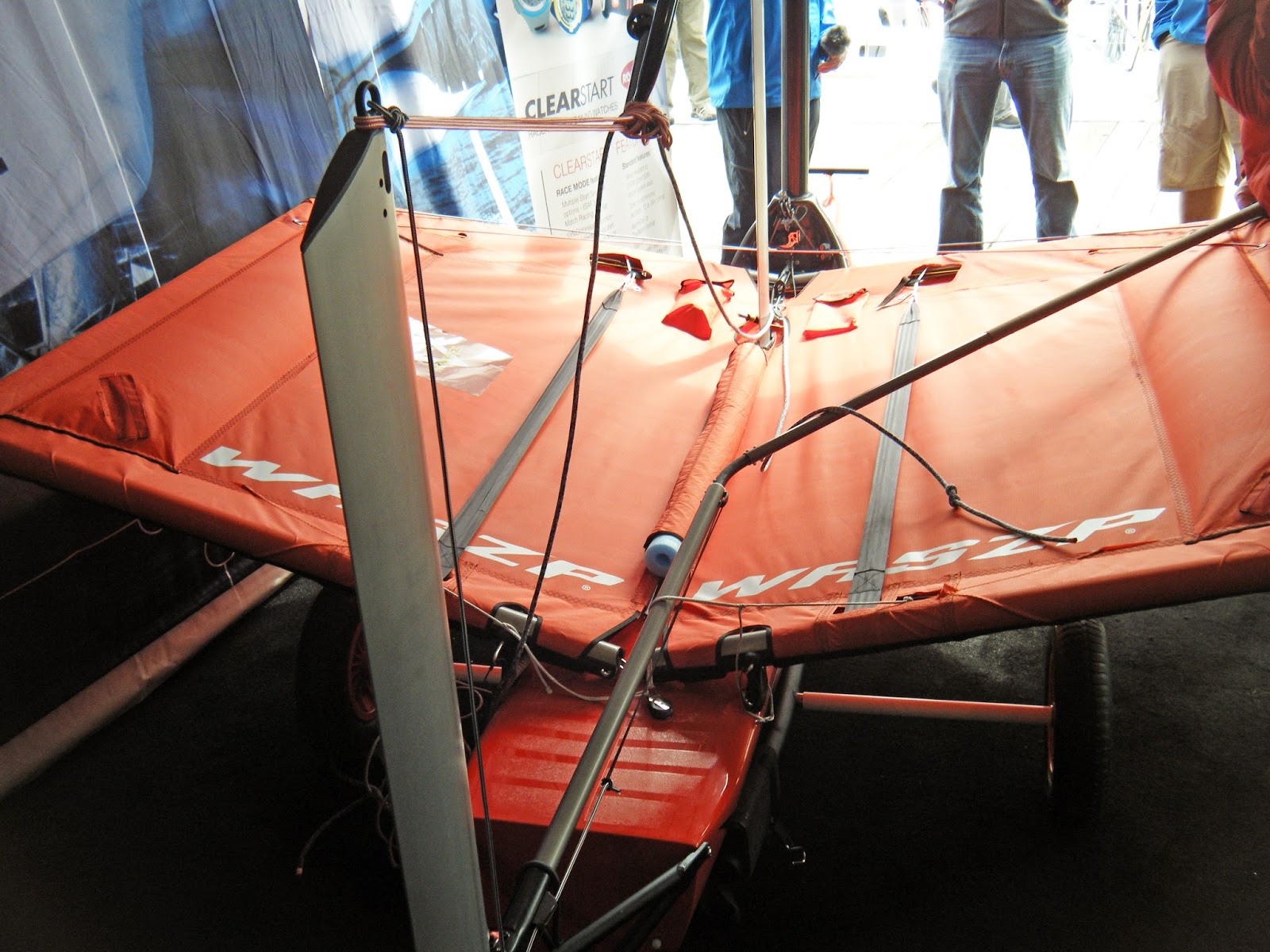
The Waszp is the dialed back International Moth foiler designed by Australian Andrew McDougall. With a simple unstayed rig, foils that are sturdier aluminium, a heavier, less hi-tech construction, the Waszp comes in with a price around $10K USD. This is less than 1/2 of the price of the current International Moth - hence the description "Peoples Foiler". (I like the term "Volks Foiler" but I guess there would be legal issues with a certain German car company.)
The Waszp was sitting inside the Ronstan tent, surrounded by a crowd. I was able to poke my camera through to take a quick photo from the transom. The designer was busy talking to a rep from the U.S sailing magazine, Sailing World, as the Waszp is up for that mag's Boat of the Year Award - hence I didn't get to ask any questions.
Most present-day development of foiling seems to be on the catamaran platform. It will be interesting to see if this low cost Moth can bump up the popularity of foiling in the small singlehanded sector.
Certainly from watching the videos the foiling performance of the Waszp seems very much Moth-like. Note the wishbone boom. I gather the angle of the wings can be altered to make it feel safer for a beginner. There are also various sail sizes offered.
I was vacuuming one of the side bedrooms in our house and came across two small pieces of paper on the floor. In picking them up, I discovered they weren't scrap paper but thumbnail prints (most likely cut out from a contact sheet) of the blogmeister sailing his Laser out of SSA (Annapolis) back in the 1970's. They must have fallen from some book I had re-shelved. I don't know who took the photos. (Warning! Blogmeister with hair and beard)
It looks like it was a gusty northwester as I was sailing upwind towards the U.S. Naval Academy.
Nobody had invented flat leg hiking yet!
From the Earwigoagin archives; a few of the Laser posts featuring the blogmeister.
I saw this wood engraving on my good friend, Tom Price's, work desk and he was kind enough to scan it in. In poring over the wood engraving, the best we can make out, putting our heads together, is this is Annapolis Harbor just after the Civil War. Sketched from the vantage point of the North Severn River, we see several Navy tall ships anchored off the Naval Academy, a steam ship motoring west on the Severn River towards the Bay, and off to the right, presumably anchored, a Monitor iron-clad war-ship. (Plus, a small cat-boat sailing amongst all this big lumber.)
James W. Cheevers, Senior Curator at the U.S. Naval Academy Museum, sent along this detailed email on the history represented by this engraving, from which I quote below.
"This line engraving is definitely post Civil War. It is a view of Annapolis from across the Severn River with the Naval Academy main pier left of center surrounded by ships, a good view of the seaward side of Stirbling Row, the Maryland State House sticking up at center, McDowell Hall at St. John's College, a clear view of the Academy's Steam Engineering Building (1866) and New Quarters or Cadet Quarters (1868) with a copula out of perspective by sticking up too high in proportion to the building.
"I think the three-turreted monitor is a mistake, too. I have record of seven different monitors visiting and/or serving the Naval Academy between 1866 and 1910, but none of them had three turrets. Those with double-turrets included USS Amphitrite, formerly Tonawanda; USS Nevada (BM 8), and USS Terror. I think the monitor is probably meant to be USS Amphitrite which had a funnel between its two turrets that when retracted could have been mistaken from a distance as a turret. It was used at the Academy for training between 1866 and 1872.
"I note that there is an inscription lower left. It looks like the words Fleet and Puck. Puck was a magazine from 1871 to 1918, but its illustrations were primarily cartoons. There appears to be another inscription on the right where the dark water meets the land. It seems to end in "weed" so it could be an artist's name. If are able to better decipher either of these inscriptions examining the original up close, let me know what they are because we do have reference books on artists to perhaps help you further.
(Click on image for larger view.)
Erratum: Peter Belenky, who it turns out has done marine etchings, points out that I originally erroneously categorized this print as an etching when it is actually a wood engraving. I've pulled his detailed comment over to the main post and made the appropriate corrections to the main post. Thanks Peter for the education.
"Not an etching, but apparently a wood engraving. In both processes, ink is rubbed into grooves on the plate and wiped off the surface. Then paper pressed down picks up the ink. In an etching, the principal means of creating grooves is scratching the design through a varnish coat on a metal plate and bathing the plate in acid. In an engraving (metal or wood), the grooves are gouged with tools. These are "intaglio" processes, meaning that the lines are printed where the surface is cut away. In the alternative "relief" process, like book printing, the blank spaces are below the surface and ink is rolled onto the raised surface to be printed.
"The wood engraving process was the chief means of publishing images in magazines of the Civil War period, and many of Winslow Homer's drawings and paintings from the front were reproduced and circulated in this way.
More from James Cheevers: In response to a further inquiry of mine about the dock with the paddlewheeler at the top right of the engraving, Mr Cheevers sent along some further fascinating details.
"Yes, there was a wharf at the end of Maryland Avenue on the Severn River. It was not a public wharf after 1847 because the Federal government had purchased the property as part of the first expansion of the new Naval School at Annapolis. In the post Civil War period the wharf was called Phlox Wharf after the screw steamer USS Phlox, built in Boston in 1864 as F. W. Lincoln and purchased by the U.S. Navy. Phlox had seen active service during the battles of Fort Fisher and then was reassigned to the U.S. Naval Academy when it returned from Newport, RI, to Annapolis. Phlox served as the academy's ferry or water taxi from 1865 to 1873.
"There had earlier been an additional pier at the end of Tabernacle Street, later College Avenue, but I think by the Civil War period it was gone.
It will be good to wrap up 2015 on Earwigoagin with a much delayed post about the French tall-ship, L'Hermione, the ship that brought Lafayette to America to fight in the American Revolution. The recently completed replica of L'Hermione visited Annapolis this past June and, as with anything nautical, vast crowds descended on City Dock to take a tour. I was one of the throng and even though I got there early enough, it took me close to an hour of snaking back and forth before I could climb the gang plank to board her.
L'Hermione was a middling warship for that era but, up close, she remains today an impressive working monument of the late 18th century. I can't help to imagine what it would have been like to row around a busy anchorage of the 1780's, surrounded by dozens and dozens of tall ships; merchantmen , privateers, warships, and coastal traders. To me, that would be just as stunning a visage as any large cathedral.
Bonnie of Frogma reported on L'Hermione's visit to New York City (unlike me, she wrote it about it when it happened). Her report can be found here.
The line on the home-stretch, within minutes of finally going on board. There was a fellow singing sea-shanties to keep those in line entertained.
Humanity packed on deck.
Given my small boat bent, I was interested in this pair of nesting launches. The mast indicated that at least one had a sailing rig.
The figure-head.
There were plenty of Revolutionary re-enactors milling about including these three in the French army uniform.
I hadn't realized until reading the local newspaper coverage of L'Hermione's visit that Annapolis has a memorial to the French soldiers and sailors who had died fighting in the American Revolution. It was tucked in the corner of St. John's college, in a copse of pine trees overlooking College Creek, just behind the boat house. After touring the L'Hermione, I took the fifteen minute stroll in the hot June sun, up Pinkney Street, over to Prince George Street, past the Paca House and across the campus, to visit the memorial. The flowers were from a commemoration service that had taken place the previous day, but on this day, I was the only one there.
I was frankly surprised to see this small dinghy cruiser at the Sailboat Show. This 12' (3.6 m) mini-dinghy cruiser designed by John Welsford has become the darling of home-builders looking for a small outside, but big inside, simple rig, able-sailing project. This community of boat builders, an alternative universe in the sailing world, revolve around the DIY wood designs of Phil Bolger, Jim Michalak, Ian Oughtred, John Welsford, Francois Vivier and others, And this alternative universe seldom intrudes on the plastic commercial world which predominates at the large boat shows. But, in 2015, there she was, a plastic Scamp, built by Gig Harbor Boatworks north of Seattle Washington.
There is no doubt this is a clever design. It has a transom bow that tapers rapidly toward the waterline, the actual sections at the bow waterline are V-ish. There is an offset centerboard under the starboard seat. This makes for an unobstructed floor, perfect to lay out a sleeping bag. The Scamp is high sided though the designer has given her a pleasant sheer to make this a jaunty looking dinghy. There is 70 kg of water ballast to dampen down what could be a very lively motion in wind and waves.
The summer of 2014, I was sitting on the back lawn at my friend Bill M's house, just off South River, when I spotted a small sailing dinghy making her way smartly against a building sea breeze. To settle our speculation about what kind of boat we were watching, Bill promptly went to get his binoculars. Through the binoculars I could tell it was a Scamp (a very distinctive profile with her balanced lug rig) and the skipper was doing a fine job getting her upwind. He poked his nose just into the Chesapeake Bay and then turned downwind to rock and roll back into South River. As a spectator, I was mightily impressed at the Scamp's sailing performance (initially being somewhat of a skeptic when the Scamp first came out). One quibble was the Scamp looked somewhat tender going offwind, rolling back and forth - not atypical for a cat-rigged boat, or maybe the skipper had dumped the water ballast for a quicker ride back home.
Two photos of the Gig Harbor Boatworks Scamp from the Annapolis Sailboat Show. Plenty of room in this 12-footer! If I remember correctly the rep said they were building about 30 a year. Base price is $13,000 USD.
The cabin is just a cuddy cabin, enough to shelter from the weather. Plenty of storage under the seats and up forward.
Wooden Scamps being built from CNC kits. This photo gives a good idea of how the kit pieces fit together. You can see in the lower Scamp the centerboard trunk incorporated into the starboard seat tank.
Click here for information about CRAB (Chesapeake Region Accessible Boating).
It somewhat pains me to admit this, but I've done more keelboat sailing over this past summer than dinghy sailing. I've been volunteering at CRAB (Chesapeake Regional Accessible Boating - my long time sailing friend, Dick White, is sailing director there) and I've been kicking around the Bay with various groups in CRAB's keelboats, the Freedom 21's, which were designed specifically for handicap sailing.
The blogmeister had to make a singlehanded delivery of a Freedom 21 from the home-port of Sandy Point State Park down to Annapolis (the Freedom 21's were sailing in Boatyard Bar and Grill fundraising regatta off Annapolis that Saturday). I took my trusty pocket waterproof camera and shot a very short video of the 6-7 mile jaunt (including selfie).
I was delivering the Freedom 21 down to Annapolis for the annual Boatyard Bar and Grill fundraising regatta, where, as it turns out, US Sailing had decided to feature this years regatta, and CRAB, in this well done video.
The local Chesapeake Bay sailing rag, Spinsheet Magazine, captured the elusive blogmeister crewing at a previous Wounded Warriors Regatta.
Bald but my eyebrows are growing at a prolific rate. Sailed Windmills and Y-Flyers in the 1960's. Founded Miami University (OH) sailing team. Sailed International 14's and Lasers in the 1970's. Sailed International Canoes in the 1980's to mid 1990's. Sailed Classic Moths since 2002. Enjoy boatbuilding though I'm very, very slow at it (the Internet doesn't help matters). Name in real life: Rod Mincher
After choosing this username (Tweezer is the name of my Classic Moth), further research on the Internet turned up that Tweezerman is a corporate name for a line of pedicure products. Let me emphasize that I do not work for, nor endorse these products.