Showing posts with label Header Photo. Show all posts

Friday, July 9, 2021

Header Photo: Firefly Upwind


The previous header photo was one of the late 1940's, 1950's hot molded Fairey Marine Fireflys being muscled upwind by a very intense crew. A great photo!

Unfortunately it looks like the Blogger template has changed once again and Blogger will now automatically shrink any new header photos I attempt to put up. For now, I don't see any work-around but if someone out there on the InterWebs has a solution, let me know. I will keep looking around on my end. This may be my last Header Photo post. A shame!

My small legion of dedicated readers may have noticed a distinct disappearance from blogging over the last six months. A major contributor was virtual teaching. After a day of sitting in front of a computer, many times talking to the great void, I had no desire to keep hammering on the keyboard after hours. The second and more important reason is my paucity of sailing over the last two years. It is hard to blog about sailing when you aren't doing much of it.


Some more photos of the 3.65 meter Uffa Fox Firefly collected mostly from FB.


Sunday, February 7, 2021

Header Photo: The New Zealand "Zeddie"


Buchanan Collection Auckland Library

The previous header photo was of the New Zealand Z class, affectionately known as the "Zeddie". This photo was part of a collection of New Zealand dinghy photos taken by Arthur Victor Buchanan during the 1950's and put online by the Auckland Libraries. This is Z-27 "Dawn" ripping it under the shy kite; the header photo is a cropped version of id 6D-007 in the Auckland Library collection.

New Zealand yachtig historian, Neil Kennedy, alerted me to the photo archive online at the Auckland Library and tells the story of the Zeddie below.

"Zeddies... this Dawn Z 27. [The] only known sailing reference [to her] was in the 1953 Auckland Anniversary Regatta sailed on the last Monday in January each year (public holiday to celebrate the founding of the Auckland Province) which certainly was the biggest one day regatta in the world of its type. Everyone who had a yacht sailed on that day; for many it was the only race they competed in every season. Dawn was sailed by a J D McKay and crew and was only giving time to the scratch boats (1%) time allowance in the A division Z class fleet...

"The photo is taken off Devonport on the North Shore side of Auckland harbour and she is heading down towards North Head,... broad reaching in 12 to 15kn south westerly, with gusts up to 18 to 20 kts, which are a feature of Auckland Harbour. She has clearly caught one, screaming, hike-out and hang-on rides in these typical Auckland conditions. The road in the background is the Waterfront drive that goes to the Eastern Suburbs. Incidentally setting and gybing the spinnaker, could be pretty exciting in a fresh breeze as once the nose [of a Zeddie] went down they could be a real handful. (Hence the large "splashboards" running back from bow to aft of the side stays, which saved many a crew from a spectacular capsize.)...

"The dimensions of a Zeddie> Length 12ft 6 in., Beam 5ft 0 in., Depth 1ft 4in., Sail area (originally a gunter main) 110sqft, Spin 60 sq ft single luff, spars solid oregon Mast 11ft 3in Gaff 10ft boom 12ft 3in spinnaker pole 9ft 3in , Hull construction planked Kauri or Kahikatea (white pine) seam batten with sawn frames and canvas covered decks. The Zeddie would have been close to 300lbs hull weight at launching, so to get her up and planing like that shows the power of the rig. Crew two, under 19yrs. Yes girls did sail on them in small numbers too at club level. How many were actually built in Auckland is hard to know but sail numbers reached 200 on the Auckland register, and given number reissues (a common practice) and the fact they were sailed all over NZ, a probable estimate is around 500 NZ wide so they were one of the biggest small boat classes in NZ , until the arrival of the Cherub and the NZ Moth ( MK II) .

"While they were adequate to windward, they were essentially a "down-wind" boat and the stories of John Spencer (who started in Zeddies) of slogging for miles to windward just so they could enjoy a wild ride down wind are legendary. This is part of the heritage that made NZ yachties such great downwind heavy weather sailors.

"Note a couple of things: The skipper has no tiller extension, although they started to appear from 53 onwards, so good skippers developed long arms... The hiking straps were made from rubberised machine belts (discarded or 'borrowed" from machinery factories) and were quiet common.(Canvas ones had a tendency to rot and suddenly give way.) At the bow chain plate what looks like a "horn" sticking out is in fact a piece of folded 'hose" designed to catch wayward spinnaker sheets or even spinnaker pole braces from getting under the boat during setting/dousing or gybing, particularly with the single luff spinnakers... There were separate guys (port and starboard) which were shackled to the sidestay at the deck then run through a snaphook at the end of the spinnaker and back to a horn cleat on the deck aft. Some boats just had cleats others had bullseyes in front of the cleat as well. Spinnaker work was deemed a premium skill for a forward hand and the best could set and gybe a spinnaker in 15secs or less. Bailing out excess water was done with a large tin can and shirts, football shorts, lifejackets (sometimes an oilskin jacket) were the standard crew attire all year round... You had to be fit, hard and tough or you soon learnt to be.

The Zeddie was designed in the 1920's; among a group of flattie dinghy designs born of the Great Depression; including, in the U.S.A; Comet, Lightning, Geary 18, the Australian VeeJay, the French 9m2 Sharpie, in New Zealand alongside the Zeddy, the Idle Along. A modern rendition of the Zeddie with Dacron sails and an aluminum mast is shown below. In searching the Net, it looks like the Zeddie was racing a class championship up to the year 2013.


Wikipedia entry for the Zeddie

Monday, January 18, 2021

Header Photo: Peanut Class, Arnold Johnson, and Boat-Tinkerers


The previous header photo is of the Peanut class singlehander (in this case Peanut #1, Charlie Brown), a plywood DIY dinghy designed by Arnold Johnson in West Islip New York. The class grew to around around 400 and then faded in the 1970's. There is a nascent effort, led by Jeff Moses, to restart the class. I've been posting about the Peanut over here.

The designer of the Peanut, Arnold Johnson, represents the engineer boat-tinkerer, a group that was especially prevalent during the 1960's in the United States. Phillip Johnson, Arnold's son, shares some biographical history of his father, and, as a homage to that era of the 1960's engineer/boat-tinkerer, I re-post it here.
"My dad went to Brown University (born in Hamden CT) and worked at Grumman Aircraft in Bethpage NY while we lived on Long Island. He was an aeronautical engineer and did a lot of wind tunnel work on airplane wing design. After Grumman, he worked at Sanders in Nashua NH for a few years then worked for Boeing and Lockheed and then at Northwind energy designing windmill turbines. He was also an avid photographer, something he passed on to all four of his children. He died in 1993 of colon cancer. He built several Peanuts (#1 and #2) and bought #7 for me and experimented on that boat the most. We raced the Peanuts, the Skylark and later on an Aquarius 23 in the Great South Bay area."
A list of Arnold Johnson's projects:

  • 1957 - Designed and built a 14' (4.26 meter) modified scow, sloop rigged.
  • 1960 - Designed and built Skylark I, at 20.5' planing sloop.
  • 1961 - Designed and built a keel with trim-tab for Skylark I. Had boundary layer trips and vortex generators. Later on this heavier keel was modified to a 90 lb retractable keel.
  • 1962 - Designed and built the 9.5' (2.9 meter) Peanut singlehander
  • 1968 - Redesigned the Narrasketuck sloop for construction in plywood.
  • 1970 - Designed a 38' trimaran ketch.
Arnold Johnson rigging and sailing a Peanut.


Arnold Johnson's Skylark I, a 20.5' (6.25 meter) 6mm plywood sloop which he constantly modified and raced handicap in a high performance division on the Great South Bay.


Saturday, December 26, 2020

Header Photo: Design Cartoon for a Bend-em-Up - Classic Moth?


The previous header photo was a design cartoon kicking around the Interwebs. There was no explanation attached but, if I engage in a bit of speculation, it seems to be a developed ply concept for a Classic Moth. Bill Schill did his last Maser conversion very similar to this, a radical looking Moth. Bill's Maser concept was very slow. Unfortunately, I have no photos of Bill's last Maser. It seems to me you could build a credible Classic Moth if you glommed some topsides onto the back half of the boat. It would take some tinkering; should be an easy build, though probably not a racing shape.

George A. has more on Bill Schill over at his Mid-Atlantic Musings blog.


Update: January 18, 2021 - It turns out this design cartoon was actually built. She is a Classic Moth design by Bertrand Warion, a prolific builder of Moths, whose design and building inventiveness has been featured in many posts on Earwigoagin. Bertrand writes of this bend-em-up design;
"The Moth Classique is "Zazou" I designed in 2002/2003? The boat was made from one sheet plywood, 5mm exterior grade. [It] was easy [to build] and quite fast but the mast was not stiff enough. [She] is now destroyed. [There] is only one photo remaining."

Zazou is Moth number 203 to the right of this gaggle of classic Moths running downwind.


Tuesday, November 24, 2020

Header Photo: Jester Dink Racing; Jester Designer/Bulider Identified


Before reading further I suggest you refer to this post for background.


The previous header photo features 8 foot Jester dink racing on Santa Cruz harbor. I particularly like the bare feet draped over the leeward side, a throwback to when I was a young kid and spent my entire summer barefoot.

Now to the other Jester class, the twelve foot, sloop rigged daysailor. In the previous post I couldn't find anything about the origins of this class on the Internet. Now thanks to reader Bob Fujita, the mystery is solved. From Bob's comment on the previous post:

"The Jester was designed and built by Cleveland, OH Sailboat dealer Jack Butte. Jack sold primarily one design daysailers, and saw an opportunity to use the influence of the Thistle, Flying Scot, and Rhodes Bantam to design a 12’ dinghy. My parents sailed with Jack Butte at Edgewater Yacht Club, and I sailed with his daughter as part of the junior sailing program"
Bob sends along advertising brochures for the Jester, listing Glas-Tec Enterprises as the builder. 


A primo-condition Jester 12 footer somewhere in the Midwest. Nothing racy here, just a capable daysailor with high freeboard and bench seats.


Saturday, October 31, 2020

Header Photo: Start at the 2011 Classic Moth Nationals


>


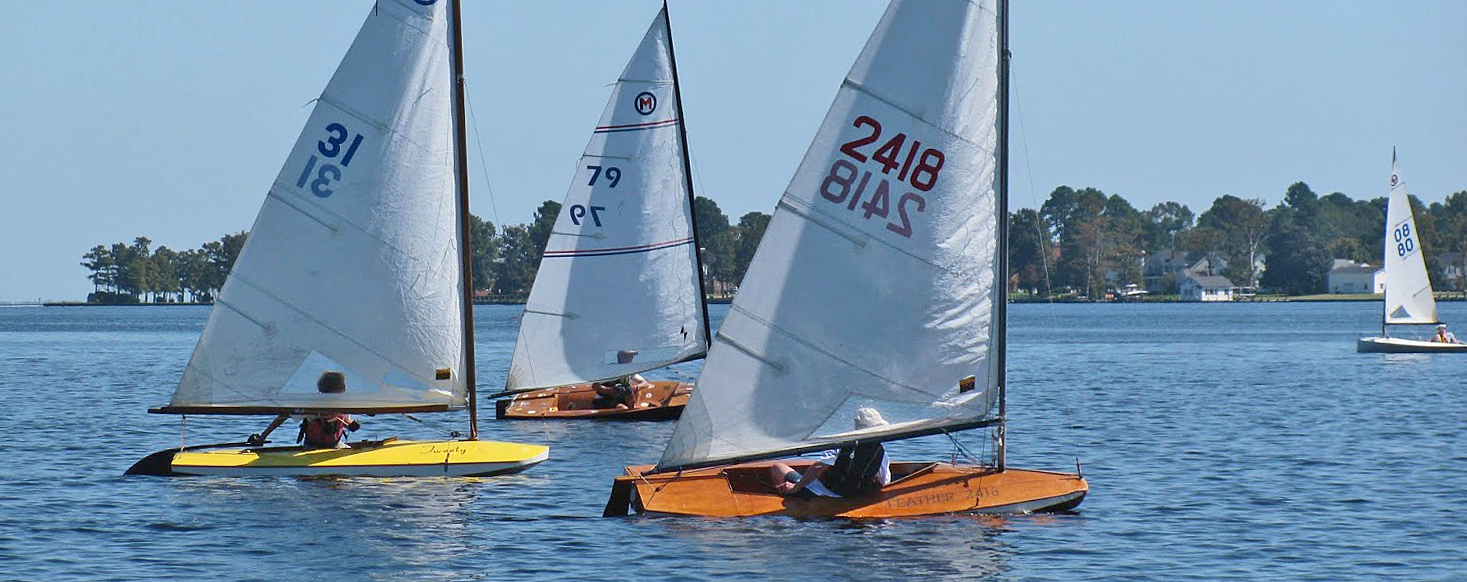
The previous header photo was from a Sunday start at the 2011 Classic Moth Nationals. Unlike this year's crawling breeze, the 2011 Nationals had some breeze. In the background of the photo is the Museum of the Albemarle (green roof), Elizabeth City, North Carolina, which has some of the more iconic Mothboats from the early years on display.


Saturday, October 10, 2020

Oh Noooo! Not a Foot Plant on the Mainsail! $$$


The previous header photo was of a Flying Dutchman capsizing; the trapeze crew being flung off the gunwhale by the quickness of the capsize. Been there, done that many times. Experienced trapeze crews know the type of landing by this crew can be very expensive. A double-foot plant on the mainsail, so near the boom, is a recipe for a long tear in the mainsail and a trip to the local sailmaker. For those who are paying for the error of their helm, the recommended best effort and the least expensive method to execute a landing, after being unceremoniously catapulted, is to endeavor to make a belly flop higher up the mainsail. Not easy to execute but even a four point landing, elbows and knees, would avoid point loading the mainsail

Saturday, September 19, 2020

Header Photo: Alruth Stacking Out


The Australian Historical 18's are just so damn photogenic, they keep cycling through my header photos.

Sunday, September 13, 2020

Header Photo: Start of the Paddling Canoe Race, Late Nineteenth Century


The previous header photo was harvested from Facebook with little identification. A paddling canoe start from the late nineteenth century, the location remained a mystery. I emailed several canoe historians and they were somewhat stumped as well. Someone said Lake George N.Y., another said possibly Hay Island right acroos from Gananoque in the Thousand Islands. Dating was also broad, sometime between the late 1880's, 1890's. Even without a precise identification, the bevy of delicate sailing canoes in the foreground still makes this photo a gem.

A sailing canoe from that era up and planing.

Monday, August 24, 2020

Header Photo: Compilation: Junior Sailors, 1960's to the Present


Every once in a while, I'll string a couple of header photos into a themed post. Over the last two weeks, I've taken featured three photos of juniors sailing U.S.A. Mothboats from the 1950's and 1960's. The 1960's had all sort of hiking styles, particularly for the flyweight juniors who found the Mothboat overpowering at times. I've contrasted this with a recent photo of a New Zealand junior sailing their indigenous P-class junior singlehander. This NZ junior is fully coached up on the modern, "correct" way to hike. (Two of the photos I lifted from George Albaugh's blog. The P-class photo was kicking around on the InterWeb.)

I started off with a 1960's Sports Illustrated photo of a 13 year old junior doing the extreme back-bend hike. This may be a show-off hike to impress the camera man.. Hull looks to be a Connecticut.


Next up, another 1960's photo. We have a small junior, fighting it, but right on the edge, one foot in the strap, the other flailing around. Hull looks to be a Challenger.


The third 1960's photo has the aft foot in the hiking strap and the forward foot hooked around the sidestay. Hull is a Cates


And finally we have the modern day "flat leg" hike, with the modern day attire, and the modern day sunglasses (and, thankfully, a life-jacket, something which is lacking in the previous photos).


The contrast of 60 years or so, does show how advanced the modern juniors are in the sport of sailboat racing. I do wonder if this advanced skill-set at a young age has to do with some of these top-notch juniors choosing another sport to pursue in their 20's, something they have to learn anew, something fresher.

Saturday, August 1, 2020

Header Photo: The Start of the Everglades Challenge


The previous photo was of the start of the Everglades Challenge, the early spring jaunt for small craft (human or sail powered) down the West Coast of Florida, a distance of 300 miles. The start is at dawn, just above Tampa Bay, and this photo, lifted from the InterWebs, shows some of the more sensible small boat cruisers launching. The winners of the race are usually hi-powered catamarans or hi-powered big dinghies (such as Jeff Linton's Spawn of FrankenScot).

From YouTube, here is the start of the 2018 Everglades Challenge:


And from the Earwigoagin archives; all posts that have Everglades Challenge mentioned, at least once.

Monday, July 13, 2020

Header Photo: Sunfish in Big Waves off Wrightsville Beach


The previous header photo was of a Sunfish racing in the ocean off Wrightsville Beach, North Carolina in their 2018 World Championships. It blew the whole week and the waves were tremendous for offwind sleigh rides. I harvested this photo from the Internet and don't have the name of the photographer. I would appreciate if someone could help with a name.

My2Fish did some research and pointed me to the web page with a slew of great photos from the Wrightsville Beach Sunfish Worlds. TOH to My2Fish.

Sunday, February 9, 2020

Header Photo: RS Aero Start


The past header photo I decided to give some love to one of the new crop of singlehanders; the RS Aero. The header photo, lifted from the InterWebs a couple of years ago, features a start in Seattle when they were sharing the line with some Lasers. Now that the new singlehanders have been out for a while, I'm not in the loop as to how the new classes are doing vis-a-vis the Laser. I haven't seen any real movement in Annapolis away from the Laser. If anyone knows the photographer let me know. I always like to have an attribution for a photo. Feel free to comment.


Sunday, January 26, 2020

Header Photo: Classic Moths in the Mist


I started off the 2020 year with a header photo of (what else) Classic Moths racing in Sunday's early morning mist of last years Midwinter Regatta. Foreground is John Zseleczky, background is Mike Parsons.


Wednesday, January 1, 2020

Header Photo: Bucolic River Scene


The previous header photo to close out 2019 was of a dinghy (possibly a Wayfarer) and a vintage cruiser drifting in opposite directions on an English river, the sun setting. This may be the Three Rivers Race on the Norfolk Broads but things get jumbled up on my computer so I can't say for sure.

Monday, December 23, 2019

Header Photo: Bermuda Fitted Dinghy; Transom Shot


Over the years, through several blog posts, Tweezerman has shown the Bermuda Fitted Dinghy a lot of love. They are just so damn photogenic. The previous header photo was a transom shot of "Victory" (at least this is my best guess). This and the following photos of the Bermuda Fitted Dinghy have been lifted from FB.


Saturday, December 14, 2019

Header Photo: 110's bashing upwind


The previous header photo was of a pair of 110 keelboats bashing upwind back in the 1970's. The 110 was an odd-ball 1936 Ray Hunt design, born in the Great Depression era. The hull was a double-ended, narrow canoe shape, flat-bottomed. I've bumped into them occasionally.  At a wedding at Ocean City Y.C, New Jersey in early 2000's I found a small fleet on trailers in the dinghy park. There was also one that showed up at the WOOD regatta back in 2011. My friend Tom Price has one awaiting restoration. I've never sailed on a 110.

The class was originally strong in New England with pockets scattered throughout the U.S. In the present day, it seems most of the 110 activity in the U.S. has shifted West; just north of San Francisco; Tomales Bay, with a fleet at the Inverness Y.C.

More history on the Ray Hunt Ten-Series designs.

The distinctive shape of the 110 can be seen in this heeled-over photo pulled from the InterWebs.

James W. Laws

The specs for the 110 as put out in the OD-OY magazine's annual class review. The hull weight is 412 kg (910 lbs.) which is identical to some of our heaviest North American dinghies.


An early photo of Hull No. 33.


Tuesday, November 26, 2019

Header Photo: Zephyr Dinghy OTP


OTP = On the Plane (This was the name of the U.S. International 14 newsletter - not sure if it still is - probably not since newsletters have gone the way of the Dodo bird.)


The previous photo featured the New Zealand Zephyr class ripping along. The Zephyr is one of four 11-footer conventional racing classes featured in the blog (Classic Moth, Europe Dinghy, British Moth, and the Zephyr).

Tuesday, November 12, 2019

Header Photo: St. Lawrence Skiff


The previous header photo is of the very pretty St. Lawrence Skiff; one of several racing classes I highlighted, over several posts, that doesn't use a rudder. The blog series was titled Look Ma, No Rudder.

Saturday, October 26, 2019

Header Photo: 2019 Classic Moth Nationals


Ingrid Albaugh

The previous header photo was taken as the fleet crawled upwind in the light air of the 2019 Classic Moth Nationals. Twenty three Classic Moths registered for the Nationals, a definite bump-up in numbers compared with the last couple of years. This can be traced to the large number of juniors racing; the fruits of the push by E-city Mothists and Joe Bousquet to get more juniors in these great little boats. The other notable was the success overall of the Vintage class, bolstered by two experienced Mothists, Gary Gowan (Gen I winner in previous years), and John Zseleczky (top competitor in the Gen II class with a 2nd place in the Nationals) sailing Vintage this year. Walt Collins, another wily veteran, won the Gen I class, sailing his design which borrows heavily from the vintage class. The header photo shows some of the top finishers; Walt Collins, foreground, (winner Gen I), John Zseleczky, on the left, (second in Vintage), and Mike Parsons, background, (winner overall and Gen II).

I had also thrown up a header photo of John Zseleczky sailing Tweety, his yellow-decked, vintage Ventnor.

Ingrid Albaugh

The fleet off and running after one of the starts.

Ingrid Albaugh

George A. has the comprehensive report on the Nationals on his blog.


Overall results. Mike Parsons in his Mistral took home the overall trophy.


Worth re-posting one of my favorite videos from the E-City Nationals, this one from 2010.