Showing posts with label Classic Moth. Show all posts

Friday, March 11, 2022

2022 Classic Moth Midwinters

Back again, at least for the moment. Been off keeping myself amused with various non-sailing, non-social larks during COVID-time. I'll try to post to Earwigoagin irregularly, particularly if it is easy; if stuff lands in my lap.

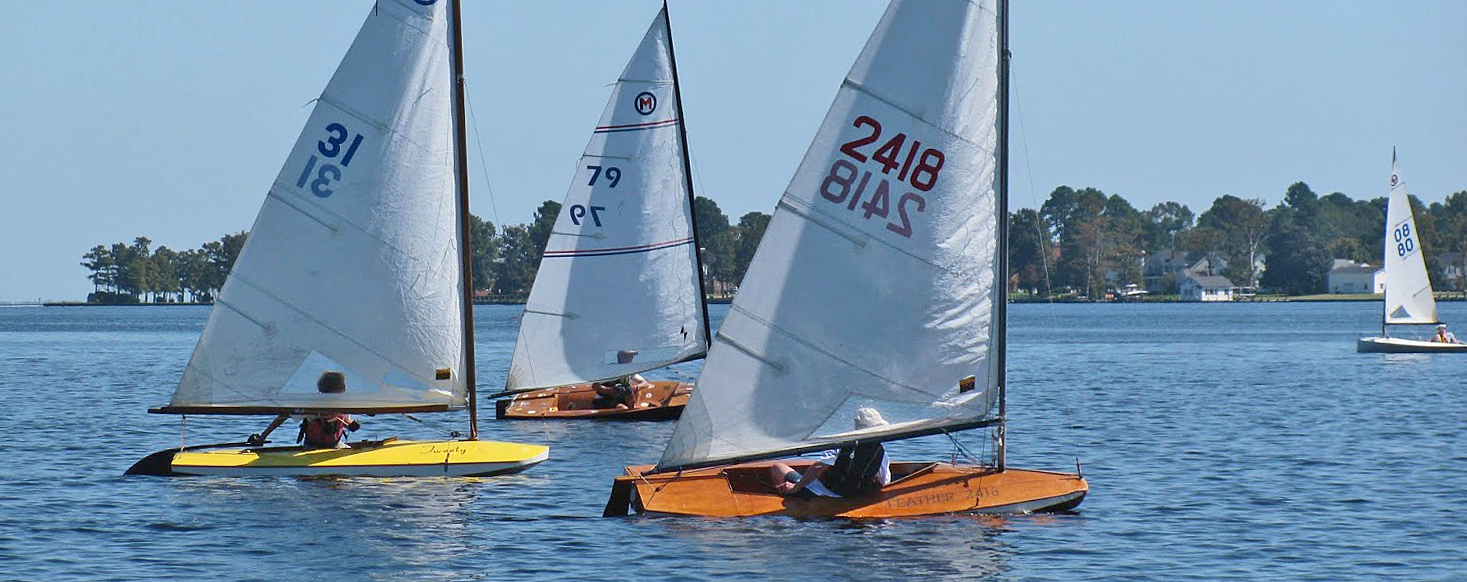
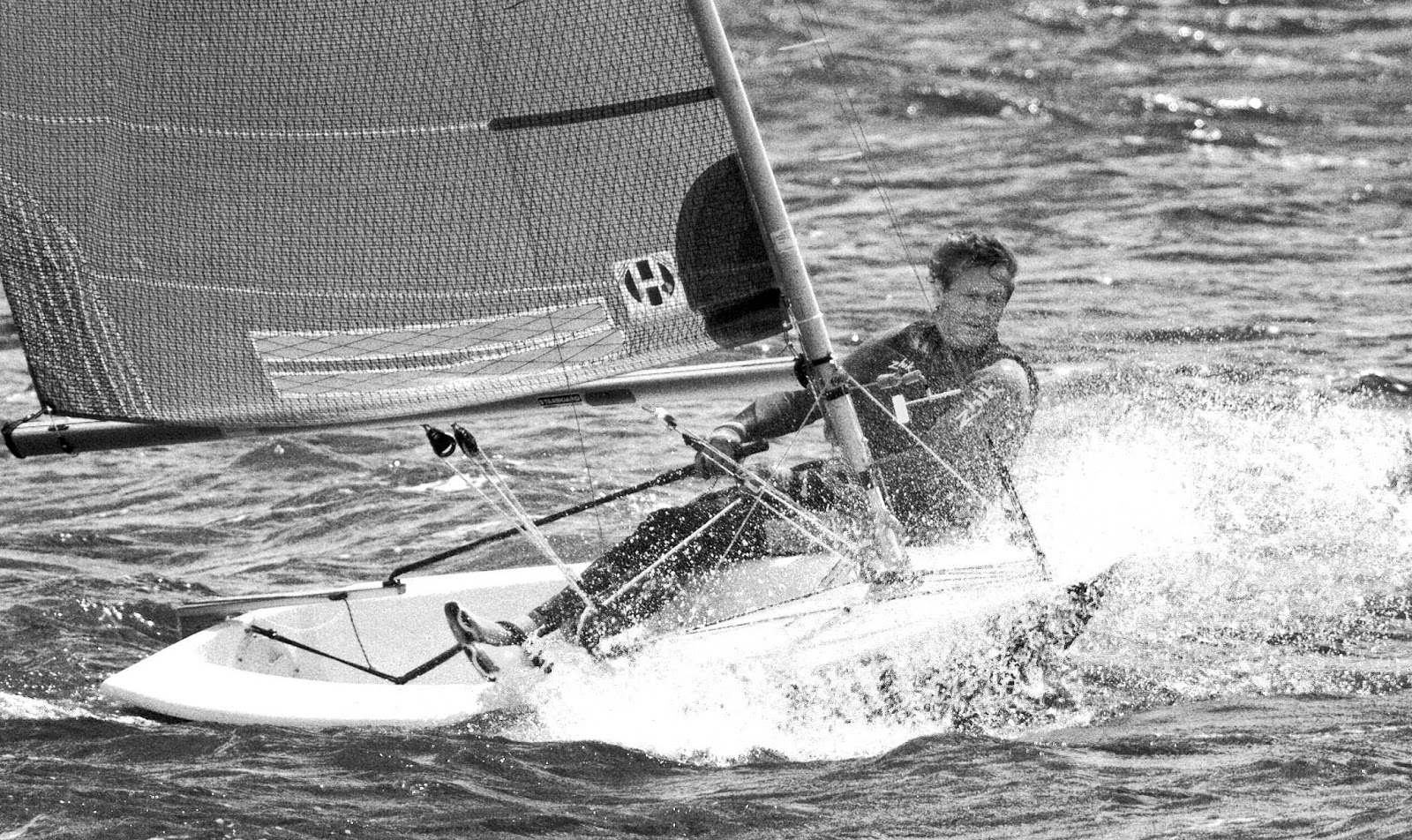
John Z went off down south for the Classic Moth Midwinters and relays the news. Weather was beautiful in Gulfport, Florida; sunny 80F (26C), light winds in the morning with the regular breeze clocking in for the afternoon. Nine Classic Moths showed up with the CMBA resident professional and all-around nice guy, Jeff Linton, again making off with top honors. Shore photos are from John Zseleczky and on-the-water photos from Amy Linton (which I have converted to black and white in my own fashion).

(George Albaugh has his more extensive Midwinter report up on his blog.)

George Albaugh with his wooden Europe on the Gulfport YC dinghy lawn.
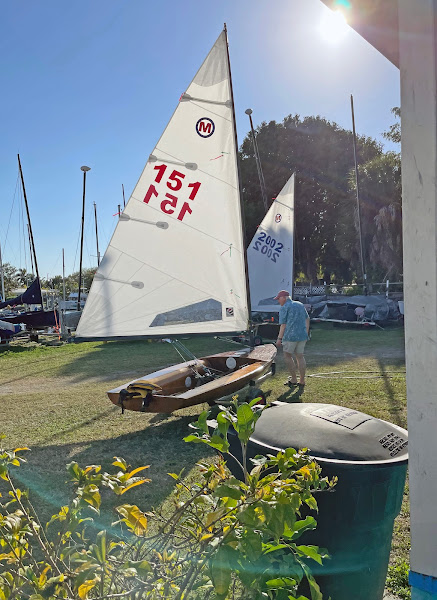

Greg Duncan rigging his glass Europe.


Jamey Rabbit with no. 134, his new modified Mistral design. Jamey had teething problems on Saturday but came back strong on Sunday, posting 1st's and 2nd's. Jamey started this project back in 2015, seven years to completion, which is getting into my extended time frame for boat projects. In the photo below, you can definitely see he pinched in the topsides up forward. (Compare to the standard Mistral shape of Joe Bosquet, no. 48, in the background.)


Jamey Rabbit rigging. His new Classic Moth has carbon bits and bobs all over the place. The aft deck looks like you could launch drones off it. Jamey documented his Classic Moth build over at his Blackberry Boatworks blog.


John Z motoring upwind. John would finish 2nd to Jeff in Gen II.


Mark Saunders in his modified wood-redecked Europe giving Jamey Rabbit a run for his money. Mark would win the Gen 1 division.


Mark Saunders in his Europe upwind. From this angle looks very similar to my Maser. I've been looking at film photography recently and somehow I rendered this photo in Photoshop very much in the ethos of Japanese street photographer, Daido Moriyama; very contrasty with bright highlights and darker darks.


A start. Jeff Linton, no.102, has already got a nice jump on the fleet.


Mike Parsons catching up with Rod Koch (the other Rod). Rod, along with Jeff is a past Sunfish champion. Rod raced a modified Europe back around the 2010 time frame.


Joe Bousquet holding a slim lead over Jeff Linton at the reach mark.


Mark Saunders in his Gen 1 Europe holding off the faster Gen II Mistrals of Mike Parsons and Joe Bousquet.


Saturday, December 26, 2020

Header Photo: Design Cartoon for a Bend-em-Up - Classic Moth?


The previous header photo was a design cartoon kicking around the Interwebs. There was no explanation attached but, if I engage in a bit of speculation, it seems to be a developed ply concept for a Classic Moth. Bill Schill did his last Maser conversion very similar to this, a radical looking Moth. Bill's Maser concept was very slow. Unfortunately, I have no photos of Bill's last Maser. It seems to me you could build a credible Classic Moth if you glommed some topsides onto the back half of the boat. It would take some tinkering; should be an easy build, though probably not a racing shape.

George A. has more on Bill Schill over at his Mid-Atlantic Musings blog.


Update: January 18, 2021 - It turns out this design cartoon was actually built. She is a Classic Moth design by Bertrand Warion, a prolific builder of Moths, whose design and building inventiveness has been featured in many posts on Earwigoagin. Bertrand writes of this bend-em-up design;
"The Moth Classique is "Zazou" I designed in 2002/2003? The boat was made from one sheet plywood, 5mm exterior grade. [It] was easy [to build] and quite fast but the mast was not stiff enough. [She] is now destroyed. [There] is only one photo remaining."

Zazou is Moth number 203 to the right of this gaggle of classic Moths running downwind.


Thursday, November 12, 2020

Flat Pack Composite Kits


Flat pack plywood small boat kits; all pieces CNC cut and shipped to you in a nice long box (or two) have been around since the mid 1990's. The local firm, Chesapeake Light Craft is a world leader in this type of kit, offering a wide array of plywood small boats in kit form; built stitch and glue with epoxy fillets. Back in 2014, Aussie Mark Hughes took the flat pack kit concept one step further and developed a composite carbon/foam flat pack kit for super-techy ultra-lightweight construction. In the photos below the flat pack kit makes a Bunyip scow Moth. Todd Oldfield, posted on Facebook on his build, which I have lifted and re-posted here.

The jig is CNC cut from MDF and is an intricate web of slotted panels designed to hold the frames.


Frames, topsides, and chine panels are cut from prefabricated vacuum-bagged carbon skinned foam. The Perverted Moth blog has the layup schedule for the Bunyip panels.


Jig assembled.


CNC cut frames in place on jig.


Topside and chine panels taped in place.


Fitting the bottom foam panel. The bottom foam panel is not glassed on the outside.This may be because the entire outside of the hull is covered in a wet/layup carbon layer to stick everything together.


Carbon ready to wet out.


Outside of the hull complete on jig.


Hull off jig. I would think there would need to be more gluing area along the gunwhales and maybe along the frames


Fitting the foam deck and foredeck. Note the cuts to help the foam bend around the curves for the nose block. A heat gun is also helpful for this.


Below: the first 2014 carbon/foam Bunyip M-scow with cut-out frames and mast support box. From Longy Oi:
"There are different versions, designs. both composite inspired by the ply Bunyip design. First build was the Mark Hughes M-Scow designed composite flat pack was built as Brian Sherrings 'Carbonara'. Possibly the strongest yet light scow built. Todd's build is to another (?bunyip) digitised design. I don't know the point of having the two designs, but, yes, some differences, there was some Wet lay-up on the latter build, maybe not on the MScow?"


It may be that a scow with it's shallow curves is more suited to this style of flat pack kit-building. Composite panels, being stiffer than plywood panels cannot be expected to twist up as plywood panels can. (Reference Todd Oldfield's comments below.) I could see someone also trying this method on the simple, Benoit Duflos Classic Moth Moth-Pop design.


Todd Oldfield answers some questions about his build:
"in answer to your question I didn't put carbon on both sides of the deck and hull under vac bagging as if i did that I would not have been able to get the desired shape in the panel if i did it on both sides. I went back after the panel was glued done and put a layer of carbon over that panel and relevant join on the chines. All the chines are covered ibn carbon both sides to. It was a good fun build that was quicker to do than expected and wasn't as hard as expected either by using a male jig to form the boat on."


Sunday, November 1, 2020

Hal Wagstaffe's 1962 New Zealand Classic Moth Design

Moth Classique

These Classic Moth lines plans popped up on FB. A multi-chine plywood, very much a middle of the road design, "Puriri" looks very worthy of someone building a reproduction. She would definitely fit in the Gen I division of the American Classic Mothboat rules. Puriri is an indigenous New Zealand tree.


More Classic New Zealand Moth designs can be found at this post (from Nedslocker). Includes Bruce Farr's first dinghy designs.

Saturday, October 31, 2020

Header Photo: Start at the 2011 Classic Moth Nationals


>


The previous header photo was from a Sunday start at the 2011 Classic Moth Nationals. Unlike this year's crawling breeze, the 2011 Nationals had some breeze. In the background of the photo is the Museum of the Albemarle (green roof), Elizabeth City, North Carolina, which has some of the more iconic Mothboats from the early years on display.


Friday, October 30, 2020

2020 Classic Moth Nationals


Lloyd Griffin


The 2020 Classic Moth Nationals in Elizabeth City was a drift-fest, with racing only on Saturday. The 2020 Nationals were postponed for one month because of concerns over too much wind from the remnants of one hurricane. Ironically the rescheduled Nationals had the wind sucked out of Elizabeth City by the passing of the remanants of another hurricane.

As usual, George A. over at Mid-Atlantic Musings has the complete report.


Results (top twelve) of the 2020 Classic Moth Nationals. Congrats to Mike Parsons, the 2020 champion, George Albaugh, winner of the Gen 1 division, Joe Bousquet, Masters champion, Sam Moncia, junior champion, and Emma Mayer, women's champion.


Skipper Races Hull Design
Mike Parsons 1,1,1,1,[2],1 Mistral
Joe Bousquet 2,2,2,2,[4],2 Mistral
Parker Purrington 3,[4],4,3,3,3 Dunand
John Zseleczky 4,5,3,[7],1,4 Mistral Y2K-mod
George Albaugh 6,3,[8],4,5,7 Wooden Europe (Gen1)
Zach Balluzo 5,[7],6,5,6,6 Mistral Y2KMod
Bob Patterson [8],6,7,8,7,5 Shelley (Gen 1)
Sam Moncia [9],8,5,6,9,8 Olympic Europe (Gen 1)
Emma Mayer 7,[10],9,10,10,10 Olympic Europe (Gen 1)
Matthew Panek 12,11,10,12,8,[DNF] Olympic Europe (Gen I)
Logan Weeks 10,[13],11,9,13,11 Olympic Europe (Gen I)
Valerie Turbett 11,[14],14,11,14,9 Olympic Europe (Gen 1)


Saturday, October 17, 2020

Make a Hole; Plug a Hole


My wife, in her pithy wisdom, has observed that all I seem to do with my Classic Moths is to cut a hole and then fill it up. And she's right in a way. My current Classic Moth project, a Savannah Wedge, is undergoing a side deck modification which entails cutting out holes and then filling them back up. And I want to lower the transom which means cutting more holes, and then filling them up.


I picked up the Savannah Wedge back in 2015 and like many of my projects, the Wedge sat neglected, aging in place, getting dirty, while I figured out what I wanted to do. With Covid-19 I'm back again making holes, plugging holes on the Wedge. When a Savannah Wedge has been raced, back around 2010, she performed miserably. It suffers from too much wetted surface, the bane of slow Classic Moths. Yet I persist. The original idea was the Wedge would be an ideal Moth to take the grandkids out; she does have a grand big cockpit. We shall see; for there are more holes to cut, and more holes to fill.

My boatbuilding philosophy.

Monday, September 14, 2020

That Pesky Lee Shore: Europa Moth Fail


From the February, 1971 issue of OD-OY.


Lee shores are always tricky, especially if the run-in is framed by rock jetties. I ran an International Canoe straight into the beach once, but that is another story. Sometimes the safest option is to lower the main when you can still get head-to-wind and scull your way to shore.  Or leave the main about 1/4 the way up and get gently blown to shore. (Lasers and other sleeve-luff classes excluded.)

I was scratching my name at the weirdness of this Europa Moth's chemical name, "Paradichlorobenzene" until I looked it up on the InterWebs.
"Paradichlorobenzene is used as a fumigant insecticide to control clothes moths... Mothballs containing paradichlorobenzene are solids that turn into toxic gas that kills moths."

Looks like this Moth was still in payback mode for the skipper's cheeky frivolity.

Monday, August 24, 2020

Header Photo: Compilation: Junior Sailors, 1960's to the Present


Every once in a while, I'll string a couple of header photos into a themed post. Over the last two weeks, I've taken featured three photos of juniors sailing U.S.A. Mothboats from the 1950's and 1960's. The 1960's had all sort of hiking styles, particularly for the flyweight juniors who found the Mothboat overpowering at times. I've contrasted this with a recent photo of a New Zealand junior sailing their indigenous P-class junior singlehander. This NZ junior is fully coached up on the modern, "correct" way to hike. (Two of the photos I lifted from George Albaugh's blog. The P-class photo was kicking around on the InterWeb.)

I started off with a 1960's Sports Illustrated photo of a 13 year old junior doing the extreme back-bend hike. This may be a show-off hike to impress the camera man.. Hull looks to be a Connecticut.


Next up, another 1960's photo. We have a small junior, fighting it, but right on the edge, one foot in the strap, the other flailing around. Hull looks to be a Challenger.


The third 1960's photo has the aft foot in the hiking strap and the forward foot hooked around the sidestay. Hull is a Cates


And finally we have the modern day "flat leg" hike, with the modern day attire, and the modern day sunglasses (and, thankfully, a life-jacket, something which is lacking in the previous photos).


The contrast of 60 years or so, does show how advanced the modern juniors are in the sport of sailboat racing. I do wonder if this advanced skill-set at a young age has to do with some of these top-notch juniors choosing another sport to pursue in their 20's, something they have to learn anew, something fresher.

Sunday, January 26, 2020

Header Photo: Classic Moths in the Mist


I started off the 2020 year with a header photo of (what else) Classic Moths racing in Sunday's early morning mist of last years Midwinter Regatta. Foreground is John Zseleczky, background is Mike Parsons.


Saturday, October 26, 2019

Header Photo: 2019 Classic Moth Nationals


Ingrid Albaugh

The previous header photo was taken as the fleet crawled upwind in the light air of the 2019 Classic Moth Nationals. Twenty three Classic Moths registered for the Nationals, a definite bump-up in numbers compared with the last couple of years. This can be traced to the large number of juniors racing; the fruits of the push by E-city Mothists and Joe Bousquet to get more juniors in these great little boats. The other notable was the success overall of the Vintage class, bolstered by two experienced Mothists, Gary Gowan (Gen I winner in previous years), and John Zseleczky (top competitor in the Gen II class with a 2nd place in the Nationals) sailing Vintage this year. Walt Collins, another wily veteran, won the Gen I class, sailing his design which borrows heavily from the vintage class. The header photo shows some of the top finishers; Walt Collins, foreground, (winner Gen I), John Zseleczky, on the left, (second in Vintage), and Mike Parsons, background, (winner overall and Gen II).

I had also thrown up a header photo of John Zseleczky sailing Tweety, his yellow-decked, vintage Ventnor.

Ingrid Albaugh

The fleet off and running after one of the starts.

Ingrid Albaugh

George A. has the comprehensive report on the Nationals on his blog.


Overall results. Mike Parsons in his Mistral took home the overall trophy.


Worth re-posting one of my favorite videos from the E-City Nationals, this one from 2010.


Sunday, October 20, 2019

James Island Boy Scout Moth


I've written before about the group small boat building craze in the 1960's. That post featured an article from a 1964 issue of the American magazine, One-Design and Offshore Yachting (OD-OY). I recently came across a similar article in the February 1970 issue of OD-OY, this time featuring a group build of Mothboats. The group was from James Island, just outside of Charleston South Carolina, and the Mothboats became James Island One-Designs.


George A, over at Mid-Atlantic Musings blog, has done a more extensive post on the Boy Scout Moth. It is ironic that two American Mothboat designs, the Skimmer Moth and the Monadnock Moth (or Boy Scout Moth), are probably responsible for more home builds than any other Moth design, even though they never featured in the racing circuit.

Sunday, June 30, 2019

Header Photo: Joe Bousquet at it again!


Ingrid Albaugh

The 2018 CMBA (Classic Mothboat Association) national champ, Joe Bousquet, is a restless soul. Not content with winning, he branches out, searching for yet another Mothboat design that will bring him victory. He showed up at the June Brigantine regatta, having modified an early Magnum 2 design (sitting for years in his garage) to fit the CMBA rules (I won't bore the reader at how he cleverly used the rules to make this winged design legal.) The experiment wasn't a success. Joe capsized a lot and one of the capsizes was captured by Ingrid Albaugh. It may be too early to write the Magnum off. Joe has a grit to keep going on a project despite initial failures.

Joe, in his Swiss Miss, a Dunand design, winning the 2018 Nationals. (The first non-Mistral design to do that in twenty years.)


Sunday, June 9, 2019

Header Photo: British Moths Sending It!


The previous header photo was of a British Moth,; "in a bit of a bother" as they would say in England. I have written several posts on the British Moth, as well as featuring the class in two header photos. The class seems to have a knack in getting photographers that offer up some stunning sailing shots. Here are some brilliant photos from the same webpage, same championship. Perhaps some reader can off up the photographers name?


Having a daggerboard lunch.


Yee-haw!


A scow bow parts the waves.


Saturday, May 18, 2019

Header Photo: English Moths Launching - Early 70's


Lowrider Moth Facebook Page

The previous header photo is of English Moths launching in the early 1970's. (I'm guessing) The International Rule had just been introduced and, in this transition period, you still see a wide variety of hulls and rigs. It wouldn't be long after this that the class started moving inexorably down the path of narrow skiffs with wings pushed out to max beam. On the left foreground you see the production Skol design, in the middle foreground, a scow, and on right foreground, the Duflos. In the background there is the mixture of the low-aspect Circle M rigs mixed in with the high-aspect Australian rig.


While we are on the topic of the European Moths of this period, John Claridge, who would become the premier European builder of Moths through the 1970's and into the early 1990's, sends along his recollections of the epic heavy-air slugfest that was race 3 of the 1968 Moth Worlds. It is an interesting read.


Some photos that have been popping up on the Lowrider Moth Facebook group:

One of the light air starts during the 1968 Worlds. The Swiss and French contingent of Duflos designs with Finn-type rigs, that were to dominate the light air races and in the overall results, have launched out quickly in the left of this photo.


The KM Moth was one of the finishers in race 3. Here returning through the breakwater. From G. Albaugh, "I seem to recall seeing this photo years ago and if memory serves it was captioned as being John Shelley, sailing, at that time, from Malta." John mentions in his article that John Shelley was using a hockey stick mast, which this Moth seems to be using, so G.A.'s ID seems good-to-go.


The following photos are not of race 3 but I think they are from 1968 (maybe the European championship). A heavy air beat  in a good sea. All low-rigged Moths.