Showing posts with label Boat Show. Show all posts

Thursday, November 29, 2018

Seen at the 2018 Sailboat Show: The RS21

One couldn't help but notice the small keelboat jammed right up against the fence line of the Sailboat Show. She was tucked into the corner facing Annapolis's dockside restaurant row and sported all the accoutrements of modern keelboat design, reverse bow, bulb keel, skinny rudder, assymetric spinnaker. Once inside you discovered this keelboat, the RS21, is RS Sailing's new entry into the day keelboat market, the design brief targeting the emerging club keelboat market where the sailing club buys the boats and the sailors pay an extra fee to climb aboard and race.

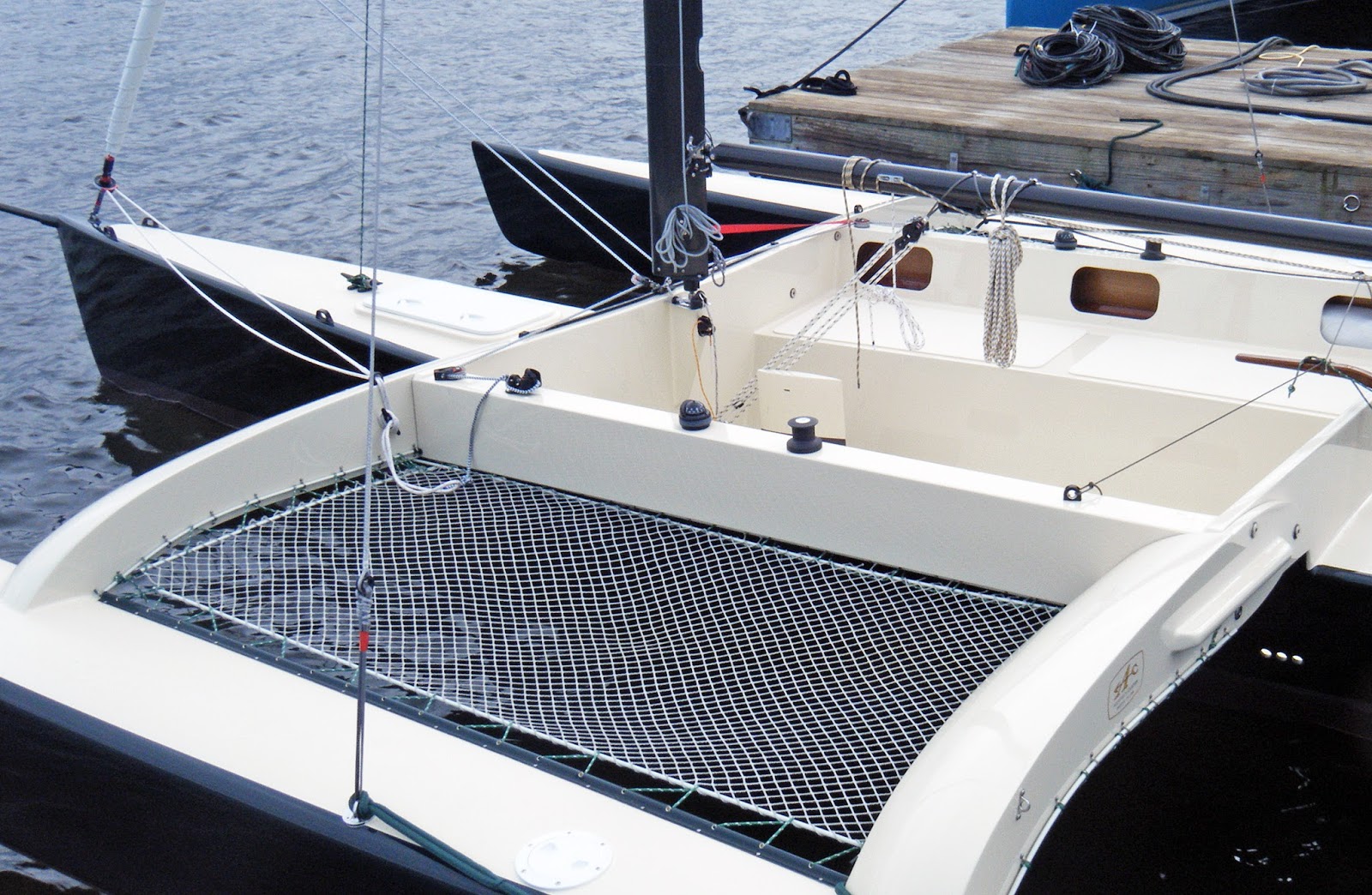
A photo of the cockpit looking aft. Two mainsail cleats; the forward one for the mainsheet trimmer when going upwind, the aft one for the skipper or trimmer that has moved aft for the offwind legs.


Looking forward it is a very clean cockpit.


The bulb keel. It does have a weed cleaner/cutter that comes standard which is a must given the very straight leading edge of the keel. A Torqueedo electric drive comes with the RS21 (You can see the prop in front of the rudder - I think it gets raised when saililng.)


The business end of the mast. Plenty of controls to keep the crew occupied.


Some videos of the RS21 on the water. I would have to say the RS21 most closely matches the market where the popular J70 currently dominates in the U.S.A.


Wednesday, October 31, 2018

Seen at the 2018 Sailboat Show: the Minicat Guppy


Given the millennial's desire to store things in their apartments (see this post, Whither the Millennials), the models of inflatable sailboats continues to expand. (I previously wrote about the Tiwal inflatable sailing dinghy from the 2016 Sailboat Show.) At this year's show it was the small Minicat Guppy catamaran, a 3 meter inflatable that continues to expand the market selection for knock-down small boats. I took two photos but didn't hang around to talk to the salesman so I didn't get an idea on U.S.A. pricing. (More info at the above link.)

I've dragged this comment from Nail Sadykov to the main post. Nail says the Russian and Ukraine sailors have been designing inflatable sailboats for a while and the technology is advanced.
"English language link, with several different models; From Boatdesign.net. And from a Russian forum. New Ukrainian boat. Possibly, next year in Everglades challenge or R2AK race. In ex-USSR existed a long tradition of inflatable, demountable boats, suitable for transportation by passenger train or other public transport."


This year I did come across a rather forlorn, inflatable SUP, somewhat deflated, on a car roof rack. My guess is this particular boat owner assembled the SUP early in the summer, strapped it on his car for the duration of the summer months, and hit it with some air pressure when he wanted to use it.


Sunday, October 28, 2018

Seen at the 2018 Sailboat Show: the UFO


I've already posted about the UFO, the Clark design, short LWL catamaran entry into the foiling market. At this years Annapolis Sailboat Show, I was able to look at the UFO on the stand with the rig up and also watch it sail out of the harbor (they were giving demo rides at the show). Unfortunately, in my short time at the Sailboat Show, I only was able to see the UFO sailing in lowrider mode. According to Dave Clark they have now produced 200 UFO's and shipped all over the world.

Lowrider Mode. The bowsprit holds the wand which automatically controls ride height.


This is a big rig on a short hull, but, then again, the hull is not in the equation when foiling.


Modern fat-head, clear mylar mainsail.


A brilliant solution to constructing the wishbone boom. The front end is attached to the outboard end of the jumpers on the mast. You can use straight tubing and still get the wishbone away from the sail and the wishbone also adds leverage to get the mast to rotate in-line with the sail.


Another shot of the end of the wishbone attached to the jumpers.


Thursday, December 15, 2016

Seen at the 2016 Sailboat Show: Wrap-up

(Ed. Note: I repeat, this blog is not about timeliness.) (Way past) time to take the rest of my photos of the Annapolis 2016 Sailboat Show and package them into a wrap-up post on the 2016 event.

The Chris White designed Discovery 21 day-sailing trimaran (builders - Aquidneck Custom Boat Builders/Performance Multihulls). This is a 35 year old design being re-introduced in hi-tech (carbon fiber/honeycomb hulls). Hull weight was quoted at a stunning 340 kg. (750 lbs). If you want to put a lot of miles in for your afternoon sail, this tri should do it. (The Discovery 21 is the same concept as the Corsair Pulse 600 featured from the 2015 show.)


I've seen these interlocking plastic cubes  make up floating docks (Xinyi Floating Dock) but, at the show, in another demonstration of their versatility, these cubes were used to make a dry-sail dock for the J-70 keelboat.


Ronstan Shock, sheaveless blocks, was featured on the rigging photos of John Z's Classic Moth. Certainly for dinghies in lower load situations, this seems to be the lightest method of making up multi-part tackles or leading lines around.


The RS Quest family/school-training dinghy added some visual pizzazz this year with a color splash on the bench seats.


You can certainly build some swoopy deck-lines into the plastic boats. The Topper Topaz.


The webbing attachments to boom have been used by the skiffie crowd for some time and is now being seen on production boats (another photo of the Topper Topaz).


Thursday, November 24, 2016

Seen at the 2016 Sailboat Show: The X-Cat "Multi-Sport"

Another engineering design marvel at the show was the X-cat.

The X-Cat is an Austrian import; a rowing, sailing catamaran that is designed to be easily broken down for transport or storage. Marketed as a "multi-sport" catamaran, one can buy four models: the base model which is just the catamaran (presumably with this model you would desire to add some low horse-power motor to get around with), a sailing model, a sliding seat rowing model with a conventional rear-facing seat and oar set-up, and a front-facing rowing model. The X-cat at the show was out-fitted with both the sailing rig and the front-facing rowing kit.

The X-cat website. (Note that the header photo on the website is actually a very slickly produced movie utilizing drone footage for all of the scenes. Click on the arrow.)

One of the X-cat hulls. Interesting to note was this riveted center seam which indicates the hulls are molded in 2 pieces and then assembled together. This makes sense as the brochure touts the hulls being entirely foam-filled (it doesn't appear to be the blown in type but rather custom molded foam pieces to match the hull shape). Also, according to the brochure, none of the base hull pieces weigh more than 17.5 kg, so the X-cat can be easily loaded onto roof-racks when broken down.


The front-facing bent oar system. The X-cat goes together with lots of custom push button fittings (no tools required). Obviously I couldn't witness an assembly of the hull - the brochure touts a time of 2 minutes, which seems a bit ambitious.


The X-cat is approaching the market that has been carved out by the brilliant Hobie kayak/trimarans, but from a fitness machine, higher performance angle than the Hobies which have found a large market in the fishing, kick-back, day-sailing crowd. From my quick look over of the X-cat at the Annapolis Sailboat Show, the X-cat is indeed a very high-quality product. The brochure mentions there will be some new E-power options in 2017.

Wednesday, November 2, 2016

Seen at the 2016 Sailboat Show: the Tiwal - an Engineering Marvel


The Tiwal is the French inflatable sailing dinghy. Tiwal has been shown at the Annapolis Show for the last couple of years, but I've quickly walked past the booth, dismissing it (from my hard hull, traditional dinghy perspective) as most likely a very slow-performing, oddity. Thus, the Tiwal never made it into an Earwigoagin post. Why post about the Tiwal this year? During the show, Tiwal had one of their dinghies out bombing around on Annapolis Harbor and, I must admit, the Tiwal sailed well, tacking easily and showing a good turn of speed. It's time to confront my prejudices and admit that there may be something to this blow-up sailing dinghy.

The Tiwal is a 3.2 meter (10 1/2 foot) scow, or in modern parlance, a fat stand-up paddleboard. (To my eye, the Tiwal looks like a small, modern version of the 1900 French scow, the Monotype de Chatou; though I doubt the designers actually referenced this vintage design.) An exoskeleton of interconnecting tubes and wings, support all the sailing bits; mast, daggerboard, rudder, skipper - one reason I find the Tiwal an engineering marvel. I was pressed for time so I didn't spend any time talking to the salesman at the booth; I just had time for a quick photo.

The trend in the United States is for the young to prefer to live in apartments or townhouses (something the Europeans have always done). Without a large yard to store large objects, the easy-to-store Tiwal may gain some inroads among millennials, who are trying to figure out how to go boating without worrying about where to stash a boat on a trailer.

The Tiwal official website

The following video is this years Tiwal Cup, which looks to be a fun-based regatta held in France.


2016 TIWAL's CUP from TIWAL on Vimeo.

George A. has a better camera and took a better shot of the Tiwal sailing in Annapolis Harbor, so I lifted the photo from his post on the 2016 Sailboat Show.

George Albaugh


Sunday, October 23, 2016

Seen at the 2016 Annapolis Sailboat Show: The Singlehanders Waszp and VX Evo

Two new one-design singlehanders pushing the performance envelope were seen at the 2016 Sailboat Show.


The VX-Evo is designer Brian Bennet's addition to the long list of assymetric spinnaker singlehanders (the MX-Ray, the Devoti D-One, the RS 100, the Weta trimaran - have I left anyone out?). It is a big singlehander, 4.77 meters long, 1.7 meters beam with a big rig, approx 10 sq. meter main and a spinnaker about the same size. The VX-Evo seems designed for big Americans but the salesman also metioned that there were some couples interested in buying the boat and sailing two-up.

The VX-Evo is built by Ovington in England. As of the boat show there were definite plans to ship three containers to the U.S. for a total of 24 boats to jump-start the class.

I just got a chance to look down into the VX-Evo cockpit but you can see the wedge hull with max beam and chine continuing well aft for power. Price complete is $14 K USD.

VX-Evo Website


Video of the prototype being put through the paces. Interestingly there is no forestay (which allows the spinnaker to pop through on gybes) but there are sidestays.


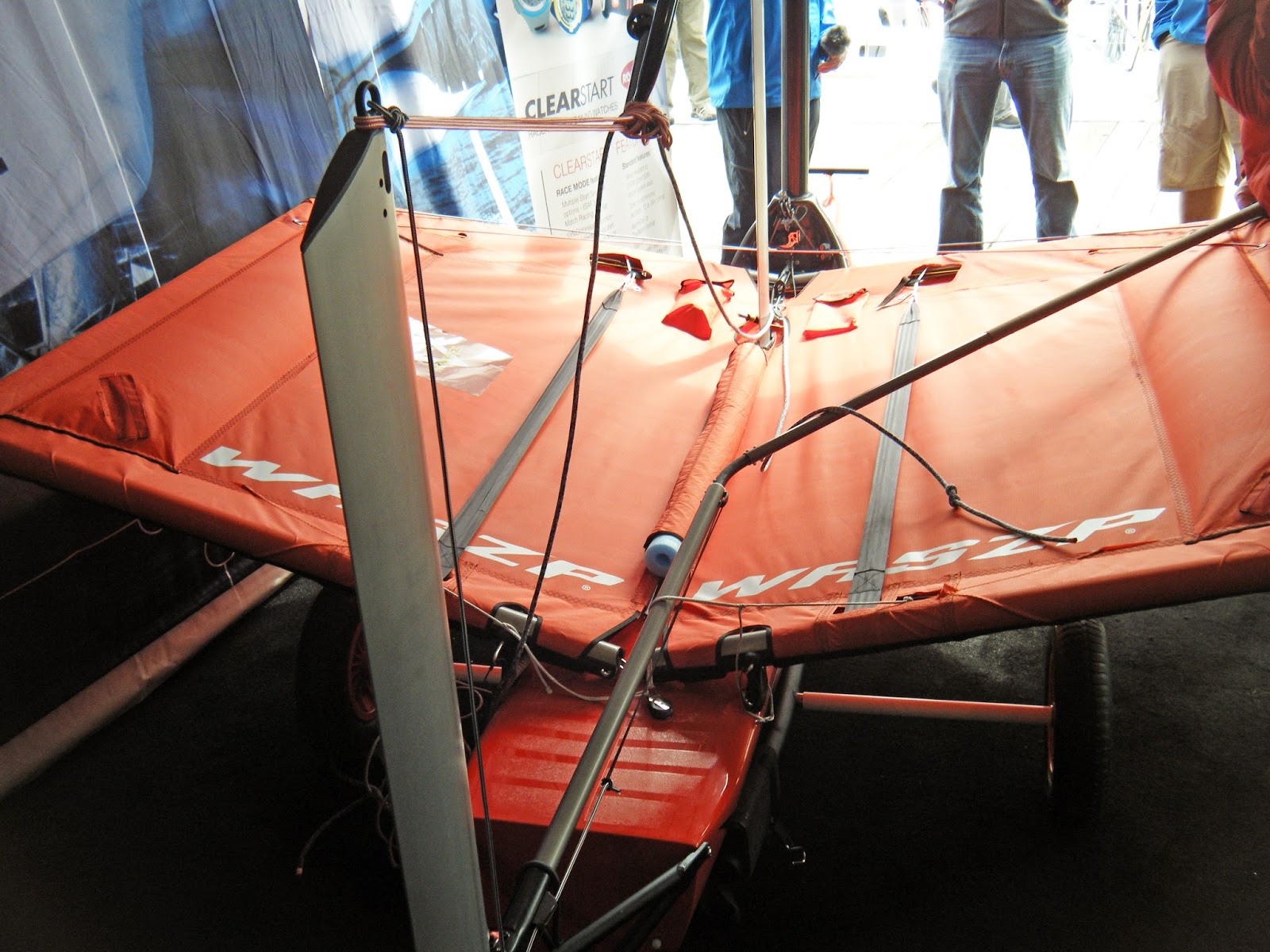
The Waszp is the dialed back International Moth foiler designed by Australian Andrew McDougall. With a simple unstayed rig, foils that are sturdier aluminium, a heavier, less hi-tech construction, the Waszp comes in with a price around $10K USD. This is less than 1/2 of the price of the current International Moth - hence the description "Peoples Foiler". (I like the term "Volks Foiler" but I guess there would be legal issues with a certain German car company.)

The Waszp was sitting inside the Ronstan tent, surrounded by a crowd. I was able to poke my camera through to take a quick photo from the transom. The designer was busy talking to a rep from the U.S sailing magazine, Sailing World, as the Waszp is up for that mag's Boat of the Year Award - hence I didn't get to ask any questions.

Most present-day development of foiling seems to be on the catamaran platform. It will be interesting to see if this low cost Moth can bump up the popularity of foiling in the small singlehanded sector.

Waszp Website


Certainly from watching the videos the foiling performance of the Waszp seems very much Moth-like. Note the wishbone boom. I gather the angle of the wings can be altered to make it feel safer for a beginner. There are also various sail sizes offered.


WASZP in Japan from Hiroki Goto on Vimeo.


Wednesday, October 19, 2016

U.S Sailboat Show: The Singlehander Wars in the U.S. Updated

I made it over to the U.S Sailboat Show last weekend. I took some photos with my older waterproof camera (my newer one died) which I'll post at some point. If you want photos now, go over to fellow Classic Mothie, George A's blog where he has put up a slew of photos of the Show.

Just a quick comment on the singlehander wars in the U.S. market, as gleaned from talking to the manufacturers reps at the U.S. Sailboat Show. (I've put the dinghies up in the order I visited their stands.)

Melges 14 - (Previous posts here, here and here.) Around one hundred Melges 14's have been built with about half of them going overseas (interest is strong in Germany and Italy). Nearly all of the U.S Melges 14's are in the Midwest, the backyard of Melges Boatworks. There was no racing schedule this past year but the class did hold their first regatta at Lake Max, Culver, Indiana this past weekend. (Video from the class Facebook page.) My feeling, in talking with the Melges salesman, is they are angling the Melges 14 towards a more general purpose crowd, particularly with their large cockpit (though the 14 is certainly racy enough.) For a mid-winters, there is some thought at piggy-backing a Melges 14 regatta off a Melges 24 regatta in Florida.

RS Aero - (Previous posts here and here.) I hadn't realized that Zim Sailing had become the East Coast rep for RS Sailing (evidently this happened last year just after the Show) and the RS boats were featured  on the Zim Sailing stand at this year's show. The RS Aero is a clear leader in quantity, hundreds have been built (I forgot to ask for a specific number), there is a strong presence in Europe and the RS Aero can be found in ones and twos in most areas of the U.S. (but surprising, no activity yet in the Annapolis area). The big concentrations of RS Aero activity in the U.S. are the Pacific Northwest and the Northeast where there are some nasceant fleets and organized racing. For more detail on RS Aero activity, there is no better place on the InterWebs than to click over to Tillerman's blog.

There you have it; the RS Aero is gaining a foothold in the Pacific Northwest and the Northeast, the Melges 14 is percolating in the Midwest. If you were taking a round-about tour of the U.S., you would more likely bump into an RS Aero than a Melges 14. (But a RS Aero or a Melges 14 sighting would still remain very rare, as it remains true today, nearly every yacht club in the U.S. has some number of Lasers kicking around the dinghy park.) Unlike the Laser, which exploded on the U.S dinghy scene in the 1970's, given the factors at work in 2016, I would expect these new singlehanders to chart a more gradual acceptance into the sailing scene.

Addendum October 20, 2016: Tillerman left a comment indicating I am under-reporting the numbers and activity of RS Aero sailing in the U.S. I've moved his comment over to the main post.
"Thanks for the update on the RS Aero and the plug for my blog.

"I believe over a thousand RS Aeros have been sold worldwide, and the biggest countries by sales are UK, US and Germany in that order. About 150 have been sold in the US. In the first year, boats were sold in 39 countries on 4 continents - not sure of the latest numbers.

"You are correct that there are active RS Aero fleets in the Northeast and Pacific Northwest. There are also fleets in southern California, Florida and Texas. The RS Aero scene in Texas is really heating up with 14 RS Aeros already registered for the Wurstfest Regatta next month. There were 4 RS Aero regattas in New England this year with 16 and 17 boats at a couple of them. And there were 35 RS Aeros at the US Nationals at the Columbia River Gorge this year.

"There will definitely be two RS Aero regattas on back-to-back weekends in Florida this winter, and early indications are that attendance will be in the 20s at least.

"The RS Aero has World Sailing international class status now and the first RS Aero Worlds will be at Carnac in France next year.


Wednesday, June 22, 2016

Segeln - in the Bathtub!

I've had this video bookmarked for years. Time to put it up on Earwigoagin.

An arresting (definitely arresting), ultimately humorous ad for the German Interboot boat show. Sailors will be sailors!


Segeln from WORKFLOW FILMS on Vimeo.

Tuesday, March 1, 2016

Seen at the 2015 Annapolis Sailboat Show: Wrapup

I've been milking the Annapolis Sailboat Show for several posts (it was, after all, only 4 months ago), but it is time to wrap it up with a post featuring a few of the other boats that captured my eye.

Sailboat manufacturers are designing or redesigning some of their product line so they can be marketed for sail-training or community sailing groups. Beneteau has reworked their Beneteau 22 for American Sailing Association as a sail-trainer (so it sports an ASA designation). A very long cockpit for big groups, double rudder for positive control, a dutchman sytstem for holding the mainsail, roller furling jib; all make for a simpler boat. Click here for more information on the Beneteau ASA First 22.


Corsair has brought out a 20 foot (6 meter) day-sailing trimaran, the Pulse 600. If you want to go fast, as fast as anything on the river or bay, but do it more sedately than hanging from a trapeze or foiling, this would seem to be a good option. Again, like the Beneteau ASA, the Pulse 600 has a nice long cockpit to accommodate all your friends. More info at the Corsair website.


The RS Quest is their model for a main/jib dinghy trainer. The 14' (4.3 meter) roto-molded Quest dinghy with assymetric was designed using the requirements of the British Sea Cadets. Most modern roto-molded hulls use chines, or in this case a stepped spray chine to provide stiffening to the hull.


It really is amazing how complicated a dinghy interior they are able to manufacture in roto-molded construction nowadays. I wonder if these companies have a dedicated roto-molding engineer to successfully put together a dinghy such as the RS Quest.


To take the stresses off the plastic hull, RS has put the mast of the Quest onto an aluminum mast thwart (shades of the pre-WWII Uffa 14's!). More information on the RS Quest here.


The Seascape 18 joins a long list of those mini-sport boats, the one's that measure plus/minus 20' in length (the Open 5.7 and the Viper VX One are two that come immediately to mind). This one is built in Poland and the VOR influence is definitely seen in the very wide stern and double rudders. Information on the Seascape 18 over here.


A step up from a bean bag chair, I like the idea of a couple of soft chairs thrown around the Seascape 18's wide cockpit floor for post-race socializing. The Torqueedo E-outboard was also a nice touch.


Saturday, February 13, 2016

Seen at the 2015 Annapolis Sailboat Show; The America's Cup


Oracle Team USA has been working steadily to bring the America's Cup to the attention of the masses. One part of that strategy is to publicly display the actual cup around the U.S. And there it was, tucked into a corner of the 2015 Annapolis Sailboat show, next to the old Fawcett building. As trophies go, impressive enough, very tall and ornate.

After snapping a photo, I got a kick out of talking to one of the security contingent. He was dressed in a suit, sporting an ear bud, looking identical to the Secret Service, except for the white gloves. He was based out of San Francisco and when the America's Cup went out on the road, so did he. As security gigs go, this one didn't sound half bad.

The security guys were amazingly tolerant about letting people close enough for group photos but physically touching the cup was a big no-no.

The car behind the America's Cup was one of the fancy Tesla E-cars, Tesla being one of the sponsors of the America's Cup tour. I took a look and, compared to our known fossil fuel vehicles , the Tesla was somewhat topsy-turvy. The powertrain and batteries were well hidden, out of sight, the front hood opening up to another storage compartment. One got the impression that the Tesla ran on some magical ether it collected from the air.


Saturday, January 30, 2016

Seen at the 2015 Annapolis Sailboat Show: The Portland Pudgy dinghy

I spent an interesting fifteen minutes over at the Portland Pudgy stand. The Portland Pudgy is a another variation on the dinghy tender; this one in rotomolded plastic, with an emphasis on dual use as a life-boat if disaster struck. After looking the Portland Pudgy over, one comes away with the impression of a different take on the cruising dinghy; well designed, not too expensive, commodious despite the short length, and buoyant enough to work out as a life boat if needed.

All of my time spent at the stand was in talking with Pam, the wife of the designer, David Hulbert. We mostly discussed the travails of running a Mom and Pop boat production business, particularly how little things can gum production up. The sub-contractor that made the specialty designed inspection ports for the Portland Pudgy went bankrupt, unbeknownst to the Pudgy production team. When they went over to subcontractor's shop, they found it shuttered up with the specialty tooling for the inspection ports locked inside. Once they got it all sorted with a new subcontractor there was a three month hiatus on getting Pudgy's out the door. I detected an undertone in her story of maybe this was too much, too all consuming, particularly for a couple in their senior years. But the Portland Pudgy does offer something unique in the boating world and there appears to be a steady market going forward.

The FAQ page on the Portland Pudgy as a straight up dinghy.

The FAQ page on the Portland Pudgy sailing rig.


Wednesday, January 20, 2016

Seen at the 2015 Annapolis Sailboat Show: The Small Cats

Foils, foils and more foils. Foils were the centerpiece of attention for two very interesting small catamarans on display at the 2015 Annapolis Sailboat Show.

The Nacra 15 junior catamaran was the first cat that I stumbled upon as I wandered the show, sitting next to the Melges 14. It had all the bells and whistles of the modern cat, double trapeze, square-top rig, assymetric spinnaker with tube launcher though what stood out were some nifty foils usually not seen on a production catamaran. The problem with the high aspect, tall rigs of the modern cats is that, when married to a short hull, they pitchpole spectacularly. To work around this problem the designers of the Nacra 15 have fitted curved daggerboards and anti-diving winglets on the rudder. The curved daggerboard provides upward lift when fully down. This unweights the leeward hull and keeps the bow out. The anti-diving winglets on the rudder take over when the pitch angle starts to go negative, applying force to hold the stern down. Despite just a couple of production prototypes sailing in the fall of 2015 the Nacra 15 impressed ISAF enough to be named their official junior catamaran in December, 2015.

If I was marketing director over at Nacra I wouldn't keep this platform only for junior sailing. What about offering a second, smaller rig with only a single trapeze and making a detuned Nacra 15 class targeted for couples?

More about the Nacra 15 here.

In this photo is one of the curved daggerboards. Also the entire deck between the beams is covered in SUP anti-slip foam.


The small rudder winglets.


Promotional video of the Nacra 15 at speed.


The second catamaran to catch the eye was the spectacular, all carbon, foiling 5.4 meter/17.7 feet Whisper from England. The platform weighs just 78 kg. The moldings and fine detail work was exquisite. The foils are typical to what is used on the International Moth, T-foils up forward, controlled by a wand, and a T-foil on the rudder. I didn't hang around long enough to get an explanation on how it is all adjusted but I did have a short conversation with Robb White, the builder. He said the foils were designed for early lift-off (more area), and not ultimate speed.

Only $30,000 USD if you have a burning desire to be the fastest one on the river (and if you have the time and crew to learn how to sail her).

More info on Whisper by clicking here.


Yachting World's Matthew Sheehan put out this video on his sail test of the Whisper foiling cat. At the end of the video, Matthew, like many in the media, feel that foiling will take over the sport. I, on the other hand, feel foiling will always remain an enthusiasts niche - not one for the general sailing population.


Saturday, December 26, 2015

Seen at the 2015 Annapolis Sailboat Show: the Scamp Mini-cruising Dinghy

I was frankly surprised to see this small dinghy cruiser at the Sailboat Show. This 12' (3.6 m) mini-dinghy cruiser designed by John Welsford has become the darling of home-builders looking for a small outside, but big inside, simple rig, able-sailing project. This community of boat builders, an alternative universe in the sailing world, revolve around the DIY wood designs of Phil Bolger, Jim Michalak, Ian Oughtred, John Welsford, Francois Vivier and others, And this alternative universe seldom intrudes on the plastic commercial world which predominates at the large boat shows. But, in 2015, there she was, a plastic Scamp, built by Gig Harbor Boatworks north of Seattle Washington.

There is no doubt this is a clever design. It has a transom bow that tapers rapidly toward the waterline, the actual sections at the bow waterline are V-ish. There is an offset centerboard under the starboard seat. This makes for an unobstructed floor, perfect to lay out a sleeping bag. The Scamp is high sided though the designer has given her a pleasant sheer to make this a jaunty looking dinghy. There is 70 kg of water ballast to dampen down what could be a very lively motion in wind and waves.

The summer of 2014, I was sitting on the back lawn at my friend Bill M's house, just off South River, when I spotted a small sailing dinghy making her way smartly against a building sea breeze. To settle our speculation about what kind of boat we were watching, Bill promptly went to get his binoculars. Through the binoculars I could tell it was a Scamp (a very distinctive profile with her balanced lug rig) and the skipper was doing a fine job getting her upwind. He poked his nose just into the Chesapeake Bay and then turned downwind to rock and roll back into South River. As a spectator, I was mightily impressed at the Scamp's sailing performance (initially being somewhat of a skeptic when the Scamp first came out). One quibble was the Scamp looked somewhat tender going offwind, rolling back and forth - not atypical for a cat-rigged boat, or maybe the skipper had dumped the water ballast for a quicker ride back home.

Two photos of the Gig Harbor Boatworks Scamp from the Annapolis Sailboat Show. Plenty of room in this 12-footer! If I remember correctly the rep said they were building about 30 a year. Base price is $13,000 USD.


The cabin is just a cuddy cabin, enough to shelter from the weather. Plenty of storage under the seats and up forward.


Wooden Scamps being built from CNC kits. This photo gives a good idea of how the kit pieces fit together. You can see in the lower Scamp the centerboard trunk incorporated into the starboard seat tank.


A Gig Harbor Boats promotional video.


Also, over on my blog list is this duo building a 17' Devlin designed daysailor-cruiser.


Saturday, November 7, 2015

Seen at the 2015 Annapolis Sailboat Show: The Melges 14

Melges Performance Sailboats introduced their Melges 14 singlehander at this years Annapolis Sailboat Show. The 14 is one of the new generation hiking singlehanders; a racier, speedier alternative to the Laser and, at the Annapolis show, the Melges 14 was on display only six meters apart from one of the first entrants in this market segment, the RS Aero.

Visually the Melges 14 looks bigger than the RS Aero and the tale of the tape shows that it is bigger than the RS Aero. The Melges 14 is longer at 4 meters and wider at 1.57 meters. Given the American penchant for going bigger in everything, this may not be a bad marketing move for U.S. sales. The long, flat cockpit floor looks quite spacious compared to the narrow RS Aero cockpit and the tiny cockpit of the Laser. (If, in buying a faster singlehander with carbon rig and mylar sails, one of your odd requirements is also a design where you can daysail with your kids stuffed here and there - the Melges 14 is the one for you.)

A wider beam allows more hiking power so it is not surprising that in comparing sail areas between the Melges 14 and the RS Aero, the Melges 14 again comes out bigger. The Melges 14 big rig is 9.1 meters vs the RS Aero 8.9 meters and, in the mid-range rig, the Melges 14 is 7.8 vs the RS Aero 7.4. Usually more horsepower may give better light wind performance but I haven't yet seen any side by side performance comparisons published.

The ultra-lightweight RS Aero hull comes in at whopping 25 kg less than the Melges 14 which, at 54 kg. is lighter than the Laser by about 5 kg. One of the benefits of the smaller hull of the RS Aero is less surface area which translates into a lighter hull. The Melges salesman countered as he made the pitch for the heavier Melges 14 hull. "How light can you go before sacrificing durabiltiy?"

The RS Aero came out early in this market (not quite two years ago), is being marketed agressively and the factory in England is pumping a goodly number out every month. In contrast, the Melges 14 appears a little late. I asked the Melges salesman about this and being a good salesman, he remained nonplussed. Admitting there is "quite a bit of competition" in the new singlehanders, he pointed out that Melges has already built 40 of the 14's and they expected that the existing customer base of Melges products (from the 20, 24, 32, the myriad Melges scows) would initially provide a steady stream of buyers for the 14.

There you have it. The Melges 14 is a bigger, heavier (though lighter than the Laser), more powerful (with a very roomy cockpit!) entry in the hiking singlehander marketplace. I have no idea how it compares on the water with the RS Aero or the D Zero (which has yet to put in an appearance in North America  - Correction, there are three in North America - see bottom of post.). Price for a Melges 14? It seems to be moving target but somewhere around 9K U.S.

Also check out the Tillerman blog post on the Melges 14.

The Melges 14 has a mylar sail on a carbon mast and boom. (This is different from the RS Aero which has remained with the tried and true dacron sailcloth.). The Melges 14 also is round-bilged but one thing you can't do very easily at a boat show is turn the dinghy over and inspect the hull - so I can't comment on the hull shape.


This photo taken from a more bow-on angle definitely shows the very distinctive straight gunwhale line (seen also on the RS Aero - this provides flare at the gunhwale and more hiking power) starting just forward of the daggerboard case.


The wide flat cockpit and more beam means there are two hiking straps instead of the usual center one. The Melges 14 uses the typical Laser split mainsheet rig with a transom bridle. I forgot to ask the salesman how you controlled athwartship boom placement as there doesn't seem to be any control lines for the aft bridle, just a stopper ball on each side. Boom vang control is at the mast, the other cleats are for the cunningham and outhaul.


The mainsheet turning block uses a a nifty hose to hold it upright (versus those metal springs). The Melges 14 has a small raised shelf just forward of the daggerboard trunk, ending some 100-200 mm aft of the mast - probably a tricky engineering tweak to provide structural support to both the front of the daggerboard trunk and the mast. (I can see an aftermarket storage turtle being designed to fit this shelf - perfect for water bottles, spray jackets, sandwiches.) The cockpit also has the comfy non-skid foam that the SUP crowd invented.


My other Melges 14 posts:

Over at the Sailing Anarchy thread on the Melges 14, user Woodman is of the opinion the Melges 14 is similar to the English Supernova singlehander, which is considered a big-guy singlehander.

Also on the Sailing Anarchy thread, user Jeffers corrects me when I say there are no D-Zero's in North America. There are three D-Zero's now in North America.


Sunday, October 11, 2015

Edensaw Boatbuilding Competition: A Sailing Dinghy Wins!

Most wooden boat shows have live boatbuilding; usually it involves a group of families assembling a quantity of small rowing skiffs which are then launched at the end of the weekend. At the Wooden Boat Festival hosted by the Northwest Maritime Center in Port Townshend, Washington, Edensaw Woods sponsors a boatbuilding competition where they move away from the typical novice boatbuilding event and open it up to a diverse group of boats from professional designers and being built by skilled woodworkers. In this year's competition, built alongside the traditional dory and Irish curragh were two sailing dinghies. One of them, Richard Wood's Zest singlehander, won the competition

Here are two of the boats on the beach after the time-limit for boatbuilding expired, ending all construction. On the left was a dory built only with hand tools. On the right is a 14 foot, V-sectioned sailing dinghy designed by sometime Classic Mothist, Stephen Ditmore. As the photo reveals, Ditmore's team got the hull done over the weekend but the decking and rigging awaits.


Winner of the competition, designer Richard Woods on board at the initial push-off of his Zest dinghy. This is definitely a racing singlehander with hiking wings. (The hull is a relatively narrow, flat bottom shape.) The hull was completed by the team over the weekend and Richard was able to scavenge sailing parts from some of his other projects to get this design sailing in short order. I think the pushee in the photo is Michael Scott who owns several sailing dinghies including a couple of Classic International 14's and who is constantly feeding news tidbits to the blogmeister.


Instead of painting over the freshly applied epoxy, the Richard Woods team decided to apply a silver vinyl decal material over the hull (purchased at an auto supply store). Very distinctive, hence the boat's name Silver Bullet.


Designer of the other sailing dinghy at the competition, Stephen Ditmore sailing his Classic Moth design. Unfortunately we have only seen his Moth show up once at Brigantine, New Jersey.


The wrap up video from the Edensaw competition.


Third Annual Edensaw Wooden Boat Building Challenge! from Al Bergstein on Vimeo.


Friday, December 26, 2014

Seen at the 2014 Sailboat Show - Part 3; the Zim 15

One of the hidden casualties in the ongoing clash between Laser Performance Europe's business strategy and the rest of the small boat sailing world has been the virtual stoppage of production of the Vanguard 15, a two-hander racing and recreational dinghy that, since the late 1990's, has sold well in the United States and still has a national presence. As with any vacuum in the market someone will step in and in this case Steve Clark, one of the original team that developed the Vanguard 15, has linked up with Zim boatbuilders to produce his higher-end version of a hiking doublehander, the Zim 15.

Zim Sailing freely admits they are targeting the post-collegiate market with the Zim 15 and it comes with a bunch of modern performance features, albeit at a higher selling price compared to the Vanguard 15. What modern features do you get?
  • A hull designed for higher speeds.
  • Carbon spars.
  • High aspect ratio blades.
  • Roachy Mylar sails.
  • Gnav vang to clear up the forward end of the cockpit.
  • A multi-purchase rig-tensioning system run through the forestay.
  • A bow stem made of high-impact plastic.
  • A dangly whisker pole.
  • A flow-through double bottom cockpit with open transom.
  • Enough cleats in the right positions to make adjustments easier.
Some photos.

Here is the bow bumper which is cleverly molded in during construction so as to be an integral part of the hull.


The Zim 15 has a centerboard for easier launching but the centerboard trunk has grooves in each side so the board can be pulled up and "reefed" in a breeze, just as you would with a daggerboard.


The dangly whisker pole is not seen in the U.S much but is very popular in the U.K. non-spinnaker classes. It resides on the front of the mast when going upwind. To deploy, pull the dangly pole down with it's control line. To retract. uncleat the control line and a shock cord returns it to the front of the mast. There is also the multi-purchase forestay tensioner sitting on the foredeck in front of the mast.


The flow-thru double-bottom cockpit with the nifty tilt-up rudder. The hull sports soft-chines as it was also designed for team racing.


The business end of the cockpit. We can see the Gnav vang on top of the boom, the dangly pole, recessed cleats in the wide thwart and plenty of adjustments at the base of the mast.


A computer-rendered sideview of the Zim 15 (lifted from Zim Sailing's website).