Showing posts sorted by relevance for query RS Aero. Sort by date Show all posts

Wednesday, October 19, 2016

U.S Sailboat Show: The Singlehander Wars in the U.S. Updated

I made it over to the U.S Sailboat Show last weekend. I took some photos with my older waterproof camera (my newer one died) which I'll post at some point. If you want photos now, go over to fellow Classic Mothie, George A's blog where he has put up a slew of photos of the Show.

Just a quick comment on the singlehander wars in the U.S. market, as gleaned from talking to the manufacturers reps at the U.S. Sailboat Show. (I've put the dinghies up in the order I visited their stands.)

Melges 14 - (Previous posts here, here and here.) Around one hundred Melges 14's have been built with about half of them going overseas (interest is strong in Germany and Italy). Nearly all of the U.S Melges 14's are in the Midwest, the backyard of Melges Boatworks. There was no racing schedule this past year but the class did hold their first regatta at Lake Max, Culver, Indiana this past weekend. (Video from the class Facebook page.) My feeling, in talking with the Melges salesman, is they are angling the Melges 14 towards a more general purpose crowd, particularly with their large cockpit (though the 14 is certainly racy enough.) For a mid-winters, there is some thought at piggy-backing a Melges 14 regatta off a Melges 24 regatta in Florida.

RS Aero - (Previous posts here and here.) I hadn't realized that Zim Sailing had become the East Coast rep for RS Sailing (evidently this happened last year just after the Show) and the RS boats were featured  on the Zim Sailing stand at this year's show. The RS Aero is a clear leader in quantity, hundreds have been built (I forgot to ask for a specific number), there is a strong presence in Europe and the RS Aero can be found in ones and twos in most areas of the U.S. (but surprising, no activity yet in the Annapolis area). The big concentrations of RS Aero activity in the U.S. are the Pacific Northwest and the Northeast where there are some nasceant fleets and organized racing. For more detail on RS Aero activity, there is no better place on the InterWebs than to click over to Tillerman's blog.

There you have it; the RS Aero is gaining a foothold in the Pacific Northwest and the Northeast, the Melges 14 is percolating in the Midwest. If you were taking a round-about tour of the U.S., you would more likely bump into an RS Aero than a Melges 14. (But a RS Aero or a Melges 14 sighting would still remain very rare, as it remains true today, nearly every yacht club in the U.S. has some number of Lasers kicking around the dinghy park.) Unlike the Laser, which exploded on the U.S dinghy scene in the 1970's, given the factors at work in 2016, I would expect these new singlehanders to chart a more gradual acceptance into the sailing scene.

Addendum October 20, 2016: Tillerman left a comment indicating I am under-reporting the numbers and activity of RS Aero sailing in the U.S. I've moved his comment over to the main post.
"Thanks for the update on the RS Aero and the plug for my blog.

"I believe over a thousand RS Aeros have been sold worldwide, and the biggest countries by sales are UK, US and Germany in that order. About 150 have been sold in the US. In the first year, boats were sold in 39 countries on 4 continents - not sure of the latest numbers.

"You are correct that there are active RS Aero fleets in the Northeast and Pacific Northwest. There are also fleets in southern California, Florida and Texas. The RS Aero scene in Texas is really heating up with 14 RS Aeros already registered for the Wurstfest Regatta next month. There were 4 RS Aero regattas in New England this year with 16 and 17 boats at a couple of them. And there were 35 RS Aeros at the US Nationals at the Columbia River Gorge this year.

"There will definitely be two RS Aero regattas on back-to-back weekends in Florida this winter, and early indications are that attendance will be in the 20s at least.

"The RS Aero has World Sailing international class status now and the first RS Aero Worlds will be at Carnac in France next year.


Saturday, November 7, 2015

Seen at the 2015 Annapolis Sailboat Show: The Melges 14

Melges Performance Sailboats introduced their Melges 14 singlehander at this years Annapolis Sailboat Show. The 14 is one of the new generation hiking singlehanders; a racier, speedier alternative to the Laser and, at the Annapolis show, the Melges 14 was on display only six meters apart from one of the first entrants in this market segment, the RS Aero.

Visually the Melges 14 looks bigger than the RS Aero and the tale of the tape shows that it is bigger than the RS Aero. The Melges 14 is longer at 4 meters and wider at 1.57 meters. Given the American penchant for going bigger in everything, this may not be a bad marketing move for U.S. sales. The long, flat cockpit floor looks quite spacious compared to the narrow RS Aero cockpit and the tiny cockpit of the Laser. (If, in buying a faster singlehander with carbon rig and mylar sails, one of your odd requirements is also a design where you can daysail with your kids stuffed here and there - the Melges 14 is the one for you.)

A wider beam allows more hiking power so it is not surprising that in comparing sail areas between the Melges 14 and the RS Aero, the Melges 14 again comes out bigger. The Melges 14 big rig is 9.1 meters vs the RS Aero 8.9 meters and, in the mid-range rig, the Melges 14 is 7.8 vs the RS Aero 7.4. Usually more horsepower may give better light wind performance but I haven't yet seen any side by side performance comparisons published.

The ultra-lightweight RS Aero hull comes in at whopping 25 kg less than the Melges 14 which, at 54 kg. is lighter than the Laser by about 5 kg. One of the benefits of the smaller hull of the RS Aero is less surface area which translates into a lighter hull. The Melges salesman countered as he made the pitch for the heavier Melges 14 hull. "How light can you go before sacrificing durabiltiy?"

The RS Aero came out early in this market (not quite two years ago), is being marketed agressively and the factory in England is pumping a goodly number out every month. In contrast, the Melges 14 appears a little late. I asked the Melges salesman about this and being a good salesman, he remained nonplussed. Admitting there is "quite a bit of competition" in the new singlehanders, he pointed out that Melges has already built 40 of the 14's and they expected that the existing customer base of Melges products (from the 20, 24, 32, the myriad Melges scows) would initially provide a steady stream of buyers for the 14.

There you have it. The Melges 14 is a bigger, heavier (though lighter than the Laser), more powerful (with a very roomy cockpit!) entry in the hiking singlehander marketplace. I have no idea how it compares on the water with the RS Aero or the D Zero (which has yet to put in an appearance in North America  - Correction, there are three in North America - see bottom of post.). Price for a Melges 14? It seems to be moving target but somewhere around 9K U.S.

Also check out the Tillerman blog post on the Melges 14.

The Melges 14 has a mylar sail on a carbon mast and boom. (This is different from the RS Aero which has remained with the tried and true dacron sailcloth.). The Melges 14 also is round-bilged but one thing you can't do very easily at a boat show is turn the dinghy over and inspect the hull - so I can't comment on the hull shape.


This photo taken from a more bow-on angle definitely shows the very distinctive straight gunwhale line (seen also on the RS Aero - this provides flare at the gunhwale and more hiking power) starting just forward of the daggerboard case.


The wide flat cockpit and more beam means there are two hiking straps instead of the usual center one. The Melges 14 uses the typical Laser split mainsheet rig with a transom bridle. I forgot to ask the salesman how you controlled athwartship boom placement as there doesn't seem to be any control lines for the aft bridle, just a stopper ball on each side. Boom vang control is at the mast, the other cleats are for the cunningham and outhaul.


The mainsheet turning block uses a a nifty hose to hold it upright (versus those metal springs). The Melges 14 has a small raised shelf just forward of the daggerboard trunk, ending some 100-200 mm aft of the mast - probably a tricky engineering tweak to provide structural support to both the front of the daggerboard trunk and the mast. (I can see an aftermarket storage turtle being designed to fit this shelf - perfect for water bottles, spray jackets, sandwiches.) The cockpit also has the comfy non-skid foam that the SUP crowd invented.


My other Melges 14 posts:

Over at the Sailing Anarchy thread on the Melges 14, user Woodman is of the opinion the Melges 14 is similar to the English Supernova singlehander, which is considered a big-guy singlehander.

Also on the Sailing Anarchy thread, user Jeffers corrects me when I say there are no D-Zero's in North America. There are three D-Zero's now in North America.


Sunday, November 9, 2014

Seen at the 2014 Sailboat Show: the RS Aero

Where was I before I got distracted on some other topics? Oh, that's right, I was going on about what I had seen at the Annapolis Sailboat Show. With all the hype about RS Sailing's new hiking singlehander introduced to the Laser market, the RS Aero was top on my must-see list.

Initial impression as I walked up to the RS exhibit and tried to pick out the Aero from afar, was that the Aero was smaller than I imagined. I'm not sure why. The dimensions of the Aero put it smack-dab in the Laser size range but optically it was registering smaller to me. Maybe the hype had inflated the physical size of the Aero in my brain. Strange!

First and foremost, when looking at the RS Aero, remember that RS designed this singlehander for racing, unlike the Laser which was originally designed to target the off-the-beach Canadian cottage sailors. (Kirby slyly put enough racing features into the Laser that,when introduced in 1971, it immediately appealed to the dinghy racers.) The RS Aero, as also the Devoti D-Zero, another recently introduced racing singlehander, has considerably more racing features and undoubtedly will be faster than the Laser.

Inspecting a boat at a boat show is mostly from the top. You can get down on your knees and look more closely at the side profile to get a better idea of hull shape but I settled to go over the Aero only from the deck-side. Fit and finish of the Aero was superb; no surprise there, RS is an industry leader in that respect. RS is also known at adding innovative touches to their products. Some that I saw on the Aero are:

  1. The foils sported carbon fiber trailing edges with the daggerboard having height markings already stenciled in. The foils looked to be of some laminar flow section with the max thickness close to 50% back. Laminar flow sections, famously promoted by Frank Bethwaite, are designed for higher speeds.
  2.  The carbon spars are from Selden. Like the Laser, when you change rig sizes in the RS Aero, the top mast stays the same and the bottom mast changes length. The lower section also had the nice touch of integrated markings for the cunningham set-up
  3. The Aero is set up for vang sheeting and the vang, a cascading type, looked powerful enough.
  4. The problem with flow-thru double-bottom layout of the Aero is that, in light air, water can slosh over the transom and into the back of the boat, especially when the skipper is moving aft during a tack. RS solves this by putting two honeycomb transom fittings with mylar flaps either side of the rudder attachment hump.
  5. RS has a clever custom designed fitting so that two turning blocks can hang off the same rope attachments, either side of the mast.
  6. Two controls are led to the side deck, the cunningham and the outhaul. The tails on these are shock corded so they don't drag in the water. The vang is led to a swivel cleat fitting sitting just forward of the daggerboard.
Some photos:

Bow on shot. You can see the two controls led out to the gunwhales. The hiking coutour of the deck also looks particularly comfy.


The cascading vang. It ends in a single part led along the bottom of the boom, thru the gooseneck, down to a turning block at the base of the mast and then to a swivel cleat in front of the daggerboard. I didn't count the purchase but it looked to have enough grunt.


The trailing edge carbon strip which was on both daggerboard and rudder. This is the daggerboard with the integrated height markings.


The honeycomb transom flap fitting. A simple mylar flap keeps the water out and opens up when there is enough water pressure from inside.


The custom designed turning block fitting that utilizes modern rope attachment technology.


And finally, you can't truly kick the tires at a boat show. You need some hands-on experience and for that it is best to jump over to Tillerman at Aerobian.com who is actually a passionate Aero sailor and is blogging about his impressions.

Sunday, July 6, 2014

A Cautionary Tale of Ultralightweight Production Dinghies

I have been keeping up with Tillerman's excellent posts about his new love, the RS Aero singlehander. RS intends to build the Aero hull to a 30 kg. (66 lbs.) hull weight. This is a very, very ambitious target for a production dinghy. When I read of such super-lightweight numbers for the hull, especially for a dinghy designed for mass-market appeal, it reminds me of a cautionary tale from my days as a young blood, not quite 40 years ago.

In the 1970's Ian Bruce followed up the Laser with the two man Tasar, a very early, ambitious attempt to reset dinghy technology. The Tasar, designed by Frank Bethwaite, was a larger version of the Northbridge Senior, a 14' two person hiking development class in Australia. The NS 14 was built at that time, in plywood to 100 lbs hull weight. Ian and Frank figured they could build the larger Tasar to 140 lbs. hull weight in foam/glass, a good 50 lbs. lighter than the Windmill class, which, here in the United States, we considered lightweight. The prototype Tasar, which I got to sail, was beautifully built in Montreal using Kevlar skins over foam core and polyester resin. Testing of the prototype showed no problems.

However, when Performance Sailcraft switched the Tasar to the production phase, economics dictated that the Kevlar skins be jettisoned and very thin glass skins substituted to keep the hull weight at 140 lbs.. When the first production boats came out, it quickly became obvious that the thin glass skins had nowhere near the dent resistance of the prototype's Kevlar skins. Treating early production Tasars over the space of several months with, what we considered normal Laser-type usage in the seventies, (dollies were mostly non-existent) quarter size dents appeared over the bottom of the production Tasar hull, giving the hull an appearance of surviving a hailstorm. Occasionally a stray protruding nail head on a dock would actually puncture the outer skin. This fragility would doom the Tasar in North America. It would not be another best-seller for Performance Sailcraft. In his next attempt at the market, Ian Bruce stepped back and did a more Laser-like two-hander, the Laser II.

Granted, in forty years, today's material technologies for building production dinghies have improved and RS is using all the modern wrinkles to create the Aero. Epoxy resin is better than polyester. There are better fabrics. Still, thin outer skins over foam construction are more damage prone. Two or three years ago I was on the lawn at West River Sailing Club at the end of a day of racing. The A-Cat catamarans (which use similar thin skin construction to keep weight to a minimum - though they use carbon skins throughout) had been racing and I watched a fellow maneuver his A around the various boats strewn on the lawn to reach the water hose at the side of the club. In the process of turning, he smacked one of his hulls against the corner of the club house, leaving a nice dent about 6 inches from the transom. To an A-Cat skipper, this type of damage is part and parcel of owning a very lightweight, very high-performance sailboat. I'm not sure, given the intended market RS has envisioned for the Aero, that this constant danger of small contact becoming a visual blemish, lump, dent, or hollow on the hull is what an RS Aero skipper is buying into. It will be interesting to see how the introduction of the RS Aero plays out. And, I will be the first to admit, many times my predictions have been wrong.

Click here for some previous Earwigoagin posts that have featured the Tasar.

Click here for some previous Earwigoagin posts that have featured the RS Aero.

Tuesday, March 4, 2014

AH-WOOGA! AH-WOOGA! Laser Market Sector under attack!

Given the current uncertainty in who has the right to produce the Laser, combined with the feeling that it's time to modernize the mass-market hiking singlehander, two manufacturers unveiled hiking singlehanders (RS Aero and the Devotti D-Zero) smack-dab in the Laser size range during the U.K dinghy show this past weekend. Both are considerably lighter than the Laser with a more "modern" hull shape. I have my opinions about whether one of these two will eventually achieve the Laser mantle in the future - I'll save that for a future post. First, as a background, let me direct you to Tillerman's more detailed post on the RS Aero. For the rest of the post I'll let the readers of Earwigoagin absorb the design concepts as explained by the designers/builders behind these two new dinghies, as voiced in YouTube interviews during the dinghy show.

First the RS Aero design team:

Hmmm! Well, that video disappeared from public consumption after one day. Oops! No it hasn't, it's back again. TOH to the chaps at Yachts and Yachting.


And Dan Holman, designer of the Devotti D-Zero, courtesy of the RYA roving reporter:


Another recent singlehander around the same size of the Laser, though not designed with the upper end performance criteria of the RS Aero or Devotti D-Zero, here is my post on the Australian GO 4.8 singlehander.

Friday, January 2, 2015

D-Zero Singlehander Video

In the battle in the sailing marketplace to be the next "modern" singlehanded racing dinghy there is, besides the RS Aero, the Devoti D-Zero, designed by Brit Dan Holman. Visually the D-Zero looks more "swoopier" than the Aero and the snout, the area in front of the mast, looks more pronounced. The D-Zero is not as super-light as the RS Aero (but at 42kg still very light).

There is the rumor on the InterWebs that Melges also has a 14-foot singlehander in pre-production testing. This will add an interesting third new singlehander to the mix; a development bemoaned by some as cluttering up consumer choice and prohibiting one class from gaining traction. However, it is not a bad move by Melges, given the odd tendency of Americans not to buy sailboats that were foreign designed or built (or if they were foreign designed we need to re-work them such as the Collegiate 420 or Collegiate FJ).

Back in Mark 2014, I did a post of the unveiling of the RS Aero and Devotti D-Zero at the London Dinghy Exhibition.

As promised, a send-them reaching video of the Devotti D-Zero.


Saturday, March 23, 2019

Commentary: Olympic Equipment Trials - Singlehanded Dinghy


I've put the header photo of the Laser being blown over as a sort of tongue-in-cheek; I've always been joshing the Laser class; great boat that the Laser is. In the beginning of March, World Sailing ran a week long trials in Valencia, Spain to ostensibly select the singlehander dinghy for the Paris games in 2024. (I say ostensibly because politics always intervene, see my post on the Contender.) This could mark the end of the Laser in the Olympics (and then, perhaps not). Three newish classes were invited; the RS Aero, the Devoti D-Zero, the Melges 14. The Laser was also invited but kept ashore for the final day. Conditions were varied enough during the trials with the exception of a real blow. All three trialists represent modern dinghy thinking; low rocker hulls, flattish transoms, high aspect sails, and, (bullshit opinion alert!, since the blogmeister was nowhere near being present at the trials) during the week, there probably wasn't a huge difference in performance from class to class. So we await the report of the selection committee; which, if truth be told, probably doesn't have a lot of weight when the Annual Meeting of World Sailing convenes in November. Like any political body, behind the scenes maneuvering and lobbying will win the day.

I've come around, slowly, to the idea that Olympic classes should be elite dinghies, not popular world wide classes. This is the way the 49'er has evolved. It is a very difficult boat to race and only the Olympic sailors race this class. (One of these days I might re-tell the tale of Macy Nelson, who decided as an amateur, to race his 49'er in the Miami, Florida, World Sailing event.) My idea of the elite Olympic hiking singlehander is a version of the RS300. Olympic racing and the rest-of-us racing are two different concepts. Let the Olympic sailors have their own singlehanders and to us, the amateurs, leave us be, enjoyably racing our Retro singlehanders (long live our Retro singlehanders!), or our Laser's, or our RS Aero's, or D-Zero's, or Melges 14's. It's time to stop pretending these two, very different versions of our sport should be sharing the same classes.

I should mention that I know Dina Kowalyshyn, an Annapolitan, who was the head of the selection committee. Her husband was an International 14 crew during my era in International 14's; he is known by the 14'ers of that time as "Easy Bob". I ran into Dina at my normal Saturday breakfast joint about six months ago. She was breakfasting with Lorie Stout and we had a interesting conversation about where community sailing was going in Annapolis (or not going as it was determined).


Update: May 4, 2019: The World Sailing committee released their recommendations; either the Laser or the RS Aero is fit for Olympic competition. The Melges 14 was too big of a boat and the D-Zero had too fine a bow - not enough buoyancy for the trialists.

Sunday, February 9, 2020

Header Photo: RS Aero Start


The past header photo I decided to give some love to one of the new crop of singlehanders; the RS Aero. The header photo, lifted from the InterWebs a couple of years ago, features a start in Seattle when they were sharing the line with some Lasers. Now that the new singlehanders have been out for a while, I'm not in the loop as to how the new classes are doing vis-a-vis the Laser. I haven't seen any real movement in Annapolis away from the Laser. If anyone knows the photographer let me know. I always like to have an attribution for a photo. Feel free to comment.


Sunday, April 14, 2019

The B Course


In poking around Tillerman's new blog I came across his post on the RS Aero Florida State Championship where he published the course diagram for the regatta; it is another version of the Harry Anderson course, this one having the tight reaches at the bottom of the course.


The normal Harry Anderson has the tight reaches at the top of the course. (Making it look like a backwards P, some sailors have affectionately referred to it as the Dolly Parton course.) I'm not sure what the advantages of having the tight reaches at the bottom, maybe more fleet separation? It does place the start line toward the bottom of the course for a longer first beat (I'm going to refer to this RS Aero course as the B course - for Big Booty.)

Tillerman also mentioned in a comment to this post that the RS Aero's have used a Z course.
"[The]Z course which has three reaches - first leg beat followed by a starboard reach to a gybe mark with then a port reach to a second gybe mark with another starboard reach to a leeward mark. Enables you to have somewhat tighter reaching angles than a triangle course."


The Z course definitely bumps up the reaching legs as a percentage of the total course.

Back in 1991 I was a PRO for an Olympic Training Event (Europe's, 470's) at West River SC where we ran a Harry Anderson course on the breezy day. The second reach was a beam reach and that angle did seem ideal for the Europes, not so much for the 470's who had to take down their chutes for the leg.

That version we ran in 1991 has morphed into my version of the Harry Anderson, the D or Dammit course.

Sunday, March 9, 2014

Why the RS300 is Better than the Laser - Let's Stir the Pot!

(For this  post I borrow the title and concept from Tillerman's popular series "Why XYZ class is better than the Laser" to make a point using sideways logic.)

If you sift through comments in various dinghy forums about the introduction of the two new entrants in the Laser-sized hiking singlehanded market (the singlehander sans the assymetric chute), the RS Aero and the Devotti D-Zero, there seems to be a vocal majority that want to see the Laser displaced because;

  1. After forty years we need to incorporate newer technology (i.e. epoxy construction, carbon spars, laminate sails), a modern hull-shape and a double-bottom, flow-thru deck layout etc.
  2. After forty years, we should be able to get a faster hiking singlehander than the Laser.

Surprise! surprise! RS has had this hiking singlehander in their U.K. product line for fifteen years. It is the RS300 and it fulfills both of these requirements.

  1. The RS300 has carbon spars, laminate sails, and a double bottom layout, sexy flares - nothing Laser-like about this design..
  2. The RS300 is fast; faster than the Laser, faster than the Olympic Finn, and probably, when the smoke clears, faster than both the brand new RS Aero and the Devotti D-Zero.

The RS300 sold like hotcakes,  Right? Wrong. Although it has achieved a solid base of committed sailors (Steve Cockerill, the man behind Rooster Sailing was a particular fan and won several national championships), the RS300 never achieved runaway popularity. Why? It was much too tippy for the average sailor. Designed by Clive Everest, who made a name for himself in the very narrow International Moth class before it foiled, the RS300 doesn't have a flat section anywhere. In degree of difficulty, the RS300 rates behind the International Moth but probably close to the International Canoe - not a formula for mass-market success. In this case, the race for market success doesn't always go to the swiftest or sexiest.

I have come across two entertaining YouTubes of sailors trying to master the RS300.


A caveat. This blogger has never seen a RS300, let alone sailed one. Also this blogger doesn't live in the U.K so much of this info is from what I can glean from the InterWebs.

Thursday, March 23, 2017

Why is a Laser Faster than the Classic Moth - Or Is It?

Over at the WoodenBoat Forums there is this thread that recently popped up that was started with this question by "cmjns":
"I've spent a lot of time ogling classic moth designs, from the Gen II mistrals to the Gen I Mint, and I'm a bit smitten by the Farr 3.7 and the Contender (very different boats, I know). So I'm curious: among all the shapes swirling around in my head, some of them reportedly are much faster than others. And the moths in particular *look* fast but aren't nearly as fast as a laser, which nevertheless "sails like an aircraft carrier" in comparison.

"So my question: how do I evaluate a hull shape? What characteristics are associated with downwind vs. upwind performance, and what equates to overall speed? And why is a laser faster than a moth? Is it the sail? Is it the length? Is it the shape? What happens to a laser when you cut it down and put a moth sail on it (maser)? Does it slooooooow down?

The answer in a nutshell. A Laser is faster than the Classic Moth because it is longer (as several of the commenters to this thread noted - see "Chris249" comments for a more detailed hydrodynamic explanation). The Laser also has more sail area - the Classic Moth rig is more-or-less equivalent to the area of the Laser Radial. And No... making a Laser into a Maser doesn't make it faster than a Laser. (It does make it more fun in my opinion.)

I think the crux of "cmjns" question deals with hull shape and, specifically, why the flat Laser shape is so different from our fastest Classic Moth hull shape, the Mistral or Duflos designs which have low wetted area, narrow waterline beam, rocker forward, with a large amount of flare to the gunwhale. Does that mean the flat Laser shape is inherently "faster". Are the fastest Classic Moth hull shapes an anomaly?

First up is the Laser shape:


For a comparison is the following four views of the Mistral hull shape as modeled by Andrew Slavinskas. Not a flat area to be found. The transom is a very circular shape.
Andrew Slavinskas


Andrew Slavinskas


Andrew Slavinskas


Andrew Slavinskas

What gives? It turns out the characteristics of a Classic Moth Gen II fast hull (low wetted surface, narrow waterline beam, high flare to support hiking power) translates very well into a longer, very fast conventional hiking singlehander - in fact the fastest conventional hiking singlehander. It is the RS300 and it was designed by Mothist Clive Everest back in 1998. It is not length that gives the RS300 an advantage. (It is only slightly longer than the Laser - +.07 meter, giving the RS300 the same length as a Melges 14.) It is a hull with very little flats anywhere, where wetted surface is pared back ruthlessly, where the waterline beam is as narrow you can get away. The dirty little truth! For a design close to twenty years old the RS300 is faster than the latest, much ballyhooed RS Aero and the D Zero. Some RYA Portsmouth numbers:
  • RS300 - 973
  • RS Aero - 1024
  • D Zero - 1029
  • Farr 3.7 - 1039 (Yes, I know the Farr is a trapeze singlehander.)
  • Laser - 1097
  • Europe Dinghy - 1145 (I would expect our Classic Moth Mistrals to be slightly faster than this number.)
The downside to this hull shape. As with our Mistral design, the RS300 is very tippy and has a tendency to trip up her skipper with regularity. The RS300 is worse than our Gen II Classic Moths in that respect because the RS300's modern rig is much more powerful than our vintage low-aspect rig. As such the RS300 has carved out a small niche among those singlehanders who want an athletic, challenging, conventional (no-foils) full-on racing dinghy. The market for the RS300 is small enough that RS has given the RS300 production over to another low-volume builder.

So our fast shapes in the Gen II Classic Moth fleet are not an anomaly. There are exactly the shapes you would design if you want the fastest hiking, non-trapeze, non-sliding seat, non-foiling singlehander. However, if  you are trying to sell a lot of dinghies, you just might not find a large enough crowd that would enjoy all that wind-swimming.

From the Earwigoagin archives, you can find other RS300 posts.

A very well done RS300 promotional video:


Saturday, April 25, 2015

Header Photo: Sabre Dinghy and the Return of the Retro Singlehanders


The previous header photo is of Aussie Matt Kiely sailing the Australian singlehander Sabre class dinghy. The photo was lifted from the South Gippsland Y.C.Facebook page.

Probably the major trend in dinghy racing over the last 30 or so years has been the growth of singlehanded racing at the expense of doublehanded or triplehanded classes. And the trend since the millenium has been the explosive comeback of  what I call the retro hiking singlehanders; those other singlehanded classes designed before, or around the date of the introduction of the Laser (1969). For the most part, these classes are not international (excepting the OK Dinghy and Europe Dinghy); they are popular country-by-country or region, and they attract fleets of thirty, forty or more boats at major championships. They have a builder or two turning out modern hulls, some have carbon masts, many have aluminum. They seem to fill a need in the marketplace that the Laser does not.

I have compiled a list of retro singlehanders. I have excluded the Olympic Finn - 1949 (which has a huge Masters scene) and singlehanders with hiking assists (trapeze, sliding seat). Feel free to add your thoughts about this list in the comments section. (Before the Sunfish sailors jump all over me for excluding the Sunfish from the list - let me state the Sunfish has maintained high levels of popularity in parts of North America and parts of South America for many, many years - I don't see a comeback in popularity - they just maintained it.):
Despite the recent introduction of the "modern" RS Aero, or Devoti D-Zero, with lightweight hulls, mylar sails (correction - the Aero has dacron sails), carbon rigs, it seems the singlehanded market is marching in the other direction. (I must admit the North American market is an anomaly here with not a lot of singlehanded classes under the Laser - still king by a long-shot-, and the Sunfish - a solid runner-up, The other singlehanded classes in North America - like my Classic Moth - are mustering small numbers...Oops! I forgot about the MC scow, now very popular in the U.S.)


Thursday, November 7, 2019

Singlehand Dinghy Racing Shorts of 2019


As the night takes over the day during the winter months, time to pop over to YouTube for some vicarious thrills. Here is a compilation of some 2019 singlehanded racing dinghy videos which Earwigoagin has deemed worthy of viewing.

From the Lake Garda video maestro, two junior singlehanded classes that are not the Laser; the O'pen skiff (designed to go after the Opti market) and the Zoom 8 class (a Laser 4.7 alternative).


The English Solo Dinghy class. Move the slider to the 1:40 mark and watch some incredible planing action.


Again, the Worlds most popular Classic Moth, the Europe Dinghy.


And the two classes designed to take down the Laser in the Olympics but couldn't surmount World Sailing politics; the RS Aero and Devoti D Zero.


Sunday, November 1, 2015

Header Photo: Blue Jay on Megunticook Lake Maine


The previous header photo was of a Blue Jay drifting during the 2014 "Polly's Folly" regatta on Lake Megunticook, Maine. Two of the "Free-for-Alls" that I listed were cancelled this year; Polly's Folly because of a conflict with a Laser regatta, and the MASCF at the Chesapeake Maritime Museum because of Hurricane Joaquin lurking offshore during the first weekend in October.

The Archipelago Rally went off without a hitch with over 40 extremely diverse small boats. Fellow sailing blogger, Tillerman, almost won this year's Rally in his RS Aero. The Sebago Cup was mostly an event for the local Sebago Canoe Club's Laser and Sunfish fleet. The 2015 NSHOF Classic Wooden Sailboat Rendezvous had only one dinghy registered this year. There was, however, a large fleet of restored Stars. My friend, Tom Price, had his 1959 Lippincott racing and sent along this report.
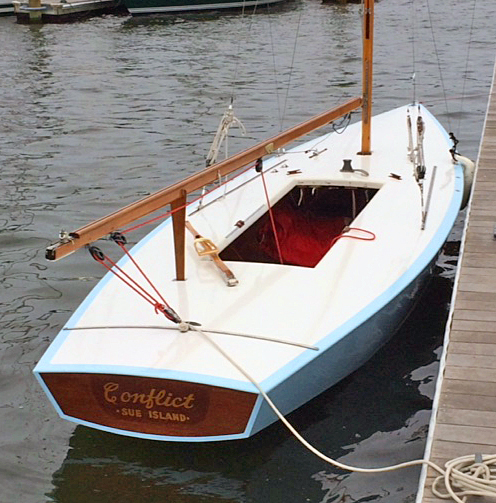
"We launched at AYC on Saturday but it was too rough in the City Dock basin for us so we hauled out again. On Sunday we relaunched and raced. It was a very nice day contrary to predictions, never getting over 15. "Conflict" (and John Sherwood - both classics) did well despite using our 1963 sails (because of their cool yellow color). Keith Donald won with his fully modern wood Star and we were second beating Elliott and # 177 "Trout". Nothing broke and we felt quite comfortable. I did the clinging vine style hiking and it suited the placement of cleats and winch perfectly. It was all reaching so the Stars didn't shine overall ( we were the last start ) but it was a real blast.
Tom Price's restored 1959 Lippincott Star at the AYC dock.


Tuesday, November 27, 2018

D Zero Video: Is this the one?


I don't really keep up with the machinations of ISAF or World Sailing or whatever the international governing body of sailing is called now - I really only have x-amount of aged grey matter to devote to all the digital information flowing in daily. I did read that there was to be some sort of singlehanded trials to replace the Laser (did they call them off? - or are they still on?). If I recollect, the singlehanded classes that made the cut were the most recent design additions in the mix; the RS Aero, the Melges 14, and the D Zero. And, of the most recent videos of these classes (within the past six months) Earwigoagin nominates this D Zero video as the winner.


Disclaimer: No endorsement of any of these three classes is implied with this post. (My heart belongs to the Classic Moth.) Click here to see some more of Earwigoagin's babbling about these (and other) singlehanded classes.

Sunday, January 18, 2015

Bloody Mary Handicap Race - 2015

There is nothing like this in entire world. In the middle of winter, 235 racing dinghies from most of the English classes, and based all around England, show up at a reservoir in West London to race a pursuit race. This year the breeze was on and Yachts and Yachting online has the story.

If you are like me and can watch dinghies planing this-way-and-that-way all day long on YouTube, you'll find this video of the 2015 Bloody Mary enjoyable. It's nice to see the 1960's vintage Fireball placing on top. They still have symmetrical spinnakers and seeing the crew manhandle the spinnaker pole onto the mast on the spinnaker sets reminds me of my crewing days. One can also glimpse the two new singlehanders, the RS Aero and the D-Zero making appearances at the leeward mark.

(I also noticed Steve Cockerill, head honcho of Rooster Sailing, who can have his pick of the latest, greatest sailing kit, sailing without gloves....Wassup with that!...Ouch!)


For a previous post on English winter sailing click here.

Tuesday, October 28, 2014

Seen at the 2014 U.S. Sailboat Show - Part 1 - Dinghy Rudders

I did attend the U.S Sailboat Show this year - as usual somewhat late in getting around to posting on it.

How deep is your rudder? Probably not deep enough when looking at the rudders to these three performance dinghies exhibited at the show.

Rudder for the MX-Next


Rudder for the RS Aero.


And the winner for the deepest, narrowest rudder goes to the Zim 15.


Sunday, May 15, 2016

Ian Bruce - A Lifetime of Experiments and Achievements in Sailing

Ian Bruce's memorial was early May at Royal St. Lawrence Y.C. I knew Ian, mostly through a work connection, but we also bonded over a love of the now Classic International 14 (although Ian had retired from 14's when I was racing them). In the late 1970's I saw him about twice a year when he was in Annapolis, and in the later years I touched base when he was up for the Annapolis Sailboat Show. Most of what has been written about Ian centers on the Laser; "Father of the Laser" being the typical moniker bestowed on Ian, but the Laser was only one part of what Ian, the designer, and Ian, the engineer worked at throughout his career.

Ian embraced emerging technologies to make the Laser a true one-design.

When Ian sold a bucketful of Laser's at the first New York Boat Show, he knew he had a winner but he wasn't satisfied. Ian set to work to make this class a true one-design, in every aspect. He wrote a very detailed construction manual so there was no leeway on how international manufacturers were to build the Laser (and this construction manual seems to be the only recognized IP in the current dispute between Bruce Kirby and Laser Performance). Ian didn't like the variation in the Laser sails so he, Steve Haarstick, and Jack Lynch formed Chesapeake Cutters, which was the first company to computer cut sails (using the Gerber Cutter and this is where I come in; I was production manager of the cutter operation). Ian didn't like the variation in the wood blades for the Laser so he developed, with an English company, a method to make them from expanded, self-skinning urethane foam using bronze molds with steel rods as reinforcement. When it came to making parts for the Laser more reproducible consistently, Ian was an early adopter of emerging technologies. The current term, SMOD, Single Manufacturer One-Design, came well after introduction of the Laser but credit to Ian Bruce in his drive to keep seeking out and then implementing the manufacturing technology needed to achieve identical dinghies.

Ian was a project guy.

Ian was happiest when he was up to his elbows in a project and the projects he chose were usually pushing the limits. In the 1970's nobody had built a production two-man dinghy at 64 kg (140 lbs.) in glass; the lightest dinghy going before the Tasar was around 90 kg. (The Tasar was designed from the Aussie NS-14 which was built in plywood at that time.) Ian went with full foam core and light skins, a relatively new technology, to achieve the very lightweight Tasar. When Ian did a keelboat, the Laser 28, he decided to build it using resin infusion (which uses a vacuum to pull the resin through the cloth) in order to have a tighter control over the laminate. Problem was, at that time, no one had done a part as big as a 28-foot boat using resin infusion. The last time I saw Ian, in 2012, he had his latest project, an all-electric runabout that he was aiming to get to 30 knots. Ian was more than a boat-builder, even more than an industrial designer, he was, using U.K slang, a true "boffin".

After the Laser, Ian set the lofty goal to bring high performance dinghies to the World.

Once Ian had set the Laser onto the path for international success, he set out with another goal, to introduce the World to the Antipodean high-performance dinghy. Ian felt that the North American and English dinghy classes, compared to the Australian and New Zealand dinghies, were too heavy and too slow. So he partnered, first with Australian designer Frank Bethwaite to produce the Tasar and the Laser II, and then with New Zealander Bruce Farr to produce the Laser 28 and the singlehander MegaByte. Having a conversation with Ian Bruce in the late 1970's you knew you were in the presence of a true believer in the Australian/New Zealand lightweight, overpowered dinghy. Did he succeed? Yes and no. Certainly the classes mentioned, the Tasar, Laser II, Laser 28, and Megabyte never gained traction as big international classes with staying power but, by bringing the Antipodean designers, and their boats front and center to the sailboat world, Ian paved the way for Bethwaite Olympic class, the 49'er and helped push the International 14 into the Aussie skiff camp. In many ways the current crop of lightweight singlehanders coming to market, the RS Aero, the D Zero, the Melges 14 and others owe a large debt to Ian Bruce's pioneering efforts to introduce these type of dinghies 40 years ago.

Mention must be made of two other people that were an integral partners in Ian's success; Ward McKimm, the "money man" who had complete faith in Ian Bruce and was a major force behind the scenes, and Peter Bjorn, the "right-hand man" who was with Ian through both Laser Performance days and the Byte days.

And then there is an entire history of early Ian Bruce and the International 14's but that needs to be told in another post.