The previous photo was of the start of the Everglades Challenge, the early spring jaunt for small craft (human or sail powered) down the West Coast of Florida, a distance of 300 miles. The start is at dawn, just above Tampa Bay, and this photo, lifted from the InterWebs, shows some of the more sensible small boat cruisers launching. The winners of the race are usually hi-powered catamarans or hi-powered big dinghies (such as Jeff Linton's Spawn of FrankenScot).
From YouTube, here is the start of the 2018 Everglades Challenge:
The previous header photo is from the 2015 R2AK - the 720 mile Race to Alaska - of Team Boatyard Boys finishing in Ketchikan, Alaska; two guys in a 16' Swampscott Dory that was so slow under sail they ended up rowing most of the 720 miles. It was obvious from last year's race that a crewed multihull was the ticket if you wanted to claim the $10,000 prize. So what craft did Tim Penhellow (I think he's the one on the left in this photo of the original Team Boatyard Boys) choose to compete in the 2016 R2AK? The same 16' Swampscott Dory, though this time he decided to do the race solo. Alone! Predictably he finished last, amassing the slowest time over the two R2AK's (of those who did the race twice). Some of Tim's quotes when he was drinking a beer after crossing the finish line:
When asked what it was like racing the R2AK solo:
"Like losing your virginity. You're glad you did it but embarrassed by your performance."
"I'm bored of being bored."
"Solo sailing is not for me." (Where he went on to relate some terrifying moments under sail when he needed an extra set of hands - but all he could do was hold his breath and wait for the outcome.)
Truth be told, the organizer of the R2AK originally envisioned this race as one for the Tim Penhellow's of the world, an ultra-marathon grit and grind up the western wild coast of Canada, where human-power is just as important as sail power. Unfortunately this narrative for the R2AK only plays out in the boats under 20' of length. Several millennia of history have pointed out the fastest way to eat up the miles in non-carbon water transport is a sailboat. Fast sailing beats a fast rowing boat every time - and there is no better fast sailboat then the modern multihulls, who this year made the 720 mile R2AK a three day sprint (for the winners).
As a race for the prizes, the R2AK is now a long distance multihull race, the R2AK adding some navigational wrinkles and spectacular coastal scenery as compared to a slog in the ocean. The guys that do the R2AK with boats under 20 feet - 2016 Luddites, all of them. They will finish weeks after the multihulls, but I tip my hat to all of them.
Congratulations to Tim Penhellow, to the other small boat adventurers in the R2AK, and particularly to the older duo, Heather Drugge and Dan Campbell, racing the only sailing dinghy, a Mirror 16, who managed an incredible 600 miles before pulling out.
Further proof of why racing a Swampscott Dory in the R2AK is like bringing a knife to a gun fight - video from day 6 of the 2016 R2AK.
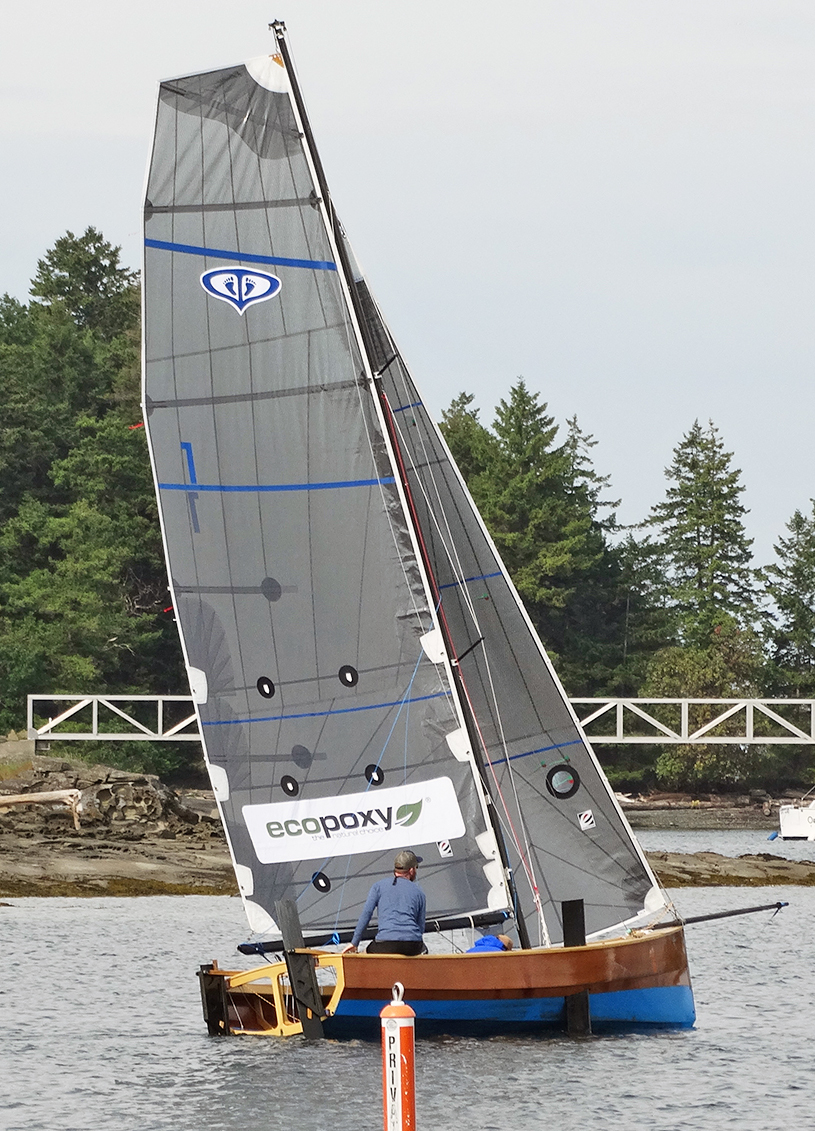
I chronicled the start of the Race To Alaska, R2AK, the 1207 km. (750 miles) slog from Port Townshend, Washington to Ketchikan, Alaska. The race is now finished with an attrition ratio of 25 DNF's vs. the 15 who were able to complete the course in the allotted one-month time-frame. Unusual for me, I monitored the tracker during the race, being particularly interested in how the large open dinghies (there were two of them, a Barefoot 5.8 built specifically for this race and a Mirror 16) would fare in this marathon. Not good as it would turn out. The Mirror 16 would drop out, and the Barefoot 5.8 would be the last to finish, 15th.
I can't resist a bit of Internet armchair race analysis here. (WARNING - this from a sailing dude, who likes to day race and sleep in a comfy bed, who last spent overnight on a sailboat decades ago and the closest I've come to the Seattle/Vancouver Island cruising grounds is Portland, Oregon.)
With an inaugural race, over such an unusual course of such length, the initial possibilities of what constitutes a successful race program remain wide open. After the race, the picture is much clearer. Now with the results in, we can safely say; to win the R2AK with the current course, pick a very fast trimaran around the 8 - 9 meter (25 - 30-foot) range, and then crew it with three experienced offshore racers who know the drill, and can keep the accelerator down 24/7. That is what Team Elsie Piddock, in a F-25 carbon trimaran did, and they surprised themselves and everybody else by finishing in just over 5 days. Multihulls over 6 meters (20 feet) long took 5 of the first 6 positions.
What type of experience wins the R2AK? Team Elsie Piddock goes over their sailing resume before the race.
In the sailing monohulls, a disparate set of keelboats finished on top of that division. A Hobie 33 finished 3rd after holding 2nd for most of the race but lost out to a trimaran that made up about 160 km. or 100 miles in about a day and half of open water racing. A day racing keelboat, the Etchells 22, with a crew of three, finished tenth. It would be interesting to see how much the Etchells 22 sailed versus rowed as they seemed to spend much of their time making their way up to Alaska in the narrow cuts and not out in open water. The upwind ability of an Etchells 22 is extremely good but there are none, nada, creature comforts.
And in another demonstration of the turtle winning out over the hare (in this case the purpose built Barefoot 5.8), a pocket cruiser-keeler, the Montgomery 17 of Team Excellent Adventure finished 12th. When conditions were bad, they hunkered down, when they were good they kept going and when they had a chance to recharge, they took it (looks like they spent two days in Prince Rupert drying out, getting a shower, enjoying the restaurants.). All in all, a very creditable performance.
What happened to the team I was pulling for; the Tad Roberts design Barefoot 5.8? Two things:
Three crew on a 5.8 meter dinghy added too much weight in stores.
The lack of stability of an open dinghy meant they couldn't safely keep the pedal down 24/7 so they pulled up at night. This negated the third crew, who was added so they could keep racing at night.
If the R2AK as an event keeps going, and you want finish it in a monohull sailboat under 6 meters (20 feet) the best path seems to be a keel type pocket cruiser with a crew of two. Of course, the type of sailor who already owns a pocket cruiser isn't one to think a 1207 km. race in colder and colder water would be any fun at all.
A tip-of-the-hat to the design and sailing team of Team Barefoot Wooden Boats. They didn't finish where they thought they would, but they did finish. The Barefoot 5.8 was an innovative and bold design. It was wood and can be home-built. For shorter distance races this would be a very quick monohull.
Designer Tad Roberts kindly sent along some photos of the build of the Barefoot 5.8 and some early pre-race debugging..
The Tad Roberts Barefoot 5.8 sail plan, Set on a tall mast, the sail area was quite big for this size dinghy. The initial plan was to reef early and often but I'm betting, if they had a choice, they would have changed to a shorter rig in the middle of this race. A very pretty sheer on this design.
The Barefoot 5.8 was built around the very substantial double-bottom grid. The sides would be added on later. Wood was 6mm. plywood.
Sides on. Deck on. You can see the kness that were used to support the top-side panels.
Open transom and double rudders a'la the French offshore machines. The Barefoot 5.8 used hi-tech leeboards to keep the double bottom open for rowing and sleeping.
The Barefoot 5.8 looks to be a very potent Everglades Challenge design. In that race, open dinghies of this size (I'm thinking of the Core Sound 17 and 20) can finish in just over two days. That seems about the right amount of time to drive an open dinghy 24/7 without completely boinking.
Here is a short video of Team Coastal Express in their Mirror 16. They slogged their way through the toughest parts, the Seymour Narrows and the Johnstone Straits, before deciding they couldn't afford the time to finish the race out. This video looks cold, very cold.
Mention must be made of the tenacity and persistence of the human-powered competitors that finished:
6th place - Team Soggy Beavers -Six paddlers in an OC-6 canoe (with ama)
11th place - Roger Mann - first solo competitor in a stock Hobie Adventure kayak/trimaran with Mirage Drive. Either you think this guy is Superman (he kept pushing 20 hours out of 24 for 13 days) or crazy-dumb (he almost lost his life twice, a pitchpole and another time he ended washed out but tethered to his kayak).
13th place - Team Boatyard Boys - two guys in a 17 foot Swampscott Dory, on which was added a small cuddy cabin. The original intention was to sail a fair bit but the windward performance was so bad they ended up rowing for most of the race
14th place - Mike Higgins in a 17 foot kayak. Yep, he paddled all the way.
Reader Mike Scott, who lives on the left coast, and was much closer to the action, added this comment which I've dragged over to the main post.
"I've been avidly following the race after being at the pre-race party, and getting up at 4am the next day to watch the start - which was set to the fanfare of the Russian National Anthem - quite bizarre, very stirring music, and typical Jake Beattie. I, too, loved the Barefoot Wooden Boat entry, and am hoping they might bring it up for the Wooden Boat Festival in September. Will be very interesting to see who and what enters next year - if it flies again. Much speculation on the 'perfect' boat, but as all depends on available wind and this year certainly favoured the speedsters, with a knarly Northwesterly blowing for much of the race......."
R2AK, the Race to Alaska, a 750 mile jumbo version of the Everglades Challenge, started the 2nd and final leg yesterday. The first leg, raced last Thursday, was a 40 mile sprint from Port Townshend, Washington to Victoria. The rules are simple; no engines, no outside assistance.
Unlike the Everglades Challenge, the R2AK racetrack is open water, very cold and some of the entries are sensible, full out cruising craft. I expect once the dust has settled, the racier catamarans and trimarans will fill the top spots. I don't envy those hardy kayakers in their kayak-trimaran hybrids who will spend the entire race ensconced in their dry suits.
There is at least one large open dinghy racing (editors correction: There are two - a Mirror 16 is also competing).Team Barefoot is the product of Barefoot Wooden Boats and is a Tad Roberts design, a 5.8 meter (19 foot) plywood dinghy playing in the same design space for long distance small boats as the i550 mini-sportboat. In looking at the video, the Barefoot dinghy appears to be more in the realm of a high freeboard Classic International 14 from the 1980's. Team Barefoot put this interesting video up on their dinghy and the thoughts behind designing for this race.
Some photos of the Barefoot Dinghy I pulled from the InterWebs.
It turns out that Classic Mothist, Jeff Linton, is pursuing the same direction for the next Everglades Challenge. He has scrapped his modified Flying Scot (which won the monohull class in 2014) and is home-building a new 6.7 meter, O.H. Rogers designed, large dinghy for next years Challenge. Boatbuilding details with lots of photos are over at Amy Linton's blog.
Last May I ventured over the Bay Bridge to Kent Island to look at Chesapeake Light Craft's OcoumeFest and also to look at some of the competitors in the inaugural WaterTribes Chesapeake Challenge long-distance along-shore marathon (an offshoot of their Everglades Challenge). They were starting that Sunday morning of the OcoumeFest.
Of particular interest was the 17-foot i550 sport boat specifically built by the Gougeon brothers for these type of events. The race poses several challenges that a modern small sailboat is not normally designed for; low bridges, traversing very shallow water, human propulsion when the wind quits and for those endurance types, the ability to keep going on little-to-no-sleep. It is a race where it is tough for a sailboat to keep up with those machine-like kayakers who maintain a steady, grueling pace.
Bob Ames, John Z and I had an interesting conversation with the two sailors who were piloting the Gougeon i550 sport boat Hot Canary;Joe Frohock, the creator of the Mothmaran, being one of the team.
The sleeping arrangements - just simple camp-mats laid on the floor under the cuddy cabin.
This is Joe Frohocks life-jacket. The following live on his life jacket during the race. A very sharp serrated knife, electrical tape, a whistle, a mirror, a high-pitched rescue whistle, a waterproof flashlight (and several other items I've forgotten -I think he also had an EPIRB).
A mast tabernacle so the mast can be quickly pivoted down to get under bridges. It turns out this wasn't quite enough, the freeboard on Hot Canary too high for one of the bridges in the race. They were stuck in front of one low bridge for several hours until the tide went out.
A rudder cassette allows the rudder to be pulled up or "reefed" for shallow water steerage. The mulit-part shock cord assemblage allows the aft part of the cassette to bounce back in case of a hard grounding.
The sideview of the i550 sport boat. The i550 is specifically designed for home-building in plywood and has a flat bottom panel.
The rowing station was a simple carbon plank that sat on the side decks, just behind the lifting daggerboard trunk. Rowing the i550 was not one of the design's strong points. The flare to the i550 sides can be seen at the transom.
This is a good video if you can block out the time - 40 minutes. A duo spend two weeks going around a natural circular body of water in central Quebec, formed by the impact of an asteroid.
From the blurb accompanying the video:
"The Eye of Quebec (Lac Manicouagan) is visible from space as a perfectly ring-shaped lake. Its center island is far larger than the water that surrounds it. 100km in diameter, it is the fourth largest meteor impact site on earth. We sailed around it and think that was the first ever circumnavigation of the reservoir under sail and oar. (We can find record of two other sailboats that have attempted the trip. While we're not sure of their success, both appeared to carry auxiliary engines. If it wasn't the wind pulling us it was our backs.)
Three years ago, when John and I drove the Trans-Labrador highway, we camped one night on the shores of the great Manicouaga and it captured our imaginations. Finally, this year, aboard the expedition re-fitted Wayfarer 4610, we made the voyage. We were on the water for about twelve days after a two day drive north. It is an astronomically great lake.
We camped ashore every night, and packed nearly 100 Ibs of dried food for the journey. We wore drysuits most of the time, cause the weather was typically cold and wet!
The 2015 Everglades Challenge starts tomorrow, a 300 mile sprint down the West coast of Florida in all manner of small craft. Last year, Classic Moth champion Jeff Linton won the monohull division in his extensively modified Flying Scot.
This year we have a Classic Moth entered - well sort of. Joe Frohock picked up a Mistral Classic Moth that was languishing at the Gulfport Y.C. and made this tippy Moth into a trimaran - a Mothmaran. He unveiled the new Holland Tunnel over a year ago and in the interim he has already done a 100 miles jaunt in the contraption. Tomorrow will be the real deal.
Len Parker can't believe his eyes. The Mothmaran uses stock kit Chesapeake Light Craft amas. The fixed prodder flys a gennaker on a roller furler.
The familiar deep-Vee hull of the Mistral Classic Moth married to something different.
With everything unfurled there is plenty of sail for this 11-footer.
The crossbeams were stock lumber pieces screwed into the deck (the screws being replaced by through bolts when they started pulling out).
Joe Frohock, master cobbler together of disparate pieces into a very credible sailing machine.
The 2015 version, entered in the 300 mile Everglades Challenge. Additions are some fairings for the crossbeam attachments and a massive foredeck coaming to keep water out of the cockpit. The word from Earwigoagin's reporter from Gulfport was once he loaded all the required Everglades gear he had water coming over the daggerboard trunk - time for a quick redesign! As with the sailing canoes entered there is no room for onboard sleeping! Good luck Joe!
Some of you, after viewing Part 1 of the Mirror Cruise on the French Canals, may have already jumped over to view Part 2. But to dot the i's and cross the t's, (and to get an easy second post out of this subject) here is another beautifully done video on the second month of the Cruise.
Again, from the video description by our intrepid adventurer, Digby Ayton.
"This month was filled with sunny days, wonderful people and beautiful scenery. I travelled through the Canal du Nivernais and the Canal du Lateral du Loire where I had to finished my journey and sold my boat at the beginning of the Canal du Centre, which was closed due to water problems.
I finished my adventure having rowed 700km and passed 240 locks and had an absolutely amazing time.
Part 1 of a well-shot video of one man's cruise in France, in, of all things, a small Mirror Dinghy. From the blurb attached to the video by the dinghy cruiser and videographer, Digby Ayton:
"A short film from my first month sailing and rowing through the French canals in a 3m sailing dinghy. I was given the boat in the town of Rouen, 150km west of Paris. After some repairs I began my adventure, sailing and rowing up the River Siene. After about 100 km I hitched a lift on a barge and three days, two nights in the cargo hold and 200km later I was past Paris and beyond. I began to row again in the town of St Mammes and soon after turned down the River Yonne. I have travelled 100km since then and have arrived at the beginning of the Canal du Nivernais in the Burgundy region of France.
I had one of those double take moments last Wednesday, 7:15 am, just after I crested the hill on Route 450, opposite the Naval Academy. Framed by the new Severn River bridge was one of the Navy 44 sloops, blue and gold spinnaker drawing beautifully in the early morning mist. As I stopped at the intersection, I could pick out five of the Navy 44 sloops spread out on the Severn River, fronting the Academy, all with their spinnakers up and drawing. But wait..... what was this?...... all five were furiously going backward under motor; the only way they could fly their spinnakers in the dead morning calm. Trying to keep one eye on the road, I digested such a bizarre sight. The conclusion.........obviously a photo op designed to take advantage of the ethereal early morning light. I wonder if those in the know will be able to pick out the stern wake in those photos?
Len Parker keeps me updated on his continuing adventures with his mate Ray (see the post about Len and Ray on the Norfolk Broads cruise here ). Ray, who is a genuine boatbuilder in the UK, got a job over the winter to build a landlocked pirate ship for the Blackgang Chine Amusement Park on the Isle of Wight (I think the previous Pirate ship was rotting away). As you can see, he built it using traditional boatbuilding techniques with genuine big bits of timber.
The frames going up..............
Picture taken when the terra firma-bound ship was more or less finished. Not sure what Ray did about rigging those masts.
And as for scow sailing...............
Between the two of them, they have amassed four scow Moths. Len and Ray took the older Imperium design wingless scow on a jaunt on NewTown Creek, Isle of Wight in early April. I'm amazed that those two were sailing in shorts and T-shirt, early April in England.
Ray with a bow on shot......................
Picture of Len taken from the side...................
This blog vicariously visits exotic sailing locale mostly through YouTube videos. The blogmeister, not being particularly flush with cash, does most of his jaunts up and down the East Coast of the U.S.
Transplanted Englishman, Len Parker of the Mashed Minifish project, sends along a travel report of a cruise he and his mate, Ray, did on the English Norfolk Broads this fall. This past summer, I had done several posts on the traditional dinghies that race the Three Rivers Race on the Norfolk Broads, using Dylan Winter's gorgeous videos that, unfortunately, have gone away. As Len relates, cruising on the Norfok Broads is done in traditional boats with big rigs, on narrow rivers, with masts that can be lowered under bridges, and of small towns with pubs close at hand.
"In late September I flew over to England just a few days after getting back to south Florida from my adventures with the MiniFish at the Classic Moth Nationals.The plan was to land at Heathrow , rush down south to the Isle of Wight ... say a quick hello to my parents , say a quick hello to my kids , grab something warmer than shorts and flipflops , also make sure I had loads of tea bags , then a few hours later jump in Ray's van , back on the car ferry & 250 miles North up to the Norfolk Broads where we'd hire a classic sailing dinghy for three days and Ray would 'show me the ropes'.
We got to the famous Hunter's Yard in Ludham in the wee 'early hours , had a cup of tea or three and waited patiently for them to open. They hire a variety of lovely looking wooden classic sailboats and we hired "Sundew" , a 1950's Waverney One Design gunter rigged 22+n footer with 290 sq ft of main & jib. All the boats have high rigs , probably to get sail area above the high reed beds on the narrow river stretches.
We had 200 odd miles of the waterways to explore including Hickling Broad , Ranworth Broad and Barton Broad , plus the rivers Thurne and Ant. We followed some of the route of the famous 45 mile long three rivers race ( Thune , Ant , Bure). Areas of the rivers are really narrow , so no time for brewing tea , it was tack-tack-tack. Then it opens up into a Broad. Beautiful scenery and wildlife. The original plan was to sail , camp , sail , camp , sail ... but seeing as it was late in the season , and what with my knee & jetlag as another excuse , we soon changed the plan to sail , pub , hotel , sail , pub hotel ... A much better plan ! We figured that as kids were long back at school there shouldn't be too many grockle families ( tourists ) clogging up the place in their large hire motorboats ... luckily we were right.
We had a mix of wind conditions varying from rowing in the doldrums , to gusts of over 25 knots , and after the rental lady mentioned that we ought to reef the main when the wind piped up Ray laughed , saying that only girls and poof's do that on a river.
Sundew was surprisingly nimble and easy to control but being the novice I am , I had my moments. We were hiked out as far as we could be a few times , great fun. It was brilliant to see some of the boats with their huge sails dwarfing us. The largest was named White Moth , very apt & I took a photo. It was fun to spot a sailing dinghy ahead of us , as we couldn't resist "hunting them down".
We went under the 13th century Heigham Bridge. You have to lower the pivoting mast onto a brace on the transom & row under the little 6' high brick built bridge. No tides to worry about , sounds easy ... yeah right ! .. The current was ripping through the bridge. One person steers , one person rows backwards whilst straddling the mast , boom & sails. You duck and hope for the best. Luckily we did good , but it was knackering and then you have to row another 100 yards to clear another bridge before you can restep the mast, then have a cuppa and carry on your way ... I let rip about 50 unmentionable swear words in 30 seconds , thinking we were going to smash the hull , so hats off to those crews who do this whilst racing. Of course we had to do it all again on the way back , but at least we knew what to expect.
It was great fun exploring and after running aground in the deep mud a couple of times , you soon realize that the channel markers are spot on. The Norfolk folk are a friendly lot , but they really do have a funny accent as it's really rural and proper "carrot country". It was a great trip , and I'll be back for sure."
Len sent along some pictures. (Click on picture for higher resolution.)
I think this the large Broads Cruiser "White Moth".
Another traditional Norfolk Broads cruiser.
"Sundew" chasing down a cruiser in the narrow confines of the river.
Ray with "Sundew's" mast lowered for negotiation of the Heigham bridge.
"Sundew" at the dock.
Len skippering on one of the wider expanses of water.
There are other blogs that do a great job covering traditional and open boat sailing.....
DoryMan is my favorite (in my blog list) but two others that also do a good job covering open boat sailing are InTheBoatShed and 70.8% .
The increasing popularity of RAID's (a weeklong event for open and traditional sailboats with each day featuring a point to point race/cruise) and MessAbouts (events based out of one location) are giving open boat cruising new impetus. I would like to do an open boat cruise myself somewhere in the future.
This video is of a Welsford open boat design Navigator (Welsford designs are very comfortable in big wind and waves) sailing from Auckland NZ to the island of Kawau (about 30 km NE).
In between running the summer series for the Flying Scots and the Classic Moth Nationals, I got the call to fill in as a Wednesday crew for John Jenkins on his Star boat. I hadn't been in a Star for 30 or so years but Wednesday nights are usually light air drifters .... so how hard could it be? Well when we arrived at the St. Michaels YC, the wind was a consistent fifteen and the tutorial on the sail out to the starting line was short and sweet; here are the cleats for the running backs, don't thread the whisker pole through the mainsheet on the way in or out, and here is a nifty fine tune adjust on the jibsheet. From my perspective, there looked to be plenty of lines, that, if pulled wrong, could pose big problems, not just in racing around the buoys but in keeping the mast up .... those thoughts I put out of my mind.
John got the best start at the weather end and we were ahead comfortably 2/3 the way up the first beat. Unfortunately his closest rival got out to the right and rode a nice starboard tack lift to lead us into the mark. Off we went downwind. John was intent on running down his rival; not only was the leeward running back off, he let off some 8 inches of the weather one and we pulled on a jib thing-a-majingy to bag the jib out. I got the pole out after a delay, my feet effectively cleating the sheets for a while until I figured out what the problem was. I hadn't screwed up too bad until we attempted what would turn out, for a neophyte Star crew, to be the equivalent of a an inward three-and-a-half somersault in tuck position ..... we did a gybe into a leeward mark rounding.
Well, lets say I did get the whisker pole back into the boat properly before we rounded the leeward mark but .......... the weather running back was not fully on, the jib sheets were in a huge ball right at the turning block, and I had pulled the jib thing-a-majingy on instead of out and the jib was a good three feet up the forestay. I did get the weather runner on before the mast went anywhere bad, I was able to miraculously free the jib sheet ball in about 20 seconds and we eventually got the jib down to the deck. By that time our rival was well gone. We were able to hang onto second for another windward/leeward but another boat ground us down just before the finish (I just don't have anywhere near the beef of a true Star crew).
All in all, I was pleased with a third. It could have been worse though we didn't do John's series lead any favors. Lesson, if you are going to be a pickup crew in a Star, definitely do it in under 10 knots when things happen a little slower.
Dylan Winter, the videographer slowly making his way counter clockwise around England in a Mirror 19, has posted a video summary of his spring and summer travels. As to be expected from Dylan, beautifully shot and edited.
A couple of months ago, I posted some earlier Dylan's videos . More and more out in the bloggosphere are picking up his work. If you want to spend most of the evening going through his travelogue, click here.
Now is the season for my cruiser friends, whose leadmines were hauled for the winter and, who have done all sort of needed maintenance or upgrades (such as JM who took a tumble off a ladder from his CAL 36 and now has been limping around on a badly bruised leg), to now get them back in the water. Our friend Dylan Winter , who spent the winter working in New Zealand is now back to continue his trip around England in his Mirror 19. In this video he documents the slight hiccup with the Marina workers in getting his boat back on the water.
As I get older, I make mistakes .... BIG MISTAKES in my sailing regattas. At the 2008 Classic Moth Nationals, I capsized upwind, had an OCS, and T-boned Joe Bousquet at a weather mark.
At the 2009 Mdwinters, in race 2, I had the mainsheet knot come undone and the mainsheet snake itself through the boom blocks. In the unintended stop to fix the problem, I never got back to the group I had been dueling with.
In race 4 on the second reach, I was pushing the boat hard by the lee. Mike Parsons, who can go deeper with his unstayed rig had already gybed over but I persisted. Not for long! The sail unloaded .... the Moth, already heeled to weather, took another quick lurch and despite my quite comic efforts to climb the mountain, spun out and capsized.
(Sigh!... and this is my so called stable Classic Moth .... yeah I own two of them!)
Picture from Amy Linton............Double click on pic for higher resolution.
Capsize to weather is always the worst and I seem to do it regularly. It always involves a double capsize to get going again. Step1, get the boat up and it capsizes again to leeward. Step 2, climb onto the daggerboard and right the Moth from the weather side. There was the option of riding the daggerboard under the water to quicken the process but the water seemed too cold and I wussed, instead swimming around for the second try. I ended up last when all this was sorted out. I got one boat back by the finish but there was my throwout!
I had some decent starts but on two of the starts in the Midwinters, I lost track of where I was in the sequence and was rewarded with some disasters in the second row. They say the human brain can slow time down in emergency situations. My brain was doing a good job of replicating this behavior just trying to start a sailboat race.
Finally I had a tendency to hit the weather mark, doing this twice in the Midwinters.
Why all these mistakes? Impatience? An inflated sense of how my reaction reflex used to save me (remember the quickness I had in my 20's). Who knows? When I am in the midst of flailing about, I may grind my teeth at my incompetence, but age has at least given me the wisdom to laugh at these foibles.
From Len Parker, a picture of me upright at the Midwinters;
Tip of the hat to Tillerman who also regularly documents his failings on the race course.
Back in the 70's, Bob Dull and I organized a 24 hour Laser Marathon during the October Annapolis Sailboat Show. We ran it out of SSA, taped flashlights to the bow eye (colored red and green for the appropriate side). We had a lot of fun. Teams were anywhere from super organized 6-8 sailors to teams that were trying to recruit people off the dock at 3 am. We did it for two years and then wrapped it up. We couldn't do it now as the show is too popular and the harbor too crowded for it to be safe.
I found a video of Dutch juniors doing a 6 hour relay race in Lasers. A fair bit of breeze and the skipper changeover, in it's various permutations, is hilarious.
The barge carrying the cement truck crossing the race course is a nice touch.
And the grandaddy of all 24 hour dinghy races is the Southport race hosted by the West Lancashire YC in England. Teams race in doublehanded Enterprises (blue sails), GP 14's or Lark dinghies. The action around the gybe mark gets very hairy.
The Vanguard 15 class should look into doing something similar in the U.S.
There is a large amount of crap on YouTube. So it is always a joy to find a professional videographer slumming on YouTube, particularly spinning a sailing adventure with video. Dylan Winter is attempting a counter clockwise circumnavigation of England in a Mirror 19 (think of a stretched Uffa/O'Day Daysailor with bilge keels). He is recording everything in a crisp and witty multi-part YouTube documentary. There is no rush. His Mirror 19 is presently under cover for the winter with his voyage only making it around the South Coast and up to the Crouch (just north of the Thames) for the first year.
Here is a three part sample of his trip up the Crouch and Roach.
Part 1
Sorry, videos have been removed!
The entire trip up to now and in order can be found here
Bald but my eyebrows are growing at a prolific rate. Sailed Windmills and Y-Flyers in the 1960's. Founded Miami University (OH) sailing team. Sailed International 14's and Lasers in the 1970's. Sailed International Canoes in the 1980's to mid 1990's. Sailed Classic Moths since 2002. Enjoy boatbuilding though I'm very, very slow at it (the Internet doesn't help matters). Name in real life: Rod Mincher
After choosing this username (Tweezer is the name of my Classic Moth), further research on the Internet turned up that Tweezerman is a corporate name for a line of pedicure products. Let me emphasize that I do not work for, nor endorse these products.