Showing posts with label Antipodean Sailing. Show all posts

Saturday, December 26, 2020

New Plywood Cherub Build


These photos of a plywood Cherub build in New Zealand crossed my Facebook feed. A plywood Cherub is a rare beast. As is the fashion these days, most Cherub's are built of more exotic composite materials. New Zealand, the home of the famous Kiwi designer, John Spencer and his Cherub class, has seen a recent revival of the class; the class being moribund since the 1990's. As I've mentioned, buried in an old post; I raced one weekend in an English Cherub regatta in the 1970's. (Back when the design fashion was a deep V carried all the way to the transom.) I've always had a soft spot for these 12' double-handers (the original single wire, wide Cherub, not the two wire, rack version the English cooked up to compete in their Portsmouth handicap racing).

This blog has sprinkled various Cherub antics throughout posts over the years.

This build uses 4mm plywood throughout. Minimum hull weight is 51 kg.

On the jig


Minimum frames, double bottom.

Carbon Tube for Pole Launcher.


Hull complete. Fitting rudder gantry.


Typical flat hull sections of an assymetric-powered skiff.


A modern Cherub upwind in max power conditions.


Addendum April 2022

For a modern day source of Cherub plans, Alan Roper writes:
"In regards to the cherub it depends what you want .Greame Hill has a hull kitset I have designed. ...There is another boat I designed to he built of stitch and tape system and there is another one built of conventional methods. The latter 2 have paper plans.


Sunday, November 1, 2020

Hal Wagstaffe's 1962 New Zealand Classic Moth Design

Moth Classique

These Classic Moth lines plans popped up on FB. A multi-chine plywood, very much a middle of the road design, "Puriri" looks very worthy of someone building a reproduction. She would definitely fit in the Gen I division of the American Classic Mothboat rules. Puriri is an indigenous New Zealand tree.


More Classic New Zealand Moth designs can be found at this post (from Nedslocker). Includes Bruce Farr's first dinghy designs.

Saturday, September 19, 2020

Sailing Dinghy Restorations during the Pandemic


It seems the Covid Pandemic has driven the older dinghy guys into the shop, particularly the Antipodeans who have been busy restoring 60 year old scow Moths and Australian 14-footers.


And this old skiff as well.


Monday, August 3, 2020

Australian Sailfish: Building Photo Documentation


Greg Barwick of the Australian Sailfish Association emailed me to point out they have now added a marvelous photo essay on building the Australian Sailfish to their website. (Look in the top Menu for "Building - a Visual Guide".) A must see for anyone interested in building plywood dinghies. Even experienced boatbuilders can pick up an idea or two in going through the photos. To make it easier I've listed the various chapters of "Building - A Visual Guide" with their links below.

To order plans for the Australian Sailfish.

Brian Carrol's photos of his build of an Australian Sailfish

Tuesday, November 26, 2019

Australian Sailfish: updated plans


News from Down Under. The Australian Sailfish class has updated their plans. From Greg Barwick:
"After many, many months of hard work, writing, editing; reviewing (repeat until you can’t sleep :-)), a new set of Building Instructions, complete with CAD drawn frame diagrams is now available. This has been an enormous task led by our own Chris Cleary, who built a boat as he went along just so he could adjust the Instructions and take photographs There was also a lot of input from Ian Urban (our CAD specialist), Ian Milton and others to get us to this point.

"When we kicked off the website and made the plans available three years ago, we had no idea how popular that would be, so plans have been sent out for the last three years without an allocated number. To mark this relaunch of the Plan Sets we are also starting numbering the plans once again.

"The highest number issued up to now was 3500, so we have decided that we will start the numbering of the new Plan Sets from 3501. I even have the original Plan Sales book to record it in!

"As well as a comprehensive set of Building Instructions, (76 pages) there are two A0 sheets of frame diagrams that will give full size Frame templates, one A0 Centreboard Plan & Section sheet and one A1 Rudder Sheet in each Plan Set.
We have also launched a new section on the website, 'Building . . . a Visual Guide', to be used in conjunction with the Building Instructions, so check that out as well.


Click here to order a set of Australian Sailfish plans.


Also a very earnest Earwigoagin TOH to the hard-working folks reviving this great little Australian dinghy.


Friday, May 24, 2019

Header Photo: Big Tasmanian Dinghy


As you would guess, I have a lot of sailing images collected from the Web; some filed in generic terms that give me no help in identifying them when I want to post them up on Earwigoagin. This great photo is one of them. I filed it under New Zealand-boat-planing, but I have no idea what class it is. This is quite a large dinghy, planing quite happily. I peg the date to be immediate post WWII. I'll see if any of my readers can fill in the details.


I figured it would be Neil Kennedy, Antipodean historian par excellence, that would set me straight on this photo. Neil writes:
"That [photo] is definitely NOT a NZ class; we didn't ever wear white sailing gear and "Aussie Sunhats". I think you will find that the picture is of a 21ft restricted class that was sailed in Tasmania, Victoria and South Australia from the early 1900's till the 1950's. They had a challenge trophy which was fought out on an interstate challenge basis with a level of intensity to rival the NYY (New York Yankess for those not versed in American sports culture) v Red Socks saga's. I have a feeling that they originally sailed for the "Stonehaven Cup", donated by a Lord Stonehaven for interstate competition, but not 100% certain on that. I think a couple have been restored in Tasmania, and were featured in recent "Classic Yacht regatta's held in Hobart. Like all Aussie yachts they carried plenty of Rag ( sail) and a crew of hefty footballers to keep them afloat."
TOH to Neil of NedsLocker.


More digging around the web shows this is the Tasmanian 21ft. Restricted Class, Tassie Too, recently restored. And the Interdominion Cup was called the Forster Cup. From the Royal Brighton Y.C. Victoria history:


Saturday, March 2, 2019

Header Photo: The Australian Sailfish; ICWDR 2019


The previous header photo is from the 2019 ICWDR regatta; Emma Milton on Australian Sailfish 2192, Apsu, going into a jibe on a very narrow scow with very little clearance under the boom. I can't do any better than the description offered by Kiwi Neil Kennedy (who built an Australian Sailfish and sailed one for a while).
"The moment of truth before a full blooded, square-run gybe on a Sailfish. The bow wave almost level with the deck, a hand full of mainsheet, knees braced, tiller angled behind the back, ready to fling the boom across while remembering to hit the deck as the boom whistled across, all the while hoping that a sudden gust didn't arrive just as you heaved on the main sheet ! It was even more fun in a Sailfish as there was nowhere to brace yourself so... get it right!! or slide off the deck into the deep blue... laughing!
Ninety something, Jack Carroll, one of the original designers of the Sailfish, got out in his original Sailfish, Debonair.


The fleet on the Inverloch beach.


Beating among the sandbars of the Inverloch Inlet.


Greg Barwick sends along this report. Twenty Sailfish showed up at the ICWDR and Sailfish are now being built around the globe. Read more below.


I've put a post up with abbreviated plans for the Sailfish up on Earwigoagin but best to go to the original source for the Australian Sailfish plans.

Some other Earwigoagin posts about the Australian Sailfish.


Friday, February 22, 2019

12 Foot Skiff - Drone Footage

I've read that the Antipodean 12 Foot Skiff is the hardest dinghy to sail. I won't doubt it. A short dinghy is always twitchy; two wiring is always tricky; no limit on the sail area just ups the ante. Here is a short drone video of a 12 Foot Skiff jib-reaching back and forth. Even without the assymetric spinnaker up, you get a good feel for how on the edge this dinghy is, how much skill she requires from the crew, as she blasts along.


Earwigoagin has featured the slightly more sane 12 foot Cherub dinghy in several posts:

Saturday, February 16, 2019

Header Photo: Gwen 12's at the ICWDR


Photos from the 2019 ICWDR (Inverloch Classic Wooden Dinghy Regatta) held over the Australia Day Weekend (January 26, 27 2019) have been filtering into Earwigoagin Central. The previous header photo features the Gwen 12 class, another Australian Classic Dinghy class that is making a concerted effort to find and restore old boats. Four Gwen's showed up at Inverloch with Grasshopper, the Gwen in the header photo getting the Best Overall Award. From Andrew Chapman:
"The Best Presented Sailing Dinghy was won by Rod Mackintosh’s Gwen 12 ‘Grasshopper’ sail number 2846. Rod... traveled from South Australia to sail with the other Gwen's. When he acquired the boat it was covered in thick green paint and since then it has been completely restored with clear finishes all over. The Inverloch and District Lions Club Perpetual for the Best Overall boat at the regatta, which is selected from the category winners, was [also] given to Rod Mackintosh’s Gwen 12 ‘Grasshopper’."


Kiwi Neil Kennedy offers up this description of the header photo in "Strine" slang. (It would be nice to have definitions for all this, but with second thought, we'll leave it all to the imagination.)
"As the Aussie's would say " Strewth cobber, ... here is a header photo of two "old Galahs" in a Gwen 12 thinking they were 30 years younger as they get set for a downwind blast. Of course 30 yr's ago they would have been lean and tanned, wearing a footy jersey and shorts, with bare feet, and after blasting around the bay, would have returned to the beach where they would have had two Shiela's in minimal bikinis equally tanned lying on beach towels waiting for their blokes with cold beers ready and waiting in the "esky" for the boys to "scull down" while they derigged and contemplated the evenings activities with the Sheila's, knowing that they were "good sorts" who liked a drink or two and with the usual approach of Aussie girls in that era " if you want a "root" to round out the nights entertainment "just ask !! I kid you not, I lived there for four years and I remember well; " with more than a smile or two."


A comment from unknown previous Gwen sailor:
"In Adelaide, South Australia first off-wind leg (Close Reach to Beam Reach), 1 nautical Mile long, 3 minutes with a decent wind or more. She sits on a dinner-plate size contact with the water. Water spews out the well (up to 1 metre) and straight over the stern transom. Oh and something hums! If you are not anticipating this kind of speed then you underestimate the Gwen 12's capabilities. It's a heavy weather specialist. You can still put up a kite when no-one else can."


More photos. No. 1905 is Wayne Fry's Scud IV.


No. 1941 is Toby Leppin’s recently restored 1960’s Gwen 12 Avenger. From Andrew Chapman: "Avenger won the Gwen 12 Challenge Cup. Toby sailed with crew Geoff Rippingale using the trapeze and setting the flat cut wire luff spinnaker...


Simon Wilson in Chaos Restored


Toby Leppin and Geoff Rippingale upwind.


Back in my International 14 days, when we saw such a relaxing photo, especially with the spinnaker being ready to be deployed, we said the crew was pausing to make the skipper a cup of tea.


I've commented before in Earwigoagin about the seeming complete die-off of the single trapeze performance dinghy - a puzzlement to this old fellow who remembers large fleets of Fireballs and 470's and Flying Dutchman in North America. (The 505 soldiers on but at an almost professional level.) I can't think of a better plywood project for a single trapeze, spinnaker dinghy than the Gwen 12.


From Drift Media, the 2017 Dinghy Show on the Glade. (I'm not sure this happened this year.)

ICWDR 2017 SEGMENT5 from drift media on Vimeo.


Apologies, but Andrew sent me photo attributions for these Gwen pics but I've mixed the photos up to the point I'll have to wait for Andrew to set me straight.

Sunday, January 13, 2019

Historical 18-footers: December 2018 Race

It's always fun to watch video of the Historical 18-footers as they bash their way around Sydney Harbor in a good breeze.


Sunday, November 11, 2018

Aussie 18-foot skiff: Vintage Photos


Some great vintage photos of the Aussie 18 have been filtering out at regular intervals from The Open Boat on Facebook. I'm reposting a couple on Earwigoagin.


Saturday, October 13, 2018

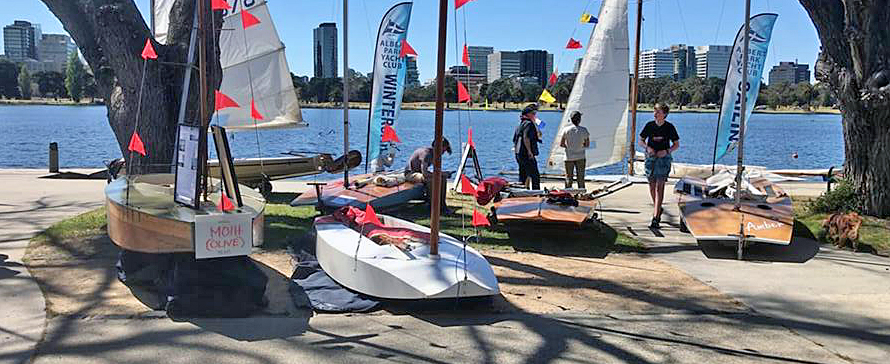
Scow Moth Rendezvous: Albert Park Lake

A week ago, six Classic (non-wing) Aussie scow Moths made it out on the small lake in the Melbourne city park, Albert Park.


Details are sketchy but they raced in the first of the summer series racing. (It seems if it is fall in my neck of the woods in the Northern Hemisphere then it must be spring in Australia - but if they call it a summer series, then so be it.)

Rigging area. Not sure what the designs of these scow Moth they are but I imagine they are of the Imperium time-frame.


The original Len Morris Olive made it outside the museum. Next to her is the Len Morris Mk II.


The scow Moths started with a Europe dinghy and a Laser Radial. We see a Solo dinghy and Sabre dinghy in the background, waiting for their start.


Some racing pics:

.

.
Phil Johnson in his painstakingly restored Peter Cole Mouldie design.

.
Photos originally appeared in Scow Moth Club group on Facebook.

Monday, April 2, 2018

Header Photo: Start at Largs Bay, 1986


The previous header photo was of a start at the 1986 Moth World Championships at Largs Bay, Adelaide, Australia, the last time the scows and skiffs would mix it up. More photos from that regatta can be found here.

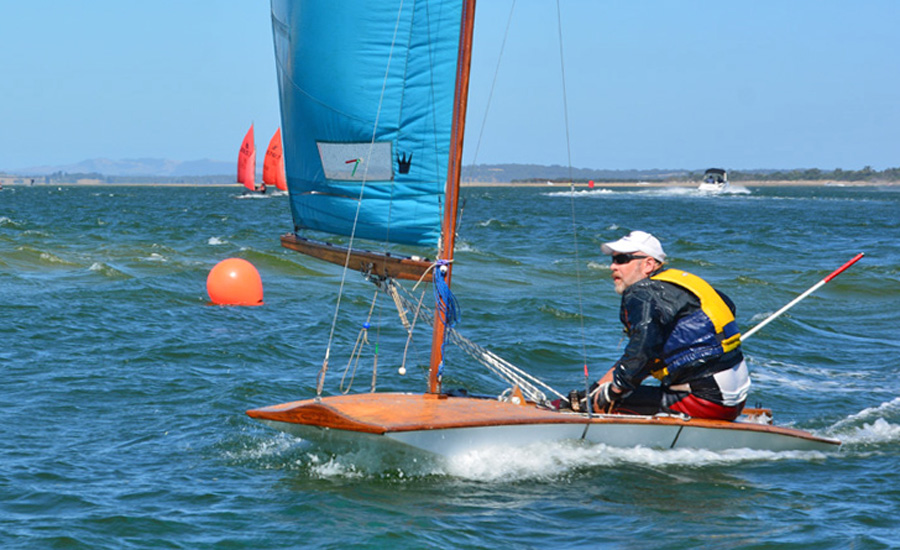
Moth and Sailfish Scows at the Inverloch Classic Wooden Dinghy Regatta

Time to wrap up the scow thread which I've kept Earwigoagin on for a month or so. This post I stay with the Australian Inverloch Classic Wooden Dinghy Regatta and the other two vintage scow classes competing; the Australian scow Moth and the Australian Sailfish design.

As mentioned before, the Inverloch Classic Wooden Dinghy Regatta celebrated the 90th year of Len Morris building his "Olive" which would become the Inverloch 11-footer class and then, when they spied the Rudder magazine article with Crosby's plans for his Skimmer Moth, the Inverloch group appropriated the emblem and become the Australian Moth class. The original "Olive" is still in one piece and was on display in the gymnasium at the Inverloch Regatta. The original definitely has high freeboard. Nowadays we would probably say the design is more pram-like than scow-like.


Len Morris's second Moth design, the Mk II, built post WWII, would take Australia by storm and was definitely more in line with the low freeboard American scows. Graeme Cox brought along an early Mk II. Note the low roach mainsail on the MkII (#3021) compared to a later 1960's scow design (#3396, an Imperium perhaps?).


Graeme Cox's MkII from the stern.


Phil Johnson, in his beautifully restored Cole Mouldie Moth, won the "Best Moth" prize at the regatta.


Nine Australian Sailfish made it to the 2018 ICWDR, down slightly from the eleven that showed at the 2017 ICWDR. Nine Sailfish still made up the largest class attending in 2018. There was even a brand new build. Brian Carroll, son of Jack Carroll, one of the designers of the Australian Sailfish brought the freshly launched "Jacks Toy" to Inverloch.


The new build Sailfish sported SUP non-skid tread, certainly a big help in staying on these slippery, narrow, beach boats.


Sunday, March 11, 2018

Two different scows at the Inverloch Classic Wooden Dinghy Regatta: Rainbow and A-12


While I'm on a scow kick, mention must be made of two different scow designs that competed in the Australian ICWDR out of the South Gippsland Y.C. One of the kingpins of the Classic Wooden Dinghy event, Andrew Chapman and family, had two restored Rainbows in the regatta. (Correction: Andrew did the restoration of one "Annie", his son-in-law, Jonathan, a fine craftsman in his own right - music instruments - did the restoration of the other one, "Moonraker".The Rainbow is an Australian 3.65 meter design that was popular as a junior trainer in South Australia in the 1960's. Andrew sailed one Rainbow with his grand-daughter and, his daughter Trilby, sailed the second one with Andrew's other grand-daughter. I asked Andrew what he thought of the Rainbow scow as a parent/kid sailing dinghy and he was enthusiastic.
"The Rainbow is lovely small boat to sail. It is very forgiving and a lot faster than a Mirror and Heron without using the trapeze and/or large spinnaker. I think it is an ideal boat for an adult and young kid or young teenagers. Trilby and I sailed with each of her two daughters and we plan to introduce them to using a trapeze on a beat and then the trapeze with spinnaker on reaches. We are also putting them on the helm and they enjoy sailing the quicker boat and they are not overwhelmed by the boats size. When they are comfortable using the trapeze and spinnaker trapeze combination the next stage will be the Gwen 12 then Cherub. I think the Rainbow is a very good small boat and it is one that is very easy for home builders to make.
Andrew Chapman and grand-daughter in "Annie".


Trilby and daughter in "Moonraker"


Three very different Australian scows in one shot. Trilby with the Rainbow on the beach, a modern carbon foiling Moth scow, and, in the background, a Classic wingless Moth scow.


Plans for the Rainbow scow can be found here.


The A-12 scow was Frank Bethwaite's follow-on to his Northbridge Junior scow. Designed to be a higher performance dinghy, the A-12 was longer, 12 feet or 3.65 meters, sported Frank's signature rotating mast and had a trapeze. Neil Kennedy from Nedslocker dug out a November, 1970 issue of the Australian Modern Boating which featured the class when newly introduced. Some photos from that article:


An A-12 scow has shown up at the Inverloch Classic Wooden Dinghy Regatta for the last two years but, as Andrew Chapman writes, in the beginning no-one knew what type of scow it was.
"At the first regatta Andrew Kean sailed the boat as a Moth, with two tone blue sails, because that what it was sold to him as. He did wonder why someone had put a trapeze fitting on the mast. Apparently he never thought to measure the length. He sailed it again in the most recent regatta as an A12 with blue and white sails with a different rig.
From the photos it looks like Andrew was able to find a genuine Bethwaite rotating rig and A-12 sail.

The A-12 with the original Moth rig; a blue sail, wooden spars.


The A-12 on the Inverloch beach next to an Australian Sailfish.


For the 2018 regatta, Andrew was able to plug in the correct rig; aluminum rotating mast with a very big sail.


I'm not sure any plans exist for the A-12. None have come forward yet.


George McGee adds more info on the A12. (From a comment I dragged to the main body.)
"I raced an A12 at Northbridge sailing club in the mid seventies. My boat came from Starbord Products with 2 rigs. The first rig was the 85 sq foot two tone blue sail with the over-rotating wooden mast. The second rig was a 65 sq foot two tone sail with a shorter wooden mast. (Not sure of the 65sq foot size). When the smaller rig was used the boat was classed a J12 rather than A12. NSC had a number of A12s and J12s competing on Sundays in the mid seventies.I spent many a happy afternoon on the A12 redefining the term "screaming reach"
.