Showing posts sorted by relevance for query Gwen 12. Sort by date Show all posts

Saturday, February 16, 2019

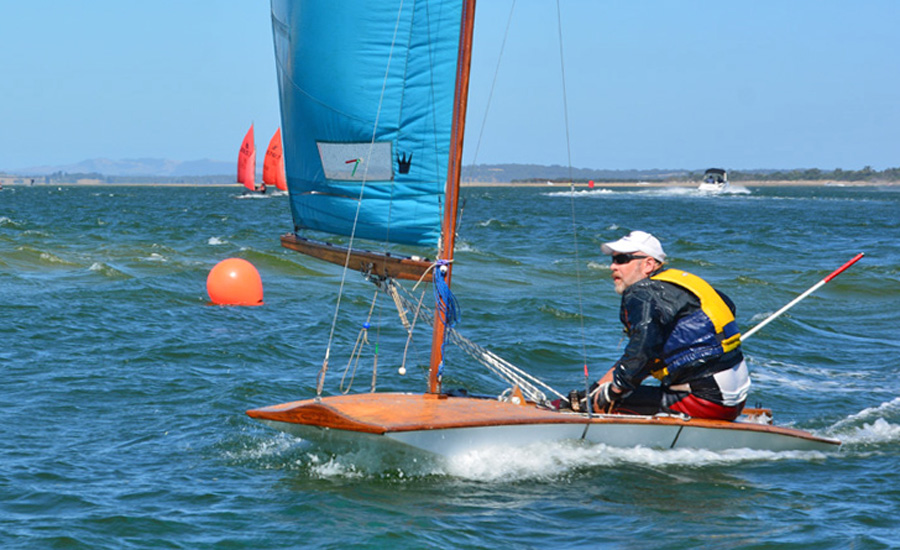
Header Photo: Gwen 12's at the ICWDR


Photos from the 2019 ICWDR (Inverloch Classic Wooden Dinghy Regatta) held over the Australia Day Weekend (January 26, 27 2019) have been filtering into Earwigoagin Central. The previous header photo features the Gwen 12 class, another Australian Classic Dinghy class that is making a concerted effort to find and restore old boats. Four Gwen's showed up at Inverloch with Grasshopper, the Gwen in the header photo getting the Best Overall Award. From Andrew Chapman:
"The Best Presented Sailing Dinghy was won by Rod Mackintosh’s Gwen 12 ‘Grasshopper’ sail number 2846. Rod... traveled from South Australia to sail with the other Gwen's. When he acquired the boat it was covered in thick green paint and since then it has been completely restored with clear finishes all over. The Inverloch and District Lions Club Perpetual for the Best Overall boat at the regatta, which is selected from the category winners, was [also] given to Rod Mackintosh’s Gwen 12 ‘Grasshopper’."


Kiwi Neil Kennedy offers up this description of the header photo in "Strine" slang. (It would be nice to have definitions for all this, but with second thought, we'll leave it all to the imagination.)
"As the Aussie's would say " Strewth cobber, ... here is a header photo of two "old Galahs" in a Gwen 12 thinking they were 30 years younger as they get set for a downwind blast. Of course 30 yr's ago they would have been lean and tanned, wearing a footy jersey and shorts, with bare feet, and after blasting around the bay, would have returned to the beach where they would have had two Shiela's in minimal bikinis equally tanned lying on beach towels waiting for their blokes with cold beers ready and waiting in the "esky" for the boys to "scull down" while they derigged and contemplated the evenings activities with the Sheila's, knowing that they were "good sorts" who liked a drink or two and with the usual approach of Aussie girls in that era " if you want a "root" to round out the nights entertainment "just ask !! I kid you not, I lived there for four years and I remember well; " with more than a smile or two."


A comment from unknown previous Gwen sailor:
"In Adelaide, South Australia first off-wind leg (Close Reach to Beam Reach), 1 nautical Mile long, 3 minutes with a decent wind or more. She sits on a dinner-plate size contact with the water. Water spews out the well (up to 1 metre) and straight over the stern transom. Oh and something hums! If you are not anticipating this kind of speed then you underestimate the Gwen 12's capabilities. It's a heavy weather specialist. You can still put up a kite when no-one else can."


More photos. No. 1905 is Wayne Fry's Scud IV.


No. 1941 is Toby Leppin’s recently restored 1960’s Gwen 12 Avenger. From Andrew Chapman: "Avenger won the Gwen 12 Challenge Cup. Toby sailed with crew Geoff Rippingale using the trapeze and setting the flat cut wire luff spinnaker...


Simon Wilson in Chaos Restored


Toby Leppin and Geoff Rippingale upwind.


Back in my International 14 days, when we saw such a relaxing photo, especially with the spinnaker being ready to be deployed, we said the crew was pausing to make the skipper a cup of tea.


I've commented before in Earwigoagin about the seeming complete die-off of the single trapeze performance dinghy - a puzzlement to this old fellow who remembers large fleets of Fireballs and 470's and Flying Dutchman in North America. (The 505 soldiers on but at an almost professional level.) I can't think of a better plywood project for a single trapeze, spinnaker dinghy than the Gwen 12.


From Drift Media, the 2017 Dinghy Show on the Glade. (I'm not sure this happened this year.)

ICWDR 2017 SEGMENT5 from drift media on Vimeo.


Apologies, but Andrew sent me photo attributions for these Gwen pics but I've mixed the photos up to the point I'll have to wait for Andrew to set me straight.

Wednesday, October 25, 2017

Ian Oughtred on Building a Gwen 12

Famous classic boat designer, Ian Oughtred, got his start in the sporty Australian Gwen 12, a single trapeze, DIY plywood, double hander. He was class champion sometime in the 1960's. Andrew Chapman has been feeding me some Gwen 12 material including this article by Ian Oughtred on building the Gwen 12. This looks to be from Seacraft issue of boat plans.

The Gwen 12 was designed by Australian Charlie Cunningham in 1948 as one of the first stressed ply dinghies. Like most Australian designed plywood dinghies, the Gwen 12 was extremely popular in the 1950's, 60's,  and 70's but died out in the 1980's. Below is the cover of the May 1958 Seacraft issue with what almost looks like a colored post card of the Gwen 12.


Here is the article by Ian in PDF format. Click here for 1971 plans for a double-bottom version of the Gwen 12.


Two restored Gwen 12's showed up at the South Gippsland Y.C. Australian Classic Wooden Dinghy Regatta in 2017.

Monday, February 19, 2018

Gwen 12 - 1971 Plans

Back in October, 1971, I wrote about the plywood, 12' two man Australian speedster, the Gwen 12, I mentioned I had in my possession a set of double bottom plans from the 1970's, courtesy of Aussie Andrew Chapman. I present them below. As always it is best to view this PDF file in another tab; click the arrow icon on the top right of the view box.


I think if I was to build a Gwen 12 in the U.S.A. I would glom a 420 rig onto the hull, particularly the non-class legal fat-head main that the collegiate programs seem to be now favoring.

TOH to Andrew Chapman for sending these along.

Thursday, March 2, 2017

2017 Australian Classic Wooden Dinghy Regatta - More Photos

ICWDR

I covered the Australian Sailfish class at the Inverloch 2017 Classic Wooden Dinghy Regatta and this is the second post of that regatta to cover some of the other vintage dinghy classes that made an appearance. Attendance was close to fifty dinghies which was a record for this, still young, event. Many of these dinghies were also featured in photos from previous Classic Wooden Dinghy Regattas.

A nice shot of the Classic dinghies on the beach. A scow Moth and and yellow-sailed Impulse are in the foreground. The blue and white sail is an Australian Sailfish.

Tim Wilson

Another beach shot with the Mirror dinghies and their distinctive red sails to the fore.

Tim Wilson

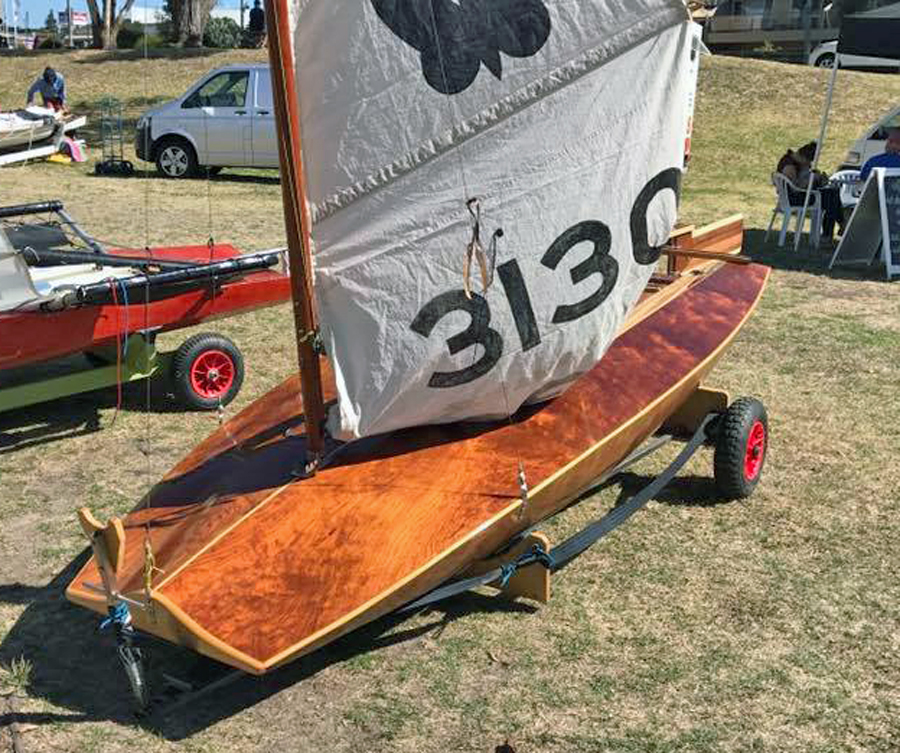
Australian scow Moth number 3130 is a Cole mouldie (wingless) design from the 1960's. This scow was painstakingly restored by Phil Johnson who had to reglue many of the veneers.

David French

This is an Aquanaut class dinghy sailed by Graeme Cox. The dinghy is around the Mirror length, 10 feet, main and jib sporting a single-chine, plywood shape. (I think it was designed for stitch and glue.) Earwigoagin has posted about an aluminium Aquanuat. I'll see if I can find out more about this design.

Tim Wilson

The Gwen 12 was a 12-foot single-trapeze design by Charles Cunningham. The class had large fleets in Australia up to about 1980 and the boat was known to be a heavy-air flyer. Two restored Gwen 12's showed up at Inverloch. (I think Earwigoagin correspondent, Andrew Chapman, is in number 2555.)


The beautiful cold-molded Aussie 16-foot skiff. Owned by Frank Raisin, this skiff was professionally refurbished.

Tim Wilson

This looks to be a double-bottom Gwen 12 (yet to be confirmed).


Another winged Aussie scow Moth.

Tim Wilson

Two of the larger three-man vintage dinghies crossing tacks; the cold-molded Aussie 16-foot skiff and the chined Olympic 12m2 Sharpie.


At the end of the racing, the dinghies transition from the beach to the "glade", a grassy area where spectators can look without getting their sandals gritty and the judges peruse for "Concours de elegance" awards.

Tim Wilson


The Australian Classic Wooden Dinghy Regatta is hosted by the South Gippsland Y.C.

Sunday, March 11, 2018

Two different scows at the Inverloch Classic Wooden Dinghy Regatta: Rainbow and A-12


While I'm on a scow kick, mention must be made of two different scow designs that competed in the Australian ICWDR out of the South Gippsland Y.C. One of the kingpins of the Classic Wooden Dinghy event, Andrew Chapman and family, had two restored Rainbows in the regatta. (Correction: Andrew did the restoration of one "Annie", his son-in-law, Jonathan, a fine craftsman in his own right - music instruments - did the restoration of the other one, "Moonraker".The Rainbow is an Australian 3.65 meter design that was popular as a junior trainer in South Australia in the 1960's. Andrew sailed one Rainbow with his grand-daughter and, his daughter Trilby, sailed the second one with Andrew's other grand-daughter. I asked Andrew what he thought of the Rainbow scow as a parent/kid sailing dinghy and he was enthusiastic.
"The Rainbow is lovely small boat to sail. It is very forgiving and a lot faster than a Mirror and Heron without using the trapeze and/or large spinnaker. I think it is an ideal boat for an adult and young kid or young teenagers. Trilby and I sailed with each of her two daughters and we plan to introduce them to using a trapeze on a beat and then the trapeze with spinnaker on reaches. We are also putting them on the helm and they enjoy sailing the quicker boat and they are not overwhelmed by the boats size. When they are comfortable using the trapeze and spinnaker trapeze combination the next stage will be the Gwen 12 then Cherub. I think the Rainbow is a very good small boat and it is one that is very easy for home builders to make.
Andrew Chapman and grand-daughter in "Annie".


Trilby and daughter in "Moonraker"


Three very different Australian scows in one shot. Trilby with the Rainbow on the beach, a modern carbon foiling Moth scow, and, in the background, a Classic wingless Moth scow.


Plans for the Rainbow scow can be found here.


The A-12 scow was Frank Bethwaite's follow-on to his Northbridge Junior scow. Designed to be a higher performance dinghy, the A-12 was longer, 12 feet or 3.65 meters, sported Frank's signature rotating mast and had a trapeze. Neil Kennedy from Nedslocker dug out a November, 1970 issue of the Australian Modern Boating which featured the class when newly introduced. Some photos from that article:


An A-12 scow has shown up at the Inverloch Classic Wooden Dinghy Regatta for the last two years but, as Andrew Chapman writes, in the beginning no-one knew what type of scow it was.
"At the first regatta Andrew Kean sailed the boat as a Moth, with two tone blue sails, because that what it was sold to him as. He did wonder why someone had put a trapeze fitting on the mast. Apparently he never thought to measure the length. He sailed it again in the most recent regatta as an A12 with blue and white sails with a different rig.
From the photos it looks like Andrew was able to find a genuine Bethwaite rotating rig and A-12 sail.

The A-12 with the original Moth rig; a blue sail, wooden spars.


The A-12 on the Inverloch beach next to an Australian Sailfish.


For the 2018 regatta, Andrew was able to plug in the correct rig; aluminum rotating mast with a very big sail.


I'm not sure any plans exist for the A-12. None have come forward yet.


George McGee adds more info on the A12. (From a comment I dragged to the main body.)
"I raced an A12 at Northbridge sailing club in the mid seventies. My boat came from Starbord Products with 2 rigs. The first rig was the 85 sq foot two tone blue sail with the over-rotating wooden mast. The second rig was a 65 sq foot two tone sail with a shorter wooden mast. (Not sure of the 65sq foot size). When the smaller rig was used the boat was classed a J12 rather than A12. NSC had a number of A12s and J12s competing on Sundays in the mid seventies.I spent many a happy afternoon on the A12 redefining the term "screaming reach"
.