Showing posts with label Scow. Show all posts

Thursday, November 12, 2020

Flat Pack Composite Kits


Flat pack plywood small boat kits; all pieces CNC cut and shipped to you in a nice long box (or two) have been around since the mid 1990's. The local firm, Chesapeake Light Craft is a world leader in this type of kit, offering a wide array of plywood small boats in kit form; built stitch and glue with epoxy fillets. Back in 2014, Aussie Mark Hughes took the flat pack kit concept one step further and developed a composite carbon/foam flat pack kit for super-techy ultra-lightweight construction. In the photos below the flat pack kit makes a Bunyip scow Moth. Todd Oldfield, posted on Facebook on his build, which I have lifted and re-posted here.

The jig is CNC cut from MDF and is an intricate web of slotted panels designed to hold the frames.


Frames, topsides, and chine panels are cut from prefabricated vacuum-bagged carbon skinned foam. The Perverted Moth blog has the layup schedule for the Bunyip panels.


Jig assembled.


CNC cut frames in place on jig.


Topside and chine panels taped in place.


Fitting the bottom foam panel. The bottom foam panel is not glassed on the outside.This may be because the entire outside of the hull is covered in a wet/layup carbon layer to stick everything together.


Carbon ready to wet out.


Outside of the hull complete on jig.


Hull off jig. I would think there would need to be more gluing area along the gunwhales and maybe along the frames


Fitting the foam deck and foredeck. Note the cuts to help the foam bend around the curves for the nose block. A heat gun is also helpful for this.


Below: the first 2014 carbon/foam Bunyip M-scow with cut-out frames and mast support box. From Longy Oi:
"There are different versions, designs. both composite inspired by the ply Bunyip design. First build was the Mark Hughes M-Scow designed composite flat pack was built as Brian Sherrings 'Carbonara'. Possibly the strongest yet light scow built. Todd's build is to another (?bunyip) digitised design. I don't know the point of having the two designs, but, yes, some differences, there was some Wet lay-up on the latter build, maybe not on the MScow?"


It may be that a scow with it's shallow curves is more suited to this style of flat pack kit-building. Composite panels, being stiffer than plywood panels cannot be expected to twist up as plywood panels can. (Reference Todd Oldfield's comments below.) I could see someone also trying this method on the simple, Benoit Duflos Classic Moth Moth-Pop design.


Todd Oldfield answers some questions about his build:
"in answer to your question I didn't put carbon on both sides of the deck and hull under vac bagging as if i did that I would not have been able to get the desired shape in the panel if i did it on both sides. I went back after the panel was glued done and put a layer of carbon over that panel and relevant join on the chines. All the chines are covered ibn carbon both sides to. It was a good fun build that was quicker to do than expected and wasn't as hard as expected either by using a male jig to form the boat on."


Saturday, September 19, 2020

Sailing Dinghy Restorations during the Pandemic


It seems the Covid Pandemic has driven the older dinghy guys into the shop, particularly the Antipodeans who have been busy restoring 60 year old scow Moths and Australian 14-footers.


And this old skiff as well.


Monday, August 3, 2020

Australian Sailfish: Building Photo Documentation


Greg Barwick of the Australian Sailfish Association emailed me to point out they have now added a marvelous photo essay on building the Australian Sailfish to their website. (Look in the top Menu for "Building - a Visual Guide".) A must see for anyone interested in building plywood dinghies. Even experienced boatbuilders can pick up an idea or two in going through the photos. To make it easier I've listed the various chapters of "Building - A Visual Guide" with their links below.

To order plans for the Australian Sailfish.

Brian Carrol's photos of his build of an Australian Sailfish

Friday, July 24, 2020

Dutch Skûtsje in a Bit of a Pickle


I came across this photo on the InterWebs of a Dutch working scow, a Skûtsje, doing what sailboats without keels are wont to do every once in a while; reward in-attention by coming close to capsizing. From the Earwigoagin archives, I've written before about the Dutch Skûtsje, here, and here.

All of my posts on Dutch sailboats.

Friday, November 29, 2019

The Playboy Bunny


Next year is the fiftieth anniversary of the Teacup Regatta, the regatta famous for introducing the world to the Laser (originally named TGIF, Thank God it's Friday). The above photo is from the article on the Teacup Regatta in the December 1970 issue of One-Design and Offshore Yachting. OD-OY came up with the idea of pitting all the 1970 American off-the-beach sailboats in a regatta and judging competition and did all the leg work in putting the event together. The Teacup Regatta was held on Lake Geneva, Wisconsin, about a two hour drive from Chicago. In 1969 Hugh Hefner had opened a huge Playboy resort on Lake Geneva, hence this photo of a trio of Playboy Bunnies taking a spin on one of the competing dinghies between races.

This photo jogged the old memory banks about my own Lake Geneva and Playboy Bunny story. Two or three years later, as a poor college student on summer break, I decided to enter the O'Day cup, a singlehanded championship of the old USYRU (U.S. Yacht Racing Union). You qualified in ascending elimination rounds (club to district to region and then to the finals). I didn't have any lofty aspirations; my racing skills were somewhat rudimentary, but it was a cheap way to get in some sailboat racing as the host club supplied the boats and entry fees were either free or nominal. My local club, Berlin Yacht Club, put my name forward and I awaited being told where to go for the Ohio-Pennsylvania district eliminations. It turned out that there was only one other club to put up a name and he dropped out. Without sailing a race I had qualified for the Midwest Regional O'Day eliminations.

The Midwest Regional O'Days were to be held by the Lake Geneva Y.C. in Lasers, a 500+ mile trip from my home and I didn't own a car. During the 1970's this was no problem  as hitchhiking was a viable means of getting around. I had already crisscrossed the Midwest several times on the kindness of others stopping to give me a lift. I duly made it into Lake Geneva. (This may have been the time the rides dried up late at night and I had to spend the night at the Milwaukee Airport; elevator music, bright lights and trying to sleep across three hard seats.) The regatta was midweek and there were four or five of us racing in typical on-off, shifty lake conditions. I finished third or a close fourth, the memory is hazy, but I was fine with that. I had no plan B if I had improbably qualified for the finals and had to figure out how to get to a regatta during the school year and far away.

The Lake Geneva YC had their midweek evening summer series during the O'day eliminations and I got a crewing job on a M-16 scow. (Which has now morphed into the very popular cat-rigged MC scow; the M-16 was main/jib). I remember being miffed at having to handle leeboards on every tack and came away with a better appreciation of my Dad's Y-Flyer scow which was my Berlin YC racing ride.

In the fog of long-ago recollections there is one searing memory from that race and that is of another fellow crew. One of the leading competitors in the M-16 scow class had married a Playboy Bunny who was now his crew. We were far enough back in the race that we didn't cross tacks often with the couple but I did join the gaggle of sailors that surrounded her (bikini-clad) apres-racing. I came away with the impression of a separate female race; not so much titillated by her but more having encountered something genetically unique. Hugh Hefner's vision of an ideal American woman was rooted in the 1950's and 1960's, all jutting breasts, small waist, small butt, very much top-heavy. I had the good sense, even back then, to realize this wasn't the real world.

I never went to the Playboy Club at Lake Geneva during that trip. No money and besides, when hitchhiking, travel times were always open-ended. No time to dawdle. Best to hit the road when things were wrapped up. The Lake Geneva Playboy Club closed in 1981.


Two videos of the Lake Geneva Playboy Club.


Tuesday, November 26, 2019

Australian Sailfish: updated plans


News from Down Under. The Australian Sailfish class has updated their plans. From Greg Barwick:
"After many, many months of hard work, writing, editing; reviewing (repeat until you can’t sleep :-)), a new set of Building Instructions, complete with CAD drawn frame diagrams is now available. This has been an enormous task led by our own Chris Cleary, who built a boat as he went along just so he could adjust the Instructions and take photographs There was also a lot of input from Ian Urban (our CAD specialist), Ian Milton and others to get us to this point.

"When we kicked off the website and made the plans available three years ago, we had no idea how popular that would be, so plans have been sent out for the last three years without an allocated number. To mark this relaunch of the Plan Sets we are also starting numbering the plans once again.

"The highest number issued up to now was 3500, so we have decided that we will start the numbering of the new Plan Sets from 3501. I even have the original Plan Sales book to record it in!

"As well as a comprehensive set of Building Instructions, (76 pages) there are two A0 sheets of frame diagrams that will give full size Frame templates, one A0 Centreboard Plan & Section sheet and one A1 Rudder Sheet in each Plan Set.
We have also launched a new section on the website, 'Building . . . a Visual Guide', to be used in conjunction with the Building Instructions, so check that out as well.


Click here to order a set of Australian Sailfish plans.


Also a very earnest Earwigoagin TOH to the hard-working folks reviving this great little Australian dinghy.


Saturday, May 4, 2019

CVRDA: First Regatta of the Season


The English organization, Classic, Vintage, Racing Dinghy Association, CVRDA, held their first regatta of the season at Hunts SC. Photos were posted on Facebook by Nikky Evans. I've taken the classes that I'm interested in; Classic Moth, Minisail, and reposted them here.

Ian Marshall in the Shelley design Classic Moth.

Nikky Evans

Nikky Evans

A yellow Skol design Classic Moth - I think sailed by Richard Woods. It looks like Richard is using a heavy air sail given the short foot length of the sail.

Nikky Evans


Nikky Evans


Nikky Evans

The English pretty much invented the clinker (lapstrake) built small sailing boat. Here is an pretty 12 foot Sea Ranger, found mostly at Gunfleet SC. (Geez!, the Brits have the best sailing club names!)

Nikky Evans


A Minisail. An Ian Proctor designed scow; the precursor to the Topper. Sailed by a fellow named Steve. It looks like Steve glommed a Laser Radial rig onto the Minisail.

Nikky Evans


Nikky Evans


Sunday, April 28, 2019

Header Photo: San Diego Swallow Scow


Paul Naton


The previous header photo was of Rudder's Swallow scow being sailed on San Diego Bay. Paul Naton sent this historical photo along and I present the un-cropped version. It is of his great grandfather Fred O'Farrell, who co-owned this Swallow with Claude Woolpas. Paul details below how he received the photo and his dogged research into the time and place this photo was taken.


Saturday, October 13, 2018

Scow Moth Rendezvous: Albert Park Lake

A week ago, six Classic (non-wing) Aussie scow Moths made it out on the small lake in the Melbourne city park, Albert Park.


Details are sketchy but they raced in the first of the summer series racing. (It seems if it is fall in my neck of the woods in the Northern Hemisphere then it must be spring in Australia - but if they call it a summer series, then so be it.)

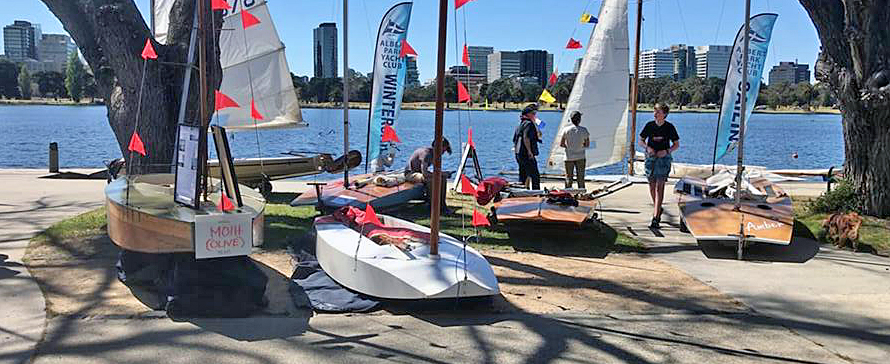
Rigging area. Not sure what the designs of these scow Moth they are but I imagine they are of the Imperium time-frame.


The original Len Morris Olive made it outside the museum. Next to her is the Len Morris Mk II.


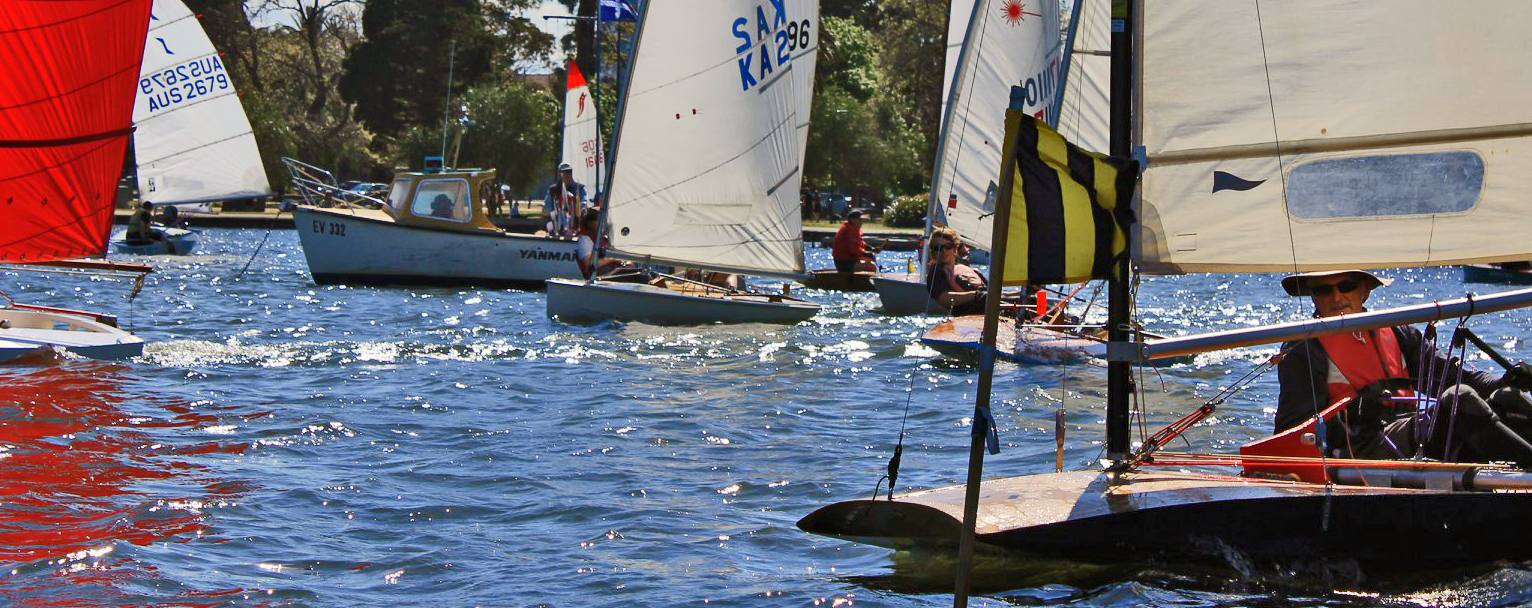
The scow Moths started with a Europe dinghy and a Laser Radial. We see a Solo dinghy and Sabre dinghy in the background, waiting for their start.


Some racing pics:

.

.
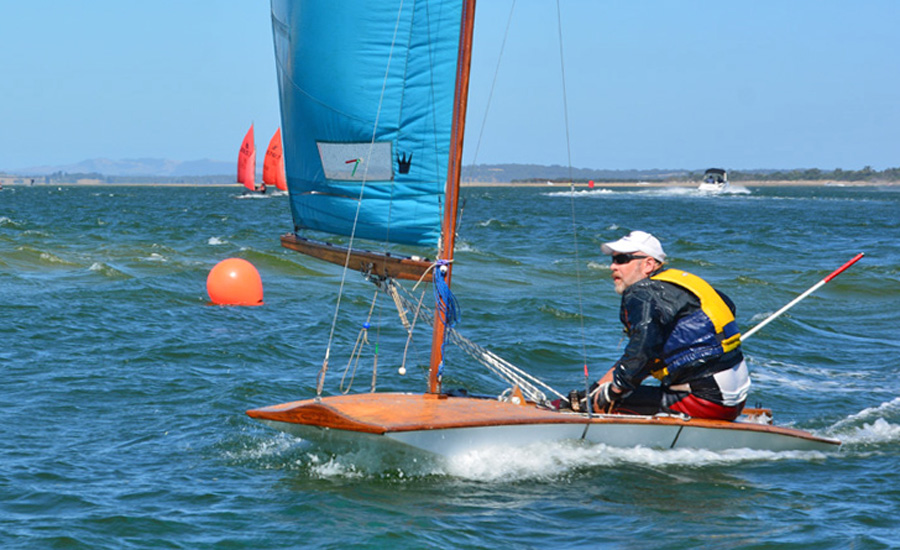
Phil Johnson in his painstakingly restored Peter Cole Mouldie design.

.
Photos originally appeared in Scow Moth Club group on Facebook.

Monday, April 2, 2018

Header Photo: Start at Largs Bay, 1986


The previous header photo was of a start at the 1986 Moth World Championships at Largs Bay, Adelaide, Australia, the last time the scows and skiffs would mix it up. More photos from that regatta can be found here.

Moth and Sailfish Scows at the Inverloch Classic Wooden Dinghy Regatta

Time to wrap up the scow thread which I've kept Earwigoagin on for a month or so. This post I stay with the Australian Inverloch Classic Wooden Dinghy Regatta and the other two vintage scow classes competing; the Australian scow Moth and the Australian Sailfish design.

As mentioned before, the Inverloch Classic Wooden Dinghy Regatta celebrated the 90th year of Len Morris building his "Olive" which would become the Inverloch 11-footer class and then, when they spied the Rudder magazine article with Crosby's plans for his Skimmer Moth, the Inverloch group appropriated the emblem and become the Australian Moth class. The original "Olive" is still in one piece and was on display in the gymnasium at the Inverloch Regatta. The original definitely has high freeboard. Nowadays we would probably say the design is more pram-like than scow-like.


Len Morris's second Moth design, the Mk II, built post WWII, would take Australia by storm and was definitely more in line with the low freeboard American scows. Graeme Cox brought along an early Mk II. Note the low roach mainsail on the MkII (#3021) compared to a later 1960's scow design (#3396, an Imperium perhaps?).


Graeme Cox's MkII from the stern.


Phil Johnson, in his beautifully restored Cole Mouldie Moth, won the "Best Moth" prize at the regatta.


Nine Australian Sailfish made it to the 2018 ICWDR, down slightly from the eleven that showed at the 2017 ICWDR. Nine Sailfish still made up the largest class attending in 2018. There was even a brand new build. Brian Carroll, son of Jack Carroll, one of the designers of the Australian Sailfish brought the freshly launched "Jacks Toy" to Inverloch.


The new build Sailfish sported SUP non-skid tread, certainly a big help in staying on these slippery, narrow, beach boats.


Sunday, March 11, 2018

Two different scows at the Inverloch Classic Wooden Dinghy Regatta: Rainbow and A-12


While I'm on a scow kick, mention must be made of two different scow designs that competed in the Australian ICWDR out of the South Gippsland Y.C. One of the kingpins of the Classic Wooden Dinghy event, Andrew Chapman and family, had two restored Rainbows in the regatta. (Correction: Andrew did the restoration of one "Annie", his son-in-law, Jonathan, a fine craftsman in his own right - music instruments - did the restoration of the other one, "Moonraker".The Rainbow is an Australian 3.65 meter design that was popular as a junior trainer in South Australia in the 1960's. Andrew sailed one Rainbow with his grand-daughter and, his daughter Trilby, sailed the second one with Andrew's other grand-daughter. I asked Andrew what he thought of the Rainbow scow as a parent/kid sailing dinghy and he was enthusiastic.
"The Rainbow is lovely small boat to sail. It is very forgiving and a lot faster than a Mirror and Heron without using the trapeze and/or large spinnaker. I think it is an ideal boat for an adult and young kid or young teenagers. Trilby and I sailed with each of her two daughters and we plan to introduce them to using a trapeze on a beat and then the trapeze with spinnaker on reaches. We are also putting them on the helm and they enjoy sailing the quicker boat and they are not overwhelmed by the boats size. When they are comfortable using the trapeze and spinnaker trapeze combination the next stage will be the Gwen 12 then Cherub. I think the Rainbow is a very good small boat and it is one that is very easy for home builders to make.
Andrew Chapman and grand-daughter in "Annie".


Trilby and daughter in "Moonraker"


Three very different Australian scows in one shot. Trilby with the Rainbow on the beach, a modern carbon foiling Moth scow, and, in the background, a Classic wingless Moth scow.


Plans for the Rainbow scow can be found here.


The A-12 scow was Frank Bethwaite's follow-on to his Northbridge Junior scow. Designed to be a higher performance dinghy, the A-12 was longer, 12 feet or 3.65 meters, sported Frank's signature rotating mast and had a trapeze. Neil Kennedy from Nedslocker dug out a November, 1970 issue of the Australian Modern Boating which featured the class when newly introduced. Some photos from that article:


An A-12 scow has shown up at the Inverloch Classic Wooden Dinghy Regatta for the last two years but, as Andrew Chapman writes, in the beginning no-one knew what type of scow it was.
"At the first regatta Andrew Kean sailed the boat as a Moth, with two tone blue sails, because that what it was sold to him as. He did wonder why someone had put a trapeze fitting on the mast. Apparently he never thought to measure the length. He sailed it again in the most recent regatta as an A12 with blue and white sails with a different rig.
From the photos it looks like Andrew was able to find a genuine Bethwaite rotating rig and A-12 sail.

The A-12 with the original Moth rig; a blue sail, wooden spars.


The A-12 on the Inverloch beach next to an Australian Sailfish.


For the 2018 regatta, Andrew was able to plug in the correct rig; aluminum rotating mast with a very big sail.


I'm not sure any plans exist for the A-12. None have come forward yet.


George McGee adds more info on the A12. (From a comment I dragged to the main body.)
"I raced an A12 at Northbridge sailing club in the mid seventies. My boat came from Starbord Products with 2 rigs. The first rig was the 85 sq foot two tone blue sail with the over-rotating wooden mast. The second rig was a 65 sq foot two tone sail with a shorter wooden mast. (Not sure of the 65sq foot size). When the smaller rig was used the boat was classed a J12 rather than A12. NSC had a number of A12s and J12s competing on Sundays in the mid seventies.I spent many a happy afternoon on the A12 redefining the term "screaming reach"
.