Good friend, Tom Price, top-notch racer and also an artist, sends along these pencil drawings he did as trophies at a recent Star Regatta. Obviously most of them are of Stars but he also did a nice one of a traditional tall ship, I think a barquentine. Just superlative work! As always click on one of the photo to get an expanded view.
The previous header photo was of some chaps in Australia racing radio control model yachts, specifically the A class model yachts, the biggest of the RC classes. Some out in Interweb land interpreted this to mean that Tweezerman, in his dotage, had resigned himself to sailing from the shore, but nothing could be farther from the truth. The few times I have tried RC model yachts, I found that, spatially, I am challenged to sail properly when I'm off the boat. (Read this to mean dangerous to fellow model yachts as well as buoys of the course.) Also, my finger reaction with joy sticks and knobs is pathetic. Thirdly, racing model yachts doesn't excite my passion the way a full size dinghy does.
The reason I post this; If I was of the 1% crowd, and, if I was to pour some of my ill-gotten gains into a keel boat, I would want a custom built yacht with a long, long overhanging stern. I love those classic long sterns. There would be nothing cooler than be a a helm of my yacht and look astern at a transom that goes on forever. And where does the RC A class model yacht fit into this. They have the longest overhanging sterns going. Just look at two pics of the current crop of designs.
So as a 1% playboy, I would take some play money and have a full sized A-class model yacht built, say about 10 meters in length; designed to sail with only two people; minimal accommodation under a tiny coach roof; completely impractical. But I would have that long, long beautiful stern and the stern waves curling off the hull and those waves finally rejoining the playing field off in the distance astern.
The previous header photo was of a pair of 110 keelboats bashing upwind back in the 1970's. The 110 was an odd-ball 1936 Ray Hunt design, born in the Great Depression era. The hull was a double-ended, narrow canoe shape, flat-bottomed. I've bumped into them occasionally. At a wedding at Ocean City Y.C, New Jersey in early 2000's I found a small fleet on trailers in the dinghy park. There was also one that showed up at the WOOD regatta back in 2011. My friend Tom Price has one awaiting restoration. I've never sailed on a 110.
The class was originally strong in New England with pockets scattered throughout the U.S. In the present day, it seems most of the 110 activity in the U.S. has shifted West; just north of San Francisco; Tomales Bay, with a fleet at the Inverness Y.C.
The distinctive shape of the 110 can be seen in this heeled-over photo pulled from the InterWebs.
James W. Laws
The specs for the 110 as put out in the OD-OY magazine's annual class review. The hull weight is 412 kg (910 lbs.) which is identical to some of our heaviest North American dinghies.
Found this in the International Soling Association Guide 1992-1995. A beautiful, subtle ink and watercolor (or ink wash) drawing by Michel Bernard of Paris.
One couldn't help but notice the small keelboat jammed right up against the fence line of the Sailboat Show. She was tucked into the corner facing Annapolis's dockside restaurant row and sported all the accoutrements of modern keelboat design, reverse bow, bulb keel, skinny rudder, assymetric spinnaker. Once inside you discovered this keelboat, the RS21, is RS Sailing's new entry into the day keelboat market, the design brief targeting the emerging club keelboat market where the sailing club buys the boats and the sailors pay an extra fee to climb aboard and race.
A photo of the cockpit looking aft. Two mainsail cleats; the forward one for the mainsheet trimmer when going upwind, the aft one for the skipper or trimmer that has moved aft for the offwind legs.
Looking forward it is a very clean cockpit.
The bulb keel. It does have a weed cleaner/cutter that comes standard which is a must given the very straight leading edge of the keel. A Torqueedo electric drive comes with the RS21 (You can see the prop in front of the rudder - I think it gets raised when saililng.)
The business end of the mast. Plenty of controls to keep the crew occupied.
Some videos of the RS21 on the water. I would have to say the RS21 most closely matches the market where the popular J70 currently dominates in the U.S.A.
This blog is mostly about small boat sailing but I have covered keelboats occasionally. For those in the depths of Northern Hemisphere winter, inside the house, with time on their hands, you can watch my previous keeler posts on Earwigoagin here.
In 1856, the last year of his life, George Steers, the designer of America, designed a small 24' racer for Harry Latrobe Roosevelt of Skaneateles N.Y. Named Laura, this Steer's racer would spend her entire career on Skaneateles Lake. On Christmas Day, 1936, after being hauled for the last time, Osgood R. Smith, John Barnes, and Art Emerick would measure Laura on the beach. Eight years later, Osgood R. Smith wrote an article on Laura in the August 1944 issue of Yachting magazine and included the lines they had assembled.
Laura provides a glimpse of how the New York designers were moving the lines of the New York oystering workboat into a recreational racer. (See also Chris Thompson's article on the 1853 Una design by Bob Fish). We see the basis of form that would be tweaked, some fifteen years later, into the all-out Sandbaggers of the 1870's. Compared to Sandbaggers, the George Steer's Laura is a wholesome hull of moderate proportions though we can see the fine bow and the tucked-up aft rocker of the Sandbaggers. There is no record of Laura needing sandbags to be raced.
Laura's sections show a fair bit of tumblehome.
The beam is not excessive.
This side view has the stern lopped off because the copier distorted the stern as the page made it's way down into the binding of the book.
Sometimes all it takes to brighten the mood is a video of a class of topsail cutters, crews working hard, these powerful sailing craft cutting deep furrows, their jaunty bowsprits leading the way as they bash upwind, .
A video of Falmouth Working Boats racing with their big rigs combined with insightful interviews of those involved with the class:
A drawing of the Falmouth Working Boat shows a full keel, broad shoulders, narrowish stern and cutter sections of the traditional English fishing boats
The St. Mawes Sailing Club has this warning to spectators, particularly those who are watching the Falmouth Working Boat racing from a boat:
"A final cautionary note to add is that most Working Boats carry no engine and under full racing sail they are a handful for even the most experienced sailor. A long keel and limited visibility to leeward for the helmsman means that manoeuvrability is limited especially on crowded start lines or amongst moorings. I would recommend viewing from a distance and marvel at the skill of the top skippers as they navigate their way through the obstacle course that is the Carrick Roads on a summer's day.
We had a bit of snow and wind over the weekend here in the Mid Atlantic. Damned inconvenient in the modern world... waiting, ... waiting... house-bound, but the snow plow did finally come through today to free us up. To overcome the ennui of isolation what better than to view a video where life is balmy, even tropical. Ah! shorts, bare feet!
A video of a twilight sail in a traditional day charter boat our of St. John, U.S. Virgin Islands.
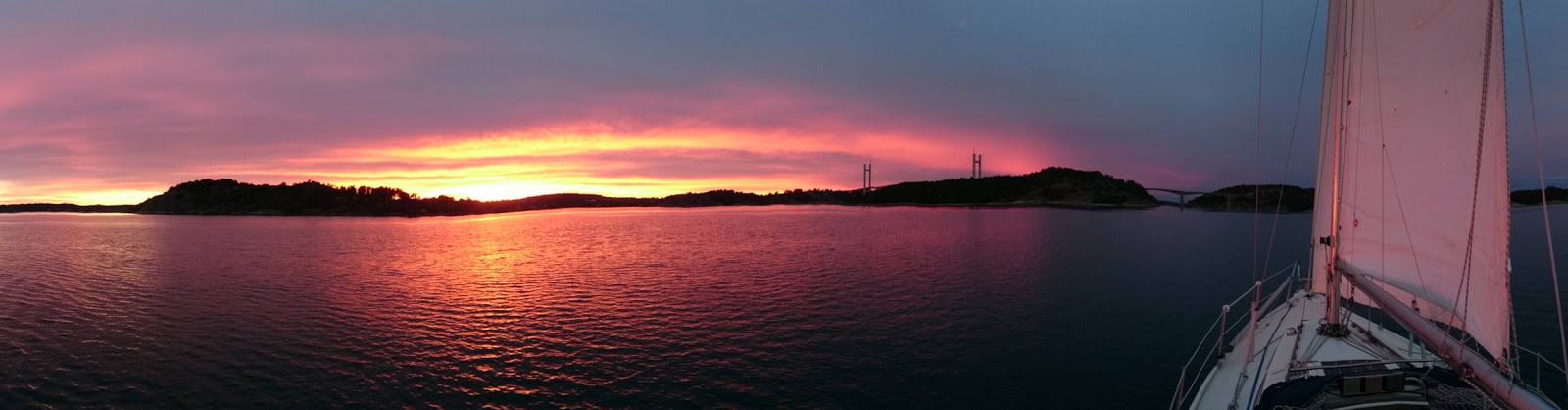
Martin Rutgersson, Laser Sailor from Stenungsund, Sweden (just above Gothenberg on the west coast), sent along a video of him doing some bombing around in a Laser in September. Apparently fall twilight in Sweden lasts between 2-3 hours and sailing in this muted light is an entirely different sensory experience. From Martin's email:
"To sail in the beautiful long sunsets we have
here in Sweden this time of the year is just marvelous.
Martin also sent along this spectacular sunset photo.
Martin Rutgersson
I was under the impression that Stenungsund was a Swedish backwater until I went poking around the Internet and discovered that Stenengsund is the focal point for the Tjörn Runt, a 50 km race. round Tjörn Island, held in August that attracts 1000 sailboats of all types, from all-out multihulls and carbon monohulls to the mom and pop cruiser Evidently this race is also popular with spectators as there are parts of the course where the sailboats must navigate narrow inlets; short tacking among crowded groups and sometimes crashing into the shore. A short video advertising the 2014 race:
This is one project of the super-rich where the beauty just radiates outward into one colossal superlative and, even if you are to the left of the political spectrum, all you can say is, "Well done, well done!"
Click here for information about CRAB (Chesapeake Region Accessible Boating).
It somewhat pains me to admit this, but I've done more keelboat sailing over this past summer than dinghy sailing. I've been volunteering at CRAB (Chesapeake Regional Accessible Boating - my long time sailing friend, Dick White, is sailing director there) and I've been kicking around the Bay with various groups in CRAB's keelboats, the Freedom 21's, which were designed specifically for handicap sailing.
The blogmeister had to make a singlehanded delivery of a Freedom 21 from the home-port of Sandy Point State Park down to Annapolis (the Freedom 21's were sailing in Boatyard Bar and Grill fundraising regatta off Annapolis that Saturday). I took my trusty pocket waterproof camera and shot a very short video of the 6-7 mile jaunt (including selfie).
I was delivering the Freedom 21 down to Annapolis for the annual Boatyard Bar and Grill fundraising regatta, where, as it turns out, US Sailing had decided to feature this years regatta, and CRAB, in this well done video.
The local Chesapeake Bay sailing rag, Spinsheet Magazine, captured the elusive blogmeister crewing at a previous Wounded Warriors Regatta.
Dave Raison, in his latest scow Mini Transat 6.5, won the Mini Fastnet this past June. There are now other scow Mini 6.5's appearing. Swiss Simon Koster put one together he has named eight Cubed after the number he sails under. Included below are some photos of his new creation.
Make no bones about, these sailboats are Uglee.....High freeboard on a scow shape is not pretty. Simon Koster waved the ugly stick even more by making his cabin top very blocky.
From the The Simpsons, a quote by bartender Moe before he underwent plastic surgery. Moe
"I've been called ugly, pug-ugly, fugly, pug-fugly, but never ugly-ugly."
I'll go with pug ugly. I like scows. I like different. I like that, with these shapes, form follows function. Some would call these Mini 6.5 scows cute. (Can you call a sailboat cute?).
From this bottom-up, bow-on angle, combined with the paint scheme, eight Cubed appears to have the bottom of a rubber ducky bathroom toy.
Ah! That's more like it. The familiar wide arse of a Mini-Transat 6.5.
You can see the odd split, blocky looking, almost comical cabin house with forward facing window in this photo of eight Cubed hanging in the shop before the initial launch.
A video of the start of the Mini-Fastnet. Winner David Raison in #865 with the distinctive blue jib can be seen starting about 56 seconds into the video and then at 2:20. 8-Cubed shows up at the 1:43 mark.
The VX One is one the new generation of hybrid racing designs, in this case a design that targets the longer (17' to 19' or 5 to 5.8 meters) dinghy market in the U.S.. The VX One is that modern mashup of dinghy, skiff, and keeler concepts. It borrows most from the skiff world; the fat arse, narrow bow sections, flat rocker, assymetric and roachy full-battened sailplan. To calm it down a bit, it has a lifting keel of about 60 kg (135 lbs.). The VX One's length, sail area, overall weight and, no hiking assists, it is raced as a hiking sailboat, puts it out there as a modern market alternative to America's longer traditional hiking dinghy classes; the Lightning, Thistle, and Flying Scot. Conceived and designed by Brian Bennett, with naval architect data crunching by Rodger Martin (who also did the Johnson 18 in the early 1990's) and Ross Weene, the VX One seems to have maintained steady growth in the U.S. since 2011. Though I couldn't find a price on the InterWebs, The VX One seems to be pricier than any of the aforementioned traditional large dinghies, and definitely more balls-to-the-wall than family oriented racing. Is this hybrid concept the way of the future in America small boat racing, where we seem to treasure both stability and performance?
Here is a very nice video of the VX One with the obligatory planing-at-full-speed filling up most of the footage.
A first for Earwigoagin; I put a keelboat up on the header photo. This is a 30 square meter, a type also commonly referred to as a Skerry Cruiser, and to my eye, the various square meter sizes are the prettiest of yachts with long, long, overhangs, low freeboard, and efficient rigs. (I have always found large overlapping jibs to be photogenic.)
Alden Smith put a comment up about this photo and. in reply I realized I didn't know the history of the square meter rule. So a quick tour around the Internet turned up a couple of factoids.
The rule originated in Sweden in 1907 as a reaction to the perceived rigidity of the International Meter rule. The current rule, administered by the Swedish Classification Board, traces back to 1925 with some tweaks along the way.
It is based on a sail area rule, the square meter is the sail measurement of the class though this is somewhat deceiving as only 85% of the jib foretriangle is measured, hence the extreme overlapping jibs to get free sail area.
There were a bunch of classes from 15 sq. m. up to 150 sq. m. but the two that survive in some numbers today are the 22 sq. m. and the 30 sq. m..
If you want to dig in deeper, as usual, the best place to start is the Wikipedia page.
There was a good number of 22 sq. m.'s that were either imported or were built in the United States and several years ago I came across one being restored in Annapolis. Unfortunately I've forgotten who the owner was.
Sea State Marine, out of Missouri, of all places, (their blog is part of my blog list) is in the process of restoring a 1929 sq. m. Kippis, a Skerry Cruiser that was sitting in a barn in Missouri. Some, but not all, of Sea State Marine's blog posts on the 22 sq. m. rebuild can be found here.
Mesmerizing "rockin and rollin" downwind in some breeze off the coast of Ireland. I like how the skipper steers from a relaxed, sprawled position (which probably isn't relaxing given the pull on the rudder... just looks that way).
Back in 2011 I covered the start of the inaugural Elf Classic Yacht Race run in June from Annapolis, across the Chesapeake Bay to the always popular Eastern Shore harbor of St. Michaels. The centerpiece of the race and the race's namesake is the restored 1888 Lawley topsail cutter, the Elf. I didn't catch the start of this year's race but in addition to Elf and the participation of the two reproduction Sandbaggers, based in Annapolis, a very brave Log Canoe crew ventured way, way out of their traditional confines of Eastern Shore river racing and dared the Bay crossing as well.
I came across this very good video documenting the 2014, Elf Classic Race.
Bald but my eyebrows are growing at a prolific rate. Sailed Windmills and Y-Flyers in the 1960's. Founded Miami University (OH) sailing team. Sailed International 14's and Lasers in the 1970's. Sailed International Canoes in the 1980's to mid 1990's. Sailed Classic Moths since 2002. Enjoy boatbuilding though I'm very, very slow at it (the Internet doesn't help matters). Name in real life: Rod Mincher
After choosing this username (Tweezer is the name of my Classic Moth), further research on the Internet turned up that Tweezerman is a corporate name for a line of pedicure products. Let me emphasize that I do not work for, nor endorse these products.