Showing posts with label Dutch Sailboats. Show all posts

Friday, July 24, 2020

Dutch Skûtsje in a Bit of a Pickle


I came across this photo on the InterWebs of a Dutch working scow, a Skûtsje, doing what sailboats without keels are wont to do every once in a while; reward in-attention by coming close to capsizing. From the Earwigoagin archives, I've written before about the Dutch Skûtsje, here, and here.

All of my posts on Dutch sailboats.

Sunday, February 10, 2019

Header Photo: The Dutch grote BM 16m2


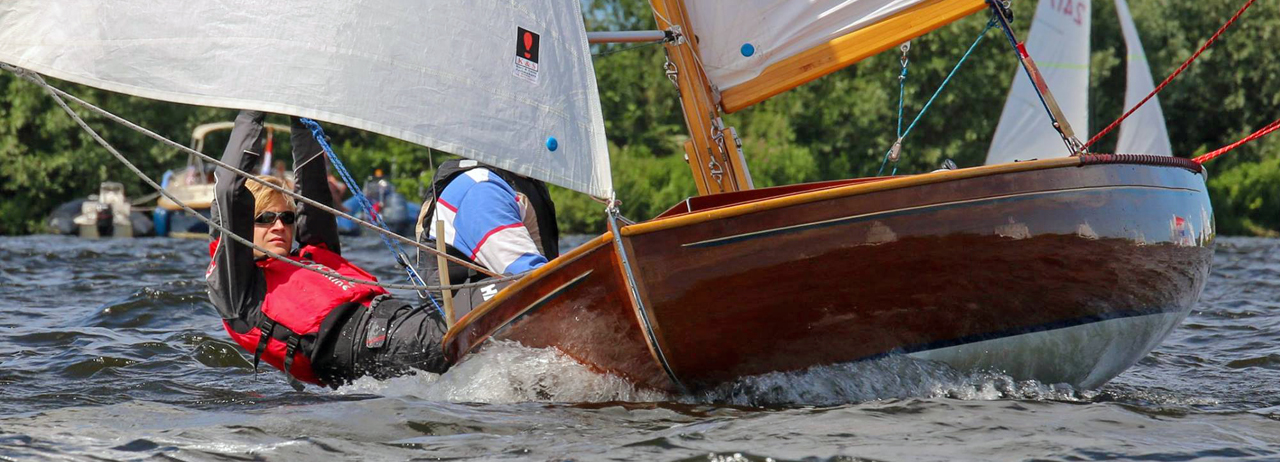
Although I can't see the sail logo in this photo, I'm confident the previous header photo is of the woodie Dutch class, the grote BM 16m2. This is the second time I've done a header photo post on this class. You can read the first post on the 16m2, a post which has more background history. The 16m2 also features in a post I did on an unique method of recovering the 16m2 from the water to dry land.

I've also mentioned that the U.S.A. had their own version of the 16m2, the Celebrity class, now defunct. The Celebrity was built in fiberglass and had the more modern Marconi rig. From the 1968 One Design and Offshore Yachtsman sailboat catalog:


Saturday, May 6, 2017

Sneekweek 2016

I've written before about the Dutch Sneekweek, a sailing regatta/dance party extravaganza. (Actually it's the other way round - a massive party featuring some sailboat racing.) The sailing classes attending feature an even balance between the plastic fantastic classes and the myriad, beautiful, vintage, Dutch wood classes. Here is a nice video wrap-up of the 2016 event which features a large number of Oops! moments.


Sunday, October 25, 2015

A Piece of Furniture: The "Woodie" Europe Dinghies

The designer of the Europe Dinghy, Belgian Alois Roland, originally built them in wood. When Roland's company went bankrupt, his assistant, Giuseppe Christalli continued building beautiful wood Europe dinghies. When the Europe Dinghy class went Olympic the wood boats were no longer competitive and the class became plastic and has remained one where the new boats are entirely made out of glass.

History of the Europe Dinghy from Classic Classes by Vanessa Bird.

My Dutch friend, René de la Rie, sent along photos of his stunning wooden Europe which is not a Roland or Christalli but a Tebberman. Tebberman was known primarily for his rudders and centerboards, and only built a few Europe Dinghies, but what lookers his Europe Dinghies were! Beautiful deep mahoganies were matched with contrasting lighter inlays to create masterpieces.


George A of Mid-Atlantic Musings also owns a Galetti woodie Europe. Whilst not as stunning as a Tebberman the Galetti hull is still very pretty. Galetti was an Italian builder on the southern shore of Lake Garda. He was more famous for his 505's and Quarter Tonners.  Over at his blog George A tries to identify the builder of his "woodie" Europe dinghy. George unveiled his woodie Europe with a new Bosquet foredeck at this year's Brigantine regatta.


Redecking a glass Europe hull.

Monday, July 20, 2015

Zen of Daysailing: A Dutch Valk and Jolle Segeln

Every once in a while I intersperse all my posts about planing boats, or racing, or boatbuilding with videos of people just enjoying a daysail and a day on the water. The wind is perfect, not too strong, not too light, the sun is out, the water temperatures are good for swimming. Sailing is best done with the feet up and a smile on the face.

The Dutch Valk klasse is similar size and original concept to the U.S.A.'s Lightning class though with a squat traditional gunter rig. It appears the Dutch build them in fiberglass for recreational sailing - the PolyValken. (I think they reserve the wood ones for racing.) By the looks of this video, the Valk fits the recreational role superbly. (I like the cross thwart at the aft end of the cockpit allowing the skipper to recline and steer at the same time.)


Zeilen op de Kagerplassen from Muxio on Vimeo.

Jolle segeln is German for dinghy sailing. Here is a daysail in a true classic German dinghy, wood with traditional fittings. (Video settings doesn't allow me to embed.) I'm not sure what the class is, maybe a reader can help out.

Monday, July 13, 2015

Kaagweek, 75 Years Ago

Kaagweek and Sneekweek are the two big sailing regatta weeks in The Netherlands. Kaagweek occurs first, somewhere around the middle of July. I came across this historically interesting video of Kaagweek filmed in 1940, seventy five years ago.

Unfortunately the video settings restricts embedding on Earwigoagin, Click here to view the video.

After viewing this video several times, thinking about it and researching, I've come to the conclusion this sailing regatta video offers up so many layers of meaning and so many unanswered questions, it ranks as the most fascinating sailing video I've viewed

My first viewings of this video took in the pastoral beauty, the windmills, the myriad of, now traditional, Dutch classes heeling gracefully as they race their way up the small fingers formed by the dike systems, the spectators dining at the water's edge, the formal race committee attire, the pretty women walking the dock, ogled by young sailors. People are having fun, which is the whole point of a sailing week. The soundtrack of wistful swing tunes from that era adds to this period piece.

It was then I realized that the 1940 Kaagweek took place two months after the Nazi's had overrun Holland. This Kaagweek was taking place in occupied Holland. Kaag looks to be about 15 km. from Rotterdam and during the invasion, the Nazi Luftwaffe had completely leveled the center of Rotterdam.


The 1940 Kaagweek must have been held with the Nazi's approval. The question becomes whether this video was put together as Nazi propaganda to show that "normalcy" had returned to occupied Holland, or whether it was filmed surreptitiously as a home movie by a Dutch videographer. The production values suggests it may have been Nazi propaganda. Of note is at the 8:21 mark of the video, there is a stern-faced spectator wearing the Jewish star.


Reader WaveDancer disagrees with my assessment that the video was Nazi propaganda. I've dragged his comment over to the main post:
"I doubt that this video was German propaganda. After the surrender of The Netherlands, it took some time for the German occupation to show its true Nazi colors. PS: Whereas de Kaag is definitely in Holland, Sneek is not! The country should be referred to as The Netherlands. Wavedancer (who was born there, just around that time)"


Wikipedia states that 205,000 civilians would die in the occupation of Holland with 1/2 of that number being Dutch Jews who died in the Holocaust. Many of those young sailors shown in the video would be forced to labor in German factories during the war. I'm not sure how many sailing regattas were still held in Western Europe during the summer of 1940 but by 1941, sailboat racing had ceased (with the exception of the Nantais Moth, which the Nazis and the French Vichy government allowed to be built during the war).

July 10, 2015 also marks the 75th anniversary of beginning of the Battle of Britain, the approximate 2 month air battle where the Nazi Luftwaffe came within a sliver of destroying the British RAF. That the Nazi's didn't break the RAF would mark one of the turning points of  World War II. Goering and the Luftwaffe would then turn in September of 1940 to bombing the British cities in an attempt to force capitulation.

One of the mysteries of my life is how my loving mother, with her parents and siblings, endured the chaos, death, and destruction of the London blitz, and later the V-1 doodlebug, and V-2 rocket attacks. I never detected any true bitterness from her. She still maintains the attitude of always looking forward, never looking back - probably a residue of that British "stiff upper lip".  The courage it took to maintain day-to-day living under such conditions still amazes me.

Monday, September 1, 2014

Header Photo: A Dutch Skûtsje Capsized

I mentioned in my previous post about the the Dutch Skûtsje working scow that they do indeed capsize. In this photo lifted from the InterWebs, it is unclear whether this behemoth is just going over or just coming up! (I'm guessing from the way the mainsail is eased that this one is being righted.)


Wednesday, July 23, 2014

The Dutch Skûtsje

Skûtsje are a version of the traditional Dutch working scows that are now raced for fun (though I think a large portion of the video below is discussing what happens to the fun part of a traditional class when the racing becomes very competitive - note the PT training in the video). These are big boats, upwards of 20 meters, but narrow to fit the canals. They are unballasted, with two leeboards, and they do capsize, with some regularity, when pushed too hard.

Click here for the Wikipedia entry on the Skûtsje.

Warning: The following video is for sailing geeks like me, who would watch an excellent 1/2 hour documentary in another language, just to marvel at the shots of these work boats racing under sail. I wonder if we will ever see a version with English sub-titles?

I've dragged over some comments from Rik who sheds some more light on the following video:
"Even if you knew Dutch you would still miss more than half of the video. They speak Fries which is spoken in Friesland. My Grandmom came from there...The story is about the sometimes opposing issues related to traditional skutse sailing versus bringing the boats and crew to a much higher competitive plane.


Wednesday, July 17, 2013

Header Photo: Dutch Zeilen, 16m2 Woodie


The Dutch sure have a bunch of active, competitive classes that use gaff and/or gunter rigs. The header photo featured one of them, the 16m2, the class with the smiley logo. The 16m2 (16m2 being the sail area) is about the same size and weight as our Lightning class (6 meters or 19 feet, 450kg or about 1000lbs) and the design was copied for the U.S. fiberglass Celebrity class (now defunct). It appears the class is entirely varnished wood; I can't think of another class that is entirely varnished. And this class is not just a bunch of "woodie" sentimentalists; it is highly competitive with upwards of 40 boats showing up for the big regattas. A two man crew, with one on trapeze, and no spinnaker, the 16m2 was designed in 1931 by Hendrik Bulthuis, a hairdresser from Bergum (more at Wikipedia here).

Pieter Bleeker, who sails an International 12 now, sends along two pictures of him and his brother sailing a 16m2 back in the 1980's with this short message:
"On your blog I saw a picture of a boat, what is called in Holland a 16m2 or Grote BM I was surprised to see this model in the USA, because it is a typical Dutch class I know this boat very well, because I have sailed in it for more as 16 years."


A video of a finish of the 16m2 at Schildweek.


Thursday, December 15, 2011

Weird European Regatta Party Traditions

The Europeans seem to have, let me say, somewhat different apres-sailboat racing traditions.

Here we have the Dutch jump up and down, wave around their hands, in a marginally choreographed dance, done to a trumpet piece. Video taken sometime during the Dutch weeklong "Sneekweek", which is a drinking festival with brief intervals of sailboat racing.

Friday, August 5, 2011

Saturday, June 11, 2011

A Dutch Schakel dinghy really moving

I previously posted about the Dutch Schakel dinghy when West River SC sailor Rene' de la Rie reminisced about his early teen years learning to race in one .

A plywood dinghy, they look moderately V'd in shape, maybe closest in concept to our Windmill class.

I came across this very short video of a contemporary Schakel (with trapeze) absolutely screaming along on a close reach. Now this is what dinghy racing is all about!


Wednesday, December 1, 2010

Neat 1963 Photo of a Dutch "Schakel" dinghy

Rene' de la Rie, a former 505 sailor out of West River Sailing Club, sent me this image of him sailing a Schakel dinghy in Holland in the 1960's. From Rene'............


"The picture is from the early 1960s, Amsterdam, The Netherlands - the boat is a 'Schakel' and was popular there at the time. I raced it for a number of years. It was a two-man boat and sort of a small version of the 'Valk'. It is a scan from an old print and it may have been its maiden voyage, which would have been 1963, out of the marina where I grew up near Amsterdam. I haven't thought about "Schakels" ("schakel" means "link") for many years. Mine was built by my father and I believe it was the second year of their existence. They were sort of a mini Lightning (the size of a 470 essentially), built from plywood, and were very popular at the time. They still exist but my brother, who lives in Holland, tells me that they are limited now mostly to the northern part of the country (Friesland). There are still a lot of wooden boats in Holland."


More information on the Schakel can be found here

Saturday, January 24, 2009

Daylong Relay Races

Back in the 70's, Bob Dull and I organized a 24 hour Laser Marathon during the October Annapolis Sailboat Show. We ran it out of SSA, taped flashlights to the bow eye (colored red and green for the appropriate side). We had a lot of fun. Teams were anywhere from super organized 6-8 sailors to teams that were trying to recruit people off the dock at 3 am. We did it for two years and then wrapped it up. We couldn't do it now as the show is too popular and the harbor too crowded for it to be safe.

I found a video of Dutch juniors doing a 6 hour relay race in Lasers. A fair bit of breeze and the skipper changeover, in it's various permutations, is hilarious.

The barge carrying the cement truck crossing the race course is a nice touch.

laser sailing for 6 hours from Floris Wijnbergh on Vimeo.


And the grandaddy of all 24 hour dinghy races is the Southport race hosted by the West Lancashire YC in England. Teams race in doublehanded Enterprises (blue sails), GP 14's or Lark dinghies. The action around the gybe mark gets very hairy.


The Vanguard 15 class should look into doing something similar in the U.S.