The previous photo was of the start of the Everglades Challenge, the early spring jaunt for small craft (human or sail powered) down the West Coast of Florida, a distance of 300 miles. The start is at dawn, just above Tampa Bay, and this photo, lifted from the InterWebs, shows some of the more sensible small boat cruisers launching. The winners of the race are usually hi-powered catamarans or hi-powered big dinghies (such as Jeff Linton's Spawn of FrankenScot).
From YouTube, here is the start of the 2018 Everglades Challenge:
The previous header photo was of some chaps in Australia racing radio control model yachts, specifically the A class model yachts, the biggest of the RC classes. Some out in Interweb land interpreted this to mean that Tweezerman, in his dotage, had resigned himself to sailing from the shore, but nothing could be farther from the truth. The few times I have tried RC model yachts, I found that, spatially, I am challenged to sail properly when I'm off the boat. (Read this to mean dangerous to fellow model yachts as well as buoys of the course.) Also, my finger reaction with joy sticks and knobs is pathetic. Thirdly, racing model yachts doesn't excite my passion the way a full size dinghy does.
The reason I post this; If I was of the 1% crowd, and, if I was to pour some of my ill-gotten gains into a keel boat, I would want a custom built yacht with a long, long overhanging stern. I love those classic long sterns. There would be nothing cooler than be a a helm of my yacht and look astern at a transom that goes on forever. And where does the RC A class model yacht fit into this. They have the longest overhanging sterns going. Just look at two pics of the current crop of designs.
So as a 1% playboy, I would take some play money and have a full sized A-class model yacht built, say about 10 meters in length; designed to sail with only two people; minimal accommodation under a tiny coach roof; completely impractical. But I would have that long, long beautiful stern and the stern waves curling off the hull and those waves finally rejoining the playing field off in the distance astern.
The previous header photo is from the 2015 R2AK - the 720 mile Race to Alaska - of Team Boatyard Boys finishing in Ketchikan, Alaska; two guys in a 16' Swampscott Dory that was so slow under sail they ended up rowing most of the 720 miles. It was obvious from last year's race that a crewed multihull was the ticket if you wanted to claim the $10,000 prize. So what craft did Tim Penhellow (I think he's the one on the left in this photo of the original Team Boatyard Boys) choose to compete in the 2016 R2AK? The same 16' Swampscott Dory, though this time he decided to do the race solo. Alone! Predictably he finished last, amassing the slowest time over the two R2AK's (of those who did the race twice). Some of Tim's quotes when he was drinking a beer after crossing the finish line:
When asked what it was like racing the R2AK solo:
"Like losing your virginity. You're glad you did it but embarrassed by your performance."
"I'm bored of being bored."
"Solo sailing is not for me." (Where he went on to relate some terrifying moments under sail when he needed an extra set of hands - but all he could do was hold his breath and wait for the outcome.)
Truth be told, the organizer of the R2AK originally envisioned this race as one for the Tim Penhellow's of the world, an ultra-marathon grit and grind up the western wild coast of Canada, where human-power is just as important as sail power. Unfortunately this narrative for the R2AK only plays out in the boats under 20' of length. Several millennia of history have pointed out the fastest way to eat up the miles in non-carbon water transport is a sailboat. Fast sailing beats a fast rowing boat every time - and there is no better fast sailboat then the modern multihulls, who this year made the 720 mile R2AK a three day sprint (for the winners).
As a race for the prizes, the R2AK is now a long distance multihull race, the R2AK adding some navigational wrinkles and spectacular coastal scenery as compared to a slog in the ocean. The guys that do the R2AK with boats under 20 feet - 2016 Luddites, all of them. They will finish weeks after the multihulls, but I tip my hat to all of them.
Congratulations to Tim Penhellow, to the other small boat adventurers in the R2AK, and particularly to the older duo, Heather Drugge and Dan Campbell, racing the only sailing dinghy, a Mirror 16, who managed an incredible 600 miles before pulling out.
Further proof of why racing a Swampscott Dory in the R2AK is like bringing a knife to a gun fight - video from day 6 of the 2016 R2AK.
The Internet bombards us daily with the inspiring, the feel-good pluck of the underdog, the gritty - so much so that we sometimes become inured to it all. Despite the overload, this particular video of the U.S. Womens Skud 18 paralympic team manages to resonate the naked courage it takes to move forward in the wake of a disastrous, paralyzing injury or sickness. This is one part of a well-done series of sailing videos sponsored by Sunbrella - the manufacturer of cover materials.
I chronicled the start of the Race To Alaska, R2AK, the 1207 km. (750 miles) slog from Port Townshend, Washington to Ketchikan, Alaska. The race is now finished with an attrition ratio of 25 DNF's vs. the 15 who were able to complete the course in the allotted one-month time-frame. Unusual for me, I monitored the tracker during the race, being particularly interested in how the large open dinghies (there were two of them, a Barefoot 5.8 built specifically for this race and a Mirror 16) would fare in this marathon. Not good as it would turn out. The Mirror 16 would drop out, and the Barefoot 5.8 would be the last to finish, 15th.
I can't resist a bit of Internet armchair race analysis here. (WARNING - this from a sailing dude, who likes to day race and sleep in a comfy bed, who last spent overnight on a sailboat decades ago and the closest I've come to the Seattle/Vancouver Island cruising grounds is Portland, Oregon.)
With an inaugural race, over such an unusual course of such length, the initial possibilities of what constitutes a successful race program remain wide open. After the race, the picture is much clearer. Now with the results in, we can safely say; to win the R2AK with the current course, pick a very fast trimaran around the 8 - 9 meter (25 - 30-foot) range, and then crew it with three experienced offshore racers who know the drill, and can keep the accelerator down 24/7. That is what Team Elsie Piddock, in a F-25 carbon trimaran did, and they surprised themselves and everybody else by finishing in just over 5 days. Multihulls over 6 meters (20 feet) long took 5 of the first 6 positions.
What type of experience wins the R2AK? Team Elsie Piddock goes over their sailing resume before the race.
In the sailing monohulls, a disparate set of keelboats finished on top of that division. A Hobie 33 finished 3rd after holding 2nd for most of the race but lost out to a trimaran that made up about 160 km. or 100 miles in about a day and half of open water racing. A day racing keelboat, the Etchells 22, with a crew of three, finished tenth. It would be interesting to see how much the Etchells 22 sailed versus rowed as they seemed to spend much of their time making their way up to Alaska in the narrow cuts and not out in open water. The upwind ability of an Etchells 22 is extremely good but there are none, nada, creature comforts.
And in another demonstration of the turtle winning out over the hare (in this case the purpose built Barefoot 5.8), a pocket cruiser-keeler, the Montgomery 17 of Team Excellent Adventure finished 12th. When conditions were bad, they hunkered down, when they were good they kept going and when they had a chance to recharge, they took it (looks like they spent two days in Prince Rupert drying out, getting a shower, enjoying the restaurants.). All in all, a very creditable performance.
What happened to the team I was pulling for; the Tad Roberts design Barefoot 5.8? Two things:
Three crew on a 5.8 meter dinghy added too much weight in stores.
The lack of stability of an open dinghy meant they couldn't safely keep the pedal down 24/7 so they pulled up at night. This negated the third crew, who was added so they could keep racing at night.
If the R2AK as an event keeps going, and you want finish it in a monohull sailboat under 6 meters (20 feet) the best path seems to be a keel type pocket cruiser with a crew of two. Of course, the type of sailor who already owns a pocket cruiser isn't one to think a 1207 km. race in colder and colder water would be any fun at all.
A tip-of-the-hat to the design and sailing team of Team Barefoot Wooden Boats. They didn't finish where they thought they would, but they did finish. The Barefoot 5.8 was an innovative and bold design. It was wood and can be home-built. For shorter distance races this would be a very quick monohull.
Designer Tad Roberts kindly sent along some photos of the build of the Barefoot 5.8 and some early pre-race debugging..
The Tad Roberts Barefoot 5.8 sail plan, Set on a tall mast, the sail area was quite big for this size dinghy. The initial plan was to reef early and often but I'm betting, if they had a choice, they would have changed to a shorter rig in the middle of this race. A very pretty sheer on this design.
The Barefoot 5.8 was built around the very substantial double-bottom grid. The sides would be added on later. Wood was 6mm. plywood.
Sides on. Deck on. You can see the kness that were used to support the top-side panels.
Open transom and double rudders a'la the French offshore machines. The Barefoot 5.8 used hi-tech leeboards to keep the double bottom open for rowing and sleeping.
The Barefoot 5.8 looks to be a very potent Everglades Challenge design. In that race, open dinghies of this size (I'm thinking of the Core Sound 17 and 20) can finish in just over two days. That seems about the right amount of time to drive an open dinghy 24/7 without completely boinking.
Here is a short video of Team Coastal Express in their Mirror 16. They slogged their way through the toughest parts, the Seymour Narrows and the Johnstone Straits, before deciding they couldn't afford the time to finish the race out. This video looks cold, very cold.
Mention must be made of the tenacity and persistence of the human-powered competitors that finished:
6th place - Team Soggy Beavers -Six paddlers in an OC-6 canoe (with ama)
11th place - Roger Mann - first solo competitor in a stock Hobie Adventure kayak/trimaran with Mirage Drive. Either you think this guy is Superman (he kept pushing 20 hours out of 24 for 13 days) or crazy-dumb (he almost lost his life twice, a pitchpole and another time he ended washed out but tethered to his kayak).
13th place - Team Boatyard Boys - two guys in a 17 foot Swampscott Dory, on which was added a small cuddy cabin. The original intention was to sail a fair bit but the windward performance was so bad they ended up rowing for most of the race
14th place - Mike Higgins in a 17 foot kayak. Yep, he paddled all the way.
Reader Mike Scott, who lives on the left coast, and was much closer to the action, added this comment which I've dragged over to the main post.
"I've been avidly following the race after being at the pre-race party, and getting up at 4am the next day to watch the start - which was set to the fanfare of the Russian National Anthem - quite bizarre, very stirring music, and typical Jake Beattie. I, too, loved the Barefoot Wooden Boat entry, and am hoping they might bring it up for the Wooden Boat Festival in September. Will be very interesting to see who and what enters next year - if it flies again. Much speculation on the 'perfect' boat, but as all depends on available wind and this year certainly favoured the speedsters, with a knarly Northwesterly blowing for much of the race......."
R2AK, the Race to Alaska, a 750 mile jumbo version of the Everglades Challenge, started the 2nd and final leg yesterday. The first leg, raced last Thursday, was a 40 mile sprint from Port Townshend, Washington to Victoria. The rules are simple; no engines, no outside assistance.
Unlike the Everglades Challenge, the R2AK racetrack is open water, very cold and some of the entries are sensible, full out cruising craft. I expect once the dust has settled, the racier catamarans and trimarans will fill the top spots. I don't envy those hardy kayakers in their kayak-trimaran hybrids who will spend the entire race ensconced in their dry suits.
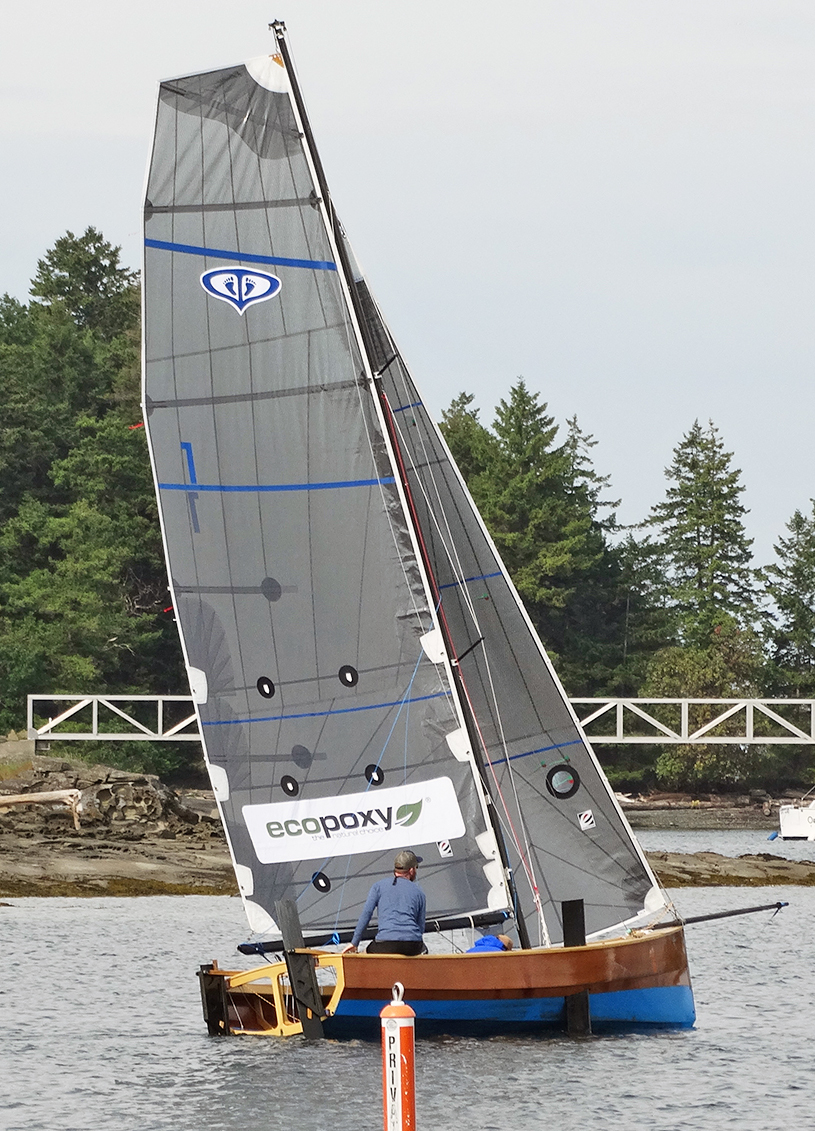
There is at least one large open dinghy racing (editors correction: There are two - a Mirror 16 is also competing).Team Barefoot is the product of Barefoot Wooden Boats and is a Tad Roberts design, a 5.8 meter (19 foot) plywood dinghy playing in the same design space for long distance small boats as the i550 mini-sportboat. In looking at the video, the Barefoot dinghy appears to be more in the realm of a high freeboard Classic International 14 from the 1980's. Team Barefoot put this interesting video up on their dinghy and the thoughts behind designing for this race.
Some photos of the Barefoot Dinghy I pulled from the InterWebs.
It turns out that Classic Mothist, Jeff Linton, is pursuing the same direction for the next Everglades Challenge. He has scrapped his modified Flying Scot (which won the monohull class in 2014) and is home-building a new 6.7 meter, O.H. Rogers designed, large dinghy for next years Challenge. Boatbuilding details with lots of photos are over at Amy Linton's blog.
Last May I ventured over the Bay Bridge to Kent Island to look at Chesapeake Light Craft's OcoumeFest and also to look at some of the competitors in the inaugural WaterTribes Chesapeake Challenge long-distance along-shore marathon (an offshoot of their Everglades Challenge). They were starting that Sunday morning of the OcoumeFest.
Of particular interest was the 17-foot i550 sport boat specifically built by the Gougeon brothers for these type of events. The race poses several challenges that a modern small sailboat is not normally designed for; low bridges, traversing very shallow water, human propulsion when the wind quits and for those endurance types, the ability to keep going on little-to-no-sleep. It is a race where it is tough for a sailboat to keep up with those machine-like kayakers who maintain a steady, grueling pace.
Bob Ames, John Z and I had an interesting conversation with the two sailors who were piloting the Gougeon i550 sport boat Hot Canary;Joe Frohock, the creator of the Mothmaran, being one of the team.
The sleeping arrangements - just simple camp-mats laid on the floor under the cuddy cabin.
This is Joe Frohocks life-jacket. The following live on his life jacket during the race. A very sharp serrated knife, electrical tape, a whistle, a mirror, a high-pitched rescue whistle, a waterproof flashlight (and several other items I've forgotten -I think he also had an EPIRB).
A mast tabernacle so the mast can be quickly pivoted down to get under bridges. It turns out this wasn't quite enough, the freeboard on Hot Canary too high for one of the bridges in the race. They were stuck in front of one low bridge for several hours until the tide went out.
A rudder cassette allows the rudder to be pulled up or "reefed" for shallow water steerage. The mulit-part shock cord assemblage allows the aft part of the cassette to bounce back in case of a hard grounding.
The sideview of the i550 sport boat. The i550 is specifically designed for home-building in plywood and has a flat bottom panel.
The rowing station was a simple carbon plank that sat on the side decks, just behind the lifting daggerboard trunk. Rowing the i550 was not one of the design's strong points. The flare to the i550 sides can be seen at the transom.
I suspect that I am not the only long time sailor that knows bupkis about the new Olympic Sailing Sport of kite racing. Maybe this video may help (though I still want to know how you keep from entangling these kites on port/starboard crossings - and still not sure how the weight equalization works out?).
Bald but my eyebrows are growing at a prolific rate. Sailed Windmills and Y-Flyers in the 1960's. Founded Miami University (OH) sailing team. Sailed International 14's and Lasers in the 1970's. Sailed International Canoes in the 1980's to mid 1990's. Sailed Classic Moths since 2002. Enjoy boatbuilding though I'm very, very slow at it (the Internet doesn't help matters). Name in real life: Rod Mincher
After choosing this username (Tweezer is the name of my Classic Moth), further research on the Internet turned up that Tweezerman is a corporate name for a line of pedicure products. Let me emphasize that I do not work for, nor endorse these products.