Showing posts with label Blogmeister. Show all posts

Saturday, October 17, 2020

Make a Hole; Plug a Hole


My wife, in her pithy wisdom, has observed that all I seem to do with my Classic Moths is to cut a hole and then fill it up. And she's right in a way. My current Classic Moth project, a Savannah Wedge, is undergoing a side deck modification which entails cutting out holes and then filling them back up. And I want to lower the transom which means cutting more holes, and then filling them up.


I picked up the Savannah Wedge back in 2015 and like many of my projects, the Wedge sat neglected, aging in place, getting dirty, while I figured out what I wanted to do. With Covid-19 I'm back again making holes, plugging holes on the Wedge. When a Savannah Wedge has been raced, back around 2010, she performed miserably. It suffers from too much wetted surface, the bane of slow Classic Moths. Yet I persist. The original idea was the Wedge would be an ideal Moth to take the grandkids out; she does have a grand big cockpit. We shall see; for there are more holes to cut, and more holes to fill.

My boatbuilding philosophy.

Thursday, August 20, 2020

My Short History with Windsurfing


With the previous post on the D2 Windsurfer, I had a chance to reflect on my short history with Windsurfing. All of my casual involvement with Windsurfing occurred when I was a young dude. I wrote about my first encounter with the very early Windsurfing community and my breakfast conversation with one of Windsurfer's emergent rock stars over at this post. It was also at Association Island in 1974 that I first stepped on a borrowed original Windsurfer. I took it out close to dusk in very little wind. I got upwind OK without major mishaps and about 200 meters from shore turned around to go downwind and back to the beach when I started falling off the board. I was wondering if I was going to have to arm paddle home when my brain finally re-calibrated my balance and I was able to drift back, standing up, without embarrassment. Back in Annapolis I learned the basics on another borrowed Windsurfer. I still remember how impressed I was with the Windsurfer's easy acceleration with just barely wafting gusts. With the original Windsurfer I was competent up to a mid-range breeze and didn't get comfortable with stronger breezes until I had some time on a F3 board, a design which was already moving toward less length, rig back further, full battened sail. Although I had several sailing friends that got out of dinghies and continued hard-core at Windsurfing (some became pros), I never never went down the rabbit hole of short boards, water starts, wave jumping, camber-induced sails in various sizes, summer trips to the Gorge or Hatteras. I stuck with racing dinghies. With the light air of the Chesapeake, it seemed to be the more comfortable choice.

Grainy photos of the blogmeister from back in the 1970's


Saturday, August 8, 2020

Getting Re-acquainted with an Old Friend


Subtitle: It takes a Village or how some old I-14 buddies got me sewing again.

I've spent six years out of my various careers working professionally as a sailmaker; several more years making dinghy sails part-time under my own label. I have owned an industrial sewing machine for many years, currently it is a Consew (having started with a Singer 107) which resides in the basement. About six years ago the original electric motor for the Consew stopped working and Paul Weiss, an old I-14 buddy sourced a replacement from E-bay and helped me install it. Unfortunately the original V-drive belt was now too large and the sewing machine sat gathering dust and aggravating my wife for several more years until Bob Ames, another I-14 buddy, decided to help me size the correct belt. So a week and half ago, with new electric motor and new V-drive belt, after an absence of many years, I sat down and got re-acquainted with an old friend . Compared to some of the incredible seamstresses I have worked with, I consider my sewing skills somewhat mediocre but passable. Bob Ames had an ulterior motive in finding the right belt; he had a cover that needed restitching... and that is what I did.

The blogmeister, his sewing machine, and Bob's cover.


Sitting behind the Consew got me thinking about all the sailmaking concerns that have gone out business since the 1970's and 1980's and wondering if there is anyone out there collecting sail logos of all the companies now gone. Picking through the cobwebs of my memory of just the Annapolis sailmakers no longer around would include, Hurricane Sails, Horizon Sails, Haarstick Sails, Sobstad Sails, Shore Sails, Scott Allan Sails... and I'm sure I'm forgetting several more.

My part-time sailmaking concern was named Severn Sails and I mostly made International Canoe sails, having some success with them in the early 1980's. I'm sure all of those sails are long gone but I still own some sails that sport this very rare logo.


The Severn Sails logo featured a stylized Route 50 bridge as it crosses the Severn River, framing a main/jib. The exit to Annapolis is just on the south end of the Route 50 bridge.

Saturday, February 22, 2020

Radio Control Model Yachting and a Rich Man's Toy


The previous header photo was of some chaps in Australia racing radio control model yachts, specifically the A class model yachts, the biggest of the RC classes. Some out in Interweb land interpreted this to mean that Tweezerman, in his dotage, had resigned himself to sailing from the shore, but nothing could be farther from the truth. The few times I have tried RC model yachts, I found that, spatially, I am challenged to sail properly when I'm off the boat. (Read this to mean dangerous to fellow model yachts as well as buoys of the course.) Also, my finger reaction with joy sticks and knobs is pathetic. Thirdly, racing model yachts doesn't excite my passion the way a full size dinghy does.

The reason I post this; If I was of the 1% crowd, and, if I was to pour some of my ill-gotten gains into a keel boat, I would want a custom built yacht with a long, long overhanging stern. I love those classic long sterns. There would be nothing cooler than be a a helm of my yacht and look astern at a transom that goes on forever. And where does the RC A class model yacht fit into this. They have the longest overhanging sterns going. Just look at two pics of the current crop of designs.


So as a 1% playboy, I would take some play money and have a full sized A-class model yacht built, say about 10 meters in length; designed to sail with only two people; minimal accommodation under a tiny coach roof; completely impractical. But I would have that long, long beautiful stern and the stern waves curling off  the hull and those waves finally rejoining the playing field off in the distance astern.

And that would be sublime.


Friday, November 29, 2019

The Playboy Bunny


Next year is the fiftieth anniversary of the Teacup Regatta, the regatta famous for introducing the world to the Laser (originally named TGIF, Thank God it's Friday). The above photo is from the article on the Teacup Regatta in the December 1970 issue of One-Design and Offshore Yachting. OD-OY came up with the idea of pitting all the 1970 American off-the-beach sailboats in a regatta and judging competition and did all the leg work in putting the event together. The Teacup Regatta was held on Lake Geneva, Wisconsin, about a two hour drive from Chicago. In 1969 Hugh Hefner had opened a huge Playboy resort on Lake Geneva, hence this photo of a trio of Playboy Bunnies taking a spin on one of the competing dinghies between races.

This photo jogged the old memory banks about my own Lake Geneva and Playboy Bunny story. Two or three years later, as a poor college student on summer break, I decided to enter the O'Day cup, a singlehanded championship of the old USYRU (U.S. Yacht Racing Union). You qualified in ascending elimination rounds (club to district to region and then to the finals). I didn't have any lofty aspirations; my racing skills were somewhat rudimentary, but it was a cheap way to get in some sailboat racing as the host club supplied the boats and entry fees were either free or nominal. My local club, Berlin Yacht Club, put my name forward and I awaited being told where to go for the Ohio-Pennsylvania district eliminations. It turned out that there was only one other club to put up a name and he dropped out. Without sailing a race I had qualified for the Midwest Regional O'Day eliminations.

The Midwest Regional O'Days were to be held by the Lake Geneva Y.C. in Lasers, a 500+ mile trip from my home and I didn't own a car. During the 1970's this was no problem  as hitchhiking was a viable means of getting around. I had already crisscrossed the Midwest several times on the kindness of others stopping to give me a lift. I duly made it into Lake Geneva. (This may have been the time the rides dried up late at night and I had to spend the night at the Milwaukee Airport; elevator music, bright lights and trying to sleep across three hard seats.) The regatta was midweek and there were four or five of us racing in typical on-off, shifty lake conditions. I finished third or a close fourth, the memory is hazy, but I was fine with that. I had no plan B if I had improbably qualified for the finals and had to figure out how to get to a regatta during the school year and far away.

The Lake Geneva YC had their midweek evening summer series during the O'day eliminations and I got a crewing job on a M-16 scow. (Which has now morphed into the very popular cat-rigged MC scow; the M-16 was main/jib). I remember being miffed at having to handle leeboards on every tack and came away with a better appreciation of my Dad's Y-Flyer scow which was my Berlin YC racing ride.

In the fog of long-ago recollections there is one searing memory from that race and that is of another fellow crew. One of the leading competitors in the M-16 scow class had married a Playboy Bunny who was now his crew. We were far enough back in the race that we didn't cross tacks often with the couple but I did join the gaggle of sailors that surrounded her (bikini-clad) apres-racing. I came away with the impression of a separate female race; not so much titillated by her but more having encountered something genetically unique. Hugh Hefner's vision of an ideal American woman was rooted in the 1950's and 1960's, all jutting breasts, small waist, small butt, very much top-heavy. I had the good sense, even back then, to realize this wasn't the real world.

I never went to the Playboy Club at Lake Geneva during that trip. No money and besides, when hitchhiking, travel times were always open-ended. No time to dawdle. Best to hit the road when things were wrapped up. The Lake Geneva Playboy Club closed in 1981.


Two videos of the Lake Geneva Playboy Club.


Wednesday, October 9, 2019

Header Photo: Fireball World Championships in Montreal


Urs Hardi

Until it crossed my FB feed, I didn't realize that the International Fireball class had held their World Championships in North America this past August; hosted by Pointe-Claire Yacht Club in Montreal, Canada. Winds really picked up for the last day of the championship when this photo was taken. Brits, Ian Dobson and Richard Wagstaff won with Australia, Switzerland, Belgium, Czech Republic and France representing a good mix of countries rounding out the top ten; .

I came into contact with the Fireball as a teenager in the late 1960's when my Dad moved the family to Youngstown, Ohio, a steel town in Northeast Ohio. In this most unlikely of sailing cities, there was an active Fireball fleet sailing on Pymatuning Lake, north of town. It was a fleet nourished by an even more unlikely sailor, Ken Turney. Ken loved the Fireball. He had his own boat shop in Youngtown's southern suburb, Boardman where he imported glass Fireball's built in Calgary. Ken was blue collar through and through. He had been a machinist at one of the steel plants and his standard outfit was a one-piece coverall, grungy, longitudinally striped in grey/black, with the neckline unbuttoned to reveal a grand tuft of silver chest hair topped with a broad Slavic face. Ken even raced Fireballs wearing this coverall. (One of my friends, in a not so charitable teenage side comment, remarked that it appeared Ken had a pet squirrel permanently tucked into the V-line of his coverall.) Ken would hold court at his cinder block boat shop, talking about Fireballs to one and all, building a small hot bed of performance dinghy sailing in this inland steel city; in a country not known for performance dinghies.

I actually didn't race the Fireball that much. I crewed several times on the Lake in very light winds. Unfortunately, I've never been on a Fireball in trapeze weather. Fifty years on, Ken Turney's legacy ticks along. A small group of Fireballs are still sailing out of the Pymatuning Sailing Club.

Other Earwigoagin Fireball Posts


Friday, September 20, 2019

What's happened to this blog?

A few of you may have wondered what has happened to this blog. I've been off drawing. You know, the art thing that old people get into. Mostly nudes. Go figure.

Sunday, March 31, 2019

Header Photo: Laser blown over


I think this is the first time in my blogging history that I have put up some random header photo and it turned out that it presaged a momentous news announcement - in this case the International Laser Class Association announcing that Laser Performance Europe was in violation of contract and couldn't build any more class legal Lasers. The Laser class, after suffering several years of legal wrangling over who owned the class, now seems set for another round of lawsuits. A shame. If you can stomach online forums with their endless drivel (and occasional nugget of wisdom), click here to go to Sailing Anarchy's thread.

And from the Earwigoagin archives, here is the blogmeister in a bit of a pickle with his Maser, Starkers.


Saturday, February 2, 2019

Brewsabee: Another Narrow Waterline Classic Moth Design


Brewsabee is my own design, done in 2005 as a follow on to my original Tweezer design. The design brief was to better compete with the Mistral in lighter air so the waterline beam and wetted surface was pared down compared with the original Tweezer. I never built Brewsabee because:
  • After Tweezer, I was getting at the age where I wasn't sure I wanted to continue to flop around in a narrow waterline Moth. Plus winning races now wasn't the end-all/be-all of my sailing existence.
  • Building would be more complicated. Brewsabee would be best done in foam/glass, something I wasn't too familiar with.
  • I wasn't sure, given the generally light conditions we sail in here in the Mid-Atlantic, that Brewsabee would offer any significant performance advantages over the Mistral.
So I decided to put together a Maser, a flatter Gen I design, which was an entirely enjoyable Mothboat sailing experience.

I don't consider Brewsabee to be an extreme V design, but she is a narrow waterline design.

The Brewsabee has forward flares at the gunwhale, legal in the American Classic Moth Rules since the 1 inch concavity rule doesn't kick in until after the daggerboard trunk. Sections below the waterline were a very hard U forward translating to flattened semicircular at the back.

Again, for printing or downloading, use the upper right icon to pop it into another browser tab.


Couldn't help myself - a video of Tweezer (no. 92) when she and the blogmeister were able to get to the weather mark first in light air in one race of the Nationals. But, dog-gurn-it, the Mistrals were still able to run us down over the course of the race.


Tuesday, November 20, 2018

Music Whenever: Hands Up


Hands Up from Bryan Eckerson on Vimeo.


A happy-happy, joy-joy boppy disco dance tune from the 1980's by the group Ottawan. You can glimpse occasional snippets of this old, baldish, be-spectacled guy with a yellow tie bouncing around. A family tradition but nuff said.

Saturday, November 17, 2018

Header Photo: Starkers... Gone!


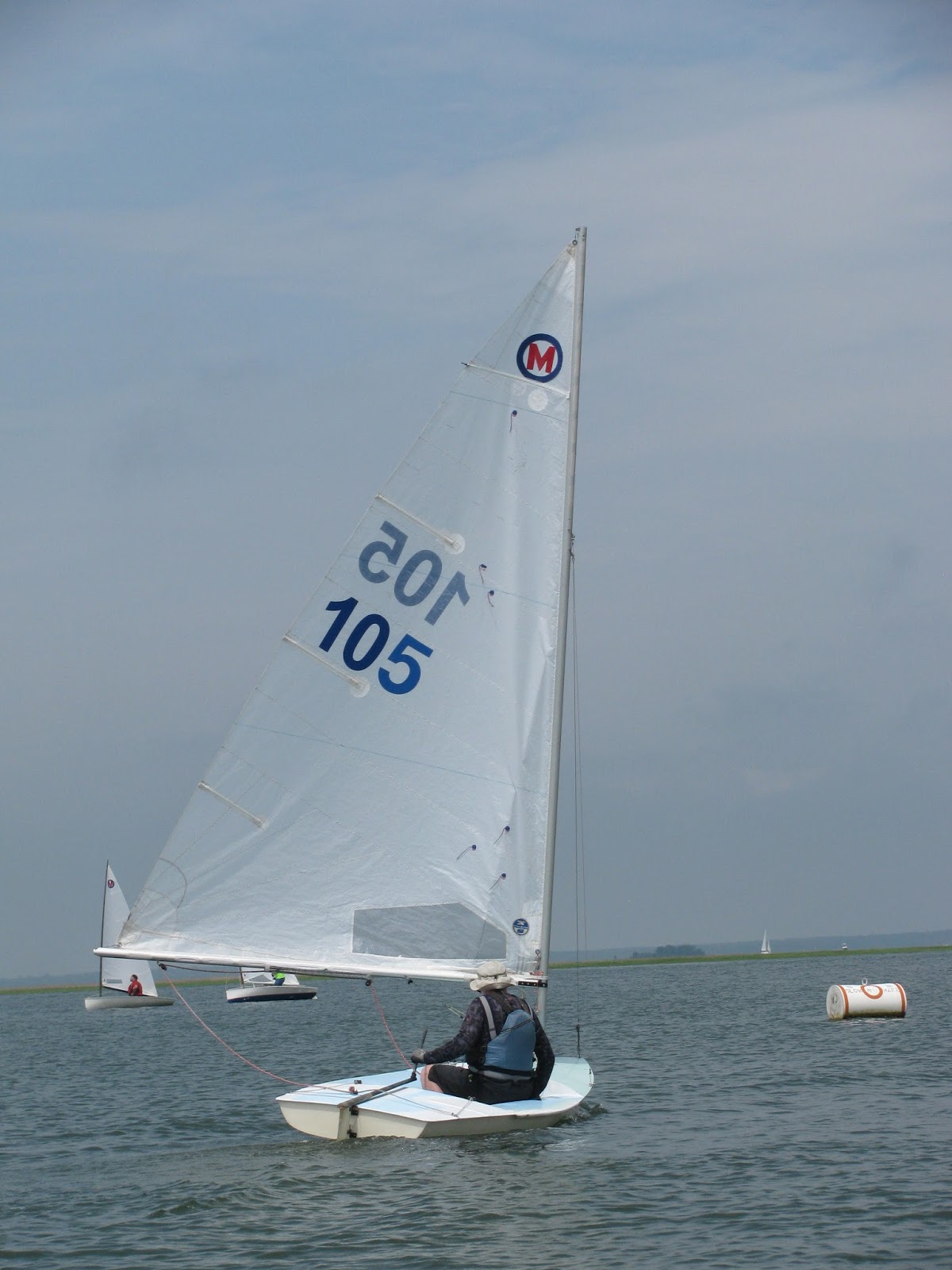
The previous header photo was the blogmeister idling around in his Maser before one of the starts of the 2015 Classic Moth Nationals. This fall I donated my Maser, number 105, (named Starkers as a Tip-of-the-Hat to her designer/builder, Randy Starks) to Joe Bousquet's expanding Classic Moth outreach to junior sailors. I haven't been racing much and felt Starkers would be better off with a younger skipper. Moth no. 105 was a good Moth. I treat my racing boats as anthropomorphic entities; they have human personalities and there was no doubt Starkers had a will to win. (Don't most singlehander's talk to their boats when racing? I even apologize to my boat if I do poorly in a race.). I like to think she was thankful at being granted another life, like a rescue dog, except in this case Starkers was brought back from an abandoned Laser hull and had a second life as a full-on racing Classic Moth. As a team, we won the trifecta of Gen 1 trophies, the Nationals, the Midwinters, and the Brigantine regatta. Great memories and I will forever have a soft spot in my heart for Starkers, this endearing mutt of a Classic Moth.


Ingrid Albaugh


Ingrid Albaugh


Monday, February 19, 2018

Header Photo: Bill Moss Over the Bar


The previous header photo is of Bill Moss and John Gallagher bombing around Annapolis Harbor in the late 1970's. Bill Moss passed away suddenly this past Christmas. We were teammates for the 1981 International 14 Team Races and World Championships and remained good friends ever since, long after I exited the International 14 class. Bill was the best of the best and his drive raised my sailing to another level for that two year campaign. It was that special slice of time when we were on top of our sailing game in an unforgiving dinghy. He will be missed.

The 1981 Team Race party; Bill on the left, the blogmeister on the right.


Sunday, November 19, 2017

Classic Moth News: Fall 2017


For you design geeks...

Andrew Slavinskas is continuing a discussion of Classic Moth design over at Woodenboat Forums. Lots of hydrostatic analysis including some of the Tweezer design.


New England News...

New Englander Yarrow Thorne has refurbished his Crosby Skimmer Moth and also picked up an Etchell's Connecticut Moth that was languishing up in the Northeast. Both were entered in the Archipelago Rally pursuit race in Rhode Island at the end of October. Unfortunately the Connecticut swamped and couldn't be self rescued, a bad habit of the vintage Moths since many had no built-in flotation. (Why would you worry about getting the Moth up quickly since the sailing season back then was Memorial Day to Labor Day and the water was warm.)

Yarrow racing his Skimmer Moth in the Archipelago Rally.

Photo by Rufus Van Gruisen

The Skimmer on the dock at the Rally.

Photo by Rufus Van Gruisen

The advantage of vintage Classic Moths is they float upright when moored out. Yarrow's fleet; the Connecticut is in the backgroud.


Meanwhile over in Merrie Old England...

Over at the Boat Building Academy at Lyme Regis, Jake Stow is building a Mistral.

The English are busy digging 1960's Rondar Skols and mint condition Shelleys out of backyards and putting them back on the water .

Stuart Mander's barn find, a beautiful double-bottom wooden Shelley.

.
A glass Skol


A Skol getting the longboard treatment.


Jim Champ has launched his UnSkol with the new hull sections he designed.


Ian Marshall has had a successful run in the English CVRDA (Classic/Vintage Racing Dinghy Association) events, sailing a Classic Moth Shelley Mk I with a tall rig.


The Classic Moth class has a good number of one-off designs. It was a easy class (inexpensive, un-complicated, with the freedom to build in wood) to show that you had invented a better mouse-trap.  English helms-woman Vanessa Weedon Jones owns this interesting double chine plywood Moth, Yellow Peril, that was professionally built in Derby. I like the free-standing wood mast.


The Chesapeake Bay Classic Moth Fleet...

The Chesapeake Bay wrapped up the season at Chestertown with the Patterson Regatta in mid-October where we had 11 Classic Moths. Even the blogmeister was finally able to get his Maser together for that regatta. (The last two years, this is the only Classic Moth regatta I've been able to make.) Mike Parsons, this year's National Champ, continued his run at the top of the podium with a clear win in the Patterson.

An indistinct I-Phone photo of the fleet on Chester River in gentle breezes for the 2017 Patterson Cup.


Here is a photo from Earwigoagin's archives of the blogmeister with two of his Classic Moth's, a modified Stockholm Sprite and the Tweezer at the 2009 Chestertown/Patterson Regatta. (Both no longer in my fleet.) Joe Bousquet is adding some welcome informed advice. I always liked the yellow painted spar of Energizer (the Stockholm Sprite on the left, the spar was a cut down Finn spar.)


Post about Classic Moth plans over here.

Saturday, November 11, 2017

Time Capsule 2009

In poking around my hard drive I came across this video I made in 2009. On a summer Sunday morning eight years ago I had my small boat fleet gathered in the front yard so I got out the digital camera and proceeded to document all of them.

Eight years later;

Gone: the Tweezer to Maine, the Surf Ski to a local paddler and the stitch and glue canoe to Bill Boyle.

Kept: Maser, the PK Dinghy which hasn't progressed any since 2009, and the City Island kayak.

Added: Two other projects, both Classic Moths.

Projects on top of projects. And the beat goes on.


Tuesday, January 31, 2017

Three-Beer Concept Model


John Z. invited me over to his place over Christmas Week. When I got over there he showed me his hand-drawings of a simple cruising dinghy similar to the Sea Snark. (He owns a 28' cruising sailboat and wanted a QD - quick and dirty constructed dinghy to tow behind the sailboat on his trips.) We quickly decided to build a concept model that evening. I returned to my house to retrieve some thin cardboard and we went to work, cutting the cardboard, and putting the pieces together with a hot-melt glue gun. I mostly watched, held cardboard pieces together, and added my two cents worth at every decision tree. I call it a three-beer model because, in an hour and half of slapping this model together, I had two craft beers and John had one.

The finished model was a simple flat bottom, slab sided hull. John has since taken the concept model and massaged it in a computer. He is planning construction when the weather turns warmer.

The blogmeister holding the three-beer model. The sides of the model are thin pink foam that John sliced up using his new hot-wire foam cutter he designed and built.


Over in the comments section, blogger My2Fish, a nuts-and-bolts guy, wanted to see photos of John Z's hot-wire foam cutter. Here are two. It is a bow cutter. (Sort of like a bow saw - one end, the top end in this photo, is the tensioner, the other end is the hot-wire.)


John cutting a thin sliver of foam using the floor as a base.


Monday, November 28, 2016

My Early Moths in Tandem; Photos taken around 2005


These photos are of two of my early Moths, taken about twelve years ago, doubled up on my trailer for a trip to the Brigantine Regatta. On top is my Classic Moth, the yellow Energizer, a modified Stockholm Sprite and on the bottom was my winged scow Moth, Flatoo-a-T. Back then, the Brigantine Regatta had a "Modern Moth" division for winged Moths and I gamely raced my scow in that division, with little success. If I remember correctly, my friend Bill Beaver, raced my Classic in a couple of races.

For some reason I made a set of custom fiberglass mudguards for this trailer (hence the blue color). Both of the Moths, the trailer, and the Ford Aerostar van are no longer in my possession (the van and trailer junked, the Moths sold off into oblivion).


The dent in the aluminum wing tube, visible in the photo, is where a fellow Classic Mothie rammed me head on (he was on port prompting an exchange of pleasantries).


The blogmeister in the yellow Energizer.


Click here for my original post in Earwigoagin about my scow Moth.

My story on my winged International scow Moth has disappeared from an International Moth website. I reprint it here.


Thursday, September 22, 2016

Medicare Part A

Today I went and registered for Medicare Part A, which, if you are a knowledgeable American, would precisely date my age. To celebrate, given my temperment, and to what I can look forward to in my coming advancing years, I present a somewhat Anglo-centric but very prescient video. (Let me also state that I work approximately five miles from the longest escalator on the East Coast of the U.S - and I have yet to take a ride on it... bucket list!)


Born to be Mild from Aeon Video on Vimeo.

Sunday, August 21, 2016

House Chores

I was vacuuming one of the side bedrooms in our house and came across two small pieces of paper on the floor. In picking them up, I discovered they weren't scrap paper but thumbnail prints (most likely cut out from a contact sheet) of the blogmeister sailing his Laser out of SSA (Annapolis) back in the 1970's. They must have fallen from some book I had re-shelved. I don't know who took the photos. (Warning! Blogmeister with hair and beard)

It looks like it was a gusty northwester as I was sailing upwind towards the U.S. Naval Academy.


Nobody had invented flat leg hiking yet!


From the Earwigoagin archives; a few of the Laser posts featuring the blogmeister.


Saturday, May 21, 2016

The Boat behind "The Dog House"

Joe Rouse's recent post about a guy who built a big Dudley Dix keelboat in his driveway brings back memories of my other encounter with a backyard boat builder putting together a large boat.

When traveling north for regattas from Annapolis there are two routes; the faster, busier, somewhat more expensive Interstate 95 through Baltimore to Delaware; or the slower, more scenic route up the Eastern Shore using the Bay Bridge to Route 50, into Delaware, to Route 13 and then to Route 40. I prefer the Eastern Shore route. One of the highlights on many of these trips thirty or so years ago was stopping at "The Dog House", a hot dog emporium located on the busy retail strip of Route 40 in Delaware, about two miles or so before the Delaware Memorial Bridge. Crossing the Delaware Memorial Bridge would put you on the New Jersey Turnpike, a two hour and change drive to New York City and then to points further north. It was a convenient travel stop, either coming or going, and, in that innocent time before I learned about nitrates, the chili dogs were very good.

The Dog House:

Google Street View ©2016 Google

In the years of going back and forth for the International Canoe racing in Rhode Island, Buzzards Bay, and City Island we would park with our trailers off to the side of "The Dog House" because there was no room out front. One year we realized that there looked like an upside-down boat in the suburban back yard of the house directly behind "The Dog House". We scrambled up the tallish, wood privacy fence to take a look and, sure enough, someone was building what looked like a Colin Archer, full-keel cruiser in ferro-cement, somewhere between 30-40 feet (9-12 meters) in length. Every year after that for, maybe, eight years in a row, we would scramble up that fence behind "The Dog House", and peer into the backyard to gauge his progress. One year, just before twilight, we were on our way home, heading south, made the customary stop at "The Dog House" and, after eating, climbed the fence to discover the builder was hard at work. We asked some questions across the fence and then he kindly invited Bill Beaver, Dick White and I into his backyard to have a close-up look. In the fading light we could see the cruiser was right side up by this time and the deck was more or less complete. I can't remember in our conversation if he said how long he had been building her, he definitely looked an older gent; all I remember was his dream of going ocean cruising in this hand-built boat was still burning bright. There was no doubt he was going to keep at it. I did wonder at that time, given the narrowness of his side yards, how he was going to get that cruiser, when finished, out of the back yard.

I retired from International Canoe racing long before Bill Beaver and several years later, in the summer, I got a call from Bill after one of his road-trips.

"It's gone," he said.
"What's gone," I replied.
"The boat... the boat behind The Dog House."

From a previous Earwigoagin post, Dr. John Vardiman building an Alden schooner in his barn.


Sunday, May 1, 2016

The Pipsqueak - A 5-Footer from the Douglas Fir Association

When I wrote about my El Toro sailing days I recounted a same-age compatriot from the community accompanying me, as I learned to sail, in his six-foot sailboat. I decided, using my faded memory, to see if the InterWebs would offer up any clues as to the identity of this tiny sailing dinghy and, sure enough, I came up with a good candidate, the Pipsqueak design by John Burroughs. The design was sponsored by the Douglas Fir Association and plans were cheaply obtained. The Pipsqueak was even smaller than I remembered it, a five-footer instead of a six-footer.

I found some photos that were put up by the Tacoma Public Library. It is indeed a very small sailing dinghy, but a very good size to tow behind a bicycle as my friend would do.

Tacoma Public Library

Tacoma Public Library

Tacoma Public Library

The May 1956 issue of Life magazine had a one-page spread on the Pipsqueak.


My recollection is the Pipsqueak was very slow compared to the El Toro (my word! - the sail looks to be made from some sort of colorful domestic fabric; dress? sheets? table-spread?), but my friend had a lot of fun with her, though mostly paddling her. I must say that I have never since seen a sailing dinghy towed behind a bicycle.