Showing posts sorted by relevance for query Maser. Sort by date Show all posts

Thursday, July 22, 2010

Frankenboat: Laser to Maser

Doryman posted a comment to my Brigantine post wondering where was I in the photos. Humble of demeanor, I left out photos of me racing at Brigantine, but, since you asked, I was the one sailing a Laser. Um.....Actually there was three of us sailing Lasers in the Classic Moth regatta at Brigantine.

Laser's in a Classic Moth regatta? How can that be?


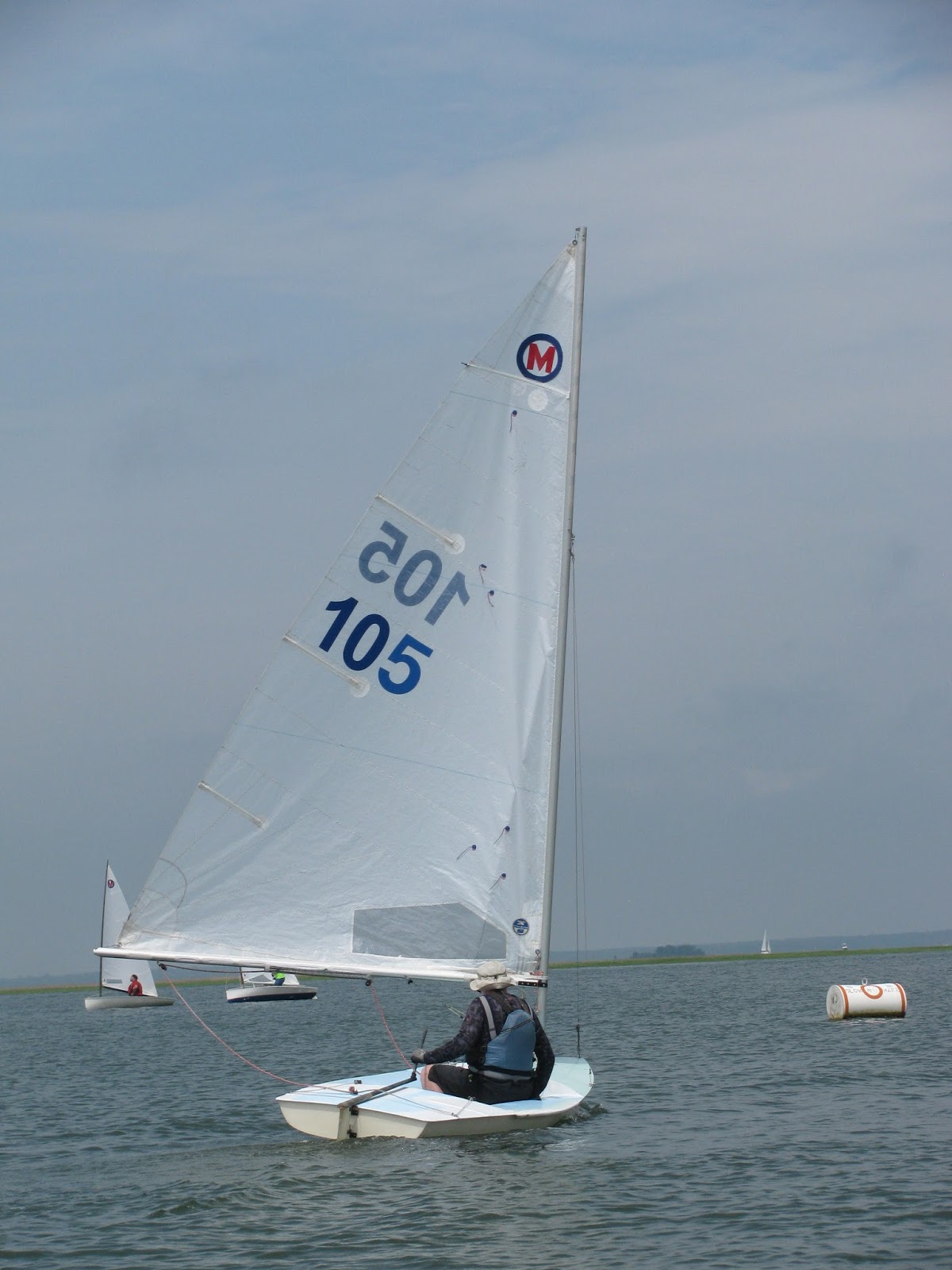
Well here is a photo of me and my "Laser".


That's not a Laser!
At one time she most certainly was a Laser, but now #105 is transformed, a rare Classic Moth emerging from the Laser chrysalis into a sailing craft we call a Maser. For the tale that can be told is about several intrepid Classic Mothist's, in true tinkering, Frankenboat tradition, have been happily sawing up old Laser hulls and then piecing them back together into Classic Moths (Masers). The trick is in figuring how to take a 13'4" (4.064 meters) Laser hull and squeeze it down to the Classic Moth length of 11' (3.35 meters).

The genre was started by two Norfolk, Virginia Mothists, Randy Starks and Al Whitener. Initially they just lopped 2 feet fron the Laser transom; a sailable solution but unfortunately ending up with too much wetted surface to stay with other Classic Moths. Undaunted, these two embarked on building several more Masers. each version getting better.

Here are the barebones steps to make a Classic Moth from a Laser (tip of the hat to both Randy and Al for their innovations).

  1. Look for an old abandoned Laser hull, either in the weeds or upside down baking in the sun, a Laser that hasn't been moved in years, preferably a Laser where the owner has lost everything but the hull. Buy hull.
  2. Cut deck off hull.
  3. Cut raked bow off hull.
  4. Cut a chevron shaped wedge out of center of hull (eliminating daggerboard trunk) to shorten hull.
  5. Glass aft hull and front hull back together.
  6. To add more rocker to hull, slit keel line to about 3 feet from transom and push more rocker in. Glass keel line together.
  7. Pinch up bow and glass together. Make sure hull is no longer than 11'.
  8. Add 1/8 inch plywood bulkheads and decks (saving about 40 to 45 lbs on the Laser weight.
  9. Add Classic Moth rig.
  10. Go sailing
Here are two Masers sitting on the lawn at the Elizabeth City Nationals. In the foreground is one of the Starks/Whitener versions. In the background is one built by Joe Bousquet.


Classic Moth #105 is the last Maser built by Randy Starks. Look hard and you can definitely tell it retains the original Laser transom.


A true Maser aficionado looking for a primo Maser conversion, one worthy of top dollar (at least $400 for the hull) should look for the following............

  1. Maser must retain the original Laser transom with serial number. Extra points if the hull still has the original Laser bailer well (and bailer).
  2. Must exhibit some lumpy unfairness along the topsides where the split hulls were joined.
Bottom line, a top of the line, show quality Maser must have some Laser lineage visually preserved. (I would also add a so-so paint job to what I consider a proper Maser..... to highlight the tinkering history of this particular model; but that is just my preference).

A shot of Joe Bousquet's Maser under sail.


And a YouTube video of your humble scribe narrating another modification project on his Maser.


Sunday, November 13, 2011

Cooper River Fall 2011

The more astute among those of you who still read my drivel after all these years; you may have noticed that I haven't been sailing my Classic Moth that much...... and you're right! I last raced my Maser in June and neither my Maser or any of my project Classic Moths have been dipped in water since.... that is until last weekend. My job as a sailmaker for the US Naval Academy went away in July, it was a temporary assignment after all, and I, in trying to navigate what is indeed a difficult job market, I haven't been able to wrap my head around racing my Classic Moths. There have been other distractions as well; a wedding and other temporary work. Well, last weekend I bundled my trusty Maser onto the trailer and made the trip up to Philadelphia with my Mothboater travel mate, John Z. The river provided a nice 5-7 knot, typically fluky breeze, the temps were close to 60 F, the sun was out, not a cloud in the sky, a gorgeous afternoon. We raced 6 short races, I finished 3rd out of 5 and had a blast. After the racing, as is the custom, the Mid-Atlantic Mothboaters spent time sampling weird and wonderful beers, orchestrated by Mike and Barbara Parsons. We had the Dogfish Pangea, a spicy beer with a strong orange taste, Fegleys Imperial Pumpkin, my review of which has been relegated to my Pumpkin Beer post , Samuel Smith Winter Ale with a typical English maltiness and my cheaper but still tasty, Farmhouse Ale Stout. A picture from left to right; George, who is the author of the blog Mid-Atlantic Musings, Mike, a friend of Mike's who only likes watered down lite beer but we still let him join the party, Barbara, who brought out the Imperial Pumpkin Ale, and the blogmeister, still sporting his zinc oxide sun screen. (John Z is behind the camera.) One of the neat things about Cooper River is that it has the feeling of being in a quiet suburban setting but you can see the skyline of Philadelphia poking out above the treeline. Here is the skyline behind the massive rowing center building on Cooper River. In my dotage, I pick my fall days I want to go sailing and you couldn't pick one better than this.

Saturday, July 31, 2010

Iconic Mashup's and the July Heat

Tillerman, the godfather to sailing blogs, took pity of my lamentations about Blog Mortality and decided to redirect blog traffic my way..... but in a perverse post as befits The Godfather. Tillerman excoriates Classic Mothists for daring to (gasp, the horror of it all) "reconfigure" beater Lasers into very functional Classic Moths. Suffice to say some Classic Mothists took umbrage at Tillerman's rant and the following exchange took place on the Classic Moth forum;

From Rod K.

"That's NOTHING! If you want a flame war, post on a Buick message
board that you just bought a mint '72 GS and want advice on putting a
small block chevy in it."


Reply from George A.

"make that a small block Ford if you want a real war."


And then from George B.

"Well, how about putting a small block Ford in a chopped up Laser...."


Sigh!..... It's hard to keep these tinkerers on topic.

Well, to look at it from the perspective of popular culture, the Maser is another mashup of an icon. For the mashup to be successful, the icon must be popular and well known..... so the Maser pays homage to Laser's ubiquity. A cut down Classic Moth project wouldn't have the same effect if Classic Mothists were cutting down Banshee hulls or Force Five hulls (sorry Joe).

And did I mention that this July ended as the second hottest July on record for the Mid Atlantic. I think we had four or five days near 100 degrees F. For the most part I repaired to the house and sweated.

Which brings together the July heat and an example of an iconic mashup.

"Tropical Heatwave".

First the iconic Marilyn Monroe;


And then the iconic mashup from Miss Piggy and the Muppets (with some Fred Astaire thrown in for good measure);


Does this clarify how the Maser and the Laser are intertwined in iconic parody?

I thought so....

Saturday, December 26, 2020

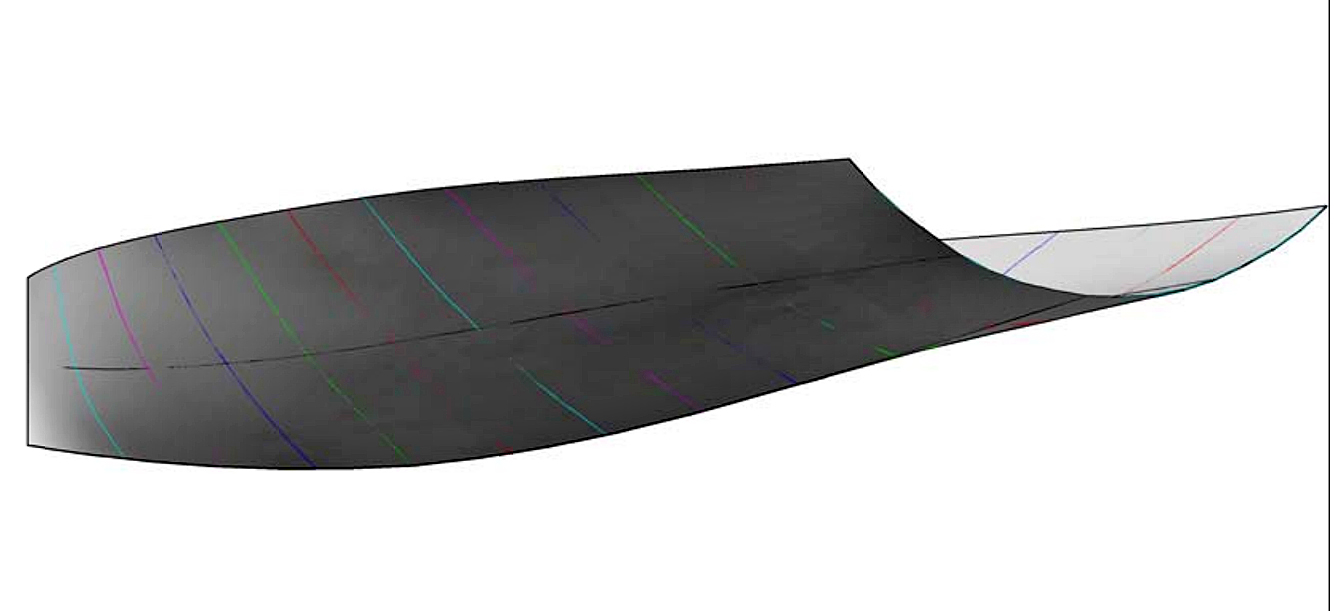
Header Photo: Design Cartoon for a Bend-em-Up - Classic Moth?


The previous header photo was a design cartoon kicking around the Interwebs. There was no explanation attached but, if I engage in a bit of speculation, it seems to be a developed ply concept for a Classic Moth. Bill Schill did his last Maser conversion very similar to this, a radical looking Moth. Bill's Maser concept was very slow. Unfortunately, I have no photos of Bill's last Maser. It seems to me you could build a credible Classic Moth if you glommed some topsides onto the back half of the boat. It would take some tinkering; should be an easy build, though probably not a racing shape.

George A. has more on Bill Schill over at his Mid-Atlantic Musings blog.


Update: January 18, 2021 - It turns out this design cartoon was actually built. She is a Classic Moth design by Bertrand Warion, a prolific builder of Moths, whose design and building inventiveness has been featured in many posts on Earwigoagin. Bertrand writes of this bend-em-up design;
"The Moth Classique is "Zazou" I designed in 2002/2003? The boat was made from one sheet plywood, 5mm exterior grade. [It] was easy [to build] and quite fast but the mast was not stiff enough. [She] is now destroyed. [There] is only one photo remaining."

Zazou is Moth number 203 to the right of this gaggle of classic Moths running downwind.


Wednesday, July 1, 2015

Holes in my Maser

One difference as I have aged is I don't mind cutting holes in my boat. I wouldn't have even contemplated such an undertaking as a young'n.

Last fall I was trying to figure out why I had paint cracking on the aft deck of my Maser. The aft deck seemed very soft. Three mm. plywood is flexible but this seemed worse than usual. The only way I was going to find out was to cut two holes in the aft deck. It turned out that there was a mini-frame, about 50 mm. deep, of 3 mm. plywood, set aft about 300 mm. from the main aft bulkhead. It had cracked on both sides about 150 mm. in from gunwhales, probably when I had moved aft on that area on a heavy-air reach.

To make the frame whole again, I sistered the frame at both the cracks.

The following photos show the process of working backwards to get a watertight aft deck once the repairs had been made.

Backing pieces glued on. Plywood top piece cut to fit. I used a top piece of pine as a gluer for the plywood top piece on the aft side. This also gave some added I-beam strength above the mini-frame. (I cut the hole right next to the mini-frame repair and didn't have room for an aft backer strip.)


Close up of the open hole with backers in place.


Both plywood pieces in place, glued up. Top aft I-beam pine piece glued down.


Repairs glassed over with 9 oz biaxial cloth.


I was eventually able to get some primer down and that is how she looks at the present time. Good enough for a Tweezerman repair.


Wednesday, September 23, 2015

2015 Classic Moth Nationals

The 2015 Classic Moth Nationals at E-City this past weekend had two glorious sunny days with winds mostly under ten knots. Jamey Rabbit repeated as National Champ with an even more dominating performance than he had last year. As usual, the Gen II Mistral or modified Mistral designs filled the top four positions. Rod Mincher returned to the Nationals after a several year layoff to take the Gen I division in his Maser. Gary Gowans, who won Gen I last year, copped another victory this year, in the Vintage division.

The fleet was split almost evenly among the divisions with 6 Gen II, 5 Gen I, and 6 Vintage to make a total of 17 Classic Moths.

I was able to wander around and take some yard shots of a few of the Classic Moth fraternity/sorority.

Usually the Classic Moth Greybeard Society doesn't have a quorum at the Nationals but this year they did. Dan Mallott, Gary Gowans, and Jahn.


Bill Boyle, who was the lead builder on the Tweezer project, has built or restored a bunch of Classic Moths. Here he is with his restored Ventnor.


Joe Courter, who puts on the great pre-race party at the Brigantine Regatta, got the Old Goat award (he's well into his 70's).


National Champion for the second year in a row, Jamey Rabbit,


John Zsecleczky finished third overall.


Mike Parsons finished second overall.


Top Twelve Results of the 2015 Classic Moth Nationals.

The Gen II  and National Championship winner is marked with yellow, the Gen I winner is marked with green, the Vintage is marked with orange.

Skipper Races Hull Design
Jamey Rabbit 1,1,1,1,1,1,[2],1,1,1] Mistral/Mousetrap
Mike Parsons 2,3,2,2,2,[4],3,2,2,2 Mistral
John Zseleczky 4,4,3,3,[4],3,1,4,3,4 Mistral/Collins
Joe Bousquet 3,2,4,4,3,2,4,3,[5],5 Mistral
Rod Mincher 5,5,5,5,5,5,5,5,4,[6] Stark Maser (Gen 1)
John Pugh 6,7,7,6,7,7,7,[9],7,3 Olympic Europe (Gen 1)
Greg Duncan 8,6,[13],7,6,9,9,8,8,8 Olympic Europe (Gen 1)
Zach Balluzzo 11,[12],8,8,9,8,6,6,9,7 Mistral
Gary Gowans 9,10,9,9,[11],6,8,7,6,9 Tennis Bracelet (Vintage)
Carol Terryberry 10,11,11,10,[12]10,10,10,12,11 Ventnor (Vintage)
Erik Albaugh 13,13,[14],13,8,11,12,12,11,10 Mistral/Savannah
Bill Boyle [14],14,12,14,14,12,11,11,10,12 Ventnor (Vintage)


George Albaugh over at Mid-Atlantic Musings blog has put more photos up in his 2015 Nationals photo album.

Thursday, September 30, 2010

2010 Classic Moth Nationals; Report and Results

Good turnout again this year with the usual ragtag Mothboat builder, tinkerer, racer clan assembling at Elizabeth City, NC to discuss Mothboat designs, drink beer, watch foiler demos in the evening and fit in 9 races to determine the National champeen.

In my several years attending this regatta in mid September, I'd estimate that 85% of the winds are from the North, NorthEast. Ditto this year, with winds mostly about 5-7 mph, which means the weather mark is tucked up against the shore where big lefty shifts or big righty shifts randomly swirl. Added to the tactical conundrum this year; the start/finish line was moved mid course and protected from crossing in the race instructions. One had to commit to the left or right at the bottom of the course, immediately after rounding the leeward mark, which again was a toss of the dice. Enough to make your brain spin but it gave good close racing throughout the fleet

Jeff Linton impinged on the protected start/finish line and was carrying a DSQ early but turned in five consecutive firsts to take home another National title. Mike Parsons, last year's winner, also carried a DSQ when he sailed through the start/finish line but kept his nose clean with mostly top three finishes to claim second. Previous National champ, Mark Saunders had some dicey first beats early on but managed big comebacks throughout the regatta to finish third, only two points behind Mike.

Your humble scribe raced his Maser to a second place in the slower Gen1 division, behind Rebecca Dudzinski, who borrowed back her Europe dinghy she used in an Olympic campaign. Rebecca gave the faster Gen 2 guys a run for their money, posting an individual race first and a second to finally place 4th overall. John Z in his Mistral and Joe Bousquet in his modified Shelley finished 5th and 6th overall

Number 1 and Number 2 for the regatta; Jeff Linton and Mike Parsons (Jeff on the left). (As always click on the picture for a high resolution image.)


Mark Saunders finished third with a legal fathead. His sail is a foot short on the luff (14' vs 15'). Mark gives up the extra foot of luff so he can eliminate the pinhead and use a fathead (his sail would lie within the outside dimensions of a normal max 15' luff sail).


Us old farts in the Classic Moths always wondered how one of the women Olympic sailors in the Europe dinghy would do if they raced a Europe in the Nationals. Now we know. Pretty damned good! Fourth to Rebecca Dudzinski in her Europe.


John Z, with his modified Mistral, was top Annapolis sailor in fifth......


And Joe Bousquet, sailing his wife's modified high freeboard Shelly was sixth........


Top ten results table;


Skipper Races Hull Design
Jeff Linton 2,[DSQ],4,2,1,1,1,1,1 Mousetrap
Mike Parsons [DSQ]4,2,1,2,3,4,3,3 Mistral
Mark Saunders 4,2,[6],4,4,2,2,2,4 Mistral
Rebecca Dudzinsky 1,3,5,[7],7,4,5,4,2 Europe
John Zseleczky [10],6,3,3,3,6,3,5,6 Mistral
Joe Bousquet 7,1,1,5,5,[10],6,6,5 Modified Shelly
Rod Mincher 5,[11],8,6,9,5,7,7,8 Maser
Rod Koch 3,7,[DSQ],8,8,7,10,8,7 Modified Europe
Walt Collins 6,[10],7,9,6,9,8,10,11 Cates
Lewis Hay 8,5,10,11,10,8,[12],11,10 Europe


Thanks again to John and Sarah Pugh for hosting this years regatta on their commodious back lawn. Thanks to Greg Duncan for putting the regatta together. Thanks to Mike and Barbara, Ed Salva, John Z for bringing some tasty beers to swill down.

Thanks to Elizabeth Albaugh and Len Parker for the photos.

And finally I couldn't let Rutledge Young of Charleston, SC off the hook for this great photo of his Savannah Wedge design.

Saturday, November 17, 2018

Header Photo: Starkers... Gone!


The previous header photo was the blogmeister idling around in his Maser before one of the starts of the 2015 Classic Moth Nationals. This fall I donated my Maser, number 105, (named Starkers as a Tip-of-the-Hat to her designer/builder, Randy Starks) to Joe Bousquet's expanding Classic Moth outreach to junior sailors. I haven't been racing much and felt Starkers would be better off with a younger skipper. Moth no. 105 was a good Moth. I treat my racing boats as anthropomorphic entities; they have human personalities and there was no doubt Starkers had a will to win. (Don't most singlehander's talk to their boats when racing? I even apologize to my boat if I do poorly in a race.). I like to think she was thankful at being granted another life, like a rescue dog, except in this case Starkers was brought back from an abandoned Laser hull and had a second life as a full-on racing Classic Moth. As a team, we won the trifecta of Gen 1 trophies, the Nationals, the Midwinters, and the Brigantine regatta. Great memories and I will forever have a soft spot in my heart for Starkers, this endearing mutt of a Classic Moth.


Ingrid Albaugh


Ingrid Albaugh


Thursday, March 23, 2017

Why is a Laser Faster than the Classic Moth - Or Is It?

Over at the WoodenBoat Forums there is this thread that recently popped up that was started with this question by "cmjns":
"I've spent a lot of time ogling classic moth designs, from the Gen II mistrals to the Gen I Mint, and I'm a bit smitten by the Farr 3.7 and the Contender (very different boats, I know). So I'm curious: among all the shapes swirling around in my head, some of them reportedly are much faster than others. And the moths in particular *look* fast but aren't nearly as fast as a laser, which nevertheless "sails like an aircraft carrier" in comparison.

"So my question: how do I evaluate a hull shape? What characteristics are associated with downwind vs. upwind performance, and what equates to overall speed? And why is a laser faster than a moth? Is it the sail? Is it the length? Is it the shape? What happens to a laser when you cut it down and put a moth sail on it (maser)? Does it slooooooow down?

The answer in a nutshell. A Laser is faster than the Classic Moth because it is longer (as several of the commenters to this thread noted - see "Chris249" comments for a more detailed hydrodynamic explanation). The Laser also has more sail area - the Classic Moth rig is more-or-less equivalent to the area of the Laser Radial. And No... making a Laser into a Maser doesn't make it faster than a Laser. (It does make it more fun in my opinion.)

I think the crux of "cmjns" question deals with hull shape and, specifically, why the flat Laser shape is so different from our fastest Classic Moth hull shape, the Mistral or Duflos designs which have low wetted area, narrow waterline beam, rocker forward, with a large amount of flare to the gunwhale. Does that mean the flat Laser shape is inherently "faster". Are the fastest Classic Moth hull shapes an anomaly?

First up is the Laser shape:


For a comparison is the following four views of the Mistral hull shape as modeled by Andrew Slavinskas. Not a flat area to be found. The transom is a very circular shape.
Andrew Slavinskas


Andrew Slavinskas


Andrew Slavinskas


Andrew Slavinskas

What gives? It turns out the characteristics of a Classic Moth Gen II fast hull (low wetted surface, narrow waterline beam, high flare to support hiking power) translates very well into a longer, very fast conventional hiking singlehander - in fact the fastest conventional hiking singlehander. It is the RS300 and it was designed by Mothist Clive Everest back in 1998. It is not length that gives the RS300 an advantage. (It is only slightly longer than the Laser - +.07 meter, giving the RS300 the same length as a Melges 14.) It is a hull with very little flats anywhere, where wetted surface is pared back ruthlessly, where the waterline beam is as narrow you can get away. The dirty little truth! For a design close to twenty years old the RS300 is faster than the latest, much ballyhooed RS Aero and the D Zero. Some RYA Portsmouth numbers:
  • RS300 - 973
  • RS Aero - 1024
  • D Zero - 1029
  • Farr 3.7 - 1039 (Yes, I know the Farr is a trapeze singlehander.)
  • Laser - 1097
  • Europe Dinghy - 1145 (I would expect our Classic Moth Mistrals to be slightly faster than this number.)
The downside to this hull shape. As with our Mistral design, the RS300 is very tippy and has a tendency to trip up her skipper with regularity. The RS300 is worse than our Gen II Classic Moths in that respect because the RS300's modern rig is much more powerful than our vintage low-aspect rig. As such the RS300 has carved out a small niche among those singlehanders who want an athletic, challenging, conventional (no-foils) full-on racing dinghy. The market for the RS300 is small enough that RS has given the RS300 production over to another low-volume builder.

So our fast shapes in the Gen II Classic Moth fleet are not an anomaly. There are exactly the shapes you would design if you want the fastest hiking, non-trapeze, non-sliding seat, non-foiling singlehander. However, if  you are trying to sell a lot of dinghies, you just might not find a large enough crowd that would enjoy all that wind-swimming.

From the Earwigoagin archives, you can find other RS300 posts.

A very well done RS300 promotional video:


Saturday, March 19, 2016

Updates on Classic Moth Builds: Spring 2016

Springtime and let's see what the makers in the Classic Moth world are cooking up.

I know two Bill's who are boat-builders and both of them are very, very quick at knocking a boat out from scratch. The next couple of photos are from Bill Boyle's blog where he is documenting his cedar strip Europe Dinghy build. He has the hull off the molds and is now fitting the bulkheads and deck reinforcements.

The king-plank for the foredeck and the mast strut connecting down to the hull. This will support the deck-stepped mast.

Repost from http://europedinghymoth.blogspot.com/

The daggerboard trunk.

Repost from http://europedinghymoth.blogspot.com/

How the mast strut is gussetted at both juncture points.

Repost from http://europedinghymoth.blogspot.com/

John Hanson, a Mainer, is starting a New Zealand Moth scow as a father/son project. John is the publisher of Maine Boats, Homes, and Harbors magazine and will be documenting the build in upcoming issues. He did a mock-up of the hull (which is essentially a Len Morris MkII scow) in luan.
Picture clipped from Issue 139 of Maine Boats, Harbors, Homes

Also, about 50 km. from where I live, Victor Stango is reconstructing the rolled deck on a Maser he picked up over the winter. Whoo! Hoo! another Maser in the local fleet.


Meanwhile our Classic Moth friends in Russia are proceeding apace with their construction of the Mistral Moth. They built the hull over full molds and report that there was little issue in getting the plywood to behave when fitting.

Here is one side of the plywood going on.

http://forum.katera.ru/index.php?/topic/51277-classic-moth-boats/


http://forum.katera.ru/index.php?/topic/51277-classic-moth-boats/

Completed shell off the molds. The builder is Serg-IF. Looking good!

http://forum.katera.ru/index.php?/topic/51277-classic-moth-boats/


http://forum.katera.ru/index.php?/topic/51277-classic-moth-boats/