Showing posts sorted by relevance for query ICWDR. Sort by date Show all posts

Saturday, February 16, 2019

Header Photo: Gwen 12's at the ICWDR


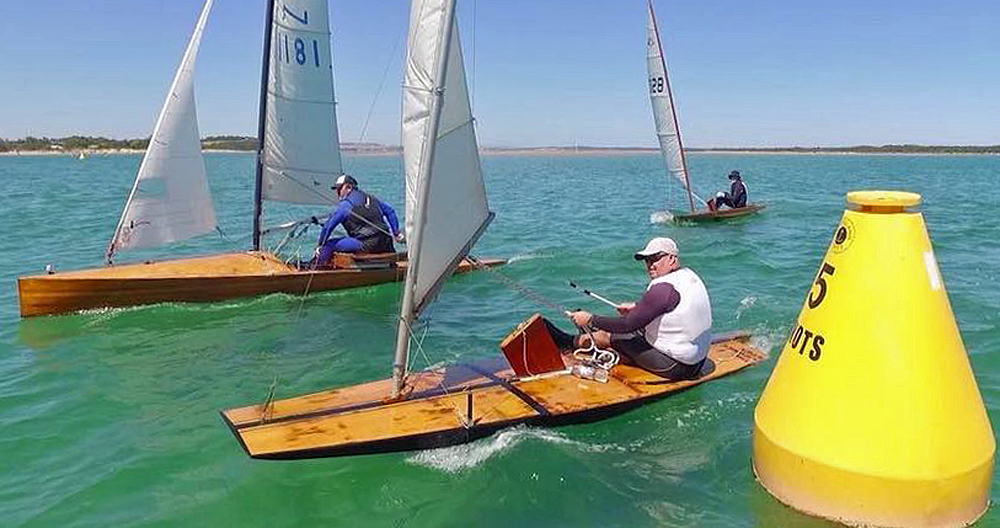
Photos from the 2019 ICWDR (Inverloch Classic Wooden Dinghy Regatta) held over the Australia Day Weekend (January 26, 27 2019) have been filtering into Earwigoagin Central. The previous header photo features the Gwen 12 class, another Australian Classic Dinghy class that is making a concerted effort to find and restore old boats. Four Gwen's showed up at Inverloch with Grasshopper, the Gwen in the header photo getting the Best Overall Award. From Andrew Chapman:
"The Best Presented Sailing Dinghy was won by Rod Mackintosh’s Gwen 12 ‘Grasshopper’ sail number 2846. Rod... traveled from South Australia to sail with the other Gwen's. When he acquired the boat it was covered in thick green paint and since then it has been completely restored with clear finishes all over. The Inverloch and District Lions Club Perpetual for the Best Overall boat at the regatta, which is selected from the category winners, was [also] given to Rod Mackintosh’s Gwen 12 ‘Grasshopper’."


Kiwi Neil Kennedy offers up this description of the header photo in "Strine" slang. (It would be nice to have definitions for all this, but with second thought, we'll leave it all to the imagination.)
"As the Aussie's would say " Strewth cobber, ... here is a header photo of two "old Galahs" in a Gwen 12 thinking they were 30 years younger as they get set for a downwind blast. Of course 30 yr's ago they would have been lean and tanned, wearing a footy jersey and shorts, with bare feet, and after blasting around the bay, would have returned to the beach where they would have had two Shiela's in minimal bikinis equally tanned lying on beach towels waiting for their blokes with cold beers ready and waiting in the "esky" for the boys to "scull down" while they derigged and contemplated the evenings activities with the Sheila's, knowing that they were "good sorts" who liked a drink or two and with the usual approach of Aussie girls in that era " if you want a "root" to round out the nights entertainment "just ask !! I kid you not, I lived there for four years and I remember well; " with more than a smile or two."


A comment from unknown previous Gwen sailor:
"In Adelaide, South Australia first off-wind leg (Close Reach to Beam Reach), 1 nautical Mile long, 3 minutes with a decent wind or more. She sits on a dinner-plate size contact with the water. Water spews out the well (up to 1 metre) and straight over the stern transom. Oh and something hums! If you are not anticipating this kind of speed then you underestimate the Gwen 12's capabilities. It's a heavy weather specialist. You can still put up a kite when no-one else can."


More photos. No. 1905 is Wayne Fry's Scud IV.


No. 1941 is Toby Leppin’s recently restored 1960’s Gwen 12 Avenger. From Andrew Chapman: "Avenger won the Gwen 12 Challenge Cup. Toby sailed with crew Geoff Rippingale using the trapeze and setting the flat cut wire luff spinnaker...


Simon Wilson in Chaos Restored


Toby Leppin and Geoff Rippingale upwind.


Back in my International 14 days, when we saw such a relaxing photo, especially with the spinnaker being ready to be deployed, we said the crew was pausing to make the skipper a cup of tea.


I've commented before in Earwigoagin about the seeming complete die-off of the single trapeze performance dinghy - a puzzlement to this old fellow who remembers large fleets of Fireballs and 470's and Flying Dutchman in North America. (The 505 soldiers on but at an almost professional level.) I can't think of a better plywood project for a single trapeze, spinnaker dinghy than the Gwen 12.


From Drift Media, the 2017 Dinghy Show on the Glade. (I'm not sure this happened this year.)

ICWDR 2017 SEGMENT5 from drift media on Vimeo.


Apologies, but Andrew sent me photo attributions for these Gwen pics but I've mixed the photos up to the point I'll have to wait for Andrew to set me straight.

Saturday, March 2, 2019

Header Photo: The Australian Sailfish; ICWDR 2019


The previous header photo is from the 2019 ICWDR regatta; Emma Milton on Australian Sailfish 2192, Apsu, going into a jibe on a very narrow scow with very little clearance under the boom. I can't do any better than the description offered by Kiwi Neil Kennedy (who built an Australian Sailfish and sailed one for a while).
"The moment of truth before a full blooded, square-run gybe on a Sailfish. The bow wave almost level with the deck, a hand full of mainsheet, knees braced, tiller angled behind the back, ready to fling the boom across while remembering to hit the deck as the boom whistled across, all the while hoping that a sudden gust didn't arrive just as you heaved on the main sheet ! It was even more fun in a Sailfish as there was nowhere to brace yourself so... get it right!! or slide off the deck into the deep blue... laughing!
Ninety something, Jack Carroll, one of the original designers of the Sailfish, got out in his original Sailfish, Debonair.


The fleet on the Inverloch beach.


Beating among the sandbars of the Inverloch Inlet.


Greg Barwick sends along this report. Twenty Sailfish showed up at the ICWDR and Sailfish are now being built around the globe. Read more below.


I've put a post up with abbreviated plans for the Sailfish up on Earwigoagin but best to go to the original source for the Australian Sailfish plans.

Some other Earwigoagin posts about the Australian Sailfish.


Monday, April 2, 2018

Moth and Sailfish Scows at the Inverloch Classic Wooden Dinghy Regatta

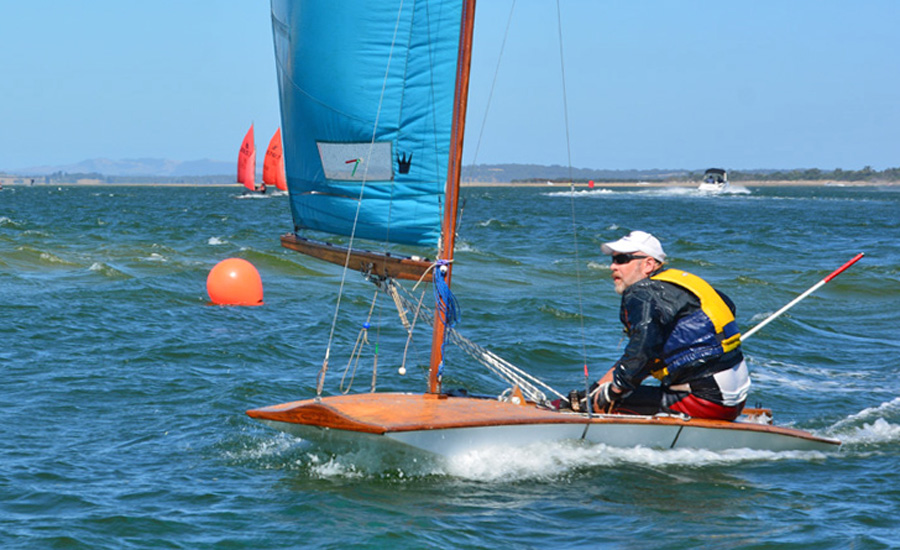
Time to wrap up the scow thread which I've kept Earwigoagin on for a month or so. This post I stay with the Australian Inverloch Classic Wooden Dinghy Regatta and the other two vintage scow classes competing; the Australian scow Moth and the Australian Sailfish design.

As mentioned before, the Inverloch Classic Wooden Dinghy Regatta celebrated the 90th year of Len Morris building his "Olive" which would become the Inverloch 11-footer class and then, when they spied the Rudder magazine article with Crosby's plans for his Skimmer Moth, the Inverloch group appropriated the emblem and become the Australian Moth class. The original "Olive" is still in one piece and was on display in the gymnasium at the Inverloch Regatta. The original definitely has high freeboard. Nowadays we would probably say the design is more pram-like than scow-like.


Len Morris's second Moth design, the Mk II, built post WWII, would take Australia by storm and was definitely more in line with the low freeboard American scows. Graeme Cox brought along an early Mk II. Note the low roach mainsail on the MkII (#3021) compared to a later 1960's scow design (#3396, an Imperium perhaps?).


Graeme Cox's MkII from the stern.


Phil Johnson, in his beautifully restored Cole Mouldie Moth, won the "Best Moth" prize at the regatta.


Nine Australian Sailfish made it to the 2018 ICWDR, down slightly from the eleven that showed at the 2017 ICWDR. Nine Sailfish still made up the largest class attending in 2018. There was even a brand new build. Brian Carroll, son of Jack Carroll, one of the designers of the Australian Sailfish brought the freshly launched "Jacks Toy" to Inverloch.


The new build Sailfish sported SUP non-skid tread, certainly a big help in staying on these slippery, narrow, beach boats.


Sunday, February 12, 2017

Australian Sailfish at the Inverloch Classic Wooden Dinghy Regatta

ICWDR

Eleven Australian Sailfish made the trip to South Gippsland Y.C.'s 2017 Classic Wooden Dinghy Regatta (Australia Day weekend, January 25-28). This was an astounding number given that class stalwarts from the 1960's, 1970's and 1980's didn't start organizing until six months before the Inverloch regatta. As to be expected, this gathering of Australian Sailfish skippers was a reunion of primarily grey-beards. It will be interesting to see if the class can harness this new-found energy into some new builds and some younger skippers. It would be great to see the class translate a reunion into a renaissance of the Australian Sailfish.

Greg Barwick's more detailed report on the weekend from the Australian Sailfish website.

Some photos:

A Sailfish rounding a mark with the wooden International Canoe on the outside.

Mick Green/Drift Media

Chris Cleary (no. 1918), who contributed two Sailfish articles to Earwigoagin, chasing the eventual winner, Steven Floyd (no. 3400) who was the last national champion in 1987.

Hayden Ramsdale

Chris Drury had the newest Sailfish at Inverloch.

Hayden Ramsdale

A beautiful graphic design on the deck of a restored Sailfish. Ian Milton's Apsu.

Greg Barwick

Ian Milton on Apsu focused on punching through a wave.

Hayden Ramsdale

The bow snout of the Australian Sailfish. Chris Drury's Blowed if I Know.

Trilby Parise

A race start. I've seen several sheepish comments from the skippers that starting skills were very, very rusty, hence only three Sailfish in this photo.

Hayden Ramsdale

Four Sailfish skippers were able to reprise a photo-op from the 1970's. Jack Carroll, the Sailfish designer and class founder is second from the left. The Sailfish is Jack Carroll's original, no. 2, Debonair.

Ian Milton

The original photo of the foursome from the 1970's.

Newcastle Morning Herald, Jan 1978

Jack Carroll tweaking on his original Sailfish.


Tony Hastings made this video of his race at the Classic Dinghy Regatta on Flotsam, his restored Sailfish. Some rot in the transom allowed the gudgeons to pull away and the rudder to float up, ending his race (starting at 8:44). For those who wonder how you tack these narrow. low boom craft; the tacking sequences are at 1:41, 2:12, 7:00, and 7:41 in this video. Chris Cleary left a comment about Tony's unorthodox tacking technique which I've tacked onto the main post.
"Tony's tacking and gybing technique is very idiosyncratic. He has end-boom sheeting on his boat, which I hadn't seen previously on a Sailfish. That gave him space for his mid-boom belly flop. Effective though - he had his appropriately named relic going like a rocket. We were sailing side-by-side on very thin water in an attempt to avoid the worst of a strong ebb tide when disaster struck for Tony. He's an excellent sailor - a current top 10 Australian Paper Tiger catamaran skipper.


Saturday, February 24, 2018

Drift Media covers Moth History talk by Aussie Ian Ward

 ICWDR

The good folks over at Drift Media put together a Moth History video, combining a talk by Ian Ward at the Inverloch Classic Wooden Dinghy Regatta dinner with a compilation of Moth shots (both classic and foiling) taken during the 2018 regatta weekend. Ian Ward was a top scow designer in the 1970's and 1980's as well as a top helm in his own right (Australian National Champion as well as top placings in World Championships). Ian was also the first one to put centerline foils on a Moth in 1998. In this video he can be seen sailing his foiling scow.


ICWDR_2018_MOTH from drift media on Vimeo.

The Inverloch Classic Wooden Dinghy Regatta was hosted, as usual, by the South Gippsland Y.C.

Sunday, March 11, 2018

Two different scows at the Inverloch Classic Wooden Dinghy Regatta: Rainbow and A-12


While I'm on a scow kick, mention must be made of two different scow designs that competed in the Australian ICWDR out of the South Gippsland Y.C. One of the kingpins of the Classic Wooden Dinghy event, Andrew Chapman and family, had two restored Rainbows in the regatta. (Correction: Andrew did the restoration of one "Annie", his son-in-law, Jonathan, a fine craftsman in his own right - music instruments - did the restoration of the other one, "Moonraker".The Rainbow is an Australian 3.65 meter design that was popular as a junior trainer in South Australia in the 1960's. Andrew sailed one Rainbow with his grand-daughter and, his daughter Trilby, sailed the second one with Andrew's other grand-daughter. I asked Andrew what he thought of the Rainbow scow as a parent/kid sailing dinghy and he was enthusiastic.
"The Rainbow is lovely small boat to sail. It is very forgiving and a lot faster than a Mirror and Heron without using the trapeze and/or large spinnaker. I think it is an ideal boat for an adult and young kid or young teenagers. Trilby and I sailed with each of her two daughters and we plan to introduce them to using a trapeze on a beat and then the trapeze with spinnaker on reaches. We are also putting them on the helm and they enjoy sailing the quicker boat and they are not overwhelmed by the boats size. When they are comfortable using the trapeze and spinnaker trapeze combination the next stage will be the Gwen 12 then Cherub. I think the Rainbow is a very good small boat and it is one that is very easy for home builders to make.
Andrew Chapman and grand-daughter in "Annie".


Trilby and daughter in "Moonraker"


Three very different Australian scows in one shot. Trilby with the Rainbow on the beach, a modern carbon foiling Moth scow, and, in the background, a Classic wingless Moth scow.


Plans for the Rainbow scow can be found here.


The A-12 scow was Frank Bethwaite's follow-on to his Northbridge Junior scow. Designed to be a higher performance dinghy, the A-12 was longer, 12 feet or 3.65 meters, sported Frank's signature rotating mast and had a trapeze. Neil Kennedy from Nedslocker dug out a November, 1970 issue of the Australian Modern Boating which featured the class when newly introduced. Some photos from that article:


An A-12 scow has shown up at the Inverloch Classic Wooden Dinghy Regatta for the last two years but, as Andrew Chapman writes, in the beginning no-one knew what type of scow it was.
"At the first regatta Andrew Kean sailed the boat as a Moth, with two tone blue sails, because that what it was sold to him as. He did wonder why someone had put a trapeze fitting on the mast. Apparently he never thought to measure the length. He sailed it again in the most recent regatta as an A12 with blue and white sails with a different rig.
From the photos it looks like Andrew was able to find a genuine Bethwaite rotating rig and A-12 sail.

The A-12 with the original Moth rig; a blue sail, wooden spars.


The A-12 on the Inverloch beach next to an Australian Sailfish.


For the 2018 regatta, Andrew was able to plug in the correct rig; aluminum rotating mast with a very big sail.


I'm not sure any plans exist for the A-12. None have come forward yet.


George McGee adds more info on the A12. (From a comment I dragged to the main body.)
"I raced an A12 at Northbridge sailing club in the mid seventies. My boat came from Starbord Products with 2 rigs. The first rig was the 85 sq foot two tone blue sail with the over-rotating wooden mast. The second rig was a 65 sq foot two tone sail with a shorter wooden mast. (Not sure of the 65sq foot size). When the smaller rig was used the boat was classed a J12 rather than A12. NSC had a number of A12s and J12s competing on Sundays in the mid seventies.I spent many a happy afternoon on the A12 redefining the term "screaming reach"
.

Thursday, March 2, 2017

2017 Australian Classic Wooden Dinghy Regatta - More Photos

ICWDR

I covered the Australian Sailfish class at the Inverloch 2017 Classic Wooden Dinghy Regatta and this is the second post of that regatta to cover some of the other vintage dinghy classes that made an appearance. Attendance was close to fifty dinghies which was a record for this, still young, event. Many of these dinghies were also featured in photos from previous Classic Wooden Dinghy Regattas.

A nice shot of the Classic dinghies on the beach. A scow Moth and and yellow-sailed Impulse are in the foreground. The blue and white sail is an Australian Sailfish.

Tim Wilson

Another beach shot with the Mirror dinghies and their distinctive red sails to the fore.

Tim Wilson

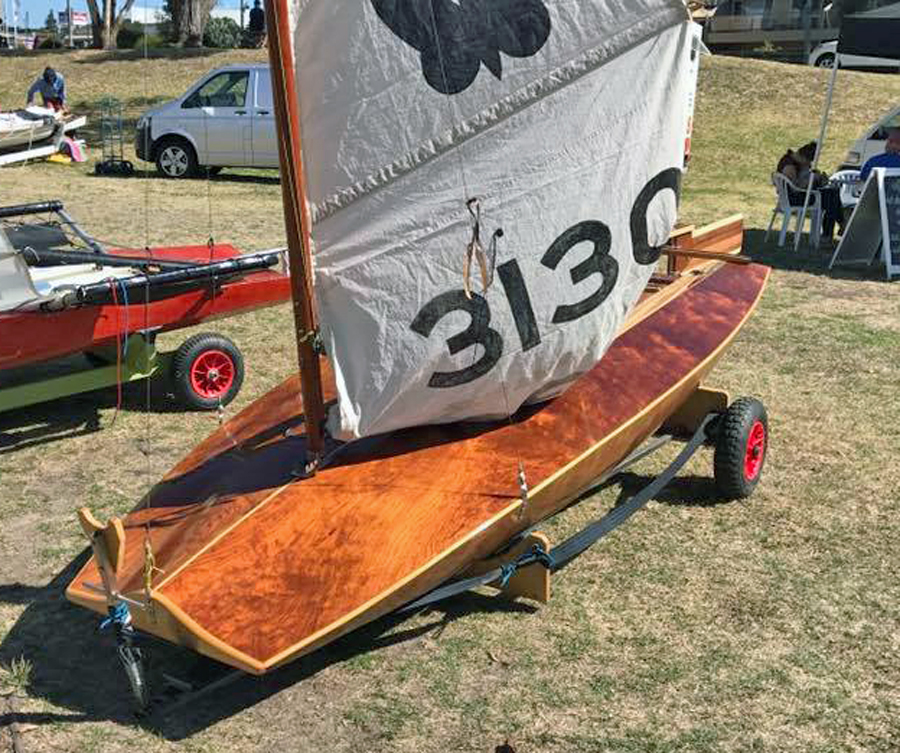
Australian scow Moth number 3130 is a Cole mouldie (wingless) design from the 1960's. This scow was painstakingly restored by Phil Johnson who had to reglue many of the veneers.

David French

This is an Aquanaut class dinghy sailed by Graeme Cox. The dinghy is around the Mirror length, 10 feet, main and jib sporting a single-chine, plywood shape. (I think it was designed for stitch and glue.) Earwigoagin has posted about an aluminium Aquanuat. I'll see if I can find out more about this design.

Tim Wilson

The Gwen 12 was a 12-foot single-trapeze design by Charles Cunningham. The class had large fleets in Australia up to about 1980 and the boat was known to be a heavy-air flyer. Two restored Gwen 12's showed up at Inverloch. (I think Earwigoagin correspondent, Andrew Chapman, is in number 2555.)


The beautiful cold-molded Aussie 16-foot skiff. Owned by Frank Raisin, this skiff was professionally refurbished.

Tim Wilson

This looks to be a double-bottom Gwen 12 (yet to be confirmed).


Another winged Aussie scow Moth.

Tim Wilson

Two of the larger three-man vintage dinghies crossing tacks; the cold-molded Aussie 16-foot skiff and the chined Olympic 12m2 Sharpie.


At the end of the racing, the dinghies transition from the beach to the "glade", a grassy area where spectators can look without getting their sandals gritty and the judges peruse for "Concours de elegance" awards.

Tim Wilson


The Australian Classic Wooden Dinghy Regatta is hosted by the South Gippsland Y.C.

Wednesday, February 19, 2014

South Gippsland Yacht Club - Australian Classic Wooden Dinghy Regatta

ICWDR

It doesn't take long when perusing this blog to catch on that the blogmeister sails a Classic Moth and that he also tends to feature those regattas that highlight the diversity and/or the history of dinghy sailing. Click on the following Earwigoagin links for regattas like the WOOD regatta, CBMM's Small Boat Festival, the Archipelago Rally, and the Bosham SC Classic Revival - UK. South Gippsland YC, southeast of Melbourne, held probably the first Australian Regatta featuring the great Australian wooden dinghies from yore. Here (was) a great video - Oops! I guess this longish video was a pre-production version, not meant for general viewing on the Net-Toobs and has now been taken down. Not to worry. There is a very good slide show of the regatta and also a video short of the GoPro view of father/daughter sailing on the double plank VeeJay..

Some class logos I recognize; JB for the Uffa Fox 19' Jollyboat, the Circle R of the Rainbow scow, also there is the M logo on the red sails of the regular Mirror dinghy as well as M logo with the halo of the Mirror Miracle, the Bell of the GP 14, the Heron of the Heron class, the red ball of the Fireball, the Butterfly logo of the Moth and the three bars of the Contender class. I've also been promised some pics from the regatta which I'll post when I receive them.

The slide show: (Oops again! they've now made the slide show so I can't embed. Jeez this is a moving target!) Click here for the slide show:

Click here to go to Drifts Media GoPro of VeeJay sailing

Sunday, February 14, 2016

Header Photo: South Gippsland Y.C. Classic Wooden Dinghy Regatta


The previous header photo was of  Australian sailing dinghies gathered on the beach for the 2015 South Gippsland Y.C. Classic Wooden Dinghy Regatta, ICWDR. In the foreground we can see, from left to right, a Mirror, and two scow Moths. The 2016 Regatta was held this past January but I haven't received a report yet. When I do, hopefully I can post some photos.