Showing posts with label River sailing. Show all posts

Wednesday, January 1, 2020

Header Photo: Bucolic River Scene


The previous header photo to close out 2019 was of a dinghy (possibly a Wayfarer) and a vintage cruiser drifting in opposite directions on an English river, the sun setting. This may be the Three Rivers Race on the Norfolk Broads but things get jumbled up on my computer so I can't say for sure.

Monday, September 30, 2019

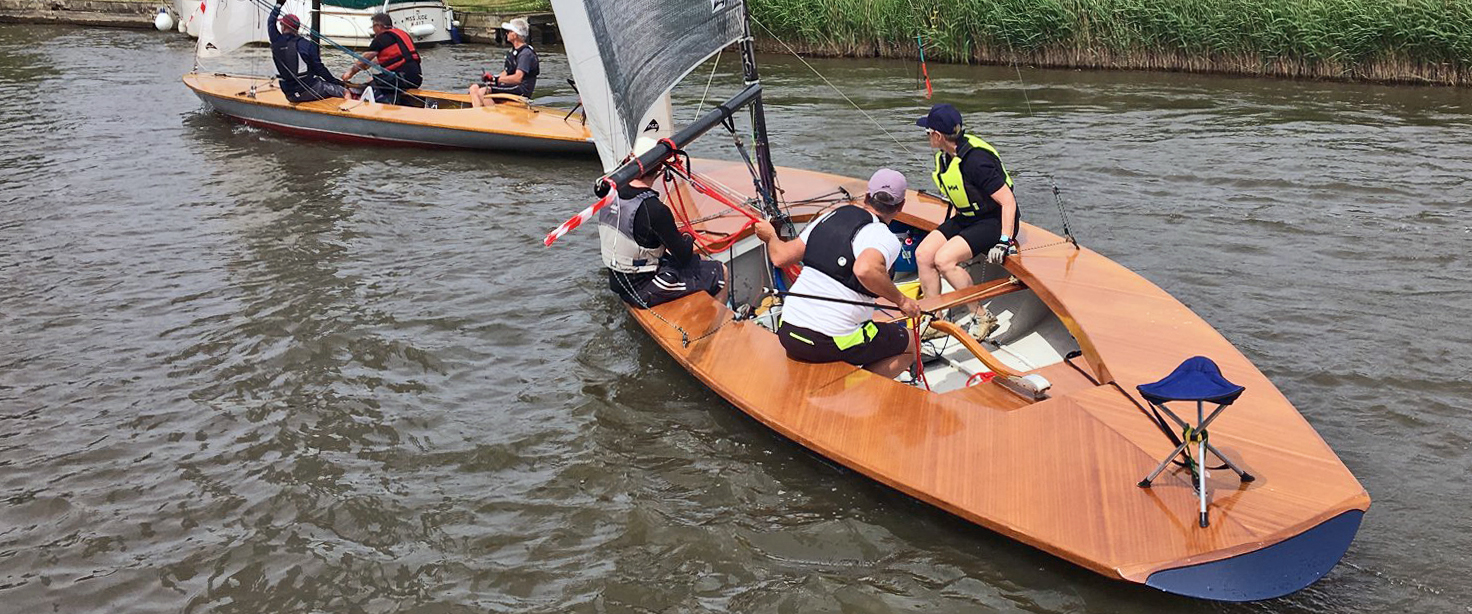
Thames Raters in the English "Three Rivers Race"


Two Thames Raters, the ultimate river sailing machine, in close quarters during the Three Rivers Race. The little camp chair on the back deck is not normal gear but necessary in this race. The mast has to be dropped several times to get under bridges and the chair keeps the mast in place when down.

Sunday, December 9, 2018

Three Rivers Race: I can't get enough of Dylan Winter!


If I had a bucket list (which I don't; I am more of the type to play it by ear, see what life offers up, and see what falls out), racing in the U.K Three Rivers Race on the Norfolk Broads would be at top. I have written several posts over the years about the Three Rivers Race, most of the posts featured the superb Dylan Winters videos which have since disappeared. However, this Dylan Winter video on the Three Rivers Race has resurfaced and is a perfect summery antidote for a Mid-Atlantic evening where we are bundled up in an early December cold-snap and the temperatures at night have been dipping well below zero.


Dylan Winter is asking those who enjoy his videos to consider contributing some cash. His website is over here.

Saturday, December 8, 2018

12 Sq. Meter Sharpie: Another Dylan Winter Short

I've written about the 12 sq. meter Sharpie before in Earwigoagin. (The Sharpie was the doublehander class at the 1956 Olympic Games.) Here is a video about the small fleet of vintage 12 sq. meter sharpies based out of the tidal rivers of northern Norfolk, U.K., done by one of my favorite sailing videographers, Dylan Winter. Dylan Winter started off documenting his circumnavigation of the U.K. coastline in a Mirror 19 (under the "Keep Turning Left moniker"), then put his videos behind a paywall, and has now brought them back out in the light for public viewing. I am always fascinated by odd-ball, local fleets of one-designs. The 12 sq. meter Sharpie has the added photogenic quality of being gaff rigged.


Other Earwigoagin posts on the 12 sq. meter Sharpie:

Monday, January 8, 2018

1858 French Sandbagger


This French engraving (I've cropped this from the whole image) is of a 1858 regatta on the Seine at Saint-Cloud. It is the oldest pictorial rendering I've come across of a full-on racing "Le Clipper Parisien", which was developed from an imported American sandbagger, and refined for racing on the rivers around Paris . This is the fleet of the larger racing sailboats (they split the fleet around a 5.66 meter length) and shows the Clipper with a good lead.

More information can be found at this website.


Here is a profile drawing of an 1887 clipper.


This image of the engraving was found by French historian, Louis Pillon, who published a book last year on the early history of yachting in France, La Voile dans les boucles de La Marne

(TOH to Tom Price who was the first to spot the image on the Net.)

Saturday, August 15, 2015

Three Bridges Race: 2015 Drone Video


I've covered the Three Bridges Race before on Earwigoagin, a 50 mile jaunt around winding narrow rivers, under low hanging bridges, in the English Norfolk Broads. Here is a drone video of this year's event, no sound, just bucolic images of classic sailing classes starting the race under typical English summer weather, alternating glorious sun with grey belly cumulus. From the text blurb accompanying this video:

"The 55th Three Rivers Race was the first time aerial photography was allowed by organisers, Horning Sailing Club. Richard Kemp of Skyhover used an octocopter to photograph the start of the race . The three rivers from which the race gets its name are the three northern rivers of the Broads (Norfolk, UK), the Bure, Ant and Thurne. There are numerous Windmills and pumps such as the white Thurne Mill along the route.

At first the race sounds simple, an out and back course, in which you must round four marks and return to the start. It begins to sound trickier when you discover the course is in the order of fifty miles in length. It requires great planning and skill to navigate in unpredictable tides and variable winds. Many of the classes are for historic boats built in Norfolk and Suffolk for the difficult local conditions: such as the River Cruiser (first built 100 years ago) Yare & Bure One Design, Norfolk Punt. The greatest outsider challenge comes from the extremely fast Thames A Raters."


Navigators & General Three Rivers Race 2015 from Skyhover Aerial Video Norfolk on Vimeo.


Monday, February 11, 2013

Header Photo: British Moth at Chippenham SC


I have posted before about sailing on small water, for example, Cooper River just outside Philadelphia Pennsylvania. But in all my searching on the Internet, I have yet to find another sailing club that sails on anything smaller than Chippenham Sailing Club in England, a club that makes do with racing small dinghies on the upper reaches of the Avon River where the average width is between 17 and 20 meters (at least according to Google Maps measuring tool). So where the winding river would offer up a beat, the British Moth pictured here in a beautiful roll tack, would have approximately 4 boat lengths to go before preparing to tack again. I've never even sailed, much less raced on such a tiny body of water. In such close quarters. it must be a hoot!

Here are the Google coordinates for Chippenham SC.

A comment pulled into the main post from Die Hard Dinghy Sailor:

"British Moths still sail on the upper Thames above Oxford, at Medley S.C. ( I used to sail there), but that was postively huge compared to the narrow reach just a couple of miles upstream, above the famous 'Trout' inn (as featured in 'Inspector Morse' on occasions) and the site of our school sailing club. We sailed Fireflies, and they were pretty poorly maintained, so what with the narrow river, frequent tacking, gusty winds...we got pretty good at handling tricky situations! But I never liked Fireflies after that."

Sunday, January 29, 2012

Frostbiting Dinghies on the River Thames

A neat video short of Merlin Rockets and Lasers river sailing on the Thames in mid January 2012. Plenty of varnished wood on those Merlin Rockets! Short tacking in the river, and staying in the puffs usually means the older boats do very well on the Thames when racing against their higher tech modern brothers. Weather looks to be very sunny and warm for an English winter (we've also had a very mild one in the Mid Atlantic region so far). I like the banter between the videographer and his compatriot at the end of the video. "or something or other"


Saturday, January 7, 2012

Why Sailors Don't Like to Race

Let's face it, most sailors don't race, they like sailing as a lower stress sport. Ask those who prefer to daysail or putter about why they don't race and you get, "I don't know the rules", and "There's too much yelling" and "I'm afraid I'm going to hit someone".

Well what about some racing in traditional sail boats. Surely that's got to be more genteel. Like this video of the traditional Salcombe Yawls of England.


Wow, utter mayhem! The yelling is so loud you can hear it a couple hundred meters away, against the wind. Add a major dose of the wince factor as we watch the entire fleet try to criss cross each other, short tacking inshore, against the current. There is another video of the always interesting Salcombe Yawls buried back in the archives of this blog.

Sunday, November 13, 2011

Cooper River Fall 2011

The more astute among those of you who still read my drivel after all these years; you may have noticed that I haven't been sailing my Classic Moth that much...... and you're right! I last raced my Maser in June and neither my Maser or any of my project Classic Moths have been dipped in water since.... that is until last weekend. My job as a sailmaker for the US Naval Academy went away in July, it was a temporary assignment after all, and I, in trying to navigate what is indeed a difficult job market, I haven't been able to wrap my head around racing my Classic Moths. There have been other distractions as well; a wedding and other temporary work. Well, last weekend I bundled my trusty Maser onto the trailer and made the trip up to Philadelphia with my Mothboater travel mate, John Z. The river provided a nice 5-7 knot, typically fluky breeze, the temps were close to 60 F, the sun was out, not a cloud in the sky, a gorgeous afternoon. We raced 6 short races, I finished 3rd out of 5 and had a blast. After the racing, as is the custom, the Mid-Atlantic Mothboaters spent time sampling weird and wonderful beers, orchestrated by Mike and Barbara Parsons. We had the Dogfish Pangea, a spicy beer with a strong orange taste, Fegleys Imperial Pumpkin, my review of which has been relegated to my Pumpkin Beer post , Samuel Smith Winter Ale with a typical English maltiness and my cheaper but still tasty, Farmhouse Ale Stout. A picture from left to right; George, who is the author of the blog Mid-Atlantic Musings, Mike, a friend of Mike's who only likes watered down lite beer but we still let him join the party, Barbara, who brought out the Imperial Pumpkin Ale, and the blogmeister, still sporting his zinc oxide sun screen. (John Z is behind the camera.) One of the neat things about Cooper River is that it has the feeling of being in a quiet suburban setting but you can see the skyline of Philadelphia poking out above the treeline. Here is the skyline behind the massive rowing center building on Cooper River. In my dotage, I pick my fall days I want to go sailing and you couldn't pick one better than this.

Tuesday, August 2, 2011

Three Rivers Race at Ludham Bridge

I haven't done a post about river sailing recently. The Three Rivers Race on the Norfolk Broads is always a good one to watch. With this video you get a true sense on what a zoo this race can be. I assume the course has the competitors reaching Ludham Bridge, turning around and retracing their course. So you have these Classic Norfolk Broads cruisers running, and beating, and tacking, and avoiding clueless motoboaters, all in a very narrow body of water. The spectators are having a jolly good time taking all this in, laughing, offering up polite clapping when the boats make their turn and then adding some very vocal razzing onto the head of the motorboat mucking the racers up.

Three Rivers Race near Ludham Bridge River Ant Norfolk UK from dee moore on Vimeo.

Wednesday, March 30, 2011

Small Water Sailing Redux

I wrote about River Sailing about a year ago. I also post regularly on scows. In a pleasant juxtaposition, here are two videos featuring narrow water sailing in two very different traditional scow types. The first is a short video of a camp-cruise somewhere on the rivers of Holland. (Original video deleted from YouTube.) Of interest is the pram bowed, open decked, sloop rig, double leeboard craft these lads are sailing. Looks to be a very capable dinghy cruiser for small water. Anyone out there in the bloggoshpere have anything to add on the design and make of this traditional Dutch sailboat?
Reader JotM came back with an answer in a flash.... pulling his comment over to the front page "The boat in the first clip is a "Lelieschouw", the first one-design in use with the Dutch Sea Scouts. The first one was commissioned in 1949. In 1955 it's successor, the "Lelievlet" was introduced. While only about 80 of the first were build there are now about 1600 of the latter. http://nl.scoutwiki.org/Lelieschouw http://nl.scoutwiki.org/Lelievlet Both are just about indestructible.

TOH to reader JotM for the insight!

(According to Wikipedia, The etymology of the word 'scow' is from the Dutch word 'schouwe'.)


And another video on a small water sailboat I've already featured in this blog; the traditional Brigham scow sailing on the impossibly narrow River Hull.


Saturday, August 7, 2010

Dylan Winter films the Three Rivers Race, Norfolk Broads, Part 3

There were two more Dylan Winter videos of the 2010 Three Rivers Race that caught my eye; both of them featuring two local Broads dinghy classes.

The Norfolk Punt sailing class developed from gunning punts, but now the sailing Punt is so tricked out as a racing dinghy (double trapeze, assymetric, full battened sails) that the only traditional characteristic that remains is the canoe stern (very similar to the International Canoe!). Punt Number 19 seems to be a traditional model with a low rig, long boom, gunter rig. Number 69 and 96 are Wyche and Coppock hard chine designs (designed in the 1950's if memory serves); the most popular sailing Punt model going. The Norfolk Punt is a restricted development class with hull lengths approaching 22 feet. Some of the higher number hulls have probably had the hand of one of the modern English dinghy boffins, like Morrison or Howlett, in drawing up their lines.


Sorry, video has been removed!


And the Norfolk One Design. Designed and built by Herbert Woods, the first in 1931 and the last was built in 1968; 86 in all. The Norfolk One Design's very much look like an Uffa Fox International 14, though they are lapstrake, not smooth bottomed. They seem very comfortable short tacking up the river. A very pretty traditional design!


Sorry, video has been removed!


Watching the video of the Norfolk One Design, it occurred to me that one could take a Jet 14 hull, knock the deck off it, put in some seat tanks, add some wooden spars and gunter rig and get very close to the same boat. Oh no, not another mashup!

Tip of the hat to Dylan, my favorite sailing videographer, for this series.

Sunday, June 27, 2010

Dylan Winter films the Three Rivers Race, Norfolk Broads, Part 2

A continuation from the Part 1 Post ............

How to drop the rig and get under one of the low lying bridges..............


Sorry, video has been removed!


Short tacking up the river. We see several examples of the classic Norfolk Broads cruiser; low freeboard, boxy coachroof, long footed gaff or gunter main with tiny jib hung off a bowsprit. I like those small bent SS tillers........


Sorry, video has been removed!


Tuesday, June 15, 2010

Dylan Winter films the Three Rivers Race, Norfolk Broads, Part 1

Dylan Winter, who I rank as the best sailing/cruising videographer going on the Internet, has put some video shorts up of this years Three Rivers Race held on the Norfolk Broads, England, the first weekend in June.

From the Thames Sailing Club website , quoted here is a description of the race......

The ..........Three Rivers Race, is organised by Horning Sailing Club....... It is a unique and taxing event which is probably the most unusual yacht race in the UK.

Taking place over a 24-hour period, the Three Rivers Race is a handicap event with entries ranging from dinghies, half-deckers, traditional Broads yachts and modern production yachts......who paddled or quanted under bridges and short tacked up narrow rivers.

The course is about 50 miles in length set around three of the rivers of the Norfolk Broads, the Bure, the Ant and the Thurne, and includes four turning points which may be taken in any order. As the rivers are tidal a great deal of tactical planning is required from skippers and crews to choose the most efficient method of getting round all the turning marks as quickly as possible.

Dylan Winters most likely will combine these video shorts into something grander. I think he is trying to make a buck off his Internet videos (as the English say, Jolly Good..... as he is, after all a professional, and his quality is always superb). These links may eventually disappear as Dylan takes them down from YouTube. Enjoy for the moment.......

The first one shows the pre-start prep and the start of the gunter Rebel class. One can catch the occasional glimpse of some of the unique gaffer river cruisers anchored about. The starting commentator is a nice touch......


Sorry, video has been removed!


And the start of the Thames A-Raters, probably the most refined light air, small water sailboat in the world. Normally raced on the upper reaches of the Thames; it looks like a fair number of the A-raters made the trip up north to race on the Norfolk Broads. If memory serves, the hulls all date back to the early 1900's and now sport enormously tall carbon rigs with fully battened mylar sails. What looks like a stool fastened to the back deck is actually there to support the mast when the rig is dropped to fit under one of many bridges in this race.


Sorry, video has been removed!


More to come.......

Tip of the hat to Dylan.........

Saturday, January 9, 2010

Small Water sailing

There is an amusing thread over at the Sailing Anarchy forums, about an English bloke who ventures forth on a canal in the 10' 6" Mirror dink to get to a waterside pub just up the way.


It reminds us that the Brits and others sail, and even race, on some very small waters that, in the States, nobody would consider suitable for sailing.

There is one small water venue that I am familiar with in the good ole US of A, a venue the Classic Moths try to go to once a year; the Cooper River SC, just outside of Philadelphia, PA, on a dammed up river of about 240 meters at it's widest. Our current Classic Moth National Champ, Mike Parson, hails from this Cooper River SC and the shiftier the conditions get, the more Mike motors to the front. A pic of Mike at this years Nationals..........


A video from France that shows Ponant class sailboats short tacking on a very narrow body of water...........


My post on the Brigham Scows, another river class is over here.

Friday, August 28, 2009

River Sailing; Brigham Scows UK

First, the Brits are sailing mad. It's amazing the numbers they get to sail on puddles, gravel pits, and very narrow winding rivers. Secondly, here is a scow class that didn't originate in the U.S.

A great historical video of a fleet of Brigham gunter
(correction: balanced lug, see comments)
rigged scows navigating the back and forth of the Hull river.