Showing posts with label Other sailing dinghies. Show all posts

Friday, July 9, 2021

Header Photo: Firefly Upwind


The previous header photo was one of the late 1940's, 1950's hot molded Fairey Marine Fireflys being muscled upwind by a very intense crew. A great photo!

Unfortunately it looks like the Blogger template has changed once again and Blogger will now automatically shrink any new header photos I attempt to put up. For now, I don't see any work-around but if someone out there on the InterWebs has a solution, let me know. I will keep looking around on my end. This may be my last Header Photo post. A shame!

My small legion of dedicated readers may have noticed a distinct disappearance from blogging over the last six months. A major contributor was virtual teaching. After a day of sitting in front of a computer, many times talking to the great void, I had no desire to keep hammering on the keyboard after hours. The second and more important reason is my paucity of sailing over the last two years. It is hard to blog about sailing when you aren't doing much of it.


Some more photos of the 3.65 meter Uffa Fox Firefly collected mostly from FB.


Sunday, February 7, 2021

Header Photo: The New Zealand "Zeddie"


Buchanan Collection Auckland Library

The previous header photo was of the New Zealand Z class, affectionately known as the "Zeddie". This photo was part of a collection of New Zealand dinghy photos taken by Arthur Victor Buchanan during the 1950's and put online by the Auckland Libraries. This is Z-27 "Dawn" ripping it under the shy kite; the header photo is a cropped version of id 6D-007 in the Auckland Library collection.

New Zealand yachtig historian, Neil Kennedy, alerted me to the photo archive online at the Auckland Library and tells the story of the Zeddie below.

"Zeddies... this Dawn Z 27. [The] only known sailing reference [to her] was in the 1953 Auckland Anniversary Regatta sailed on the last Monday in January each year (public holiday to celebrate the founding of the Auckland Province) which certainly was the biggest one day regatta in the world of its type. Everyone who had a yacht sailed on that day; for many it was the only race they competed in every season. Dawn was sailed by a J D McKay and crew and was only giving time to the scratch boats (1%) time allowance in the A division Z class fleet...

"The photo is taken off Devonport on the North Shore side of Auckland harbour and she is heading down towards North Head,... broad reaching in 12 to 15kn south westerly, with gusts up to 18 to 20 kts, which are a feature of Auckland Harbour. She has clearly caught one, screaming, hike-out and hang-on rides in these typical Auckland conditions. The road in the background is the Waterfront drive that goes to the Eastern Suburbs. Incidentally setting and gybing the spinnaker, could be pretty exciting in a fresh breeze as once the nose [of a Zeddie] went down they could be a real handful. (Hence the large "splashboards" running back from bow to aft of the side stays, which saved many a crew from a spectacular capsize.)...

"The dimensions of a Zeddie> Length 12ft 6 in., Beam 5ft 0 in., Depth 1ft 4in., Sail area (originally a gunter main) 110sqft, Spin 60 sq ft single luff, spars solid oregon Mast 11ft 3in Gaff 10ft boom 12ft 3in spinnaker pole 9ft 3in , Hull construction planked Kauri or Kahikatea (white pine) seam batten with sawn frames and canvas covered decks. The Zeddie would have been close to 300lbs hull weight at launching, so to get her up and planing like that shows the power of the rig. Crew two, under 19yrs. Yes girls did sail on them in small numbers too at club level. How many were actually built in Auckland is hard to know but sail numbers reached 200 on the Auckland register, and given number reissues (a common practice) and the fact they were sailed all over NZ, a probable estimate is around 500 NZ wide so they were one of the biggest small boat classes in NZ , until the arrival of the Cherub and the NZ Moth ( MK II) .

"While they were adequate to windward, they were essentially a "down-wind" boat and the stories of John Spencer (who started in Zeddies) of slogging for miles to windward just so they could enjoy a wild ride down wind are legendary. This is part of the heritage that made NZ yachties such great downwind heavy weather sailors.

"Note a couple of things: The skipper has no tiller extension, although they started to appear from 53 onwards, so good skippers developed long arms... The hiking straps were made from rubberised machine belts (discarded or 'borrowed" from machinery factories) and were quiet common.(Canvas ones had a tendency to rot and suddenly give way.) At the bow chain plate what looks like a "horn" sticking out is in fact a piece of folded 'hose" designed to catch wayward spinnaker sheets or even spinnaker pole braces from getting under the boat during setting/dousing or gybing, particularly with the single luff spinnakers... There were separate guys (port and starboard) which were shackled to the sidestay at the deck then run through a snaphook at the end of the spinnaker and back to a horn cleat on the deck aft. Some boats just had cleats others had bullseyes in front of the cleat as well. Spinnaker work was deemed a premium skill for a forward hand and the best could set and gybe a spinnaker in 15secs or less. Bailing out excess water was done with a large tin can and shirts, football shorts, lifejackets (sometimes an oilskin jacket) were the standard crew attire all year round... You had to be fit, hard and tough or you soon learnt to be.

The Zeddie was designed in the 1920's; among a group of flattie dinghy designs born of the Great Depression; including, in the U.S.A; Comet, Lightning, Geary 18, the Australian VeeJay, the French 9m2 Sharpie, in New Zealand alongside the Zeddy, the Idle Along. A modern rendition of the Zeddie with Dacron sails and an aluminum mast is shown below. In searching the Net, it looks like the Zeddie was racing a class championship up to the year 2013.


Wikipedia entry for the Zeddie

Saturday, December 26, 2020

New Plywood Cherub Build


These photos of a plywood Cherub build in New Zealand crossed my Facebook feed. A plywood Cherub is a rare beast. As is the fashion these days, most Cherub's are built of more exotic composite materials. New Zealand, the home of the famous Kiwi designer, John Spencer and his Cherub class, has seen a recent revival of the class; the class being moribund since the 1990's. As I've mentioned, buried in an old post; I raced one weekend in an English Cherub regatta in the 1970's. (Back when the design fashion was a deep V carried all the way to the transom.) I've always had a soft spot for these 12' double-handers (the original single wire, wide Cherub, not the two wire, rack version the English cooked up to compete in their Portsmouth handicap racing).

This blog has sprinkled various Cherub antics throughout posts over the years.

This build uses 4mm plywood throughout. Minimum hull weight is 51 kg.

On the jig


Minimum frames, double bottom.

Carbon Tube for Pole Launcher.


Hull complete. Fitting rudder gantry.


Typical flat hull sections of an assymetric-powered skiff.


A modern Cherub upwind in max power conditions.


Addendum April 2022

For a modern day source of Cherub plans, Alan Roper writes:
"In regards to the cherub it depends what you want .Greame Hill has a hull kitset I have designed. ...There is another boat I designed to he built of stitch and tape system and there is another one built of conventional methods. The latter 2 have paper plans.


Tuesday, November 24, 2020

Header Photo: Jester Dink Racing; Jester Designer/Bulider Identified


Before reading further I suggest you refer to this post for background.


The previous header photo features 8 foot Jester dink racing on Santa Cruz harbor. I particularly like the bare feet draped over the leeward side, a throwback to when I was a young kid and spent my entire summer barefoot.

Now to the other Jester class, the twelve foot, sloop rigged daysailor. In the previous post I couldn't find anything about the origins of this class on the Internet. Now thanks to reader Bob Fujita, the mystery is solved. From Bob's comment on the previous post:

"The Jester was designed and built by Cleveland, OH Sailboat dealer Jack Butte. Jack sold primarily one design daysailers, and saw an opportunity to use the influence of the Thistle, Flying Scot, and Rhodes Bantam to design a 12’ dinghy. My parents sailed with Jack Butte at Edgewater Yacht Club, and I sailed with his daughter as part of the junior sailing program"
Bob sends along advertising brochures for the Jester, listing Glas-Tec Enterprises as the builder. 


A primo-condition Jester 12 footer somewhere in the Midwest. Nothing racy here, just a capable daysailor with high freeboard and bench seats.


Saturday, October 10, 2020

Oh Noooo! Not a Foot Plant on the Mainsail! $$$


The previous header photo was of a Flying Dutchman capsizing; the trapeze crew being flung off the gunwhale by the quickness of the capsize. Been there, done that many times. Experienced trapeze crews know the type of landing by this crew can be very expensive. A double-foot plant on the mainsail, so near the boom, is a recipe for a long tear in the mainsail and a trip to the local sailmaker. For those who are paying for the error of their helm, the recommended best effort and the least expensive method to execute a landing, after being unceremoniously catapulted, is to endeavor to make a belly flop higher up the mainsail. Not easy to execute but even a four point landing, elbows and knees, would avoid point loading the mainsail

Thursday, October 1, 2020

OD-OY Cover: Thistle Planing


Another post about the straight-stemmed vintage dinghies. From the July 1967 issue of One Design and Offshore Yachtsman magazine, a stunning photo by Peter Barlow of a Thistle bombing along on the sparkling sea.

Peter Barlow

I lived out in Ohio at the same time as this photo. Ohio seemed to be the epicenter of the Thistle kingdom, (the Ohio-Penn District Championships regularly saw fleets of 60 or more in the 1960's.) I raced on the Thistle several times. There is no better light air dinghy going. It was said to be faster than the Flying Dutchman when the wind turned to zephyrs so it was an ideal dinghy for the Midwest Lakes. I crewed on one in a big blow in Lake Erie once, but that is a story for another post.


Beautifully restored wood Thistles show up occasionally. This is from the 2012 Mid-Atlantic Small Craft Festival in 2012.


.

Saturday, August 1, 2020

Header Photo: The Start of the Everglades Challenge


The previous photo was of the start of the Everglades Challenge, the early spring jaunt for small craft (human or sail powered) down the West Coast of Florida, a distance of 300 miles. The start is at dawn, just above Tampa Bay, and this photo, lifted from the InterWebs, shows some of the more sensible small boat cruisers launching. The winners of the race are usually hi-powered catamarans or hi-powered big dinghies (such as Jeff Linton's Spawn of FrankenScot).

From YouTube, here is the start of the 2018 Everglades Challenge:


And from the Earwigoagin archives; all posts that have Everglades Challenge mentioned, at least once.

Monday, July 13, 2020

Header Photo: Sunfish in Big Waves off Wrightsville Beach


The previous header photo was of a Sunfish racing in the ocean off Wrightsville Beach, North Carolina in their 2018 World Championships. It blew the whole week and the waves were tremendous for offwind sleigh rides. I harvested this photo from the Internet and don't have the name of the photographer. I would appreciate if someone could help with a name.

My2Fish did some research and pointed me to the web page with a slew of great photos from the Wrightsville Beach Sunfish Worlds. TOH to My2Fish.

Sunday, February 2, 2020

Update on the California Jester Dinghy


Xenon Herrmann sent along an update to history of the Santa Cruz Jester Dinghy. It looks like the Jester was based on an earlier "East Coast Dinghy."
"I own an ancient 8' plastic-classic sailing dinghy which I believe is the "generic East Coast dinghy" upon which the Jester was based (according to Skip Allen quoted in the July 2018 Latitude 38 article on Made In Santa Cruz Race Week It came with a stainless steel tube at the bow which I figured was more than a fishing rod holder based on the El Toro rudder and gudgeons on the stern which came along with it. The previous owner used it as a rowboat, but I built a conservative lateen rig and a leeboard; it has no daggerboard slot. Much of the wood was rotten, which I've replaced. Since taking the photo showing the sail, I've made a taller mast for it and have begun experimenting with adding sail area, though even with the 30 sq. ft. sail shown it will sail in glassy conditions. It is an absolute joy to sail.
Xenon sent along two photos:


The original stainless steel mast tube.


Monday, December 30, 2019

The Toronto Dinghy


Several years ago I was working on a sailing history project on the Genesee Dinghy, one of the earliest North American racing dinghies. It never got farther than a couple of chapters. Last week a canoe sailing historian contacted me with a question and I dug out the first chapter, "The Toronto Dinghy", which detailed the precursor to the Genesee Dinghy, the two Toronto dinghies introduced at the end of the 19th century. I reproduce a PDF of the first chapter here for the few Earwigoagin readers who are interested in early North American small boat history.

(As always, use the pop-out icon, top right, to open the PDF in another tab for printing or download.)


The George Aykroyd 14 footer would become the turn-of-the-century L.S.S.A. restricted 14-footer class.

And more L.S.S.A 14 history from the CBIFDA blog.

Monday, December 23, 2019

Header Photo: Bermuda Fitted Dinghy; Transom Shot


Over the years, through several blog posts, Tweezerman has shown the Bermuda Fitted Dinghy a lot of love. They are just so damn photogenic. The previous header photo was a transom shot of "Victory" (at least this is my best guess). This and the following photos of the Bermuda Fitted Dinghy have been lifted from FB.


Tuesday, November 26, 2019

Australian Sailfish: updated plans


News from Down Under. The Australian Sailfish class has updated their plans. From Greg Barwick:
"After many, many months of hard work, writing, editing; reviewing (repeat until you can’t sleep :-)), a new set of Building Instructions, complete with CAD drawn frame diagrams is now available. This has been an enormous task led by our own Chris Cleary, who built a boat as he went along just so he could adjust the Instructions and take photographs There was also a lot of input from Ian Urban (our CAD specialist), Ian Milton and others to get us to this point.

"When we kicked off the website and made the plans available three years ago, we had no idea how popular that would be, so plans have been sent out for the last three years without an allocated number. To mark this relaunch of the Plan Sets we are also starting numbering the plans once again.

"The highest number issued up to now was 3500, so we have decided that we will start the numbering of the new Plan Sets from 3501. I even have the original Plan Sales book to record it in!

"As well as a comprehensive set of Building Instructions, (76 pages) there are two A0 sheets of frame diagrams that will give full size Frame templates, one A0 Centreboard Plan & Section sheet and one A1 Rudder Sheet in each Plan Set.
We have also launched a new section on the website, 'Building . . . a Visual Guide', to be used in conjunction with the Building Instructions, so check that out as well.


Click here to order a set of Australian Sailfish plans.


Also a very earnest Earwigoagin TOH to the hard-working folks reviving this great little Australian dinghy.


Header Photo: Zephyr Dinghy OTP


OTP = On the Plane (This was the name of the U.S. International 14 newsletter - not sure if it still is - probably not since newsletters have gone the way of the Dodo bird.)


The previous photo featured the New Zealand Zephyr class ripping along. The Zephyr is one of four 11-footer conventional racing classes featured in the blog (Classic Moth, Europe Dinghy, British Moth, and the Zephyr).

Tuesday, November 12, 2019

Header Photo: St. Lawrence Skiff


The previous header photo is of the very pretty St. Lawrence Skiff; one of several racing classes I highlighted, over several posts, that doesn't use a rudder. The blog series was titled Look Ma, No Rudder.

Sunday, October 27, 2019

I've Built a Boat in the Attic. Now what do I do?


I found this vintage gem on the Riverton Historical website. How to get a newly built Duster hull out of the top floor of a Victorian home using what looks to be a flagpole.


Wednesday, October 16, 2019

The Jester Dinghy: The Known and the Unknown

Of late, I've been inexorably sucked into a tale of the two Jester Dinghies, one known, one unknown.


The known Jester:

When doing a Google search, the Jester Dinghy that pops up is a 8' dink designed by Santa Cruz ULDB designer George Olson, and built by Ron Moore in the 1970's. The Jesters raced out of the Santa Cruz, harbor; a cramped short harbor, the shoreline packed full of boats and docks, the north harbor and south harbor split by a bridge. The Jester has the reputation as one of the scariest boats to sail in a breeze, probably because the short hull features the fine ends of a rowing dink combined with a large, high aspect ratio rig, stepped right at the bow. This must amp up the bow-down power downwind to uncontrollable levels. Reference this quote from Latitude 38 magazine, July 2018, page 86:
"Skip [Allan] says the only way to jibe [a Jester] when it's windy is, "You run it into the beach, turn it around, and hop back in."
Although I've passed through Santa Cruz a couple of times in my travels, I have never seen this Jester in the flesh.

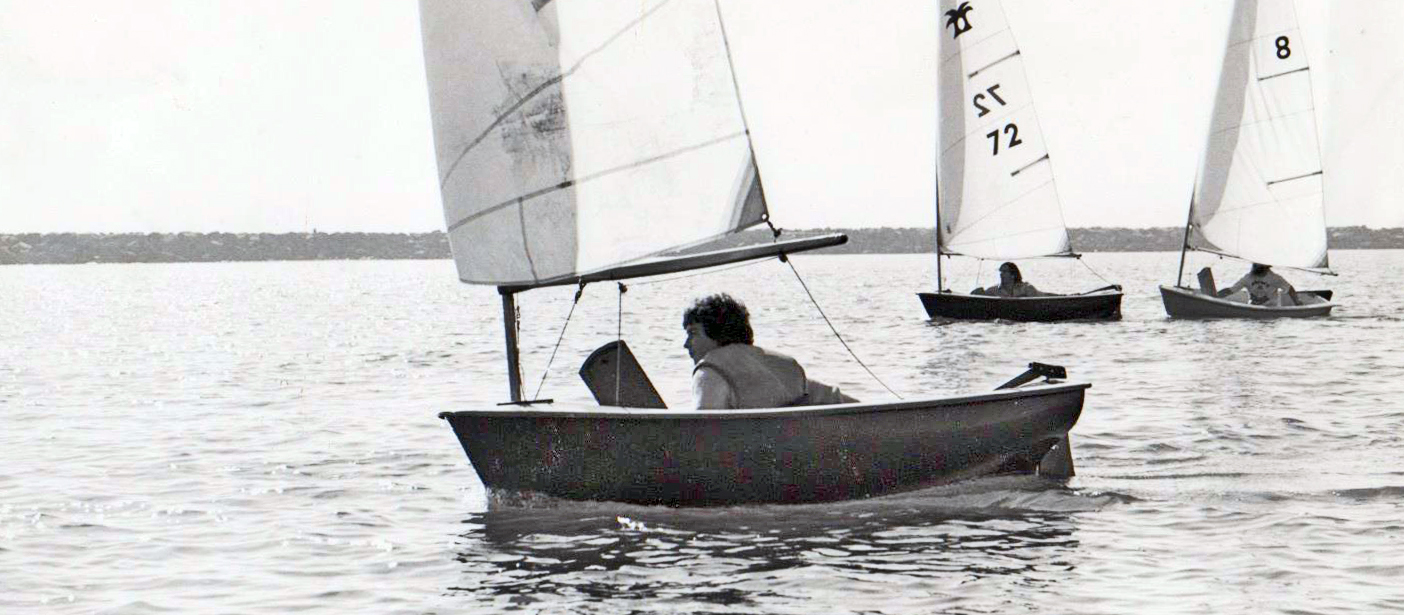
The previous header photo, plucked from the Internet, shows Jesters racing in an expansive body of water; which is obviously not the Santa Cruz harbor. You can make out the very fine, wineglass transom which suggests the Jester was more designed for rowing than sailing.


Racing in the Santa Cruz Harbor. If the sail numbers are correct, it looks like the class made it to 200 boats.


I do like the stylized logo of this Jester.


Famed naval architect, Paul Bieker, (International 14 boffin with success in that class rivaling fellow North American Bruce Kirby) put together a modified Jester for his son. (It appears the molds for the Jester have ended up in Northwest Washington State.) He has designed a gaff rig for his Jester, similar to the one he introduced on his high performance PT Dinghy, a Tasar-killer 14 foot design.


Paul had a sail made out of Tyvek which lasted a good five years.


The Santa Cruz Jester based on a generic East Coast Dinghy?


The unknown Jester:

The last two years, on my walkabouts around my hometown of Annapolis, I had noticed a mystery dinghy tied up to the floating dock of St. John's College. It obviously was a main and jib dinghy, the length was shorter than 14 feet (4.26 meters), the design had high freeboard and she was very simply rigged. Despite staring at it for a while, I could not ID this class. I shrugged. One of those unknowns.

But it was not to be left at that. Over the summer, my good friend Mike Waters, became the latest St. John's sailing coach/boatshop manager. I gave him a hand at an Intro to Sailing event he ran at the beginning of the school year. I was taking groups out in this very same dinghy I had been pondering over. It was slow but commodious for it's size with some nice bench seats. It was then I learned that this dinghy that had been donated to the St. John's program was a different Jester class dinghy; American built, but otherwise origins unknown.

Since then Mike has hauled the Jester out to have the bottom scraped of a healthy growth of barnacles and to get some paint on her. With the hull flipped over, the hull design is very interesting; a flat bottom forward with a circular transom. This is definitely not a rerun design of Uffa Fox's formulaic deep forefoot with straight flat aft sections.

Mike with the sanded Jester on the trailer.


Flat U-sections forward. Max rocker amidships. The little data we were to glean from the Internet has the Jester at 12 foot (3.6 meters) length and 5 foot (1.5 meters) beam. Both Mike and I feel the Jester has potential in a college program like St. John's (where racing isn't the priority and the waters on College Creek are very cramped.). We are just wondering who designed her and who built her. (Again, the Internet seems to point to Ohio, but who knows.)


The Jester logo on the sail.


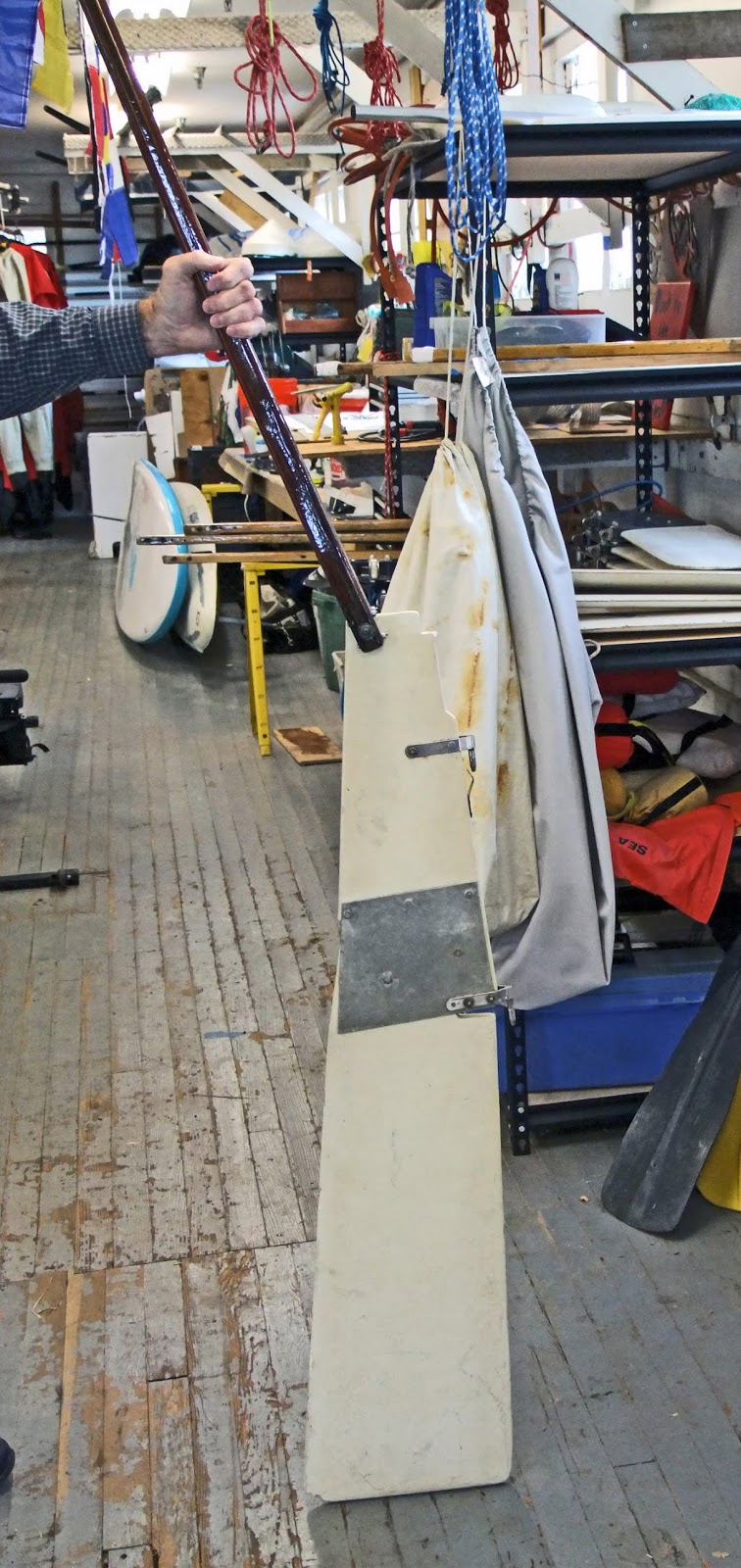
The rudder has the more modern rectangular shape. We are guessing a 1970's build time frame for the St. John's Jester. Anyone that has come across this Jester class in their sailing lifetime, please leave a comment.


Mike Waters in front of the St. John's boat house doors. The college has a sizeable fleet of crew shells as well as sailboats.


Bingo, We now have the designer of the St. John's Jester Dinghy. From a comment:
The Jester was designed and built by Cleveland, OH Sailboat dealer Jack Butte. Jack sold primarily one design daysailers, and saw an opportunity to use the influence of the Thistle, Flying Scot, and Rhodes Bantam to design a 12’ dinghy... My parents sailed with Jack Butte at Edgewater Yacht Club, and I sailed with his daughter as part of the junior sailing program


Wednesday, October 9, 2019

Header Photo: Fireball World Championships in Montreal


Urs Hardi

Until it crossed my FB feed, I didn't realize that the International Fireball class had held their World Championships in North America this past August; hosted by Pointe-Claire Yacht Club in Montreal, Canada. Winds really picked up for the last day of the championship when this photo was taken. Brits, Ian Dobson and Richard Wagstaff won with Australia, Switzerland, Belgium, Czech Republic and France representing a good mix of countries rounding out the top ten; .

I came into contact with the Fireball as a teenager in the late 1960's when my Dad moved the family to Youngstown, Ohio, a steel town in Northeast Ohio. In this most unlikely of sailing cities, there was an active Fireball fleet sailing on Pymatuning Lake, north of town. It was a fleet nourished by an even more unlikely sailor, Ken Turney. Ken loved the Fireball. He had his own boat shop in Youngtown's southern suburb, Boardman where he imported glass Fireball's built in Calgary. Ken was blue collar through and through. He had been a machinist at one of the steel plants and his standard outfit was a one-piece coverall, grungy, longitudinally striped in grey/black, with the neckline unbuttoned to reveal a grand tuft of silver chest hair topped with a broad Slavic face. Ken even raced Fireballs wearing this coverall. (One of my friends, in a not so charitable teenage side comment, remarked that it appeared Ken had a pet squirrel permanently tucked into the V-line of his coverall.) Ken would hold court at his cinder block boat shop, talking about Fireballs to one and all, building a small hot bed of performance dinghy sailing in this inland steel city; in a country not known for performance dinghies.

I actually didn't race the Fireball that much. I crewed several times on the Lake in very light winds. Unfortunately, I've never been on a Fireball in trapeze weather. Fifty years on, Ken Turney's legacy ticks along. A small group of Fireballs are still sailing out of the Pymatuning Sailing Club.

Other Earwigoagin Fireball Posts


Monday, September 30, 2019

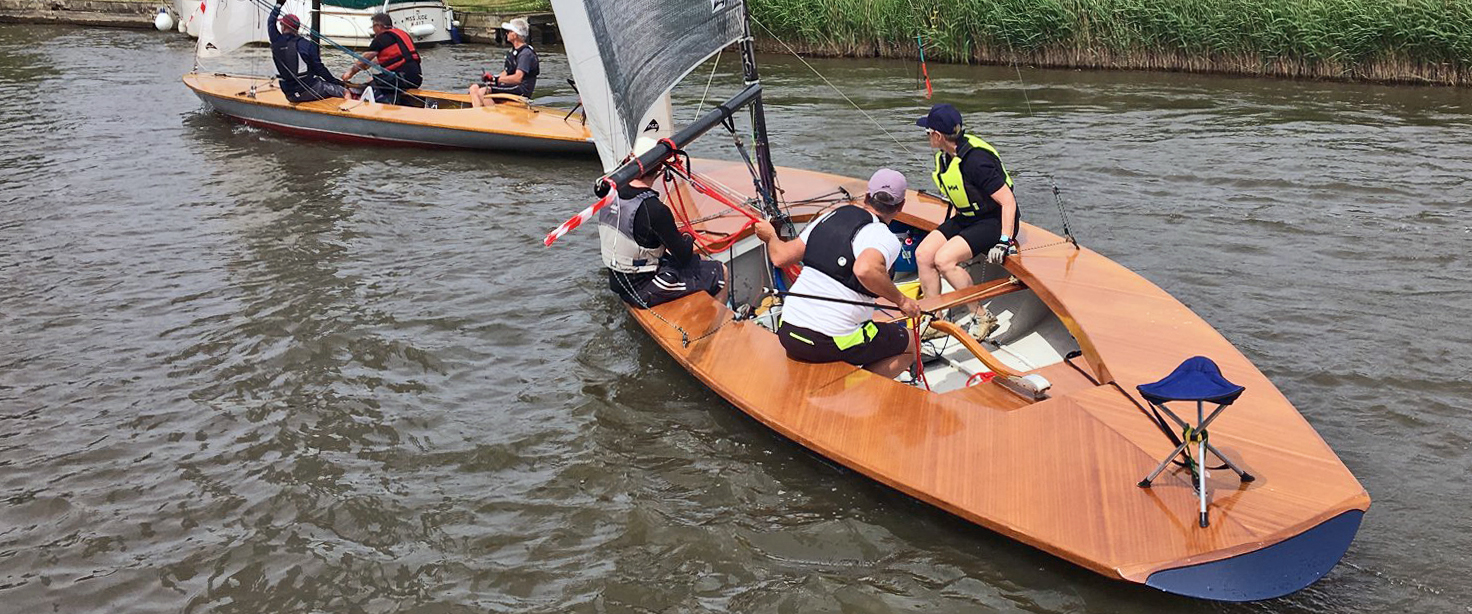
Thames Raters in the English "Three Rivers Race"


Two Thames Raters, the ultimate river sailing machine, in close quarters during the Three Rivers Race. The little camp chair on the back deck is not normal gear but necessary in this race. The mast has to be dropped several times to get under bridges and the chair keeps the mast in place when down.

Friday, July 5, 2019

Duster Plans

I've had a request for the Duster plans so here they are in PDF format. As always click on the arrow icon in the top right to open in another tab for printing or downloading.


Thursday, June 20, 2019

Man Overboard: Bermuda Fitted Dinghy


The previous header photo was of a sailor who became partially disconnected from his Bermuda Fitted Dinghy and is desperately trying to maintain his grip (as they say). This was a set of early season photos posted on Facebook. The always photogenic Bermuda Fitted Dinghy has been featured three previous times in the header photo of Earwigoagin.

View all articles on the Bermuda Fitted Dinghy.

A sampling of photos of the Bermuda Fitted Dinghy from the same FB batch.

The start in the Bermuda Fitted Dinghy class is casting off from both sides a stake boat, in this case a working craft (tugboat maybe?). No idea how they determine the order or the side you will start from.


Lots of crew for a 14 footer, hence not much freeboard.