Showing posts sorted by relevance for query Mike Waters. Sort by date Show all posts

Wednesday, October 16, 2019

The Jester Dinghy: The Known and the Unknown

Of late, I've been inexorably sucked into a tale of the two Jester Dinghies, one known, one unknown.


The known Jester:

When doing a Google search, the Jester Dinghy that pops up is a 8' dink designed by Santa Cruz ULDB designer George Olson, and built by Ron Moore in the 1970's. The Jesters raced out of the Santa Cruz, harbor; a cramped short harbor, the shoreline packed full of boats and docks, the north harbor and south harbor split by a bridge. The Jester has the reputation as one of the scariest boats to sail in a breeze, probably because the short hull features the fine ends of a rowing dink combined with a large, high aspect ratio rig, stepped right at the bow. This must amp up the bow-down power downwind to uncontrollable levels. Reference this quote from Latitude 38 magazine, July 2018, page 86:
"Skip [Allan] says the only way to jibe [a Jester] when it's windy is, "You run it into the beach, turn it around, and hop back in."
Although I've passed through Santa Cruz a couple of times in my travels, I have never seen this Jester in the flesh.

The previous header photo, plucked from the Internet, shows Jesters racing in an expansive body of water; which is obviously not the Santa Cruz harbor. You can make out the very fine, wineglass transom which suggests the Jester was more designed for rowing than sailing.
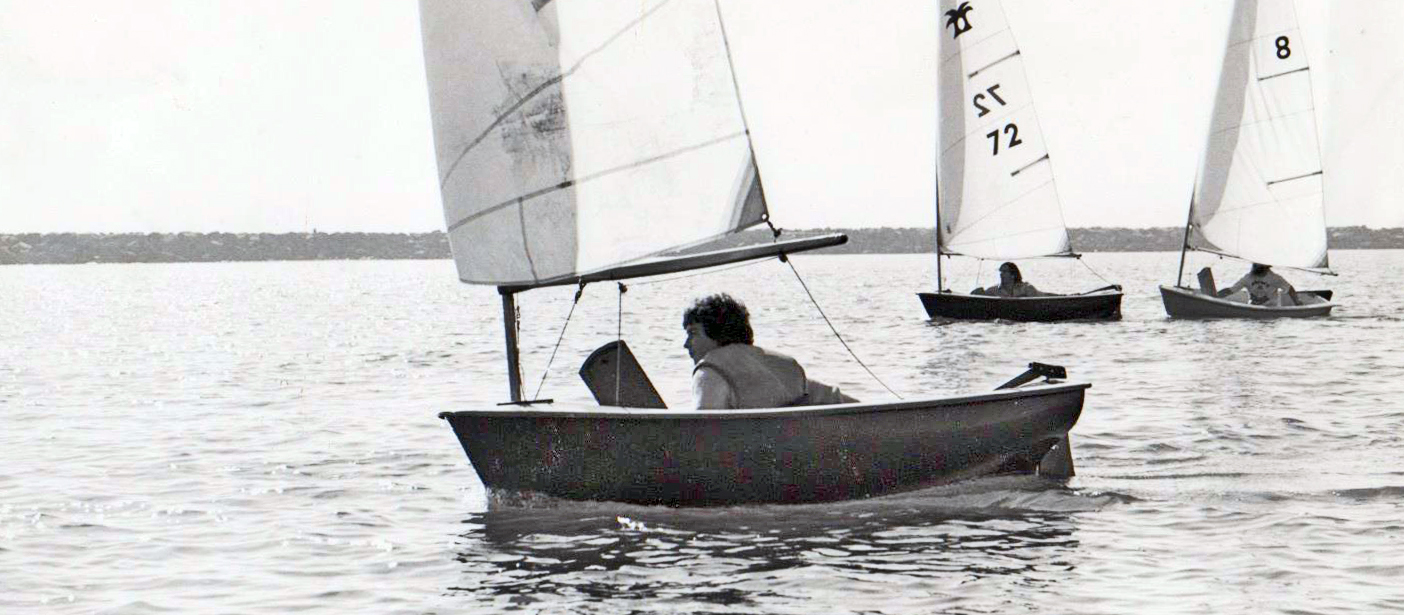


Racing in the Santa Cruz Harbor. If the sail numbers are correct, it looks like the class made it to 200 boats.


I do like the stylized logo of this Jester.


Famed naval architect, Paul Bieker, (International 14 boffin with success in that class rivaling fellow North American Bruce Kirby) put together a modified Jester for his son. (It appears the molds for the Jester have ended up in Northwest Washington State.) He has designed a gaff rig for his Jester, similar to the one he introduced on his high performance PT Dinghy, a Tasar-killer 14 foot design.


Paul had a sail made out of Tyvek which lasted a good five years.


The Santa Cruz Jester based on a generic East Coast Dinghy?


The unknown Jester:

The last two years, on my walkabouts around my hometown of Annapolis, I had noticed a mystery dinghy tied up to the floating dock of St. John's College. It obviously was a main and jib dinghy, the length was shorter than 14 feet (4.26 meters), the design had high freeboard and she was very simply rigged. Despite staring at it for a while, I could not ID this class. I shrugged. One of those unknowns.

But it was not to be left at that. Over the summer, my good friend Mike Waters, became the latest St. John's sailing coach/boatshop manager. I gave him a hand at an Intro to Sailing event he ran at the beginning of the school year. I was taking groups out in this very same dinghy I had been pondering over. It was slow but commodious for it's size with some nice bench seats. It was then I learned that this dinghy that had been donated to the St. John's program was a different Jester class dinghy; American built, but otherwise origins unknown.

Since then Mike has hauled the Jester out to have the bottom scraped of a healthy growth of barnacles and to get some paint on her. With the hull flipped over, the hull design is very interesting; a flat bottom forward with a circular transom. This is definitely not a rerun design of Uffa Fox's formulaic deep forefoot with straight flat aft sections.

Mike with the sanded Jester on the trailer.


Flat U-sections forward. Max rocker amidships. The little data we were to glean from the Internet has the Jester at 12 foot (3.6 meters) length and 5 foot (1.5 meters) beam. Both Mike and I feel the Jester has potential in a college program like St. John's (where racing isn't the priority and the waters on College Creek are very cramped.). We are just wondering who designed her and who built her. (Again, the Internet seems to point to Ohio, but who knows.)


The Jester logo on the sail.


The rudder has the more modern rectangular shape. We are guessing a 1970's build time frame for the St. John's Jester. Anyone that has come across this Jester class in their sailing lifetime, please leave a comment.
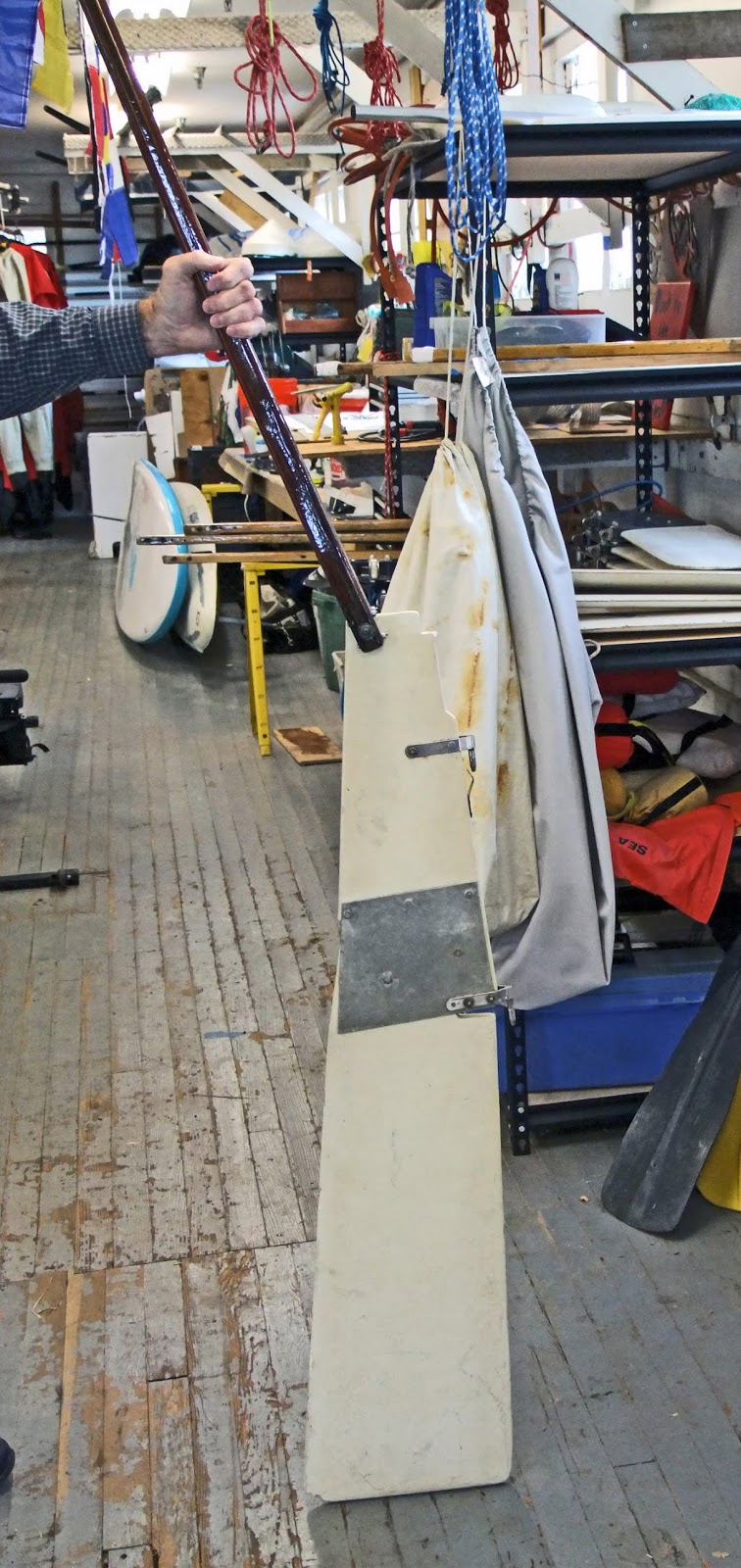

Mike Waters in front of the St. John's boat house doors. The college has a sizeable fleet of crew shells as well as sailboats.


Bingo, We now have the designer of the St. John's Jester Dinghy. From a comment:
The Jester was designed and built by Cleveland, OH Sailboat dealer Jack Butte. Jack sold primarily one design daysailers, and saw an opportunity to use the influence of the Thistle, Flying Scot, and Rhodes Bantam to design a 12’ dinghy... My parents sailed with Jack Butte at Edgewater Yacht Club, and I sailed with his daughter as part of the junior sailing program


Saturday, November 10, 2012

#16 - Bumpity Bump

As mentioned in the previous post, I did race committee for the J-24 East Coast Champs run by Severn Sailing Association. It was supposedly a race committee by invitation only which meant it was mostly greybeards and it seemed that we all brought our own wind-sticks and handbearing compasses. Many a lively discussion cackled over the radios about what the wind was doing and should we move the marks or not - credit Mike Waters, PRO, with taking all this cacophonous feedback and making command decisions that turned out to be correct.

I was on the pin boat - the leeward end of the starting line was to be the anchored SSA RIB - the idea being we could control the unruly J-24's with another set of stationary eyes at the leeward pin. I've never done this before; usually when I've been tasked to call the leeward end of the line I've done it from a moving motorboat that we are trying to hold on station - never an ideal situation. Friday we had very clean starts but Saturday the class got more aggressive, we had around 4 to 5 general recalls - still not bad by class standards; which worked out as we were trying to bang out 4 good races that day to conclude the regatta in front of approaching Hurricane Sandy.

From the vantage point of the pin boat, I got to watch the antics of good old bow number 16 who was trying the very risky starting tactic (in this caliber fleet and with a keelboat to boot) of coming in on port and tacking to leeward of the fleet with about 30 seconds to go. The first start on Saturday he made a complete hash of it and ended up slightly below and squeezing up mightily to avoid hitting the pin boat - which he ultimately failed to do. Bumpity bump he went along our inflatable bow and then his rudder fetched up on the anchor rode. In a superb feat of athleticism, one of the crew, lickety-split, leaped over the aft stanchion, straddled the rudder with one foot on top and used his extended leg to push the anchor rode down off the rudder. Quite remarkably, this was successfully accomplished in a couple of seconds and #16 was off to the races. Dutifully we radioed the main committee boat that J-24 #16 had hit the pin boat. We expected that he would take a penalty when he finished, as was written into the race instructions.

Number 16 hadn't learned his lesson for he tried the same maneuver on the next two starts. He didn't hit the pin boat this time but he did create a nice cluster of J-24's, clotted together, all downspeed at the start and straining to get around the leeward pin boat.

It was a grueling day getting four longish races (not only were we the pin boat but we traipsed up and down the course, filling in where needed especially in changing some marks).  I got out of the club around 5 o'clock, went to the beer store to get some storm stock and back to the house to get some food. Somewhere after 6 o'clock, Mike Waters called on my cell phone and wanted me to confirm that #16 had indeed hit the pin boat as the skipper was now claiming that he didn't, only that he had snagged the anchor rode which is not a foul. I confirmed and volunteered to come back to the club but he could tell in my fatigue and I could tell in his fatigue that this was not a battle we wanted to fight. Plus, everyone was hustling to de-rig their J's and leave that night as everyone had places to go and things to do to prepare for Hurricane Sandy. So I didn't drive back to the club and #16 gambled again and got away with a bald-faced lie. I've seen this happen before in sailboat racing, mostly in the protest room, but it doesn't get any easier.

Tip Of the Hat to Number 16 (I have a Filipino friend who maintains that karma always returns the favor) - The Bonzo Dog Band, "I Love to Bumpity Bump".


Tuesday, May 5, 2009

Laser Atlantic Coast; BFD; Black Flag Disqualified

Most sane RC folk would quickly make themselves scarce when the opportunity to run a major Laser regatta comes knocking. To put it bluntly, the anarchic reputation of the Laser class on the starting line is fearsome, enough to cow most RC Primary Race Officers into avoidance.

So how did I jump in; I didn't .... not exactly. Good friend Mike Waters PRO requested I do Vice Chair and I agreed .... we work well together as a team, though it's been some time, as I was off as a member of another sailing club for 20 years and just recently rejoined SSA.

I haven't had to resort to the Black Flag in any of the regattas I've run previously. I certainly considered that using the black flag in the Laser ACC a real possibility, but Mike was willing to go with a regular sequence at the beginning. After three horrendous starts (20 seconds to go .... can anyone see the pin?) the Black flag came out and it was like the regular teacher just came back after a day of the substitute teacher filling in. The fleet behaved wonderfully and we got two races off in a light 5 knots.

Sunday, we again tried to be Mister Nice Guy and run a regular sequence, which the fleet rubbed in our face big time. Black flag came out but with some more breeze, even the Black flag couldn't control the fleet. The problem was the final punch up to the line. The fleet was controlled at 10 seconds; just the one or two clueless competitors who insisted on lollygagging right on the line with a minute to go, but at the final push, the sheet in and accelerate would push about 1/3 of the fleet over. Being a dinghy sailor, I know you've got to stay with those around you; when they go, you go.

So we went into the tedious .... Display the WALL OF SHAME. Out came the white board with the numbers of all those we could identify as being guilty and run another start, with a general recall, with added numbers to the WALL OF SHAME. After three generals, we accumulated 11 numbers. I must say, the competitors, who sailed by to look at the board we're quite jovial about it (say, good fellow, have you seen if I'm on the list to be quillotined today?). The fourth one was a charm (though I must admit, one general we did need to resquare the line and move the leeward start pin as the wind had shifted over this time span

All in all, we did get five good races in. The racers got one drop race. No redress against the RC. Nobody came up and screamed at me in the dinghy park. Good, Very good.

CONFESSION: In the one club Laser race I did last year (borrowed Laser), I got two OCS penalties in four starts. Do as I say, Not as I DO!

Sunday, May 18, 2014

Header Photo: Soling Frostbite from February 2014

I've mentioned this before but it's worth repeating; this blog is all about timeliness. I posted a header photo some time ago with keelboats running downwind under spinnaker but after I moved on to the next header photo I neglected to repost the previous one with a comment (as is my custom - not that anyone has noticed).


This photo is from the race committee I did at SSA for the Soling fleet at the end of February. Luckily it was on the one pleasant weekend of a brutal winter with temperatures in the 60's (Fahrenheit) and a pleasant breeze of about 15 knots. Race committee consisted of two or us but the wind was so steady that we were able to set the course and forget it - just bang off a couple of starts.

Some other photos I was able to snap from the stationary RC boat (since the starting mark was the leeward mark). Click on the photos to view in hi-res.


My good friend Mike Waters had his spinnaker halyard jam while sporting a nice lead. He had to sail a fair distance off the course before his could get the spinnaker down.


Sailing upwind into the winter afternoon sun.


Friday, April 22, 2011

Race Committee for the Lasers Again; 2011 SOL Regatta

As much as I bash the Lasers, it is a class I enjoy supporting even if I don't enjoy racing them as much as I did long ago. Again this year, I volunteered as Vice Chair for Severn Sailing Association's spring Laser bonanza, the Sunshine Open Laser regatta, or SOL; held this past weekend.

I teamed up with good friend, PRO Mike Waters, as we had teamed up a year ago for the 2010 Atlantic Coasts. Despite the optimistic regatta title, this year the weather was not so cooperative. Races were cancelled on Saturday as a massive storm crept up the East Coast with big breeze coming right up the Severn River and throwing large breaking waves on the Naval Academy seawall. The SOL regatta, being a non-event on Saturday, why shouldn't it become a YouTube video, like so many other mundane going on's that make their way onto YouTube nowadays, (from Jon Deutsch).........


On Sunday, the breeze came up with the sun, the wind was was blowing hard through my dogwood blossoms when I pulled out of my driveway and was definitely howling through the rigging as the Lasers rigged up at SSA. Conditions looked very marginal but once on the water the breeze moderated throughout the day and not too much mayhem was seen on the course. We eventually got four races completed in a shifty Westerly breeze that ended up more to the South by the end of the day. It was an older Laser crowd out for this mid-April regatta... I have no idea where the fit and ready 20 something Laser sailor was, but they weren't in attendance for this regatta. A fair number of older geezers were in the Laser radials and they had a much closer battle going on within this fleet (compared with the Standard fleet), even though the skipper weights probably ranged from 130 lbs to a whopping 200 lbs. Finally the 4.7's were right in the thick of things with the Radials when the breeze was up. Another report and results from the District 11 website can be found over here .

Saturday, January 9, 2010

Small Water sailing

There is an amusing thread over at the Sailing Anarchy forums, about an English bloke who ventures forth on a canal in the 10' 6" Mirror dink to get to a waterside pub just up the way.


It reminds us that the Brits and others sail, and even race, on some very small waters that, in the States, nobody would consider suitable for sailing.

There is one small water venue that I am familiar with in the good ole US of A, a venue the Classic Moths try to go to once a year; the Cooper River SC, just outside of Philadelphia, PA, on a dammed up river of about 240 meters at it's widest. Our current Classic Moth National Champ, Mike Parson, hails from this Cooper River SC and the shiftier the conditions get, the more Mike motors to the front. A pic of Mike at this years Nationals..........


A video from France that shows Ponant class sailboats short tacking on a very narrow body of water...........


My post on the Brigham Scows, another river class is over here.