At least in the United Kingdom there seems to be one other hiking singlehander matching the "Kirby Sailboat Formerly Known as the Laser" step for step. Looking at the Yachts and Yachting Web Site where they have tabulated the numbers attending the UK National Championships averaged over ten years, as well of the individual year by year totals, we see the Solo Dinghy hanging right with the Laser (well, the full rigged Laser version).
10 Year Avg Turnout for UK National Championship; Laser 81, Solo 77
2011 National Championship; Solo 95, Laser 81
And before Tillerman puts up his hand and says yes, but..... yes, I know there are no Solo dinghies in North America, or Denmark, or South Africa, or the Phillipines or......
But, in dinghy mad UK, these are certainly intriguing numbers. Any UK readers of Earwigoagin that want to shed light on how the Solo class, designed by Jack Holt in 1956, is hanging with the Laser? I would be very interested in hearing what the Solo Dinghy is doing right.
Meanwhile here is a very well done promo video for the Solo dinghy
Rupert Whelan added a comment which directly addressed some of my questions...........
"The Solo (also known as the SoSlow or Slowlo) isn't fast, but gives fantastic close racing. I owned one a few years ago, but it was old and bendy, and I decided I could get a better boat for the money (a Lightning 368, another UK only boat) but the modern version is very stiff, is bomb proof thanks to the highish minimum weight, has a powerful fully batten 8 sqm sail and is raced by many of the top sailors in the country.
In light winds it will leave a Laser behind, but once hull length comes into play, the Laser will sail away, especially in waves.
As for Lasers and speed, there are plenty of faster singlehanders over here, but none have caught on in the same way as the Laser or Solo, so speed obviously isn't all - we set ourselves boundaries in order to get fair, close racing at a cost we can afford, otherwise we would be over in Namibia with Paul Larsen and his Vestas Sailrocket trying to hit 60 knots..."
Tillerman has posted a bucolic photo of lighthouses and classic yachts over on his site. Well, I was poking around my computer and came across this photo I had uploaded from the Web a while ago. It is of a singlehanded Solo dinghy (UK) in some breeze (SOME BREEZE??)
This has got to be the wildest singlehanded photo I've ever seen. For the spray to be blown flat like that, the wind gust has to be over 30. Looks like the poor skipper is a second away from having his tiny yacht driven under.
Update: Anonymous has identified the location......"Member of the Avon Sailing Club, sailing on the river Severn."
The Solo is another popular singlehander class in England (among a plethora of singlehanded classes in England). Designed by the great Jack Holt in the mid 1950's, the Solo is around 12.5 feet long (3.8 meters) and a hull weight of around 150 lbs. I think I lifted the photo from the Solo website. If anyone has the photographer's name, I would like acknowledge him/her.
Update: Oct 2012 - David Harris from Avon SC sends along a post mortem photo of Solo sailor and boat. Seems the mast complained somewhat about being sent out in these conditions.
I seem to be stuck on the old, the vintage, at the moment. It's just that so much fascinating old stuff is pouring into Earwigoagin Central that I must ride the wave. So.... expect more of the same.
Two interesting Videos just popped onto my radar. The first covers the British Moth Championship of 1956. I wrote a previous post on the British Moth. Suffice to say the British Moth is the most popular Circle M Moth going these days.
From the British Pathe' website (TOH to Nessa in the www.cvrda.org forums for pointing this out). Click on the picture to link to the webpage with the video..........
CAPSIZE - NOT LIKELY!
And an old video from the mid-60's featuring the Solo dinghy racing in Holland. Again, I wrote about the Solo dinghy in a previous post. The Solo seems to going from strength to strength in England, registering 70+ registrants in the last 5 UK nationals despite the relentless Laser Borg.
As the night takes over the day during the winter months, time to pop over to YouTube for some vicarious thrills. Here is a compilation of some 2019 singlehanded racing dinghy videos which Earwigoagin has deemed worthy of viewing.
From the Lake Garda video maestro, two junior singlehanded classes that are not the Laser; the O'pen skiff (designed to go after the Opti market) and the Zoom 8 class (a Laser 4.7 alternative).
The English Solo Dinghy class. Move the slider to the 1:40 mark and watch some incredible planing action.
Again, the Worlds most popular Classic Moth, the Europe Dinghy.
And the two classes designed to take down the Laser in the Olympics but couldn't surmount World Sailing politics; the RS Aero and Devoti D Zero.
The previous header photo is of Aussie Matt Kiely sailing the Australian singlehander Sabre class dinghy. The photo was lifted from the South Gippsland Y.C.Facebook page.
Probably the major trend in dinghy racing over the last 30 or so years has been the growth of singlehanded racing at the expense of doublehanded or triplehanded classes. And the trend since the millenium has been the explosive comeback of what I call the retro hiking singlehanders; those other singlehanded classes designed before, or around the date of the introduction of the Laser (1969). For the most part, these classes are not international (excepting the OK Dinghy and Europe Dinghy); they are popular country-by-country or region, and they attract fleets of thirty, forty or more boats at major championships. They have a builder or two turning out modern hulls, some have carbon masts, many have aluminum. They seem to fill a need in the marketplace that the Laser does not.
I have compiled a list of retro singlehanders. I have excluded the Olympic Finn - 1949 (which has a huge Masters scene) and singlehanders with hiking assists (trapeze, sliding seat). Feel free to add your thoughts about this list in the comments section. (Before the Sunfish sailors jump all over me for excluding the Sunfish from the list - let me state the Sunfish has maintained high levels of popularity in parts of North America and parts of South America for many, many years - I don't see a comeback in popularity - they just maintained it.):
Despite the recent introduction of the "modern" RS Aero, or Devoti D-Zero, with lightweight hulls, mylar sails (correction - the Aero has dacron sails), carbon rigs, it seems the singlehanded market is marching in the other direction. (I must admit the North American market is an anomaly here with not a lot of singlehanded classes under the Laser - still king by a long-shot-, and the Sunfish - a solid runner-up, The other singlehanded classes in North America - like my Classic Moth - are mustering small numbers...Oops! I forgot about the MC scow, now very popular in the U.S.)
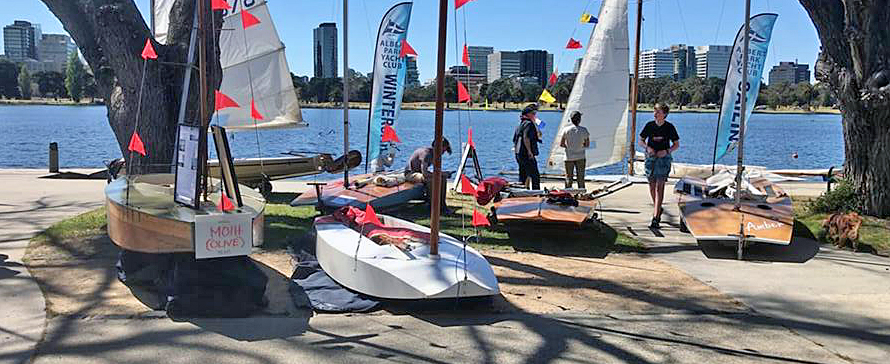
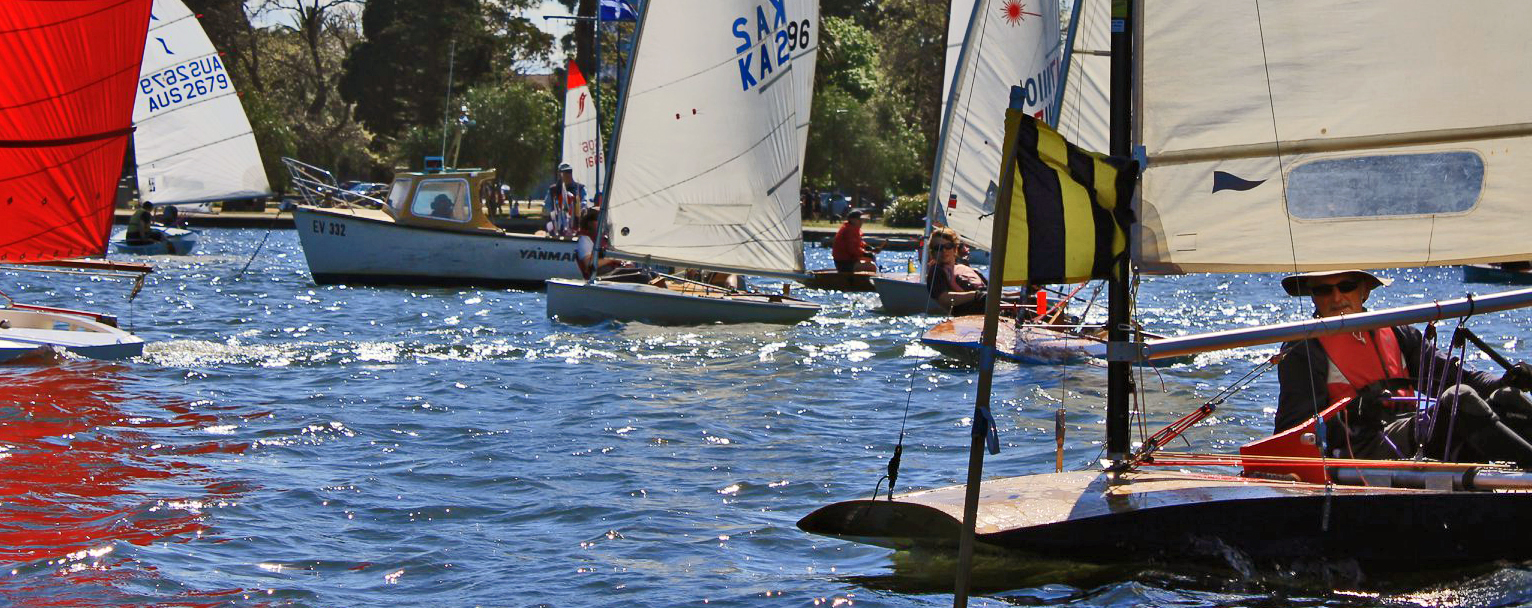
A week ago, six Classic (non-wing) Aussie scow Moths made it out on the small lake in the Melbourne city park, Albert Park.
Details are sketchy but they raced in the first of the summer series racing. (It seems if it is fall in my neck of the woods in the Northern Hemisphere then it must be spring in Australia - but if they call it a summer series, then so be it.)
Rigging area. Not sure what the designs of these scow Moth they are but I imagine they are of the Imperium time-frame.
I ran out the door early Sunday morning on my way to the U.S Sailboat Show and grabbed my small camera, half expecting the battery would be dead, but hoping it wouldn't be. It was dead. So I postponed this post until fellow CMBA'er (Classic Mothist) and blogger (he prefers the term diarist), George posted his report and photos of the event over at Mid-Atlantic Musings.
I was pleasantly surprised at the higher than normal amount of companies exhibiting sailing dinghies. As soon as I walked into the gate on the backside of the harbor bathrooms there was the Rondar stand with an interesting new hiking singlehander, the K1 (at least new to the U.S. - from the Internet looks like it has been around the U.K. since 2009). It is another take on a singlehander with a keel, I assume aimed at the aging singlehander population. Not much longer than a Laser at 15 feet LOA, it is narrower and the hull shape is much rounder. Like the International Canoe and the Swift Solo, it sports a sloop rig, but no asymmetric spinnaker (to keep the costs down). With keel the K1 weighs about 47 kg (100 or so pounds) more than the Laser. A very interesting concept but I'm not sure if there is a market. Most of the geezers who enjoy dinghy racing seem to be flogging their Lasers and Sunfishes well into their sixties and after crossing into their 70's they seem to be switching to a roomy and safe tub like the Herreshoff 12 1/2 footer, a classic that they race singlehanded in the Annapolis Yacht Club winter series.
A scan of the K1 advert picture from the crumpled brochure taken from my pants pocket;
An interior shot pulled from the Internet (not from the Sailboat Show - note the very round stern);
Rondar, an English company, has set up an U.S. manufacturing plant up near Boston where they have been providing collegiate dinghies, such as two-man Fireflies to Tufts and new carbon Tech Dinghies to MIT.
The RS stand featured two of their glass production boats and two of their rotomolded products. Of interest was their RS Venture family fiberglass daysailor/racer with assymetric spinnaker, a seventeen footer with about seven foot beam from Phil Morrison. It looked like a modern interpretation of the venerable Ian Proctor designed Wayfarer dinghy and the price point was good at 15K, cheaper even than RS's high end RS100 singlehander which was up around 16K. We'll see if this design can make any inroads against the king of the hill daysailor/racer in the U.S., the Flying Scot.
Zim Sailing picked up the Megabyte and Byte designs from Ian Bruce this past May (after 40 odd years building sailing dinghies, Ian Bruce is concentrating on producing an electric Classic speedboat). They are also producing these dinghies in Rhode Island whilst their collegiate/high school 420 is built in Asia. It seems Zim Sailing is aggressively moving into areas left wide open by the recent travails and mis-steps of Laser Performance.
I took a peek at the hardware and rope companies. I didn't see much new in dinghy hardware. The U.S. rope manufacturers (Yale and Samson) are now all offering soft-hand, double plait, super-Spectra lines so the choice for Laser mainsheets and dinghy sheets of all types has now increased exponentially (before it was either Maffioli or Marlowe Excel that had the soft hand sheets).
The Comet class (U.S double handed 16 foot chine design circa 1933, often referred to as the mini-Star) coughed up the bucks to have a very well put together stand (it is rare to see a class association at the Sailboat Show). Go over to George's blog to get some pictures. The class is looking at mylar sails to gussy up the modern image of the class so, having been through the recent discussion with the Classic Moths, I spent a pleasant 15 minutes discussing the pros and cons of mylar sailcloth. The Comet class has a new fiberglass builder on Maryland's Easter shore and they have added a double floor much like the modern fiberglass Snipes.
I had a very technical discussion on sailcloth with the Dimension/Polyant guys. It seems their M2 string sails have been used successfully by the top 505 sailors but there is a price premium if you go that route.
The rain which looked to make it a very wet day, surprisingly went away after the first fifteen minutes and instead of a quick walk through of the show that I expected, there was much to keep me interested for many hours on that Sunday.
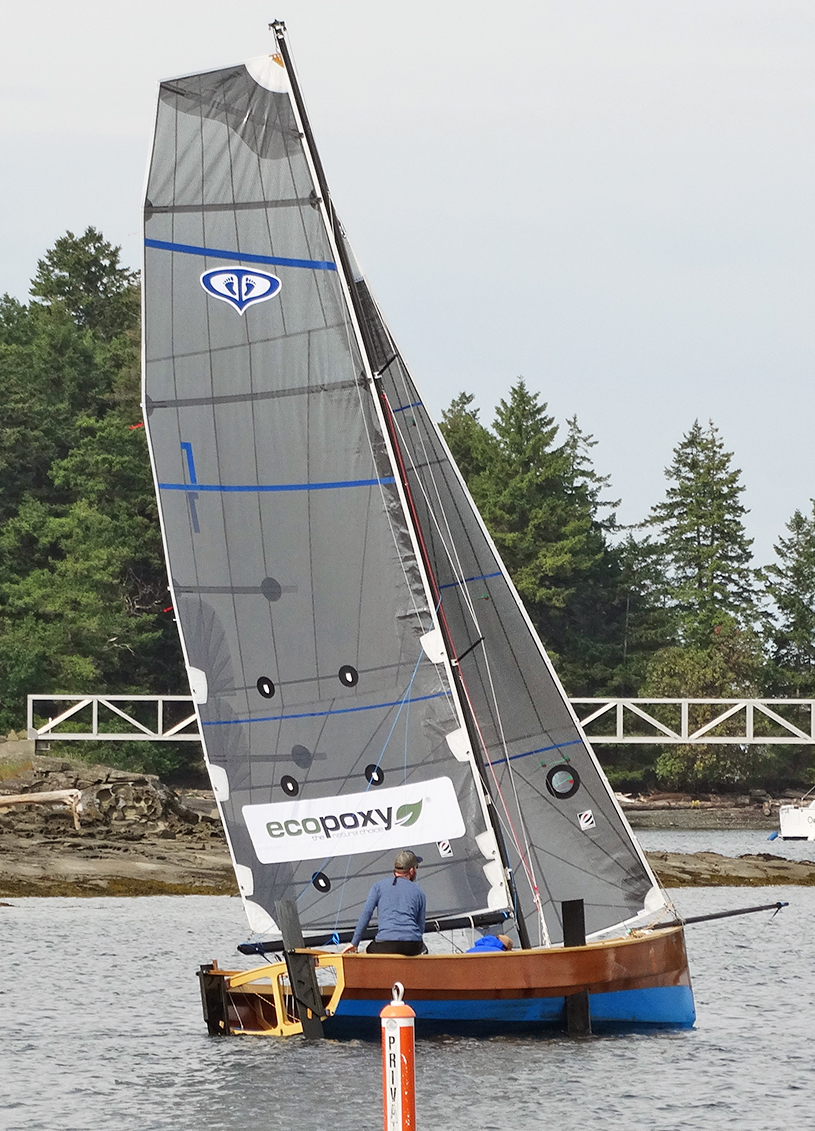
I chronicled the start of the Race To Alaska, R2AK, the 1207 km. (750 miles) slog from Port Townshend, Washington to Ketchikan, Alaska. The race is now finished with an attrition ratio of 25 DNF's vs. the 15 who were able to complete the course in the allotted one-month time-frame. Unusual for me, I monitored the tracker during the race, being particularly interested in how the large open dinghies (there were two of them, a Barefoot 5.8 built specifically for this race and a Mirror 16) would fare in this marathon. Not good as it would turn out. The Mirror 16 would drop out, and the Barefoot 5.8 would be the last to finish, 15th.
I can't resist a bit of Internet armchair race analysis here. (WARNING - this from a sailing dude, who likes to day race and sleep in a comfy bed, who last spent overnight on a sailboat decades ago and the closest I've come to the Seattle/Vancouver Island cruising grounds is Portland, Oregon.)
With an inaugural race, over such an unusual course of such length, the initial possibilities of what constitutes a successful race program remain wide open. After the race, the picture is much clearer. Now with the results in, we can safely say; to win the R2AK with the current course, pick a very fast trimaran around the 8 - 9 meter (25 - 30-foot) range, and then crew it with three experienced offshore racers who know the drill, and can keep the accelerator down 24/7. That is what Team Elsie Piddock, in a F-25 carbon trimaran did, and they surprised themselves and everybody else by finishing in just over 5 days. Multihulls over 6 meters (20 feet) long took 5 of the first 6 positions.
What type of experience wins the R2AK? Team Elsie Piddock goes over their sailing resume before the race.
In the sailing monohulls, a disparate set of keelboats finished on top of that division. A Hobie 33 finished 3rd after holding 2nd for most of the race but lost out to a trimaran that made up about 160 km. or 100 miles in about a day and half of open water racing. A day racing keelboat, the Etchells 22, with a crew of three, finished tenth. It would be interesting to see how much the Etchells 22 sailed versus rowed as they seemed to spend much of their time making their way up to Alaska in the narrow cuts and not out in open water. The upwind ability of an Etchells 22 is extremely good but there are none, nada, creature comforts.
And in another demonstration of the turtle winning out over the hare (in this case the purpose built Barefoot 5.8), a pocket cruiser-keeler, the Montgomery 17 of Team Excellent Adventure finished 12th. When conditions were bad, they hunkered down, when they were good they kept going and when they had a chance to recharge, they took it (looks like they spent two days in Prince Rupert drying out, getting a shower, enjoying the restaurants.). All in all, a very creditable performance.
What happened to the team I was pulling for; the Tad Roberts design Barefoot 5.8? Two things:
Three crew on a 5.8 meter dinghy added too much weight in stores.
The lack of stability of an open dinghy meant they couldn't safely keep the pedal down 24/7 so they pulled up at night. This negated the third crew, who was added so they could keep racing at night.
If the R2AK as an event keeps going, and you want finish it in a monohull sailboat under 6 meters (20 feet) the best path seems to be a keel type pocket cruiser with a crew of two. Of course, the type of sailor who already owns a pocket cruiser isn't one to think a 1207 km. race in colder and colder water would be any fun at all.
A tip-of-the-hat to the design and sailing team of Team Barefoot Wooden Boats. They didn't finish where they thought they would, but they did finish. The Barefoot 5.8 was an innovative and bold design. It was wood and can be home-built. For shorter distance races this would be a very quick monohull.
Designer Tad Roberts kindly sent along some photos of the build of the Barefoot 5.8 and some early pre-race debugging..
The Tad Roberts Barefoot 5.8 sail plan, Set on a tall mast, the sail area was quite big for this size dinghy. The initial plan was to reef early and often but I'm betting, if they had a choice, they would have changed to a shorter rig in the middle of this race. A very pretty sheer on this design.
The Barefoot 5.8 was built around the very substantial double-bottom grid. The sides would be added on later. Wood was 6mm. plywood.
Sides on. Deck on. You can see the kness that were used to support the top-side panels.
Open transom and double rudders a'la the French offshore machines. The Barefoot 5.8 used hi-tech leeboards to keep the double bottom open for rowing and sleeping.
The Barefoot 5.8 looks to be a very potent Everglades Challenge design. In that race, open dinghies of this size (I'm thinking of the Core Sound 17 and 20) can finish in just over two days. That seems about the right amount of time to drive an open dinghy 24/7 without completely boinking.
Here is a short video of Team Coastal Express in their Mirror 16. They slogged their way through the toughest parts, the Seymour Narrows and the Johnstone Straits, before deciding they couldn't afford the time to finish the race out. This video looks cold, very cold.
Mention must be made of the tenacity and persistence of the human-powered competitors that finished:
6th place - Team Soggy Beavers -Six paddlers in an OC-6 canoe (with ama)
11th place - Roger Mann - first solo competitor in a stock Hobie Adventure kayak/trimaran with Mirage Drive. Either you think this guy is Superman (he kept pushing 20 hours out of 24 for 13 days) or crazy-dumb (he almost lost his life twice, a pitchpole and another time he ended washed out but tethered to his kayak).
13th place - Team Boatyard Boys - two guys in a 17 foot Swampscott Dory, on which was added a small cuddy cabin. The original intention was to sail a fair bit but the windward performance was so bad they ended up rowing for most of the race
14th place - Mike Higgins in a 17 foot kayak. Yep, he paddled all the way.
Reader Mike Scott, who lives on the left coast, and was much closer to the action, added this comment which I've dragged over to the main post.
"I've been avidly following the race after being at the pre-race party, and getting up at 4am the next day to watch the start - which was set to the fanfare of the Russian National Anthem - quite bizarre, very stirring music, and typical Jake Beattie. I, too, loved the Barefoot Wooden Boat entry, and am hoping they might bring it up for the Wooden Boat Festival in September. Will be very interesting to see who and what enters next year - if it flies again. Much speculation on the 'perfect' boat, but as all depends on available wind and this year certainly favoured the speedsters, with a knarly Northwesterly blowing for much of the race......."
I did my usual quick 3 hour tour around the show. Small sailing dinghies are sparse. To my surprise, for the first time this year, RS Sailing from England had a booth featuring some of their sailing dinghy line.
The much touted RS100, 14' assymetric, hiking, singlehander was front and center. I must admit that I like my singlehanders simple. If I want to sail with a spinnaker, I'd just as soon do it with a crew assigned the task of trimming the chute and I would just be steering and pulling the main in and out just like my current singlehander. Putting aside my bias for a moment, the RS100 has all the earmarks of the current high performance SMOD's (single manufacturer one designs); carbon spars, mylar sails, fine bow, chines to a straight run. The RS100 went through the rigors of a long development cycle and the finished product looks very well thought out. A light hull at about 90lbs (41 kg) means the hull skins are very thin and would have to be handled carefully on land.
About 10K to buy. A Laser killer? No way! Will the RS100 be able to make any traction in the American market after both trapeze assymetric singlehanders; the Musto Skiff and the Swift Solo only appealed to a very small niche market? We will see. Popularity aside, I would like to get a ride on a RS100 someday.
Laser Performance had their rotomolded Bug sailing dink lined up for demo rides. I sailed one last year. This is a Joe Richards design, very well executed and at a price point around high $2000. If I remember, it is a double skeg design which made it a little sluggish around the turns but it seemed to sail well in the small confines of Ego Alley. I would put the Bug up as one of the best values for a knock around sailing dinghy.
There is a trend that has me scratching my head. I call it Faux-traditional-daysailor-keelboats that feature small cockpits, narrow meter-boat beams, a nice counter stern and modern keels and rigs. The Singlehanded Scandanavian Cruiser 20 is one of the first of these types. A newer entrant in the field is the two man, 2M from France. Featuring bamboo decks and a 49K price tag....... which, I guess is a pittance compared to putting together a Dragon or 6 meter.
And finally, there was the Stuart dinghy, which was a very attractive dink. I had my aesthetic sensibilities confirmed when the salesmen admitted it was actually a Phil Rhodes design.
The previous header photo is from the 2015 R2AK - the 720 mile Race to Alaska - of Team Boatyard Boys finishing in Ketchikan, Alaska; two guys in a 16' Swampscott Dory that was so slow under sail they ended up rowing most of the 720 miles. It was obvious from last year's race that a crewed multihull was the ticket if you wanted to claim the $10,000 prize. So what craft did Tim Penhellow (I think he's the one on the left in this photo of the original Team Boatyard Boys) choose to compete in the 2016 R2AK? The same 16' Swampscott Dory, though this time he decided to do the race solo. Alone! Predictably he finished last, amassing the slowest time over the two R2AK's (of those who did the race twice). Some of Tim's quotes when he was drinking a beer after crossing the finish line:
When asked what it was like racing the R2AK solo:
"Like losing your virginity. You're glad you did it but embarrassed by your performance."
"I'm bored of being bored."
"Solo sailing is not for me." (Where he went on to relate some terrifying moments under sail when he needed an extra set of hands - but all he could do was hold his breath and wait for the outcome.)
Truth be told, the organizer of the R2AK originally envisioned this race as one for the Tim Penhellow's of the world, an ultra-marathon grit and grind up the western wild coast of Canada, where human-power is just as important as sail power. Unfortunately this narrative for the R2AK only plays out in the boats under 20' of length. Several millennia of history have pointed out the fastest way to eat up the miles in non-carbon water transport is a sailboat. Fast sailing beats a fast rowing boat every time - and there is no better fast sailboat then the modern multihulls, who this year made the 720 mile R2AK a three day sprint (for the winners).
As a race for the prizes, the R2AK is now a long distance multihull race, the R2AK adding some navigational wrinkles and spectacular coastal scenery as compared to a slog in the ocean. The guys that do the R2AK with boats under 20 feet - 2016 Luddites, all of them. They will finish weeks after the multihulls, but I tip my hat to all of them.
Congratulations to Tim Penhellow, to the other small boat adventurers in the R2AK, and particularly to the older duo, Heather Drugge and Dan Campbell, racing the only sailing dinghy, a Mirror 16, who managed an incredible 600 miles before pulling out.
Further proof of why racing a Swampscott Dory in the R2AK is like bringing a knife to a gun fight - video from day 6 of the 2016 R2AK.
Bald but my eyebrows are growing at a prolific rate. Sailed Windmills and Y-Flyers in the 1960's. Founded Miami University (OH) sailing team. Sailed International 14's and Lasers in the 1970's. Sailed International Canoes in the 1980's to mid 1990's. Sailed Classic Moths since 2002. Enjoy boatbuilding though I'm very, very slow at it (the Internet doesn't help matters). Name in real life: Rod Mincher
After choosing this username (Tweezer is the name of my Classic Moth), further research on the Internet turned up that Tweezerman is a corporate name for a line of pedicure products. Let me emphasize that I do not work for, nor endorse these products.