Showing posts sorted by relevance for query RS300. Sort by date Show all posts

Thursday, March 23, 2017

Why is a Laser Faster than the Classic Moth - Or Is It?

Over at the WoodenBoat Forums there is this thread that recently popped up that was started with this question by "cmjns":
"I've spent a lot of time ogling classic moth designs, from the Gen II mistrals to the Gen I Mint, and I'm a bit smitten by the Farr 3.7 and the Contender (very different boats, I know). So I'm curious: among all the shapes swirling around in my head, some of them reportedly are much faster than others. And the moths in particular *look* fast but aren't nearly as fast as a laser, which nevertheless "sails like an aircraft carrier" in comparison.

"So my question: how do I evaluate a hull shape? What characteristics are associated with downwind vs. upwind performance, and what equates to overall speed? And why is a laser faster than a moth? Is it the sail? Is it the length? Is it the shape? What happens to a laser when you cut it down and put a moth sail on it (maser)? Does it slooooooow down?

The answer in a nutshell. A Laser is faster than the Classic Moth because it is longer (as several of the commenters to this thread noted - see "Chris249" comments for a more detailed hydrodynamic explanation). The Laser also has more sail area - the Classic Moth rig is more-or-less equivalent to the area of the Laser Radial. And No... making a Laser into a Maser doesn't make it faster than a Laser. (It does make it more fun in my opinion.)

I think the crux of "cmjns" question deals with hull shape and, specifically, why the flat Laser shape is so different from our fastest Classic Moth hull shape, the Mistral or Duflos designs which have low wetted area, narrow waterline beam, rocker forward, with a large amount of flare to the gunwhale. Does that mean the flat Laser shape is inherently "faster". Are the fastest Classic Moth hull shapes an anomaly?

First up is the Laser shape:


For a comparison is the following four views of the Mistral hull shape as modeled by Andrew Slavinskas. Not a flat area to be found. The transom is a very circular shape.
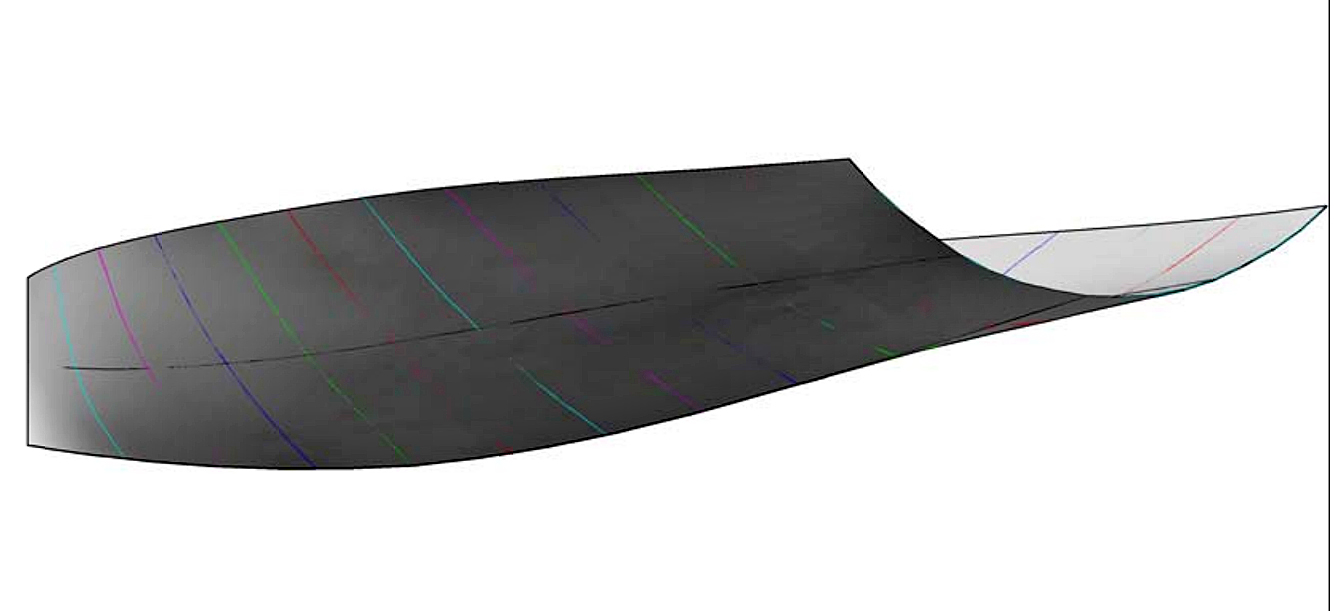
Andrew Slavinskas


Andrew Slavinskas


Andrew Slavinskas


Andrew Slavinskas

What gives? It turns out the characteristics of a Classic Moth Gen II fast hull (low wetted surface, narrow waterline beam, high flare to support hiking power) translates very well into a longer, very fast conventional hiking singlehander - in fact the fastest conventional hiking singlehander. It is the RS300 and it was designed by Mothist Clive Everest back in 1998. It is not length that gives the RS300 an advantage. (It is only slightly longer than the Laser - +.07 meter, giving the RS300 the same length as a Melges 14.) It is a hull with very little flats anywhere, where wetted surface is pared back ruthlessly, where the waterline beam is as narrow you can get away. The dirty little truth! For a design close to twenty years old the RS300 is faster than the latest, much ballyhooed RS Aero and the D Zero. Some RYA Portsmouth numbers:
  • RS300 - 973
  • RS Aero - 1024
  • D Zero - 1029
  • Farr 3.7 - 1039 (Yes, I know the Farr is a trapeze singlehander.)
  • Laser - 1097
  • Europe Dinghy - 1145 (I would expect our Classic Moth Mistrals to be slightly faster than this number.)
The downside to this hull shape. As with our Mistral design, the RS300 is very tippy and has a tendency to trip up her skipper with regularity. The RS300 is worse than our Gen II Classic Moths in that respect because the RS300's modern rig is much more powerful than our vintage low-aspect rig. As such the RS300 has carved out a small niche among those singlehanders who want an athletic, challenging, conventional (no-foils) full-on racing dinghy. The market for the RS300 is small enough that RS has given the RS300 production over to another low-volume builder.

So our fast shapes in the Gen II Classic Moth fleet are not an anomaly. There are exactly the shapes you would design if you want the fastest hiking, non-trapeze, non-sliding seat, non-foiling singlehander. However, if  you are trying to sell a lot of dinghies, you just might not find a large enough crowd that would enjoy all that wind-swimming.

From the Earwigoagin archives, you can find other RS300 posts.

A very well done RS300 promotional video:


Sunday, March 9, 2014

Why the RS300 is Better than the Laser - Let's Stir the Pot!

(For this  post I borrow the title and concept from Tillerman's popular series "Why XYZ class is better than the Laser" to make a point using sideways logic.)

If you sift through comments in various dinghy forums about the introduction of the two new entrants in the Laser-sized hiking singlehanded market (the singlehander sans the assymetric chute), the RS Aero and the Devotti D-Zero, there seems to be a vocal majority that want to see the Laser displaced because;

  1. After forty years we need to incorporate newer technology (i.e. epoxy construction, carbon spars, laminate sails), a modern hull-shape and a double-bottom, flow-thru deck layout etc.
  2. After forty years, we should be able to get a faster hiking singlehander than the Laser.

Surprise! surprise! RS has had this hiking singlehander in their U.K. product line for fifteen years. It is the RS300 and it fulfills both of these requirements.

  1. The RS300 has carbon spars, laminate sails, and a double bottom layout, sexy flares - nothing Laser-like about this design..
  2. The RS300 is fast; faster than the Laser, faster than the Olympic Finn, and probably, when the smoke clears, faster than both the brand new RS Aero and the Devotti D-Zero.

The RS300 sold like hotcakes,  Right? Wrong. Although it has achieved a solid base of committed sailors (Steve Cockerill, the man behind Rooster Sailing was a particular fan and won several national championships), the RS300 never achieved runaway popularity. Why? It was much too tippy for the average sailor. Designed by Clive Everest, who made a name for himself in the very narrow International Moth class before it foiled, the RS300 doesn't have a flat section anywhere. In degree of difficulty, the RS300 rates behind the International Moth but probably close to the International Canoe - not a formula for mass-market success. In this case, the race for market success doesn't always go to the swiftest or sexiest.

I have come across two entertaining YouTubes of sailors trying to master the RS300.


A caveat. This blogger has never seen a RS300, let alone sailed one. Also this blogger doesn't live in the U.K so much of this info is from what I can glean from the InterWebs.

Saturday, March 23, 2019

Commentary: Olympic Equipment Trials - Singlehanded Dinghy


I've put the header photo of the Laser being blown over as a sort of tongue-in-cheek; I've always been joshing the Laser class; great boat that the Laser is. In the beginning of March, World Sailing ran a week long trials in Valencia, Spain to ostensibly select the singlehander dinghy for the Paris games in 2024. (I say ostensibly because politics always intervene, see my post on the Contender.) This could mark the end of the Laser in the Olympics (and then, perhaps not). Three newish classes were invited; the RS Aero, the Devoti D-Zero, the Melges 14. The Laser was also invited but kept ashore for the final day. Conditions were varied enough during the trials with the exception of a real blow. All three trialists represent modern dinghy thinking; low rocker hulls, flattish transoms, high aspect sails, and, (bullshit opinion alert!, since the blogmeister was nowhere near being present at the trials) during the week, there probably wasn't a huge difference in performance from class to class. So we await the report of the selection committee; which, if truth be told, probably doesn't have a lot of weight when the Annual Meeting of World Sailing convenes in November. Like any political body, behind the scenes maneuvering and lobbying will win the day.

I've come around, slowly, to the idea that Olympic classes should be elite dinghies, not popular world wide classes. This is the way the 49'er has evolved. It is a very difficult boat to race and only the Olympic sailors race this class. (One of these days I might re-tell the tale of Macy Nelson, who decided as an amateur, to race his 49'er in the Miami, Florida, World Sailing event.) My idea of the elite Olympic hiking singlehander is a version of the RS300. Olympic racing and the rest-of-us racing are two different concepts. Let the Olympic sailors have their own singlehanders and to us, the amateurs, leave us be, enjoyably racing our Retro singlehanders (long live our Retro singlehanders!), or our Laser's, or our RS Aero's, or D-Zero's, or Melges 14's. It's time to stop pretending these two, very different versions of our sport should be sharing the same classes.

I should mention that I know Dina Kowalyshyn, an Annapolitan, who was the head of the selection committee. Her husband was an International 14 crew during my era in International 14's; he is known by the 14'ers of that time as "Easy Bob". I ran into Dina at my normal Saturday breakfast joint about six months ago. She was breakfasting with Lorie Stout and we had a interesting conversation about where community sailing was going in Annapolis (or not going as it was determined).


Update: May 4, 2019: The World Sailing committee released their recommendations; either the Laser or the RS Aero is fit for Olympic competition. The Melges 14 was too big of a boat and the D-Zero had too fine a bow - not enough buoyancy for the trialists.

Thursday, June 25, 2009

Laser Carving Downwind (vs. Finn)

No sooner did I post about Laser Carving Downwind than another YouTube popped up; this one of a Laser vs. a Finn downwind. As you watch the video you notice the Laser's course change is more radical than the Finn's. This is also one of Erik Bower's pithy observations; the Laser being lighter and more nimble than the Finn, there are more gains offwind for the Laser in the larger angles of up and down. That being said, the Finn class allows unlimited pumping when the wind is greater than 12 knots. Not sure if the wind is 12 knots but I would suspect the Olympic Finn sailors would be "air rowing" all the time in these conditions.

You may catch a glimpse of the dinghy ahead of these two, at one point rocking and rolling close to capsizing. This is a production RS300, longer, high aspect ratio fully battened rig, but the closest production singlehanded design to the narrow waterline Gen 2 Classic Moths. Mothist's who have sailed Mistral designs can sympathize. Sometimes the best way to get these Moths downwind is to eschew the fancy stuff, keep it bolt upright and steer for the mark.