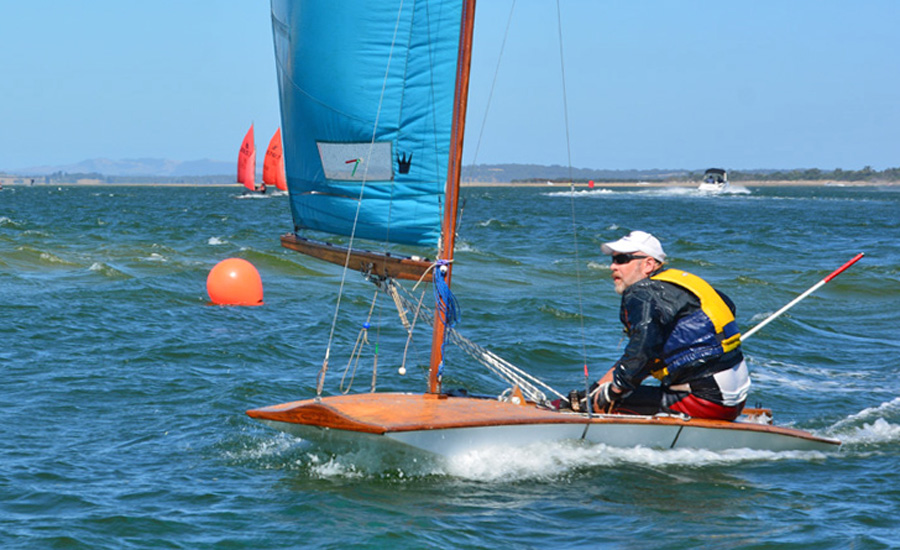
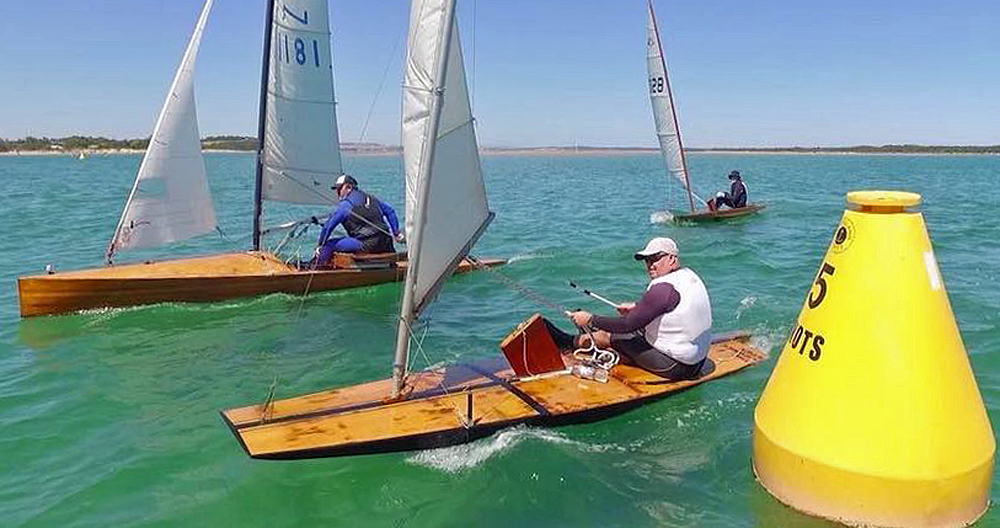
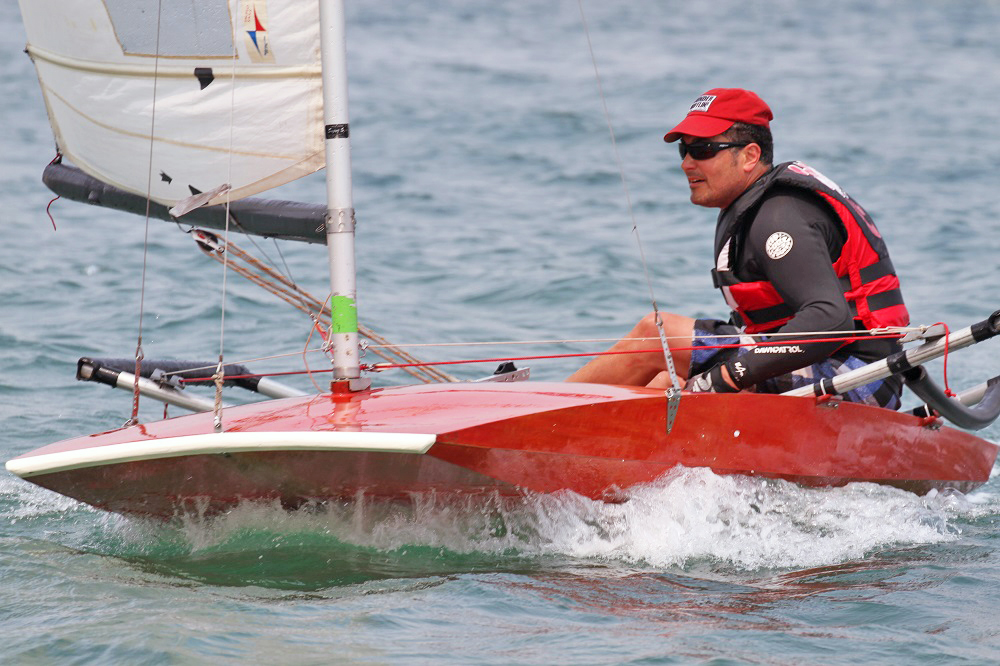
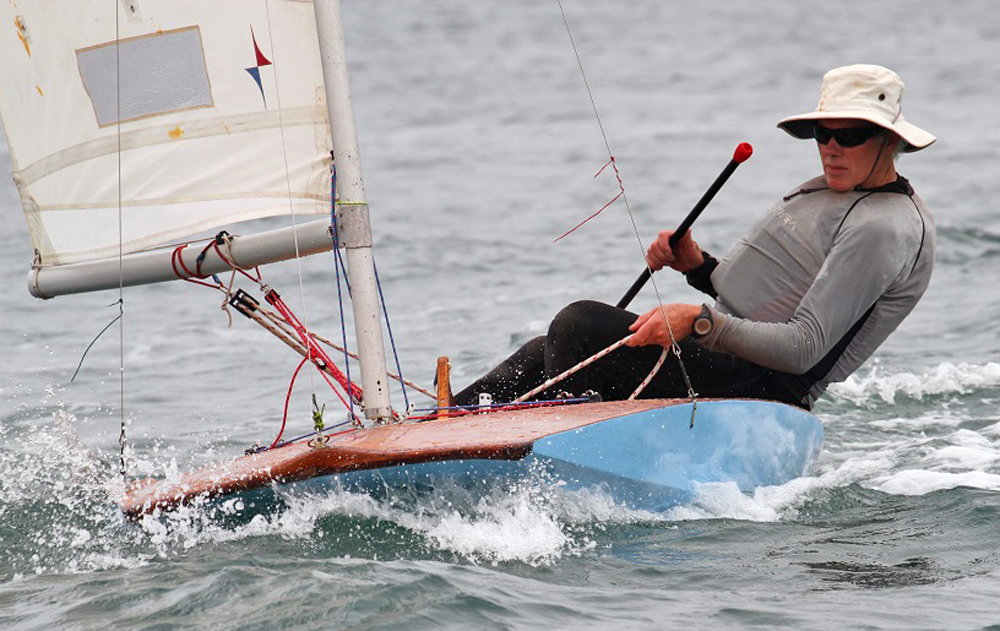
The Australian Moth will be the featured class at this year's Classic Wooden Dinghy Regatta hosted by the South Gippsland Yacht Club. 2018 marks the 90th anniversary of Len Morris introducing his Inverloch 11' scow. Several years later Len would change the name and logo of his scow when he came across the Rudder article on the Crosby Skimmer Moth. Len's scow became the first of the development Australian Moth class. (The Australian Moth class - actually Antipodean Moth class as New Zealand also had an active class organization - would feature a taller, high aspect rig compared to the U.S. and European Moth and would be mostly scow designs - the two different Moth rules would amalgamate into an International Rule Moth in 1969 .)
The South Gippsland Classic Wooden Dinghy Regatta is over the Australia Day Weekend (Jan 26 - 28). As a kid I was always salivating over the hot-rod Australian plywood dinghies of the 1960's and I always look forward eagerly to see what sailing dinghy restorations and replications the Aussies have unearthed, to be displayed and sailed on the Inverloch Inlet on Australia Day Weekend.
It doesn't take long when perusing this blog to catch on that the blogmeister sails a Classic Moth and that he also tends to feature those regattas that highlight the diversity and/or the history of dinghy sailing. Click on the following Earwigoagin links for regattas like the WOOD regatta, CBMM's Small Boat Festival, the Archipelago Rally, and the Bosham SC Classic Revival - UK. South Gippsland YC, southeast of Melbourne, held probably the first Australian Regatta featuring the great Australian wooden dinghies from yore. Here (was) a great video - Oops! I guess this longish video was a pre-production version, not meant for general viewing on the Net-Toobs and has now been taken down. Not to worry. There is a very good slide show of the regatta and also a video short of the GoPro view of father/daughter sailing on the double plank VeeJay..
Some class logos I recognize; JB for the Uffa Fox 19' Jollyboat, the Circle R of the Rainbow scow, also there is the M logo on the red sails of the regular Mirror dinghy as well as M logo with the halo of the Mirror Miracle, the Bell of the GP 14, the Heron of the Heron class, the red ball of the Fireball, the Butterfly logo of the Moth and the three bars of the Contender class. I've also been promised some pics from the regatta which I'll post when I receive them.
The slide show: (Oops again! they've now made the slide show so I can't embed. Jeez this is a moving target!) Click here for the slide show:
The previous header photo was of Australian sailing dinghies gathered on the beach for the 2015 South Gippsland Y.C. Classic Wooden Dinghy Regatta, ICWDR. In the foreground we can see, from left to right, a Mirror, and two scow Moths. The 2016 Regatta was held this past January but I haven't received a report yet. When I do, hopefully I can post some photos.
Andrew Chapman sends along some photos of the 2015 Australian Classic Wooden Dinghy Regatta, hosted by South Gippsland Y.C, out of Inverloch, Victoria, birthplace of the Australian scow Moth. Regatta was in late January.
A Classic 16-foot skiff.
One of the starts. Left to right is the pram-bowed Mirror, Heron, two Sabre's, an Oughtred Classic Shearwater dinghy, and a scow Moth.
A varnished Heron being rigged on the beach.
The Uffa Fox Jollyboat has a small fleet in Melbourne Australia. Popular in the 1960's, the 19 foot Jollyboat was eclipsed by the similar sized Flying Dutchman, with it's Olympic Status.
The two Jack Holt small doublehander designs; the Mirror Dinghy, at 10' 10" was the first stitch and glue kit dinghy and the earlier design, the 11' 3" Heron, was also designed for home boatbuilding in plywood. Both originally had gunter rigs as seen here.
This scow Moth Maggie was just recently built by Ray Eades over two weeks and is a modified Imperium design. Mark Rimington is the owner and skipper.
Beautiful decks on this new scow. Rather than aluminum wings this scow was built with shorter wooden winglets.
South Gippsland Y.C. is on Anderson Inlet, where a small protected bay meets the Bass Strait. As Maggie sails toward the sandbar break, one can see the nastiness at the entrance to the Inlet when the breeze is on.
Fitted around the on-the-water racing shedule, the dinghies are exhibited at a seaside park for the locals to come and peruse (and vote on their favorite).
On the left is the Rainbow Scow, a popular class in southern Australia up to about 1970.
This scow Moth is of the 1970's 1980's vintage, with aluminum wings.
The VeeJay has a bigger brother, the double plank 14' Skate dinghy. This one looks as if it is being pieced together on the beach, after a long layoff.
Here is a single plank VeeJay racing against the Heron. (The Heron being a good weight carrier, as we see here with three sailors stuffed into this rather small dinghy - plus one more! - I was informed there was also a small child tucked out of sight.)
The previous header photo is of Aussie Matt Kiely sailing the Australian singlehander Sabre class dinghy. The photo was lifted from the South Gippsland Y.C.Facebook page.
Probably the major trend in dinghy racing over the last 30 or so years has been the growth of singlehanded racing at the expense of doublehanded or triplehanded classes. And the trend since the millenium has been the explosive comeback of what I call the retro hiking singlehanders; those other singlehanded classes designed before, or around the date of the introduction of the Laser (1969). For the most part, these classes are not international (excepting the OK Dinghy and Europe Dinghy); they are popular country-by-country or region, and they attract fleets of thirty, forty or more boats at major championships. They have a builder or two turning out modern hulls, some have carbon masts, many have aluminum. They seem to fill a need in the marketplace that the Laser does not.
I have compiled a list of retro singlehanders. I have excluded the Olympic Finn - 1949 (which has a huge Masters scene) and singlehanders with hiking assists (trapeze, sliding seat). Feel free to add your thoughts about this list in the comments section. (Before the Sunfish sailors jump all over me for excluding the Sunfish from the list - let me state the Sunfish has maintained high levels of popularity in parts of North America and parts of South America for many, many years - I don't see a comeback in popularity - they just maintained it.):
Despite the recent introduction of the "modern" RS Aero, or Devoti D-Zero, with lightweight hulls, mylar sails (correction - the Aero has dacron sails), carbon rigs, it seems the singlehanded market is marching in the other direction. (I must admit the North American market is an anomaly here with not a lot of singlehanded classes under the Laser - still king by a long-shot-, and the Sunfish - a solid runner-up, The other singlehanded classes in North America - like my Classic Moth - are mustering small numbers...Oops! I forgot about the MC scow, now very popular in the U.S.)
While I'm on a scow kick, mention must be made of two different scow designs that competed in the Australian ICWDR out of the South Gippsland Y.C. One of the kingpins of the Classic Wooden Dinghy event, Andrew Chapman and family, had two restored Rainbows in the regatta. (Correction: Andrew did the restoration of one "Annie", his son-in-law, Jonathan, a fine craftsman in his own right - music instruments - did the restoration of the other one, "Moonraker".) The Rainbow is an Australian 3.65 meter design that was popular as a junior trainer in South Australia in the 1960's. Andrew sailed one Rainbow with his grand-daughter and, his daughter Trilby, sailed the second one with Andrew's other grand-daughter. I asked Andrew what he thought of the Rainbow scow as a parent/kid sailing dinghy and he was enthusiastic.
"The Rainbow is lovely small boat to sail. It is very forgiving and a lot faster than a Mirror and Heron without using the trapeze and/or large spinnaker. I think it is an ideal boat for an adult and young kid or young teenagers. Trilby and I sailed with each of her two daughters and we plan to introduce them to using a trapeze on a beat and then the trapeze with spinnaker on reaches. We are also putting them on the helm and they enjoy sailing the quicker boat and they are not overwhelmed by the boats size. When they are comfortable using the trapeze and spinnaker trapeze combination the next stage will be the Gwen 12 then Cherub.
I think the Rainbow is a very good small boat and it is one that is very easy for home builders to make.
Andrew Chapman and grand-daughter in "Annie".
Trilby and daughter in "Moonraker"
Three very different Australian scows in one shot. Trilby with the Rainbow on the beach, a modern carbon foiling Moth scow, and, in the background, a Classic wingless Moth scow.
Plans for the Rainbow scow can be found here.
The A-12 scow was Frank Bethwaite's follow-on to his Northbridge Junior scow. Designed to be a higher performance dinghy, the A-12 was longer, 12 feet or 3.65 meters, sported Frank's signature rotating mast and had a trapeze. Neil Kennedy from Nedslocker dug out a November, 1970 issue of the Australian Modern Boating which featured the class when newly introduced. Some photos from that article:
An A-12 scow has shown up at the Inverloch Classic Wooden Dinghy Regatta for the last two years but, as Andrew Chapman writes, in the beginning no-one knew what type of scow it was.
"At the first regatta Andrew Kean sailed the boat as a Moth, with two tone blue sails, because that what it was sold to him as. He did wonder why someone had put a trapeze fitting on the mast. Apparently he never thought to measure the length. He sailed it again in the most recent regatta as an A12 with blue and white sails with a different rig.
From the photos it looks like Andrew was able to find a genuine Bethwaite rotating rig and A-12 sail.
The A-12 with the original Moth rig; a blue sail, wooden spars.
The A-12 on the Inverloch beach next to an Australian Sailfish.
For the 2018 regatta, Andrew was able to plug in the correct rig; aluminum rotating mast with a very big sail.
I'm not sure any plans exist for the A-12. None have come forward yet.
George McGee adds more info on the A12. (From a comment I dragged to the main body.)
"I raced an A12 at Northbridge sailing club in the mid seventies. My boat came from Starbord Products with 2 rigs. The first rig was the 85 sq foot two tone blue sail with the over-rotating wooden mast. The second rig was a 65 sq foot two tone sail with a shorter wooden mast. (Not sure of the 65sq foot size). When the smaller rig was used the boat was classed a J12 rather than A12. NSC had a number of A12s and J12s competing on Sundays in the mid seventies.I spent many a happy afternoon on the A12 redefining the term "screaming reach"
Eleven Australian Sailfish made the trip to South Gippsland Y.C.'s 2017 Classic Wooden Dinghy Regatta (Australia Day weekend, January 25-28). This was an astounding number given that class stalwarts from the 1960's, 1970's and 1980's didn't start organizing until six months before the Inverloch regatta. As to be expected, this gathering of Australian Sailfish skippers was a reunion of primarily grey-beards. It will be interesting to see if the class can harness this new-found energy into some new builds and some younger skippers. It would be great to see the class translate a reunion into a renaissance of the Australian Sailfish.
A Sailfish rounding a mark with the wooden International Canoe on the outside.
Mick Green/Drift Media
Chris Cleary (no. 1918), who contributed two Sailfish articles to Earwigoagin, chasing the eventual winner, Steven Floyd (no. 3400) who was the last national champion in 1987.
Hayden Ramsdale
Chris Drury had the newest Sailfish at Inverloch.
Hayden Ramsdale
A beautiful graphic design on the deck of a restored Sailfish. Ian Milton's Apsu.
Greg Barwick
Ian Milton on Apsu focused on punching through a wave.
Hayden Ramsdale
The bow snout of the Australian Sailfish. Chris Drury's Blowed if I Know.
Trilby Parise
A race start. I've seen several sheepish comments from the skippers that starting skills were very, very rusty, hence only three Sailfish in this photo.
Hayden Ramsdale
Four Sailfish skippers were able to reprise a photo-op from the 1970's. Jack Carroll, the Sailfish designer and class founder is second from the left. The Sailfish is Jack Carroll's original, no. 2, Debonair.
Ian Milton
The original photo of the foursome from the 1970's.
Newcastle Morning Herald, Jan 1978
Jack Carroll tweaking on his original Sailfish.
Tony Hastings made this video of his race at the Classic Dinghy Regatta on Flotsam, his restored Sailfish. Some rot in the transom allowed the gudgeons to pull away and the rudder to float up, ending his race (starting at 8:44). For those who wonder how you tack these narrow. low boom craft; the tacking sequences are at 1:41, 2:12, 7:00, and 7:41 in this video. Chris Cleary left a comment about Tony's unorthodox tacking technique which I've tacked onto the main post.
"Tony's tacking and gybing technique is very idiosyncratic. He has end-boom sheeting on his boat, which I hadn't seen previously on a Sailfish. That gave him space for his mid-boom belly flop. Effective though - he had his appropriately named relic going like a rocket.
We were sailing side-by-side on very thin water in an attempt to avoid the worst of a strong ebb tide when disaster struck for Tony. He's an excellent sailor - a current top 10 Australian Paper Tiger catamaran skipper.
The good folks over at Drift Media put together a Moth History video, combining a talk by Ian Ward at the Inverloch Classic Wooden Dinghy Regatta dinner with a compilation of Moth shots (both classic and foiling) taken during the 2018 regatta weekend. Ian Ward was a top scow designer in the 1970's and 1980's as well as a top helm in his own right (Australian National Champion as well as top placings in World Championships). Ian was also the first one to put centerline foils on a Moth in 1998. In this video he can be seen sailing his foiling scow.
Famous classic boat designer, Ian Oughtred, got his start in the sporty Australian Gwen 12, a single trapeze, DIY plywood, double hander. He was class champion sometime in the 1960's. Andrew Chapman has been feeding me some Gwen 12 material including this article by Ian Oughtred on building the Gwen 12. This looks to be from Seacraft issue of boat plans.
The Gwen 12 was designed by Australian Charlie Cunningham in 1948 as one of the first stressed ply dinghies. Like most Australian designed plywood dinghies, the Gwen 12 was extremely popular in the 1950's, 60's, and 70's but died out in the 1980's. Below is the cover of the May 1958 Seacraft issue with what almost looks like a colored post card of the Gwen 12.
As promised in a previous post, Andrew Chapman sent over a slew of photos taken by Tim Wilson of the 2016 Aussie Classic Wooden Dinghy Regatta. Inverloch, where the regatta is held, is the home of the Australian scow Moth (Len Morris with his Olive - 1927) and at this year's regatta there was a good turnout in the scows.
Andrew lists the scow Moths competing;
The Moths are as follows:
Phillip Johnson's ‘Frolic’ [was] built in the early 60s.
Jim French’s ‘Skeeta’ [is] a 1965 boat. Jim is a fairly famous Moth builder and sailor and is the person who developed the scow on foils.
My ‘Blondie’ - about early 60s or could be late 50s. The sail numbers do not necessarily indicate a clear progression in design.
Jonathan Parise’s 1970s ‘Red’ is a winged Western Australian boat. A beautiful boat to sail and Jonathan is just learning to sail it and loving every minute.
Mark’s [Rimington] Maggie, which you know a bit about.
Graham Cooper’s unnamed boat that does not have a sail number. Its design is very similar to ‘Blondie’.
Matt Kiely’s ‘Street Fighter’ which is another Western Australian boat. Like ‘Red’ it is very light and quick.
The photos:
Andrew Chapman's Blondie.
Photo courtesy of Tim Wilson
Matt Kiely on Street Fighter.
Photo courtesy of Tim Wilson
Maggie was a 2015 build of the classic Imperium design and was featured in last year's Earwigoagin post on the Classic Wooden Dinghy Regatta.
Photo courtesy of Tim Wilson
Scows launching. The Mouldie in the foreground.
Photo courtesy of Tim Wilson
The Mouldie or Peter Cole designed Mouldie. They were built with super-thin veneers and thousands of staples. The restoration of this one entailed regluing a fair amount of the veneer back in place.
Photo courtesy of Tim Wilson
The Mouldie under sail. Look at that snout!
Photo courtesy of Tim Wilson
The winged Red.
Photo courtesy of Tim Wilson
Photo courtesy of Tim Wilson
Street Fighter rounding a mark.
Photo courtesy of Tim Wilson
Photo courtesy of Tim Wilson
Mike Scott, the Brit who spent his young adult life in Australia, continues his Down Under saga retelling his time in the Aussie scow Moth (dragged over from the comments section);
"Ah, memories.......after crewing Sharpies on Lake Illawarra, I moved to Sydney to work at Miller and Whitworth's new chandlery and boat store at Rochdale, where we sold the De Havilland Marine built, Alan Payne designed range of fibreglass boats - the 16ft Corsair, 12ft Vagabond, and the 10ft Gypsy.
During this time I built my first boat from a kit - a Cole scow Moth, with not much more than a Black and Decker drill and a stapler. Loved it - so fast, couldn't believe the acceleration....sailed it on Botany Bay, and at Connels Point Sailing Club just inside the Georges River. Used to get regularly beaten by the 14 yr old kids - Aussie kids in those days were super fit from swimming and surfing.
As promised, here are the plans for a sit-on-top sailing dinghy, the Australian Sailfish. The Australian Sailfish is a scow version of the American Sailfish, designed in 1958 by Bruce Scott and Jack Carroll. Designed for home construction, 780 plans of the Australian Sailfish were sold. I've chunked images from the original plans into a PDF file that can be printed out. Unfortunately frame dimensions are given as given as linear dimensions along the plank edges which might make it more difficult to lay out the frame dimensions (instead of plotting X,Y coordinates). There is enough information in the PDF plans for a competent builder, with some head scratching, to complete a hull.
The rig is a stayed marconi with full battens. A carbon windsurfer mast would work fine if one wanted to go hi-tech.
Many thanks to Andrew Chapman for providing the Australian Sailfish plans.
Australian Sailfish No. 2 at the 2016 South Gippsland Y.C. Classic Dinghy Regatta.
A sailing image from the Australian SeaCraft magazine.
To view the PDF plans in another browser tab (or to print the PDF file), go to the top right corner of the PDF window and click on the pop-out icon (box with an arrow pointing to the right).
The previous header photo was of the Australian junior class, the Vaucluse Junior, aka the Vee Jay, or simply the "VJ". A 12-foot dinghy, the Vee Jay was originally designed in 1931 by Sydney boatwright Charles Sparrow to a design brief for a junior sailboat given to him by local sporting-goods store owner, Sil Rohu. It was a simple low-angle V-shaped hull, plank and frame construction, readily built by amateurs. The pre-World War II hulls had a small cockpit, similar to the North American Sunfish class.
What makes the class stand out was it's transformation after World War II. The adoption of plywood in the late 1940's considerably lightened the hull and sailors started adding planks; the first plank (sliding seat to North Americans) added in the late 1940's but not coming into common usage until the 1950's. The second plank was added by the West Australians in 1958. The small cockpit disappeared, replaced by a self-draining surfboard deck. Combined with a small flat kite (shike), this junior dinghy had enormous power and speed in a breeze - unlike any junior trainer, before or since. (Historian Chris Thompson points out this Australian penchant, after World War II, to incorporate performance upgrades, even to supposed one-designs, even when all the previous models became immediately obsolete, was one of the main drivers in the evolution of Australian lightweight high-performance dinghies.)
The class collapsed in the 1980's under the hegemony and homogenization of fiberglass junior trainers (namely the 420).
The first design by Charles Sparrow was named Splinter. Deciding the first hull was too tender, Sparrow drew up a wider modified hull the same year named Chum from which commenced the VJ class. The original boats had a gunter rig.
Two photos of the simpler, 1930's hiking Vee Jay.
The squat sail plan was easily handled by lightweights in the typically strong Australian breezes.
To me, the most iconic photo of the Vee Jay, "Warren Nupier in Impala"
A promotional brochure with the Vee Jay at full crack, under kite.
This photo shows the final development of the Vee Jay before the class died out (the boom looks shorter with a straighter leech mainsail). There was a recent movement, documented on the Vee Jay website, of bringing back the class with a more modern sail plan, but that hasn't seemed to gain much traction.
A photo lifted from South Gippsland Y.C. of a restored Vee Jay racing at their 2015 Classic Wooden Dinghy Regatta. This is a one-planker, just for the skipper.
A 1950's video showing two juniors rigging, launching, and sailing their Vee Jay.
Ed. Sea Story
"As a young sailor, during the 1970's, I came across a Vee Jay on Annapolis Harbor. I saw this strange craft buzzing about the Harbor, two sliding seats, as we sailed our International 14 out to the starting area. On our way back after the racing, we encountered the same double sliding seat dinghy and sailors again. this time entwined in the fishing lines of two irate fishing boats, the air turning blue as the skipper was working desperately under his rudder. Inquiries on shore had the sailor as someone from the Australian embassy. I never saw him again; most likely the encounter with the fishing boats left a bad taste in his mouth.
And another sea story I've pulled from the comments... from Northwest sailor Mike S.
"When I moved to Oz in 1965 with wife and daughter in tow, aged 21, I couldn't afford a boat, but someone was selling an old VJ with cotton sails and twin planks for only 10 quid, so I couldn't resist. It was a hoot albeit pretty rough around the edges, and as I didn't have a crew I jury rigged a trapeze (stitched my own canvas harness!) and sailed it singlehanded from the trap. Great fun on Lake Illawarra with steady 15-25 knot breezes every day. Its demise happened during a race, I got a crew and we sailed with the planks, some time during the race the wind piped up, and the old plywood started to open up, with us slowly sinking. We abandoned the boat, climbed aboard the rescue boat and left it to float to the shore. I went the next day and brought it up, but it was too far gone.....Had a metal daggerboard as I recall....
Bald but my eyebrows are growing at a prolific rate. Sailed Windmills and Y-Flyers in the 1960's. Founded Miami University (OH) sailing team. Sailed International 14's and Lasers in the 1970's. Sailed International Canoes in the 1980's to mid 1990's. Sailed Classic Moths since 2002. Enjoy boatbuilding though I'm very, very slow at it (the Internet doesn't help matters). Name in real life: Rod Mincher
After choosing this username (Tweezer is the name of my Classic Moth), further research on the Internet turned up that Tweezerman is a corporate name for a line of pedicure products. Let me emphasize that I do not work for, nor endorse these products.