Friday, August 16, 2013

Classic Moth Plans: Offsetts for Zippy Design


(Update December 2013: For those who like the visual lines drawing the Zippy sections in PDF format are posted here.)

(Update February 2015: I finally have compiled and posted here the 8 station offsets which will make it easier to plot out frames.)

Plans de voiliers classiques Moth, Dériveur classique Moth.

There are two "wide-body" Classic Moth designs currently kicking around, the round-bilged Titan, an American design, which is featured in this header photo, and the French Proust design which I profiled in this post. The Proust design is a simple, v-bottom shape and should be easy to plank in plywood though Jim Young built his version in fiberglass/foam-core. If you build it with the open cockpit as Jim Young did (rather than the racing cockpit), the Proust should be more than capable in taking an adult and a young kid for a pleasant day-sail.

Jim Young named his Proust version Tippy, a misnomer since this design has more than enough stability for a Mothboat. I've taken the Proust and made some changes and in keeping with the Jim Young naming convention, I've deemed my version  Zippy.

The Jim Young Tippy at the 2008 Elizabeth City Nationals.


The original Proust had a chine log which I've eliminated to make it a true V-bottom. I changed the rocker and the sheer slightly. I have it on my list to make a model of Zippy but as my friends know, my projects take a very long, long time. If anyone out in the bloggosphere would like to make of model of Zippy, please send along photos and I'll post them.


Here are the the 8 station offsets for Zippy in metric. To print or download, click on the pop-out icon on the top-right corner. It will open the PDF in another tab where you can print or download.


Here are the offsets for Zippy for stations set at 336mm (13 inch English) which is really too many for a traditional build where you leave the frames in the boat (like the Nantais or Little Mae Moths).


And here is "Zippy the Pinhead", the cartoon star, the enigmatic master of dry wit from another dimension, a cartoon I always checked in with daily even when I didn't understand where he was going.


Where to put the mast and daggerboard in a Classic Moth?

Luckily, John Shelley's construction drawings for the Shelley Mk 1, which he used in a patent application, have now surfaced on the internet. His mast and daggerboard placement as indicated in the drawings below are good placements, though, if you went around the fleet with a measuring tape, you would find this might vary by up to 75 mm from boat to boat.

Center of mast back from stem - 695 mm.

Leading edge of daggerboard back from stem - 1453 mm.


Tuesday, August 13, 2013

Header Photo: Cotuit Skiff


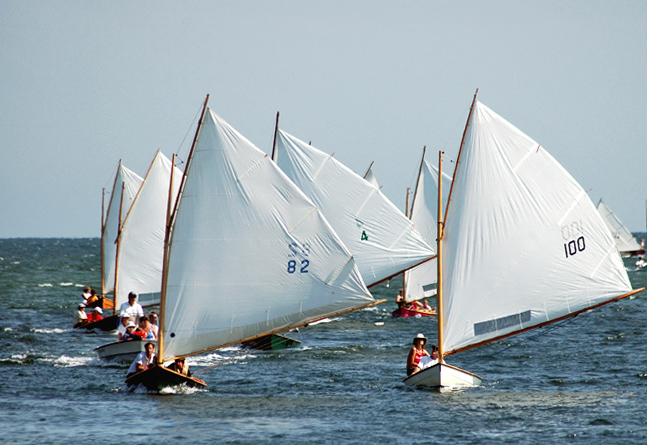
The previous header photo was of a Cotuit Skiff, a vintage design, circa 1906, that is raced in great numbers on Cotuit Bay, on the South Shore of Cape Cod. A jumbo low-slung, gaff-rigged cat sail powers this 14 foot flat bottomed craft, as is shown by the juniors in this photo desperately hiking her down. If one was closely inspecting the photo, one could wonder what happened to the skippers aft, steering arm. It has completely disappeared. Well this fellow is using both hands on the sheet and steering with his foot. The Cotuit Skiff doesn't allow tiller extensions! I suppose this is something the young and fit would do; any attempt on my part to sail a small boat, steering with my feet while hiking out, would inevitably result in a capsize.

The Cotuit Mosquito Yacht Club was formed around the Cotuit Skiff early on as a junior club. No member could be older than 25 or married. Today the club remains though there is the "Association of the Cotuit Mosquito Club" to allow the parents and older citizens to be involved. Indeed the Cotuit skiff is raced by all ages.

Some other pics:


Friday, August 9, 2013

Micro Dinghy: Bolger "Queen Mab" Catboat

Several years back, at the Mid-Atlantic Small Craft Festival, a builder of the beautiful micro-dinghy, the Bolger designed Queen Mab catboat, was offering a spin. No one else was taking her up on the offer, so I eased myself into this 7 1/2 foot craft and aimed her out of the harbor. You sail reclined, using your feet to steer, `a la the Hobie kayak/trimarans. After some trepidation with how this tiny craft would handle the motor boat chop out on the Miles River, I had an enjoyable sail. There were some equipment sore-spots. The steering cable, similar to a bicycle brake cable, was very sticky. The sail was very overbuilt and had trouble setting in the lightish breezes. The offset centerboard (offset close to the gunwhale so as to give the skipper legroom on the centerline) had a tendency to float up. But overall, the Queen Mab sailed, slowly but smartly, bobbing over the wakes. Besides the cuteness of the catboat's classical lines in a very small size, I could see this design offering up some memorable cruises on a small pond. The blogger over at 70.8 percent has a much more detailed look at the Queen Mab and her first-time builder, the post probably coming from the same MASCF I sailed her.

Queen Mab sitting on the lawn in all her regal glory.


You intrepid blogmeister, game for a go in any small craft, showing his legs.


Sunday, August 4, 2013

OD - OY Review; The Classic Moth

Voiliers classique Moth, dériveur classique Moth.

Well it wasn't the Classic Moth when One-Design and Offshore Yachtsman published their yearly dinghy review in 1964. These were the International Moths, plain and simple. (Well, the Aussies were doing their own 11-foot thing as well.). The OD-OY blurb shows a picture of a Cates design to leeward of a Ventnor/Dorr Willey type.
Update: George A., Classic Moth historian has posted a comment that the two sailors in the following thumbnail were Warren Bailey and Lewis Twitchell. If that's the case then the leeward Moth is not a Cates but one of Bailey's Mach designs (later massaged into the Cates/Florida design by boat builder Harry Cates).


Here is a picture of Pat Duane from the same time period, winning a Moth regatta in a Cates Moth. One of the best women dinghy sailors in the 1960's, she would go on to be one of the top three U.S teams (sailing with her husband) in the newly introduced Flying Dutchman two-man (or woman!) Olympic class.


Friday, August 2, 2013

Beer: Ahead of the Curve; Elysian Super Fuzz

Back when I was a young buck, my favorite summer beer after sailing was one of my own concoction. Sort of like a shandy (lemonade and beer) I would mix orange juice and beer. Through experimentation, my taste buds settled on a pilsner type beer (the original Budweiser does fine) - 2/3 of a glass with orange juice making up the other third. Most of my friends thought I was crazy and I could never entice them to try it. Now with the craft beer revolution, some of these brewers are bringing out their own version of orange juice and beer. I decided to buy a 6-pack of the craft Elysian Super Fuzz, a blood orange beer - whatever that means. I was intrigued with what a master brewer would do with this combination. Turns out it didn't taste all that different from my home-grown mix, plus, if you mix your own you can tune the beer vs. orange juice ratios - depending on your mood. But, I'm still curious. If I see another brewer with a beer/orange style, I'll probably give it a go.

Monday, July 29, 2013

Header Photo: Tillerman to the Rescue! Ladies Day at Larchmont YC

Mr. Tillerman, I doff my baseball cap to your marvelous powers of observation and unsurpassed ability to sift through and discover relevant Internet material. In two hours you have deduced much more than I have in two months. I can only repost your comments in a main post so all my readers can follow along and appreciate a master at work on his computer, piecing the puzzle together.

"The burgee on that swimming platform does look remarkably like the burgee for Larchmont Yacht Club.

"And Manor Park in Larchmont is famous for its gazebos and striated rocks.

"If you look at Manor Park on Google Maps satellite view you can actually see two gazebos on striated rocks very much like those in the second picture. But I can't identify the exact spot with those specific striations.

"Could this be a more recent photo of the same spot?

"Note that the gazebo may have been rebuilt in 100 years and a stone wall added. But look at the pattern of striations in the rock.

"Check out this photo from the Larchmont Gazette.

"Not the same day but surely the same view? Look at the trees on the point in the distance, for example.

"This is a postcard from Horsehoe Harbor in Larchmont c.1900. There is a Horseshoe Harbor YC (which is probably why your correspondent from Larchmont YC said it wasn't LYC but he did know it?)

"Oh, and I forgot to mention, Horseshoe Harbor is in Manor Park.

"On the other hand check out this photo of Ladies Day at Larchmont YC in 1911.

"This looks like a better match to your scene than that postcard of Horseshoe Harbor. The trees on the point look similar in both pictures but this one is claerly a wider stretch of water more similar to your picture. Would also explain why the swim platform has an LYC burgee.

"Maybe your header photo was of Ladies Day at LYC?

"This NYT article from 1910 does say that the fleet was dressed for Ladies Day.

"And this NYT article from 1913 about Ladies Day at Larchmont that year says that more than 200 yachts dressed ship and that possibly the fleet was larger in "former years."

"So I am pretty sure both photos are looking across Larchmont Harbor. If you look on a map you will see that the views from the gazebo in Manor Park and from LYC are both towards the same point on the opposite side of the harbor, to the NE and E respectively.

"And there's a fair amount of circumstantial evidence that this could be Ladies Day. There were canoeing and swimming races on Ladies Day which explains a lot of the foreground in the header picture too.

These photos are from the Emerson collection of Rochester N.Y.. Other photos in the collection fix the time frame. There is no explanation why young Mr.Emerson was at Larchmont YC but he did, in 1917, marry the daughter of Fred A. Mabbett, the Commodore of Rochester Yacht Club. Perhaps Fred Mabbett had chartered a yacht on the East Coast.There are some yacht racing photos in this collection.

Below are all the photos in the spectator set, including a larger version of the header photo.


Saturday, July 27, 2013

Header Photo: Where Is This?


I have noticed in the bloggosphere that these quiz posts about mystery locations are very popular. The blogger puts out some picture with some obscure hints about where it was taken, or the context, people comment about where they think the photo was taken; someone, obviously brilliant or good at Google searches, comes up with the correct answer. This one has a little twist.

I have no clue where this vintage photo was taken.

I have puzzled over it for several months and come up with two educated guesses and one obvious fact.
  • The photo was probably taken in the 1913 to 1918 time frame.
  • Given the size and abundance of large yachts, this may be the dressing of the fleet for the New York Yacht Club Cruise.
  • There is a parade of small craft, canoes, rowing skiffs for the spectators, with youngsters swimming off a large houseboat-structure.
So this may be one of the old yacht clubs on Long Island Sound - or not? I emailed someone at Larchmont Y.C who wrote back that it wasn't Larchmont Y.C, that he had an good idea of where it was and then was never heard from again.

To add to the confusion, here is another photo in the set (that may not be in the same location) that shows a gazebo and yachts, but also shows a rocky shore indicating a Maine location, or possible a L.Y.R.A rendezvous on Lake Ontario (this was my first guess but a L.Y.R.A. get together would not have so many large yachts, only the wealth of New York City could support this in the early 1900's).


Have at it.

Oh, and here is the schedule for the New York Yacht Club Cruise - from the 1916 issue of Rudder magazine. (As always, click on any of the pics to get a larger view.)