Sunday, March 11, 2018

Two different scows at the Inverloch Classic Wooden Dinghy Regatta: Rainbow and A-12


While I'm on a scow kick, mention must be made of two different scow designs that competed in the Australian ICWDR out of the South Gippsland Y.C. One of the kingpins of the Classic Wooden Dinghy event, Andrew Chapman and family, had two restored Rainbows in the regatta. (Correction: Andrew did the restoration of one "Annie", his son-in-law, Jonathan, a fine craftsman in his own right - music instruments - did the restoration of the other one, "Moonraker".The Rainbow is an Australian 3.65 meter design that was popular as a junior trainer in South Australia in the 1960's. Andrew sailed one Rainbow with his grand-daughter and, his daughter Trilby, sailed the second one with Andrew's other grand-daughter. I asked Andrew what he thought of the Rainbow scow as a parent/kid sailing dinghy and he was enthusiastic.
"The Rainbow is lovely small boat to sail. It is very forgiving and a lot faster than a Mirror and Heron without using the trapeze and/or large spinnaker. I think it is an ideal boat for an adult and young kid or young teenagers. Trilby and I sailed with each of her two daughters and we plan to introduce them to using a trapeze on a beat and then the trapeze with spinnaker on reaches. We are also putting them on the helm and they enjoy sailing the quicker boat and they are not overwhelmed by the boats size. When they are comfortable using the trapeze and spinnaker trapeze combination the next stage will be the Gwen 12 then Cherub. I think the Rainbow is a very good small boat and it is one that is very easy for home builders to make.
Andrew Chapman and grand-daughter in "Annie".


Trilby and daughter in "Moonraker"


Three very different Australian scows in one shot. Trilby with the Rainbow on the beach, a modern carbon foiling Moth scow, and, in the background, a Classic wingless Moth scow.


Plans for the Rainbow scow can be found here.


The A-12 scow was Frank Bethwaite's follow-on to his Northbridge Junior scow. Designed to be a higher performance dinghy, the A-12 was longer, 12 feet or 3.65 meters, sported Frank's signature rotating mast and had a trapeze. Neil Kennedy from Nedslocker dug out a November, 1970 issue of the Australian Modern Boating which featured the class when newly introduced. Some photos from that article:


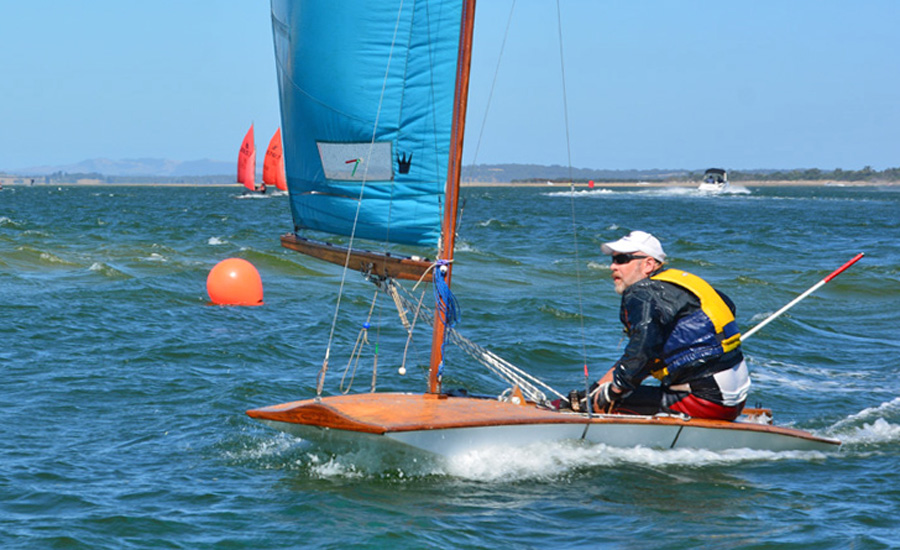
An A-12 scow has shown up at the Inverloch Classic Wooden Dinghy Regatta for the last two years but, as Andrew Chapman writes, in the beginning no-one knew what type of scow it was.
"At the first regatta Andrew Kean sailed the boat as a Moth, with two tone blue sails, because that what it was sold to him as. He did wonder why someone had put a trapeze fitting on the mast. Apparently he never thought to measure the length. He sailed it again in the most recent regatta as an A12 with blue and white sails with a different rig.
From the photos it looks like Andrew was able to find a genuine Bethwaite rotating rig and A-12 sail.

The A-12 with the original Moth rig; a blue sail, wooden spars.

The A-12 on the Inverloch beach next to an Australian Sailfish.


For the 2018 regatta, Andrew was able to plug in the correct rig; aluminum rotating mast with a very big sail.


I'm not sure any plans exist for the A-12. None have come forward yet.


George McGee adds more info on the A12. (From a comment I dragged to the main body.)
"I raced an A12 at Northbridge sailing club in the mid seventies. My boat came from Starbord Products with 2 rigs. The first rig was the 85 sq foot two tone blue sail with the over-rotating wooden mast. The second rig was a 65 sq foot two tone sail with a shorter wooden mast. (Not sure of the 65sq foot size). When the smaller rig was used the boat was classed a J12 rather than A12. NSC had a number of A12s and J12s competing on Sundays in the mid seventies.I spent many a happy afternoon on the A12 redefining the term "screaming reach"
.

Friday, March 2, 2018

The Japanese Coca-Cola Moth

It appears that the Japanese Moth class got it start in the 1960's as a scow class sponsored by Coca-Cola. Here is the Japanese history as told by Ohno San;

"This photo (shown below) is from Kensaku Hashimoto. His dad was the Japanese distributor of Coca-Cola. Coca-Cola-Japan got the lines drawing of the Peter Milne “Hurricane” scow Moth and sponsored the Okumura boatbuilders to build, in fiberglass, about 60 of the Milne design scows. As you can see from the photos, the Coca-Cola Moths had sails with a red stripe but didn’t sport the Coca-Cola logo.


Wooden masts and wooden booms.


This scow shown below may or may not be one of the original Coca-Cola Moths but it does have the double chine characteristic of the Milne "Hurricane" design. Also the halyard seems to be stored as in the other photos of the Coca-Cola Moths.


The number on this scow, 272, is a bit high for a Coca-Cola Moth but it does sport a red stripe on the sail. (The red stripe being higher up than the lower number Coca-Cola Moths.)


Mainer NZ Moth Update


John Hanson read my last post on NZ Moth's deck layouts and sent along the latest on his NZ Moth build in Maine, the U.S. state that sits at the apex of chilly New England.
"We got the sides on, before Sam away to school. We have a 420 mast and some foils. I am not allowed to work on it without Sam. Shop’s too cold anyway. 


Neil from Nedslocker sent along a 1963 article that also shows some internals of a NZ Moth.


Sunday, February 25, 2018

New Zealand Scow Moth; Some Deck Layouts


The New Zealand scow Moth is a one-design adaptation of the Len Morris Mk II Moth design though the rules were loose enough that they pushed the original Mk II lines around a bit. (An astute observer could also say that the Bethwaite design, Northbridge Junior, is also another adaptation of the Mk II scow.) Cockpit design on the New Zealand Moth is wide open and I came across these recent photos of the fleet of New Zealand Moths at Stewarts Gully, NZ. Some very inventive hiking arrangements here.

Three New Zealand Moths bow-on. It looks like 958 has shortened the luff of his sail to get a fat-head top.


A concave cockpit with stand-up rounded decks for hiking. The New Zealand Mothies do seem enamored with sticking wind indicators on the foredeck.


Another concave cockpit with semicircular hiking bumps. A nice long lever vang.


This one has narrow side decks just barely raised from the cockpit floor.


A conventional cockpit design with a repair just aft or where the skipper sits. A second layer of ply reinforcing (lightened with circular cut-outs) was supposed to be strong enough but doesn't look like it was up to the task.


Another shallow side-deck. I like the contrasting colors.


A more severe concave deck with shallow raised bumps for hiking.


You really, really have to work hard on the plywood to get this kind of double curve.


John Hanson and son are building a New Zealand Moth in Maine.

Articles from Nedslocker: Northbridge Junior build - Australian Sailing 2002


You can't put anything up about Antipodean classes that Neil Kennedy doesn't have an archived article to supplement it with. Linking with the Japanese build of the Northbridge Junior, Neil sends along this article from Australian Sailing on a Northbridge Junior build in Sydney. (Use the pop-out icon on top right of article window to put it in another tab on your browser.)


Saturday, February 24, 2018

Drift Media covers Moth History talk by Aussie Ian Ward

 ICWDR

The good folks over at Drift Media put together a Moth History video, combining a talk by Ian Ward at the Inverloch Classic Wooden Dinghy Regatta dinner with a compilation of Moth shots (both classic and foiling) taken during the 2018 regatta weekend. Ian Ward was a top scow designer in the 1970's and 1980's as well as a top helm in his own right (Australian National Champion as well as top placings in World Championships). Ian was also the first one to put centerline foils on a Moth in 1998. In this video he can be seen sailing his foiling scow.


ICWDR_2018_MOTH from drift media on Vimeo.

The Inverloch Classic Wooden Dinghy Regatta was hosted, as usual, by the South Gippsland Y.C.

Thursday, February 22, 2018

Music Whenever: Lone Justice "I Found Love"

Sorry, I missed Valentines Day with this rocking classic on love but better late then never. Featuring the full bodied voice of Maria McKee, this song is from the 1980's.