On one of my posts about the Big Guy singlehander, "Noodle" intimated in a comment that I was ignoring the Finn dinghy; the Finn dinghy being the most popular of the big guy singlehanders. How can you argue when 283 Finns showed up for the 2011 Worlds Master Championship in Punta Ala Italy!
That being said, how are these oldsters with their creaky knees and aching backs able to get under such a low boom. I owned and raced a Finn (a glass Newport that had a wood deck..... Rob Andre did the conversion) for a short while when I was in my 20's. On my first sail, my elbow got a right smart whack when I left it too high in a jibe. On tacks, you really did have to fold yourself on the floor to get under the boom. After finishing down the fleet at the U.S Nationals in Sayville NY, I realized that I was too small for the boat and, quite frankly, the Laser seemed more lively offwind.
But, there is not a better singlehander in light air than the Finn. The large cockpit makes for pleasant light air lounging compared to the contortions of the poor Laser sailor draped over the daggerboard trunk. The large sail area and finer hull shape means the Finn doesn't need much air to tramp along quite nicely in soft breezes. The Finn would be my top choice if I was just day sailing on a lake in light air (I would have to keep the Finn on the beach for the Finn is not a light dinghy to launch and retrieve). The question is, can you find one?.... demand is such that there are not too many used Finns popping up.
Here's a great video of the Geezer Finn fleet racing out of Encinal YC, California, tucked up into Oakland Inner Harbor and well away from the big breezes of San Francisco Bay. They all seem quite enamored of the Finn and not at all fazed over dealing with such a low boom..........
I got this in the inbox about a week or so ago.........
"I got in contact with Bill about the Classic Moth he built based on your station molds. I too am looking to build my own sailing boat, with looking to start on a smaller project first (~200 hours), and fell in love with the Classic Moth design, especially the curved tanks in the cockpit.
I'm 6'5" and around 260 pounds (118 kg) so not sure if the boat would sail ok with me in it! Do you have any suggestions on an appropriate design and where I may be able to get the plans from?"
C
And my reply.............
"Your size will make it hard to make it work in a Classic Moth. You need a design with some displacement and nothing like some extra length to give you that.
There's no stock design in a 14 to 15' length, easy to build, that immediately comes to mind. One of Chesapeake's Light Craft's multi-use sailboats/rowing dinghies might do the trick.
I probably could draw something up that would fit, but boat design is a hobby and I have no time for it right now. I would think that something like the US1 sailboat class (no longer built) that was a singlehander based on the Windmill hull would fit you nicely."
R
An interesting design problem as "C" is looking for a racy singlehander, easy to build and a design that would float a guy the supersize of an American football player.
There are singlehander classes that have been designed for the larger sailor; the Finn Olympic dinghy, Bruce Farr's MegaByte, and from England, the Phantom dinghy and the SuperNova. But all these classes are production glass hulls and still not big enough to fit Mr. "C".
The US1 mentioned in my reply was an American class, built by Advance Sailboats. The Internet says 450 were built out of fiberglass and a quick Google shows one or two for sale even as I write this post. Advance took the simple V-chine, easy to build Windmill hull, cut some freeboard off the hull, added some rolled tanks and a large (90 sq. ft) main. Since the Windmill was sized to carry two adults (at say 300 lbs combined), it would be safe to say that the US1 could probably handle one at 260 lbs. And, since the Windmill class was designed for homebuilding in ply, an enterprising boat builder could replicate the US1 concept in plywood.
The US1 class is no longer active. The best webpage on the US1 that I came across was an ad selling a US1 ...even had a movie.
A picture of the US1 I stole from the ad......
What the US1 doesn't completely solve for a big guy is lateral stability. When you weigh 260 lbs (118kg) small dinghies have a tendency to lean radically into the skipper, particularly when the wind eases up. A big scow, say the MC scow, with less of a tendency to roll around might be a more pleasant sail for Mr. "C".
Here's a picture of the slightly larger C-scow........
A reader response to my first post about a hiking singlehander for a very big guy pointed out my lack of knowledge in regards to the Phantom dinghy, which, at second look, is an eminently sensible choice for a big guys singlehander.
The Phantom can be home built, in fact was originally designed to be homebuilt. Plans are available though a quick search doesn't turn up an address to get them (strangely, even the class website doesn't seem to have an address).
The ideal helm weight for the Phantom is about 210 lbs (95 kg) with reader "Rudderman" commenting,
"I am also 6ft5 and over 18 stone and have absolutely no problems sailing a home built wooden Phantom which I took to runner up position in the UK Nationals. As I recall there are a couple of Phants being built in the US from plans provided by the Designer's daughter"
Longer at 4.42 meters, wider at 1.64 meters, the same hull weight as a Laser, and over 105 sq. feet (9.75 meters) of sail area, the Phantom must be a very lively sail.
Joe over at the blog "Horses Mouth" did a fantastic post on the Phantom which can be viewed over here .
Some pics I stole from the class website showing the developed ply hull shape (the hull looks very similar to the Classic Moth Shelly design) .............
A good video of a Phantom sailor blasting back and forth, forth and back, hitting over 14 knots - great fun.
Melges Performance Sailboats introduced their Melges 14 singlehander at this years Annapolis Sailboat Show. The 14 is one of the new generation hiking singlehanders; a racier, speedier alternative to the Laser and, at the Annapolis show, the Melges 14 was on display only six meters apart from one of the first entrants in this market segment, the RS Aero.
Visually the Melges 14 looks bigger than the RS Aero and the tale of the tape shows that it is bigger than the RS Aero. The Melges 14 is longer at 4 meters and wider at 1.57 meters. Given the American penchant for going bigger in everything, this may not be a bad marketing move for U.S. sales. The long, flat cockpit floor looks quite spacious compared to the narrow RS Aero cockpit and the tiny cockpit of the Laser. (If, in buying a faster singlehander with carbon rig and mylar sails, one of your odd requirements is also a design where you can daysail with your kids stuffed here and there - the Melges 14 is the one for you.)
A wider beam allows more hiking power so it is not surprising that in comparing sail areas between the Melges 14 and the RS Aero, the Melges 14 again comes out bigger. The Melges 14 big rig is 9.1 meters vs the RS Aero 8.9 meters and, in the mid-range rig, the Melges 14 is 7.8 vs the RS Aero 7.4. Usually more horsepower may give better light wind performance but I haven't yet seen any side by side performance comparisons published.
The ultra-lightweight RS Aero hull comes in at whopping 25 kg less than the Melges 14 which, at 54 kg. is lighter than the Laser by about 5 kg. One of the benefits of the smaller hull of the RS Aero is less surface area which translates into a lighter hull. The Melges salesman countered as he made the pitch for the heavier Melges 14 hull. "How light can you go before sacrificing durabiltiy?"
The RS Aero came out early in this market (not quite two years ago), is being marketed agressively and the factory in England is pumping a goodly number out every month. In contrast, the Melges 14 appears a little late. I asked the Melges salesman about this and being a good salesman, he remained nonplussed. Admitting there is "quite a bit of competition" in the new singlehanders, he pointed out that Melges has already built 40 of the 14's and they expected that the existing customer base of Melges products (from the 20, 24, 32, the myriad Melges scows) would initially provide a steady stream of buyers for the 14.
There you have it. The Melges 14 is a bigger, heavier (though lighter than the Laser), more powerful (with a very roomy cockpit!) entry in the hiking singlehander marketplace. I have no idea how it compares on the water with the RS Aero or the D Zero (which has yet to put in an appearance in North America - Correction, there are three in North America - see bottom of post.). Price for a Melges 14? It seems to be moving target but somewhere around 9K U.S.
The Melges 14 has a mylar sail on a carbon mast and boom. (This is different from the RS Aero which has remained with the tried and true dacron sailcloth.). The Melges 14 also is round-bilged but one thing you can't do very easily at a boat show is turn the dinghy over and inspect the hull - so I can't comment on the hull shape.
This photo taken from a more bow-on angle definitely shows the very distinctive straight gunwhale line (seen also on the RS Aero - this provides flare at the gunhwale and more hiking power) starting just forward of the daggerboard case.
The wide flat cockpit and more beam means there are two hiking straps instead of the usual center one. The Melges 14 uses the typical Laser split mainsheet rig with a transom bridle. I forgot to ask the salesman how you controlled athwartship boom placement as there doesn't seem to be any control lines for the aft bridle, just a stopper ball on each side. Boom vang control is at the mast, the other cleats are for the cunningham and outhaul.
The mainsheet turning block uses a a nifty hose to hold it upright (versus those metal springs). The Melges 14 has a small raised shelf just forward of the daggerboard trunk, ending some 100-200 mm aft of the mast - probably a tricky engineering tweak to provide structural support to both the front of the daggerboard trunk and the mast. (I can see an aftermarket storage turtle being designed to fit this shelf - perfect for water bottles, spray jackets, sandwiches.) The cockpit also has the comfy non-skid foam that the SUP crowd invented.
Also on the Sailing Anarchy thread, user Jeffers corrects me when I say there are no D-Zero's in North America. There are three D-Zero's now in North America.
This video covers this summer's Supernova National Championship and is one of the better sailing dinghy drone videos now flooding the Internet. Though the video is a little bit long for my taste (and the music sometime jarring to my old ears), it is a high quality production by Limitless Image Aerial Photography. The Supernova is an English hiking singlehander, one of a plethora of singlehanded dinghies thriving in the English market. It is considered a big guy singlehander sporting a full battened rig on a stayed mast.
During early summer, this song was getting a lot of play time on the local WHFS station. The song is about a crazy-in-love lunk who goes after the girl only to get the crap beat out of him by her bigger and more violent boyfriend. So, in this song, we have an underdog who loses big time. Despite the outcome, the song is still one of my favorites of 2015.
I'm leaving this place behind
And I'm heading out on the road tonight
I'm off for the hinterlands
Way up north to have taught you to stand
Before I commence my ride
I'm asking Lily to be my bride
I know there's another man
But he ain't gonna delay my plans
I know she's gonna be my wife
Gonna fall in love
I'm gonna live my life with her
You know I bet he's not so tough
Ain't afraid of him cause I'm a fool for love
I've come far to find Big Jim
Well here I am and I guess you him
I see how you got your name
You're tall as hell and broad as a train
They say you a hard-broiled man
And the baddest guy in the whole wide land
Well I'm not afraid to fight
Let's step outside and I'll show you why
I'm humming like a revved up truck
Never mind the odds
I'm gonna try my luck with her
Just tell me when you've had enough
I'm dangerous cause I'm a fool for love
You know you don't hit half bad
For my love I will lay in the grave tonight
Just wait until I catch my breath
Gonna send you off to an early death
I lie in the drifting snow
Bleeding out as it covers me up
If Spring comes before I'm found
Just throw my bones in a hole in the ground
I lost friends along my way
I knew I'd need them eventually
No, I'm not afraid to die
Just mad I left Big Jim alive
I know I should've never looked back
But you ain't gonna win a woman's heart like that
I never should've called his bluff
I was born to lose cause I'm a fool for love
I stare into the endless sky
And I saw a tale of my life go by
I drift into the great unknown
I really don't know where I'm going
I stare into the endless sky
And I saw a tale of my life go by
I drift into the great unknown
I really don't know where I'm going
I've been meaning to write about how to navigate through this blog for a while but a comment from one of my good friends, Bill Parkes (I'm just tweaking on Bill, he really is a good friend) spurred me to finally write this post. Bill commented on my post: "Another Big Guy Singlehander: The Finn Dinghy"
"Rod, You have ignored the Finn.........."
Well, not really. Lets see how to determine how many Finn posts I have done, and other ways to find what you're looking for;
Search Box: With some typing you will find that I have 9 posts referencing the Finn, with 5 of them directly featuring the Finn. How did I do that? Well, Google Blogger utilizes the same Google search engine. "Where is it?", you say. The search box for this blog is on the left of the top menu pane, right above the Title photo. Type in the word "Finn" in the box, hit enter and wala!, Blogger returns all posts that have the word Finn in them.
Blog Archive: A vast majority of readers visit this blog irregularly. To get an idea of what has been posted since you've been gone, just redirect your gaze over to the right menu pane and "Blog Archive" where Blogger will show you an index of all the posts I've done in the current month. If you want to see an index of the previous months posts, click on the right arrow next to that month to open up that index.
Labels: Finally, I've tagged all posts into general categories which you'll find under "Labels", lower down on the right hand menu. You will see, surprise! surprise! that I have 39 posts on the "Laser", click on the Laser Label to see all 39 posts. I've tried to keep the Label list from becoming too unwieldy, which is a struggle.
Hmm! Lets play stump Earwigoagin;
Search word "Flying Dutchman", aha! no posts found.
Search word "Lightning", bunch of posts with maybe three or four related to the American "Lightning" dinghy and several others to the lightning as in "thunder and.....".
Ian Bruce's memorial was early May at Royal St. Lawrence Y.C. I knew Ian, mostly through a work connection, but we also bonded over a love of the now Classic International 14 (although Ian had retired from 14's when I was racing them). In the late 1970's I saw him about twice a year when he was in Annapolis, and in the later years I touched base when he was up for the Annapolis Sailboat Show. Most of what has been written about Ian centers on the Laser; "Father of the Laser" being the typical moniker bestowed on Ian, but the Laser was only one part of what Ian, the designer, and Ian, the engineer worked at throughout his career.
Ian embraced emerging technologies to make the Laser a true one-design.
When Ian sold a bucketful of Laser's at the first New York Boat Show, he knew he had a winner but he wasn't satisfied. Ian set to work to make this class a true one-design, in every aspect. He wrote a very detailed construction manual so there was no leeway on how international manufacturers were to build the Laser (and this construction manual seems to be the only recognized IP in the current dispute between Bruce Kirby and Laser Performance). Ian didn't like the variation in the Laser sails so he, Steve Haarstick, and Jack Lynch formed Chesapeake Cutters, which was the first company to computer cut sails (using the Gerber Cutter and this is where I come in; I was production manager of the cutter operation). Ian didn't like the variation in the wood blades for the Laser so he developed, with an English company, a method to make them from expanded, self-skinning urethane foam using bronze molds with steel rods as reinforcement. When it came to making parts for the Laser more reproducible consistently, Ian was an early adopter of emerging technologies. The current term, SMOD, Single Manufacturer One-Design, came well after introduction of the Laser but credit to Ian Bruce in his drive to keep seeking out and then implementing the manufacturing technology needed to achieve identical dinghies.
Ian was a project guy.
Ian was happiest when he was up to his elbows in a project and the projects he chose were usually pushing the limits. In the 1970's nobody had built a production two-man dinghy at 64 kg (140 lbs.) in glass; the lightest dinghy going before the Tasar was around 90 kg. (The Tasar was designed from the Aussie NS-14 which was built in plywood at that time.) Ian went with full foam core and light skins, a relatively new technology, to achieve the very lightweight Tasar. When Ian did a keelboat, the Laser 28, he decided to build it using resin infusion (which uses a vacuum to pull the resin through the cloth) in order to have a tighter control over the laminate. Problem was, at that time, no one had done a part as big as a 28-foot boat using resin infusion. The last time I saw Ian, in 2012, he had his latest project, an all-electric runabout that he was aiming to get to 30 knots. Ian was more than a boat-builder, even more than an industrial designer, he was, using U.K slang, a true "boffin".
After the Laser, Ian set the lofty goal to bring high performance dinghies to the World.
Once Ian had set the Laser onto the path for international success, he set out with another goal, to introduce the World to the Antipodean high-performance dinghy. Ian felt that the North American and English dinghy classes, compared to the Australian and New Zealand dinghies, were too heavy and too slow. So he partnered, first with Australian designer Frank Bethwaite to produce the Tasar and the Laser II, and then with New Zealander Bruce Farr to produce the Laser 28 and the singlehander MegaByte. Having a conversation with Ian Bruce in the late 1970's you knew you were in the presence of a true believer in the Australian/New Zealand lightweight, overpowered dinghy. Did he succeed? Yes and no. Certainly the classes mentioned, the Tasar, Laser II, Laser 28, and Megabyte never gained traction as big international classes with staying power but, by bringing the Antipodean designers, and their boats front and center to the sailboat world, Ian paved the way for Bethwaite Olympic class, the 49'er and helped push the International 14 into the Aussie skiff camp. In many ways the current crop of lightweight singlehanders coming to market, the RS Aero, the D Zero, the Melges 14 and others owe a large debt to Ian Bruce's pioneering efforts to introduce these type of dinghies 40 years ago.
Mention must be made of two other people that were an integral partners in Ian's success; Ward McKimm, the "money man" who had complete faith in Ian Bruce and was a major force behind the scenes, and Peter Bjorn, the "right-hand man" who was with Ian through both Laser Performance days and the Byte days.
And then there is an entire history of early Ian Bruce and the International 14's but that needs to be told in another post.
I haven't done any of the 2010 SSA Tuesday night dinghy series.... until this past Tuesday. Readers of this blog will know that I have been a regular with my Classic Moth at TESOD; however this year I've been a no show.
To race my Classic Moth on Tuesday nights, I have to trailer it down to the club, rig it, race with the faster Lasers, derig it, and then trail it home. Having done this for two years, all that frantic dashing about doesn't seem worth it when you get spit out the back in quick order.....except in very light airs where the Classic Moth is competitive. But drifting racing has lost appeal in my dotage. And it's been very hot recently, even in the evening, so this makes the whole exercise a triple negative.
Well last Tuesday, John Z offered me his Laser which sits on a dolly on the SSA grounds. Combined with the break in the scorching weather and the forecast of some breeze, this looked to be a very good evening to get some dinghy racing in.
I got the Laser rigged in due order, sail up and that fancy multi-purchase vang and cunningham on, only to discover the drain plug was missing. I double checked the board bag; no plug. I called John Z and he said the plug always stayed screwed into the boat and it looked like the plug had been "borrowed". I would have to go out searching into the multitude of SSA Lasers and "reborrow" a plug for the night. Only, it turns out, the Laser can come with three styles of drain plugs and John Z's drain plug was definitely not the popular one. After going through 7 Lasers (and having to cut the ears of one plug that got stuck)..... I found a plug that fit.
All this conspired to make me very late out to the race course. I joined one race at the back after I missed the start. And the next start, I started next to the guy who led at the weather mark; promptly got schooled by these Laser hot shots in light air, rounded mid fleet, slopped downwind until the wind died, quit the race, and sailed for the club having never started or finished a complete race.
Back on shore, I hustled the derigging as my wife, daughters, and close family friend, wife and newborn were waiting for me to have dinner on the club porch. I put the rolled up Laser sail in a black tube bag on my roofracks as I rummaged around the back of my car for a change of clothes. Later that evening, my car had been moved back to the fence line with Eastport YC, out of the light. I drove off and it wasn't until the next afternoon I realized that I had dropped John Z's Laser sail off my roofracks and somewhere on the street in either Eastport, downtown Annapolis, or the road out of town. Six days later, despite walking most of the route, handing out fliers, talking to all and sundry, the sail remains gone.....
I curse my stupidity to the high heavens!
P.S Mr. ..Mrs. or Ms. Schofield; you will pleased to know your "reborrowed" drain plug has been returned safe and sound.
When traveling north for regattas from Annapolis there are two routes; the faster, busier, somewhat more expensive Interstate 95 through Baltimore to Delaware; or the slower, more scenic route up the Eastern Shore using the Bay Bridge to Route 50, into Delaware, to Route 13 and then to Route 40. I prefer the Eastern Shore route. One of the highlights on many of these trips thirty or so years ago was stopping at "The Dog House", a hot dog emporium located on the busy retail strip of Route 40 in Delaware, about two miles or so before the Delaware Memorial Bridge. Crossing the Delaware Memorial Bridge would put you on the New Jersey Turnpike, a two hour and change drive to New York City and then to points further north. It was a convenient travel stop, either coming or going, and, in that innocent time before I learned about nitrates, the chili dogs were very good.
In the years of going back and forth for the International Canoe racing in Rhode Island, Buzzards Bay, and City Island we would park with our trailers off to the side of "The Dog House" because there was no room out front. One year we realized that there looked like an upside-down boat in the suburban back yard of the house directly behind "The Dog House". We scrambled up the tallish, wood privacy fence to take a look and, sure enough, someone was building what looked like a Colin Archer, full-keel cruiser in ferro-cement, somewhere between 30-40 feet (9-12 meters) in length. Every year after that for, maybe, eight years in a row, we would scramble up that fence behind "The Dog House", and peer into the backyard to gauge his progress. One year, just before twilight, we were on our way home, heading south, made the customary stop at "The Dog House" and, after eating, climbed the fence to discover the builder was hard at work. We asked some questions across the fence and then he kindly invited Bill Beaver, Dick White and I into his backyard to have a close-up look. In the fading light we could see the cruiser was right side up by this time and the deck was more or less complete. I can't remember in our conversation if he said how long he had been building her, he definitely looked an older gent; all I remember was his dream of going ocean cruising in this hand-built boat was still burning bright. There was no doubt he was going to keep at it. I did wonder at that time, given the narrowness of his side yards, how he was going to get that cruiser, when finished, out of the back yard.
I retired from International Canoe racing long before Bill Beaver and several years later, in the summer, I got a call from Bill after one of his road-trips.
"It's gone," he said.
"What's gone," I replied.
"The boat... the boat behind The Dog House."
Two weeks ago, at the SSA Tuesday night series, I was bringing up the rear of the Laser fleet in my wooden Classic Moth when I crossed paths with a Lightning racing in the two sailed fleet. I crossed astern going upwind as the Lightning was running downwind under spinnaker. Two things caught my eye; a young toddler was perched on the back deck, happily pulling the spinnaker guy back and forth despite the admonitions of a crew intently trying to keep the spinnaker flying. Secondly, the Lightning was an old woodie, usually an indication that the crew are rank beginners who found a great deal, bought the old warhorse and then decided to try racing it.
Back on shore, I met two of the Lightning crew (woodies seem to gravitate to woodies) and they immediately put to bed my initial misperceptions. They were knowledgable and enthusiastic and actually searched out the old wooden Tom Allen Lightning (my guess, circa 1960's). They are convinced a wooden Lightning can be as fast as the current glass models and so, here they are, men on a mission.
The sight of the wooden Tom Allen takes me back to the 60's, to my later teenage years in Youngstown Ohio. Of all things, in this steel town in middle America, I joined a Sea Scout troop with Dr. Charles Maltbie as "scout master". Maltbie was a cracker jack Lightning sailor, won the Districts and had finished top ten in the Nationals. He owned a beautiful yellow wooden Tom Allen Lightning and as Sea Scouts we spent a fair number of weekends racing Lightnings out of Pymatuning Yacht Club. Winter time, Dr. Maltbie, a very good woodworker, had us building a Blue Jay which we subsequently launched and sailed (If I remember correctly, it was also painted yellow).
Back then, Pymatuning Yacht Club, was THE YACHT CLUB in NorthEast Ohio/Penn region. The Lightning and Thistle fleets were big and competitive and PYC had the reputation of where the most serious and best racers sailed. It was also a mobile home park. There was enough property that members set up small mobile homes and the yacht club became a summer weekend retreat. For young teenagers, it was like summer camp, except your parents were not too far away. For fellow "Sea Scouters", Buzz Brown, Klein, Stuart, Trevor ..... great memories.
Over at the APS blog, James just attended the 2009 Independence Day Regatta at Pymatuning YC and writes about it here.
When you tweak a company just a little - like I did in the post Melges 14 Vaporware?, it is only fair to allow the company to reply. So I emailed Melges Performance and Andy Burdick replied that they are indeed producing the Melges 14:
"We were early on our showcasing of the Melges 14 at the Chicago Strictly Sail Show. We have had such a response on the boat though that we felt as though we need a boat on display for people to see. The response was fantastic. After over 2 years of testing, tuning we feel like the Melges 14 is a great boat for one-design sailors but also for people that just want to go out and enjoy the sport of sailing. The Melges 14 is fast, modern, well built and has the ability to take a child or friend with you for a sail. Exposing people to the sport we love. Melges is excited about the future of the Melges 14. Excited for singlehanded one-design sailors and excited for the aspiring sailors that want to just go out and have fun.
Since January we have been building and distributing new Melges 14's. We have a container of boats headed to Europe soon, we had our first boat go to California yesterday. Boats are being sprinkled around the county with anticipation of further excitement.
We have been pretty "nose down" here in our boat production due to the popularity of our other one-design classes. We build 10 one-design classes now. Thus, through the winter and spring we have been working hard at getting our boats built and complete for spring deliveries.
Once we free up the current build schedules we will be more mainstream with the pushing and marketing of the boat. This is coming soon, real soon!"
There you have it. You can order a Melges 14 at this very moment. Melges Performance will build it. For the present it looks like they are depending on those "early adopters" to market the Melges 14 with Melges putting their corporate clout into more concentrated advertising and class organization of the Melges 14 later in the year, after they get through the busy spring boat building season.
On a slightly different note, but still involving Melges Performance, I realized two days after making this comment in my post about Retro Singlehanders:
"I must admit the North American market is an anomaly here with not a lot of singlehanded classes under the Laser - still king by a long-shot-, and the Sunfish - a solid runner-up, The other singlehanded classes in North America - like my Classic Moth - are mustering small numbers."
- that I had got it wrong. The retro MC Scow, has slowly but surely - mostly under the radar - become a national singlehander class in the U.S.. Mea Culpa. This seems as good a time as any to correct the error.
To most of the world, the MC Scow, at a length of 4.9 meters, a weight of 190 kg., and a sail area of 135 sq. ft. is a big hulking SUV of a singlehander (some may question whether we could correctly identify the MC Scow as a singlehander as you are allowed to take a hiking crew when the breeze is up). Nonetheless, it has become very popular in the U.S. with fleets springing up well outside the normal Midwest scow territory. My good friend, Bob Blomquist, is now racing one out of Sarasota, Florida. Following is another well done video promo for the Melges MC scow (looks to be done by the same guy who did the Melges 14 video).
Most sane RC folk would quickly make themselves scarce when the opportunity to run a major Laser regatta comes knocking. To put it bluntly, the anarchic reputation of the Laser class on the starting line is fearsome, enough to cow most RC Primary Race Officers into avoidance.
So how did I jump in; I didn't .... not exactly. Good friend Mike Waters PRO requested I do Vice Chair and I agreed .... we work well together as a team, though it's been some time, as I was off as a member of another sailing club for 20 years and just recently rejoined SSA.
I haven't had to resort to the Black Flag in any of the regattas I've run previously. I certainly considered that using the black flag in the Laser ACC a real possibility, but Mike was willing to go with a regular sequence at the beginning. After three horrendous starts (20 seconds to go .... can anyone see the pin?) the Black flag came out and it was like the regular teacher just came back after a day of the substitute teacher filling in. The fleet behaved wonderfully and we got two races off in a light 5 knots.
Sunday, we again tried to be Mister Nice Guy and run a regular sequence, which the fleet rubbed in our face big time. Black flag came out but with some more breeze, even the Black flag couldn't control the fleet. The problem was the final punch up to the line. The fleet was controlled at 10 seconds; just the one or two clueless competitors who insisted on lollygagging right on the line with a minute to go, but at the final push, the sheet in and accelerate would push about 1/3 of the fleet over. Being a dinghy sailor, I know you've got to stay with those around you; when they go, you go.
So we went into the tedious .... Display the WALL OF SHAME. Out came the white board with the numbers of all those we could identify as being guilty and run another start, with a general recall, with added numbers to the WALL OF SHAME. After three generals, we accumulated 11 numbers. I must say, the competitors, who sailed by to look at the board we're quite jovial about it (say, good fellow, have you seen if I'm on the list to be quillotined today?). The fourth one was a charm (though I must admit, one general we did need to resquare the line and move the leeward start pin as the wind had shifted over this time span
All in all, we did get five good races in. The racers got one drop race. No redress against the RC. Nobody came up and screamed at me in the dinghy park. Good, Very good.
CONFESSION: In the one club Laser race I did last year (borrowed Laser), I got two OCS penalties in four starts. Do as I say, Not as I DO!
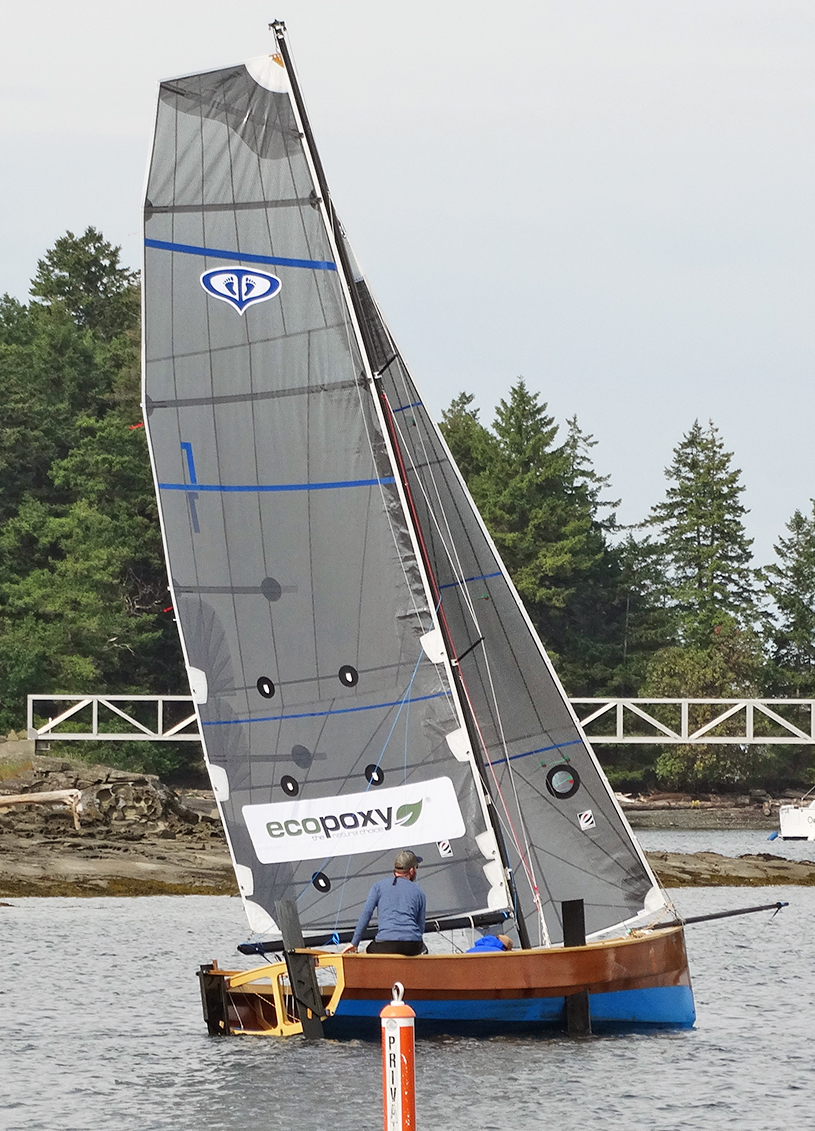
I chronicled the start of the Race To Alaska, R2AK, the 1207 km. (750 miles) slog from Port Townshend, Washington to Ketchikan, Alaska. The race is now finished with an attrition ratio of 25 DNF's vs. the 15 who were able to complete the course in the allotted one-month time-frame. Unusual for me, I monitored the tracker during the race, being particularly interested in how the large open dinghies (there were two of them, a Barefoot 5.8 built specifically for this race and a Mirror 16) would fare in this marathon. Not good as it would turn out. The Mirror 16 would drop out, and the Barefoot 5.8 would be the last to finish, 15th.
I can't resist a bit of Internet armchair race analysis here. (WARNING - this from a sailing dude, who likes to day race and sleep in a comfy bed, who last spent overnight on a sailboat decades ago and the closest I've come to the Seattle/Vancouver Island cruising grounds is Portland, Oregon.)
With an inaugural race, over such an unusual course of such length, the initial possibilities of what constitutes a successful race program remain wide open. After the race, the picture is much clearer. Now with the results in, we can safely say; to win the R2AK with the current course, pick a very fast trimaran around the 8 - 9 meter (25 - 30-foot) range, and then crew it with three experienced offshore racers who know the drill, and can keep the accelerator down 24/7. That is what Team Elsie Piddock, in a F-25 carbon trimaran did, and they surprised themselves and everybody else by finishing in just over 5 days. Multihulls over 6 meters (20 feet) long took 5 of the first 6 positions.
What type of experience wins the R2AK? Team Elsie Piddock goes over their sailing resume before the race.
In the sailing monohulls, a disparate set of keelboats finished on top of that division. A Hobie 33 finished 3rd after holding 2nd for most of the race but lost out to a trimaran that made up about 160 km. or 100 miles in about a day and half of open water racing. A day racing keelboat, the Etchells 22, with a crew of three, finished tenth. It would be interesting to see how much the Etchells 22 sailed versus rowed as they seemed to spend much of their time making their way up to Alaska in the narrow cuts and not out in open water. The upwind ability of an Etchells 22 is extremely good but there are none, nada, creature comforts.
And in another demonstration of the turtle winning out over the hare (in this case the purpose built Barefoot 5.8), a pocket cruiser-keeler, the Montgomery 17 of Team Excellent Adventure finished 12th. When conditions were bad, they hunkered down, when they were good they kept going and when they had a chance to recharge, they took it (looks like they spent two days in Prince Rupert drying out, getting a shower, enjoying the restaurants.). All in all, a very creditable performance.
What happened to the team I was pulling for; the Tad Roberts design Barefoot 5.8? Two things:
Three crew on a 5.8 meter dinghy added too much weight in stores.
The lack of stability of an open dinghy meant they couldn't safely keep the pedal down 24/7 so they pulled up at night. This negated the third crew, who was added so they could keep racing at night.
If the R2AK as an event keeps going, and you want finish it in a monohull sailboat under 6 meters (20 feet) the best path seems to be a keel type pocket cruiser with a crew of two. Of course, the type of sailor who already owns a pocket cruiser isn't one to think a 1207 km. race in colder and colder water would be any fun at all.
A tip-of-the-hat to the design and sailing team of Team Barefoot Wooden Boats. They didn't finish where they thought they would, but they did finish. The Barefoot 5.8 was an innovative and bold design. It was wood and can be home-built. For shorter distance races this would be a very quick monohull.
Designer Tad Roberts kindly sent along some photos of the build of the Barefoot 5.8 and some early pre-race debugging..
The Tad Roberts Barefoot 5.8 sail plan, Set on a tall mast, the sail area was quite big for this size dinghy. The initial plan was to reef early and often but I'm betting, if they had a choice, they would have changed to a shorter rig in the middle of this race. A very pretty sheer on this design.
The Barefoot 5.8 was built around the very substantial double-bottom grid. The sides would be added on later. Wood was 6mm. plywood.
Sides on. Deck on. You can see the kness that were used to support the top-side panels.
Open transom and double rudders a'la the French offshore machines. The Barefoot 5.8 used hi-tech leeboards to keep the double bottom open for rowing and sleeping.
The Barefoot 5.8 looks to be a very potent Everglades Challenge design. In that race, open dinghies of this size (I'm thinking of the Core Sound 17 and 20) can finish in just over two days. That seems about the right amount of time to drive an open dinghy 24/7 without completely boinking.
Here is a short video of Team Coastal Express in their Mirror 16. They slogged their way through the toughest parts, the Seymour Narrows and the Johnstone Straits, before deciding they couldn't afford the time to finish the race out. This video looks cold, very cold.
Mention must be made of the tenacity and persistence of the human-powered competitors that finished:
6th place - Team Soggy Beavers -Six paddlers in an OC-6 canoe (with ama)
11th place - Roger Mann - first solo competitor in a stock Hobie Adventure kayak/trimaran with Mirage Drive. Either you think this guy is Superman (he kept pushing 20 hours out of 24 for 13 days) or crazy-dumb (he almost lost his life twice, a pitchpole and another time he ended washed out but tethered to his kayak).
13th place - Team Boatyard Boys - two guys in a 17 foot Swampscott Dory, on which was added a small cuddy cabin. The original intention was to sail a fair bit but the windward performance was so bad they ended up rowing for most of the race
14th place - Mike Higgins in a 17 foot kayak. Yep, he paddled all the way.
Reader Mike Scott, who lives on the left coast, and was much closer to the action, added this comment which I've dragged over to the main post.
"I've been avidly following the race after being at the pre-race party, and getting up at 4am the next day to watch the start - which was set to the fanfare of the Russian National Anthem - quite bizarre, very stirring music, and typical Jake Beattie. I, too, loved the Barefoot Wooden Boat entry, and am hoping they might bring it up for the Wooden Boat Festival in September. Will be very interesting to see who and what enters next year - if it flies again. Much speculation on the 'perfect' boat, but as all depends on available wind and this year certainly favoured the speedsters, with a knarly Northwesterly blowing for much of the race......."
Almost three months ago, I wrote about the three major championships I sailed thirty years ago in August/September 1981. I wrote three posts about the 1981 International Canoe Championships that took place in August of that year but, again, in a bout of procrastination, I have yet to mention the other two championships.
In mid September, 1981, on consecutive weeks, I raced in both, the International 14 Team Races and, the International 14 Worlds out of Annapolis. I teamed with Bill Moss on his Kirby IV.
For many years leading up to 1981, the International 14 class had considered the Team Racing Championship as the defacto World Championship (oddly enough there was no perpetual trophy) but, by 1981, changes were afoot. The class had held it's first World Championship in Alamitos Bay, California in 1979. The 1981 Worlds was to be the second World Championship for the class and there was a strong movement to move the class towards amalgamating the rule with the Australian 14 class.
However, in 1981, the International Team Racing Championship was still THE prestigious event in the class, even though it was basically a three country, English speaking affair (the U.S having a West Coast and East Coast team to make it a four team round robin with England and Canada). The East Coast had never won the International Team Racing Championship but in 1981, with the event in home town Annapolis and having the reigning 1979 World Champion, John Gallagher, the East Coast team looked poised to compete for the top spot.
And we did eventually win the Team Racing Championship, but it was a difficult road as every one of us on the East Coast Team had a race where we totally screwed the pooch; for me it was one of the races against the West Coast where I tried to sneak inside at a mark without an overlap and got shut out by Baird Bardason. Extremely mad at my stupidity, I withdrew and crossed my fingers that we could pull this race out with only three boats....and we did. It seemed race after race, one of us would step up to save the team's bacon. It was an extremely hard fought series against the Canadians, there were a couple of protests that went our way but, in the end, we prevailed. The first and only East Coast team to win the International Team Race series.
Mug shot of the 1981 East Coast International 14 Team after one of the races......
From Left to Right; Chris Price, Eric Arens, Bill Moss, Tom Price, Paul Weiss, John Gallagher, David Gallagher, Rod Mincher
The World Championship the next week started with three days of a hard 20-25 mph Northwester blow. It wasn't if you were going to capsize, it was when you were going to capsize. I remember a hard reach right on the edge of control when the rudder stalled out and stayed stalled. The rudder was turned, there was a nice rooster tail but no control. "Hang on!", I yelled at Bill, "No rudder!" right before the 14 headed up and rolled over. The breeze moderated toward the end of the week.... Bill and I had a couple of good races to finish mid teens which wasn't too different from where I ended up at the International Canoe Worlds a month earlier.
Below is a photo from Annapolis rag, "The Evening Capitol". Crew were on the English team; Alan Fitzgerald and Nick Burgin.
From an email from English team member, Andy Fitzgerald.....
"Yes it's me and my crew Nick Burgin (who went on to sail a FD successfully with Roger Yeoman before pulling out before the Seoul Olympics, to be replaced by another 14 sailor Neil Mcdonald of round the world fame)........It was still in my mind the windiest race ever - we all hid in the lee of the supertanker and the race really started there. My introduction to the cut and thrust of team racing, not to mention the Canadians who were getting on top of their game."
John Evans, member of the English team, added this comment which I've dragged over to the main post.
"Yes, indeed , it was a memorable event in 1981 - as we not only had 25+knots wind for one days racing in the Worlds, but also an Annapolis "Buster" with hail, rain and thunder one evening - it stopped the Naval Academy Band from practising, which was a relief!
I won the windy day race, and did quite well overall.....Bob and Peggy Reeves hosted us.
Andy Fitzgerald raced with a guy called Nick Burgin...my crew was called Pete Barr, who knew all Baird Bardason daughters really well!"
Alan Laflin emailed his recollections;
"Eric A and I have owned 2 14s together since the 97 Worlds and raced it in the Totally Dinghy regatta in September. We're both 72 (me next week) and we won the Century Cup in England in 2008. First non Brits and the oldest combined age ever. The 1981 picture in front of the Naval Academy was just after we won the first race of the Worlds and went downhill after that. I think we were 2nd in the US Nationals part of the Regatta."
Eric Arens emailed this clarification about the photo below;
"The picture is left to right reversed as you can see in the Naval Academy. I forget the photographer's name, but he lived in Annapolis; and he reversed the picture so that it would fit on the fold-out cover of Sailing World's predecessor magazine.
Your note on the team races is very good in stating that each of us really messed up at some time or other. I got disqualified before the start of one race when I was on port tack. I still do not know how little room a boat tacking to port has to give a starboard tacker so that the starboard tacker cannot change course and bear down on the port tacker."
And Mark Adams added a comment which I've dragged over to the main post;
"I think the b/w picture is indeed of Andy Fitzgerald from the UK. I used to run into him in England on business and we would always talk about the windy day of the Worlds. We managed to make it 3 miles or so downwind in 30, then hung out in the lee of an anchored tanker while the RC set the course. We both agreed that it was the windiest day of racing we'd ever had in a dinghy. And I'm from San Francisco and he's from windy ole England. Oh and the photographer's name who took that pic of me and Chris, Alan and Jim was Bob Dollard if I recall correctly."
On the picture below, West Coasties, Alan Laflin and crew Jim Anderson (foreground) with Mark Adams and Chris Benedict (3rd in the Worlds) to weather, beating back to SSA after the days races. Photo from Sailing World.
And this article from "The Evening Capitol" fills out who made it to podium finishes.......
The following email is about some of the shenanigans that took place at the informal Team Race party. I missed the good bits because of a very pregnant wife. (I've tried to keep the players somewhat anonymous.)
"The relay race on the big lawn at Tom Price's house that resulted in Ed.... from Canada and me having to run against each other because the Canadians kept the $1 entry fee from each country and wouldn't pay up to the East Coast when we (East Coast) had won. Since the course included chugging a beer and stripping down to nothing at the far end of the lawn before returning, the opportunity was realized and taken to remove my clothes. Anyway, in the confusion we did not get the money. But justice was served, although years later. About the year 2000 I was at an airport in British Columbia getting ready to get onto a helicopter to go to a lodge in the mountains to back county ski for a week when I heard a call "Eric......" I looked over and saw Ed.... and immediately said "You owe me $10." He bought a round of drinks at the lodge, but the rest of the East Coast never did get rewarded for winning."
Bald but my eyebrows are growing at a prolific rate. Sailed Windmills and Y-Flyers in the 1960's. Founded Miami University (OH) sailing team. Sailed International 14's and Lasers in the 1970's. Sailed International Canoes in the 1980's to mid 1990's. Sailed Classic Moths since 2002. Enjoy boatbuilding though I'm very, very slow at it (the Internet doesn't help matters). Name in real life: Rod Mincher
After choosing this username (Tweezer is the name of my Classic Moth), further research on the Internet turned up that Tweezerman is a corporate name for a line of pedicure products. Let me emphasize that I do not work for, nor endorse these products.