Saturday, February 16, 2019

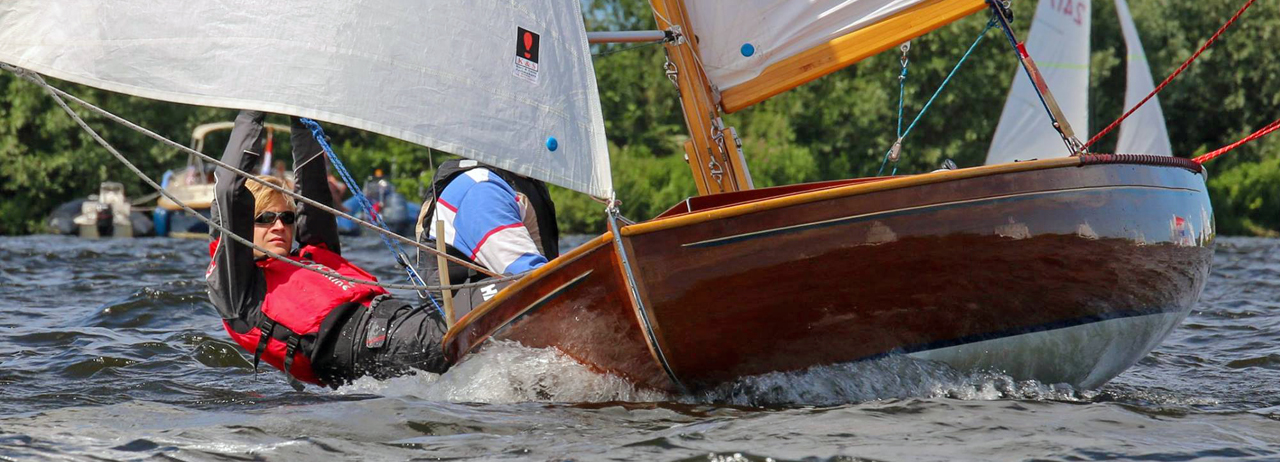
Header Photo: Gwen 12's at the ICWDR


Photos from the 2019 ICWDR (Inverloch Classic Wooden Dinghy Regatta) held over the Australia Day Weekend (January 26, 27 2019) have been filtering into Earwigoagin Central. The previous header photo features the Gwen 12 class, another Australian Classic Dinghy class that is making a concerted effort to find and restore old boats. Four Gwen's showed up at Inverloch with Grasshopper, the Gwen in the header photo getting the Best Overall Award. From Andrew Chapman:
"The Best Presented Sailing Dinghy was won by Rod Mackintosh’s Gwen 12 ‘Grasshopper’ sail number 2846. Rod... traveled from South Australia to sail with the other Gwen's. When he acquired the boat it was covered in thick green paint and since then it has been completely restored with clear finishes all over. The Inverloch and District Lions Club Perpetual for the Best Overall boat at the regatta, which is selected from the category winners, was [also] given to Rod Mackintosh’s Gwen 12 ‘Grasshopper’."


Kiwi Neil Kennedy offers up this description of the header photo in "Strine" slang. (It would be nice to have definitions for all this, but with second thought, we'll leave it all to the imagination.)
"As the Aussie's would say " Strewth cobber, ... here is a header photo of two "old Galahs" in a Gwen 12 thinking they were 30 years younger as they get set for a downwind blast. Of course 30 yr's ago they would have been lean and tanned, wearing a footy jersey and shorts, with bare feet, and after blasting around the bay, would have returned to the beach where they would have had two Shiela's in minimal bikinis equally tanned lying on beach towels waiting for their blokes with cold beers ready and waiting in the "esky" for the boys to "scull down" while they derigged and contemplated the evenings activities with the Sheila's, knowing that they were "good sorts" who liked a drink or two and with the usual approach of Aussie girls in that era " if you want a "root" to round out the nights entertainment "just ask !! I kid you not, I lived there for four years and I remember well; " with more than a smile or two."


A comment from unknown previous Gwen sailor:
"In Adelaide, South Australia first off-wind leg (Close Reach to Beam Reach), 1 nautical Mile long, 3 minutes with a decent wind or more. She sits on a dinner-plate size contact with the water. Water spews out the well (up to 1 metre) and straight over the stern transom. Oh and something hums! If you are not anticipating this kind of speed then you underestimate the Gwen 12's capabilities. It's a heavy weather specialist. You can still put up a kite when no-one else can."


More photos. No. 1905 is Wayne Fry's Scud IV.


No. 1941 is Toby Leppin’s recently restored 1960’s Gwen 12 Avenger. From Andrew Chapman: "Avenger won the Gwen 12 Challenge Cup. Toby sailed with crew Geoff Rippingale using the trapeze and setting the flat cut wire luff spinnaker...


Simon Wilson in Chaos Restored


Toby Leppin and Geoff Rippingale upwind.


Back in my International 14 days, when we saw such a relaxing photo, especially with the spinnaker being ready to be deployed, we said the crew was pausing to make the skipper a cup of tea.


I've commented before in Earwigoagin about the seeming complete die-off of the single trapeze performance dinghy - a puzzlement to this old fellow who remembers large fleets of Fireballs and 470's and Flying Dutchman in North America. (The 505 soldiers on but at an almost professional level.) I can't think of a better plywood project for a single trapeze, spinnaker dinghy than the Gwen 12.


From Drift Media, the 2017 Dinghy Show on the Glade. (I'm not sure this happened this year.)

ICWDR 2017 SEGMENT5 from drift media on Vimeo.


Apologies, but Andrew sent me photo attributions for these Gwen pics but I've mixed the photos up to the point I'll have to wait for Andrew to set me straight.

Friday, February 15, 2019

Music Whenever: Lord Huron "The Night We Met"


I've usually done a music video for Valentines Day - a day late this time. For the dark side of love, another bittersweet, lost love song; "I had all and then most of you, Some and now none of you"


I am not the only traveler
Who has not repaid his debt
I've been searching for a trail to follow
Again
Take me back to the night we met
And then, then I can tell myself
What the hell I'm supposed to do
And then, then I can tell myself
Not to ride along with you
I had all
And then most of you
Some and now none of you
Oh, Take me back to the night we met
I don't know what I'm supposed to do
Haunted by the ghost of you
Oh, take me back to the night we met
When the night was full of terror
And your eyes were filled with tears
When you had not touched me yet
Oh, take me back to the night we met
I had all
And then most of you
Some and now none of you
Oh, Take me back to the night we met
I don't know what I'm supposed to do
Haunted by the ghost of you
Oh, Take me back to the night we met


If you want a more upbeat love video I refer you back to Earwigoagin's archives.

Sunday, February 10, 2019

The "Punch" Dinghy design for the 1960's IYRU Singlehaded trials

While I am in the midst of covering some of the European Moth design history, mention must also be made of the entry of a Moth type, designed by Mothists Dunand and FragniƩre, in the IYRU singlehander trials of the late 1960's. (Three sets of trials, three different locations, Weymouth, England 1965; La Baule, France 1967; and Medemblik, Holland 1968, with the eventual winner being the Contender.) She was called Punch and it appears that she was initially designed by B. Dunand and then the project was taken over by FragniƩre for the last set of trials. Punch showed up at the second trials in La Baule and, with her low wetted surface, was the fastest over twenty three entrants in a light air regatta.

Looking at the sections of Punch, as she is turned over on the beach at La Baule, it appears she wasn't an extreme-V hull but rather a semi-circular hull. (The IYRU had initially specified the sliding seat as the only permisable hiking out aid, but allowed trapezes after Elvstrom showed up at the first set of trials with his Trapez singlehander. Still most competitors stayed with the sliding seat - with the exception of the Contender.)

Yachts and Yachting, September 29, 1967


For the last set of trials at Medemblik, surprisingly, Punch was well off the pace. Punch was hamstrung by a very high hull weight. The IYRU had specified hull weight based on sectional shape (a sort of scantlings restriction); the wider, deeper shape of Punch had to weigh more than the narrower, lower freeboard type such as the Contender. Three competitors, the Unit, the Jeton, and Punch at the weather mark at Medemblik:

Yachts and Yachting, June 7, 1968

Hubert Raudaschl, a Finn sailor, designed Jeton, which, in the last set of IYRU trials of 1968, took over the round hull-shape, low-wetted design mantle from Punch and finished second to the Contender. Below is a photo of Jeton at La Baule. She sported these weird set of folding seats that stored flush to the aft deck and individually swung out when needed. It was a feature that definitely would have needed to be changed out if she had been selected. In 1970, the Jeton hull was flattened out and re-purposed as a two man, main, jib, spinnaker dinghy.


Header Photo: The Dutch grote BM 16m2


Although I can't see the sail logo in this photo, I'm confident the previous header photo is of the woodie Dutch class, the grote BM 16m2. This is the second time I've done a header photo post on this class. You can read the first post on the 16m2, a post which has more background history. The 16m2 also features in a post I did on an unique method of recovering the 16m2 from the water to dry land.

I've also mentioned that the U.S.A. had their own version of the 16m2, the Celebrity class, now defunct. The Celebrity was built in fiberglass and had the more modern Marconi rig. From the 1968 One Design and Offshore Yachtsman sailboat catalog:


Saturday, February 2, 2019

Brewsabee: Another Narrow Waterline Classic Moth Design


Brewsabee is my own design, done in 2005 as a follow on to my original Tweezer design. The design brief was to better compete with the Mistral in lighter air so the waterline beam and wetted surface was pared down compared with the original Tweezer. I never built Brewsabee because:
  • After Tweezer, I was getting at the age where I wasn't sure I wanted to continue to flop around in a narrow waterline Moth. Plus winning races now wasn't the end-all/be-all of my sailing existence.
  • Building would be more complicated. Brewsabee would be best done in foam/glass, something I wasn't too familiar with.
  • I wasn't sure, given the generally light conditions we sail in here in the Mid-Atlantic, that Brewsabee would offer any significant performance advantages over the Mistral.
So I decided to put together a Maser, a flatter Gen I design, which was an entirely enjoyable Mothboat sailing experience.

I don't consider Brewsabee to be an extreme V design, but she is a narrow waterline design.

The Brewsabee has forward flares at the gunwhale, legal in the American Classic Moth Rules since the 1 inch concavity rule doesn't kick in until after the daggerboard trunk. Sections below the waterline were a very hard U forward translating to flattened semicircular at the back.

Again, for printing or downloading, use the upper right icon to pop it into another browser tab.


Couldn't help myself - a video of Tweezer (no. 92) when she and the blogmeister were able to get to the weather mark first in light air in one race of the Nationals. But, dog-gurn-it, the Mistrals were still able to run us down over the course of the race.


Wednesday, January 30, 2019

A Brief History of the Extreme-V Classic Moth

Moth Classique

The Swiss-Dunand Moth represents a radical design jump in Moths. Not seen before in Moths were the very deep V sections of the Dunand, married to high rocker, resulting in a very narrow waterline. It was a design type that was to dominate the non-wing Moth era in the mid to late 1960's. From an historical viewpoint, it would be nice to credit a designer or group of Mothies for the development, but it appears this slice of European history hasn't yet made it completely out to the English speaking world. From what I have been able to determine:
  1. The Swiss Mothies were the first ones to develop this shape as a light-air lake flyer. It became an all-around design in the Dunand version and Swiss Jean-Pierre Roggo would win the Moth Worlds three years running, from 1964 to 1966. Besides Roggo, other Swiss Mothies sailing the Dunand were Claude Barth, Dennis Weber and Hogg
  2. In the winter of 1966, Benoit Duflos designed his very deep-V version Moth and the Duflos would dominate Europe through the rest of the 1960's. The Duflos was tortured into a shape beyond what you could bend a single sheet of plywood and was built using a horizontal slit about mid panel each side.
  3. In 1970, Brit Derek Chester would design the Mistral as a version of the Duflos that could be tortured up. Although in the 1970's, the Mistral design didn't find great success in Europe, the Mistral became the marquee racing design in the American Classic Moth Boat Association from 1999 onward.
The lines of the Duflos: (again use the pop-out icon to print or download).


1960's Duflos on trailer (with typical buff body of all Mothies of that age).


Some questions about the early history of the very deep-V?
  1. Who was Dunand?
  2. In the Swiss fleet, was there some precursor to the Dunand design that showed the way or does the Dunand design all alone represent a radical leap of faith? My assumption is the Swiss were initially working off the Fragniere design.
  3. There is mention that Jacques Fauroux had a deep-V design in the early 1960's. Where does this design fit into the chronology?


Mention must be also made of Chris Eyre's Lucky Sixpence design of 1966. This was another chined deep-V design, though Chris was working with wings in mind and his design had much straighter topsides.


Fellow Moth historian, good friend, George Albaugh,

who lives just down the road put these comments up, with the blogmeister adding my two-cents worth. Other fellow Moth historians, Doug Halsey and John Claridge, chime in as well on this discussion.

One. GA: Warren Bailey's "Mach One" design (World's winner in 1954) had so much rocker in the keel that the forward panels had to be pulled up "pram" style and then a false pointy glass nose was grafted onto the boat to give the hull a sharp stem look. "Mach One" had a deep vee that was similar to that of the Mistral/Duflos and may have been deeper than the Swiss design. The Cates-Florida design is a very watered down version of Mach One.
Tweezerman: You make a good point that Bailey's "Mach One" might be considered the original extreme-V. It was definitely considered more extreme than the Cates version that came after the original - but how extreme? Extreme enough to be lumped in with these later designs? I think not, but we only have photos of the "Mach One" to pore over and when I think tamatoo, you think tomato. We do know the Swiss Dunand's came over in 1965 and thumped the Cates. Would they have done the same to the Mach One? It would be correct to say the "Mach One", the "Cates", and the "Fragniere" were deep-V but I don't think the "Mach One" is extreme enough to achieve the reduction of wetted surface these designs achieved.
GA: As for whether or not Mach One was a deep-vee, narrow water line boat compared to the Mistral, we'd need access to Warren's half model which his son George has, rather than my memory. I think the most dated aspect of the Bailey design would be the small, pinched transom--a feature replicated on the Cates-Florida design. The Mistral would plane sooner.

Two. GA: Duflos' boat was designed in '62 rather than '66. He tweaked the design in '72 to accommodate the the then newly adopted Aussie tall rig.
Tweezerman: This is where the history is somewhat muddied. I do have a design list in my archives, listing the Duflos as a 1962 design. I also have in my archives a history that lists the Duflos as a design done in the fall of 1966 and introduced at the Cannes Ski-Sail Regatta, April 1967. I'm going with 1966 for two reasons. If the Duflos was introduced in 1962 it should have been competing with the Swiss Moth and most likely winning. There is no record of that occurring. Also, Chris Eyre wrote a report of the 1967 Europeans where he mentioned the Duflos as a new design, at least new to the English. If the Duflos design had been out for four years by 1967, I don't think anyone would have considered it a new design.
GA: I have plans from Benoit Duflos dated 1962.
John Claridge:The first [Duflos] I saw in the UK was built for Bridget Quick, again by Bill McCutcheon, in I think 1966.
Doug Halsey: I also have plans from Benoit Duflos dated 1962, and a 1966 newspaper article (in French) referring to the 1962 date. Marie-Claude Fauroux sailed the Duflos at the 1966 Worlds in Lausanne and was extremely fast, but inconsistent. She won 3 of the 6 races, but was out of the top 10 in the other 3 and finished 4th in the final standings. (Lots of us, other than Roggo and Ganter, were very inconsistent.) Benoit Duflos and Jacques Fauroux were also there, but were not in the top 10 overall. (I'm not sure if Jacques was sailing a Duflos, or if he was there for every race though). I have newspaper articles with results of individual races, photos, and longer discussions (in French), and some shorter clips from the London Times, which I will scan and probably post somewhere when I get a chance.

Three. GA: The designer of the Mistral--a clever attempt to capture Duflos' elegant but difficult to build shape, using flat ply panels, was Derek Chester, NOT Merv Cook! The Mistral design went through two versions (we use the Mk II version here) and was followed by the Mirage which while mimicking the Mistral shape was much narrower. The Mirage required wings and even so was difficult to sail in a breeze. Few were built as faster narrow winged Moths like the Stockholm Sprite hit the race course at about the same time. The main appeal of the Mirage was that it was so narrow, one could get both hull panels from a single 4 x 12 sheet of ply.
Tweezerman: Busted on that one! I got to the end of writing the post and went with my faulty memory instead of fact checking. I've done the correction in the main post. I've tried to remain with designs that were done in the non-wing era. Below is the lines of a modified Mistral - the Y2KBug. The transom has been flattened on this mod


4. Four. GA:  I have never seen any of Jacques Fauroux's boats from the early '60s but several French designers beyond Fauroux and Duflos were building their own boats then. One of the unifying aspects of French and Swiss Moths of this era was the love of the free-standing or "Finn rig" mast. Later on, towards the end of the low aspect era, both Jacques and his sister Marie-Claude were racing Duflos Moths. Marie-Claude is one of two women to win the World's out right.


1971 Fauroux: Neil Kennedy, digging through his extensive yachting library of Nedslocker, sends along this design sketch of the 1971 World Champion Jacques Fauroux extreme-V Moth. For the 1971 Worlds Jacques had done a modified Duflos, with even more rocker than the Duflos and a more circular midsection. He had built her out of 2mm. ply at a hull weight of 22 kg. Width was 5 feet (1.52 meters) with 4 inch (.1 meter) gunwhales.

Seacraft Magazine, March 1972

Sunday, January 27, 2019

The Swiss Dunand Classic Moth

Moth Classique, 2018 Classic Moth Nationals

At the 2018 Classic Moth Nationals, for the first time in about twenty years, a hull design other than the Mistral won the Gen II class (faster designs). Joe Bousquet took a dilapidated Swiss Dunand Moth, (a fiberglass Swiss hull built by Fletcher Marine), rehabbed it with his signature tub cockpit, and proceeded to win easily in very light airs.

This is Blair Fletcher in the original plywood Swiss Dunand Moth he purchased from the Swiss after they won the World Championship in 1965 at Cape May, New Jersey.


As seen below on Joe's double-deck trailer, the Swiss Dunand (top) and the Mistral (bottom) share very much the same rocker line and the midship V-shape is also very similar. The differences are the Swiss Moth has much fuller bow sections, there is a topside chine on the Swiss Moth, and the stern is V-shaped vs. the semi-circular transom on the Mistral. The Swiss Moth also has more freeboard.
 

Joe pioneered the swoopy tub cockpit on the his first Mistral, Try-Umph, back in the late 1990's and put the same cockpit on the Swiss Moth. (Almost all the Mistral's built since have the same cockpit.)


Joe going upwind in as much breeze as showed up at the 2018 E-City Nationals. Joe had to sit much further forward on the Swiss Moth to keep the full bows in the water.


Another view of the full bow of the Swiss Moth.


Joe in Swiss Miss (2379), to the right of the Mistrals of  Mike Parsons (70) and John Zseleczky (111).


The lines for the Swiss Dunand Moth showed up on Louis Pillon's Moth website and are reproduced below. It appears that some anonymous Moth nerd has fed the Swiss Moth lines through some hull fairing program. If you want to print, use the top right arrows pop-out icon to put this into another tab on your browser.


See this post for Bertrand Warion's fiberglass Dunand variant.


2018 Classic Moth Nationals

George A. over at the Mid-Atlantic Musings blog did a three part series on the 2018 Classic Moth Nationals with plenty of photos. Click on the links below to read through his reports.