Showing posts sorted by relevance for query Lark scow. Sort by date Show all posts

Monday, July 28, 2014

The Lark Scow; the Laser of the early 1900's

Note:


In the winter of 1897 - 1898, American C.G. Davis designed and built a 16-foot chined scow for his own use. It was a simple build for that time, the hull copying the shallow arc bottom of the Clapham designed Bouncer (a designer Davis highly respected). Davis claims he designed the Lark scow as a general daysailor but, in 1898, he raced his newly built scow in the fifteen-foot class in several Long Island regattas and won. Sensing a great deal of interest in his little scow, Davis, at the time the design editor of The Rudder, printed the plans over three issues in the fall of 1898. The response was enormous and readership in The Rudder exploded. When you tap into a successful market, you keep going and The Rudder started a How-To series of cloth bound boat plans offering several different boats with the plans for the Lark advertised as "How to Build the Racer".

In the early 1900's the Lark scow was built everywhere, worldwide. Fifteen Larks were built at the Yokohama Y.C. Builders built to plans and those who couldn't help themselves built smaller Larks, bigger Larks, Larks with counter sterns. By the 1920's Lark fleets in the U.S. seemed to be concentrated around the Great Lakes. By the 1930's the Lark was disappearing as Crosby, a later editor at The Rudder, in 1931/32 introduced his own small sailboat design, the home-build V-shaped centerboarder, the 15- foot Snipe. The Rudder republished the plans for Lark in 1940 but by then, on the eve of World War II, the Lark was now in competition with several popular chined centerboarders available in the United States; the aforementioned Snipe,  as well as the Comet, Moth, and Lightning classes.

As far as I can determine, there is one Lark fleet remaining in the world (there are two Lark variants still going - I'll cover those further down this post). Rondeau Bay in Ontario, Canada (just across Lake Erie from Toledo, Ohio), specifically Erieau Y.C., has a fleet of about a dozen. The Lark fleet on Rondeau Bay got going in the 1930's.
From a comment by Don Weir on the Rondeau Lark builders: "I am proud to say my grandfather Fred "Pop" Weir and my Uncle Al built the fleet of them in Rondeau. I first learned to sail in one of them."
The Lark fleet at Erineau YC bucked the gradual extinction of the Lark by achieving its greatest popularity after World War II. In 1972 between 30-50 Larks were racing on Rondeau Bay. In 1963 Bill Kerr produced plans to build the Lark in plywood and the current fleet in Erieau Y.C has a combination of some new builds as well as restorations. They still retain the traditional wooden spars and have made the rig a gunter rig compared to the original gaff rig.

Lark variants still going strong are the Larken Klasse of The Netherlands, specifically Friesland, and the Monotype de Chatou of France. The Larken Klasse is a smaller Lark, a 13-footer singlehander with keel, a design that came out at the beginning of the 1920's. The Larken Klasse is the most popular of any Lark type today, the class experiencing a resurgence with upwards of 20+ attending regattas. The Larken Klasse sports a full battened, gunter rig that Manfred Curry popularized in the 1930's.

The Monotype de Chatou was a French variant that combined the Lark with the Linton Hope Sorceress design and was built at the beginning of the early 1900's. It is hard to see a direct connection to the Lark when looking at photos of the Monotype de Chatou as it appears to be round-bilged like the Linton Hope Sorceress and not hard-chined as is the Lark. Those still sailing, as far as I can determine, are restorations.


This ad comes from a 1901 issue of The Rudder. The plans for the Lark were so successful that The Rudder began a very popular How-To series at the turn of the century. They would also add another scow, the Mower designed 24 foot Swallow scow, the plans first published in the magazine and then a cloth bound How-To book.


A Erieau Y.C Lark. Nice varnish job on the deck! The fleet retains the wood spars. (Doug Kerr and crew in Sandhopper)


The Erieau Lark sports a gunter rig (the original plans called for a gaff). It still has a big mainsail for a 16 footer. (Stephanie Pirscher and Louise Marshall in Hangover)


One can get an inkling on the shape of the arc-bottom design from the shape of the transom. (Tug Worst, Jeff Graham and Jack Graham in Boweevil)


Compared to the original plans the Erieau Larks have elongated the cockpit (made the back deck shorter) and have changed the rudder design to improve handling. (John and Mackenzie Graham in Pinky II)


A photo of a the shorter Friesland;Larken Klasse stuffing her bow into a wave.


A photo of the French Monotype de Chatou. The dimensions are the same as the Lark scow but the design is round bilged and doesn't have a scow bow. Photo by Pascale Guittonneau.


Click here for the Swallow scow, The Rudder magazines second DIY scow. Plans came out in 1899.

Sunday, February 8, 2015

The Swallow Scow Plans: The Rudder Magazine's Second DIY Scow

The Rudder magazine launched their second scow, the Swallow, a 24 foot, three person scow in December 1898, just three months after they started publishing the plans for the 16 foot Lark scow. A year later, in the November and December 1899 issues of the magazine, they would serialize the Swallow plans, and like the Lark, issue a stand-alone plans and building booklet  The design is credited to Charles Mower but the prototype builder, Larry Huntington, was a renowned scow designer in his own right. I can't imagine that Larry Huntington didn't have a large say in the design of this scow so I personally would credit the design to a collaboration, a Mower/Huntington design.

As with the Lark scow, the Swallow proved very popular with amateur builders and was built around the world. Unlike the Lark, the Swallow didn't make it wholly into today's sailing scene. In looking at all the modern day scow designs, it appears to me that only the Sea Island One-Design seems to have inherited a large portion of her DNA from the Swallow. (The Sea Island One-Design ended up wider, particularly at the back end.)

For those who wish to delve further, you are in luck; the Library of Congress has scanned the Swallow plans booklet into PDF format.


Click here for the Library of Congress PDF scan of The Rudder plans booklet of the Swallow scow.


The following photos were harvested from The Rudder Swallow plans booklet. As always click inside the photo for a larger view.

The cover of the booklet.


The lines. The very shallow arc bottom was also the shape of Larry Huntington's Seawanhaka scow, Question, of 1895.


Two photos of the prototype on her maiden voyage in December 1898, The Rudder magazine editor Thomas Day skippering and Larry Huntington crewing. The day was cold and blustery.


Entering the harbor.


Group boatbuilding party planking the hull and flipping her rightside.


Compendium of launch and sailing photos.


Tuesday, August 19, 2014

Plans for the Classic Lark Scow

I've chunked together, into a PDF file, the plans for the Lark scow as published in Rudder magazine in the 1940's. It calls for a traditional build of the Lark but that doesn't mean you couldn't utilize modern technology and build it another way. To download the PDF plans click on the upward pointing arrow icon in the top right of the app bar. This will pop the PDF into another tab and you can print or download from there. Note that page 12 of the PDF file is blank.

Click here for the William Kerr plans and instructions to build the Lark scow.

Click here for the background post on the Lark scow.


For The Rudder magazine's second DIY scow, the Swallow, click here.

Thursday, August 20, 2015

The Larken Klasse: Another Modified Lark Scow Resurrected

As mentioned in my post on the Lark Scow - The Laser of the 1900's, Thomas Day of The Rudder magazine encouraged the home-builders of the Lark to be inventive; there was no strong concept of one-design strictness at this genesis of small sailboat development. So builders strayed from the plans, building Larks with yachty looking counter sterns, with cuddy cabins, longer and shorter Larks and they gleefully sent reports of their modifications into The Rudder and Thomas Day published them.

In 1903, in The Netherlands, W. Beekhuis, owner of the boat building yard "Navis" te Loosdrecht, built a small Lark, only 3.6 meters long (11.8 feet). He built them from the time period 1903-1905 but it is unclear how many he actually produced.

The 1903 Beekhuis Mini-Lark


In 1919, A Van Gool, from the northern coastal district of Friesland, The Netherlands, built a Beekhuis type Lark with additional modifications. Having traveled to America and observed American sailboats, Van Gool borrowed the Star type keel and grafted it on the Beekhuis Lark scow hull. He made the hull longer, 4 meters (13.1 feet). He replaced the squat gaff rig with a taller gunter rig. This Larken Klasse would become very popular in Friesland and Twente during the 1920's and 1930's.

The Van Gool/Friesland Larken


In 1934, Romke Vries designed an even higher aspect, full battened gunter rig for the Larken Klasse. By the end of the 1930's the more modern O-Jolle singlehander centerboarder was cutting into the Larken Klasse numbers and, as the Finn dinghy and OK dinghy were introduced after World War II, the class continued to lose popularity. In 1965, the class made its last appearance at Sneekweek, seemingly destined to fade into obscurity.

That is until 2004 where a group of Larken Klasse enthusiasts banded together to start restoring the old Larkens and build new ones. In the short span of 11 years they have built the class up to where they are now getting a vibrant 20+ turnout at the major regattas. An amazing resurrection of a true classic!

The newer Larkens have adopted a more modern keel with a separate rudder. The lead ballast is 34 kg.


The present day Larken Klasse on a reach (Anyone know who the photographer is?)


A vintage photo of a happy Larken skipper.


At this years Sneekweek regatta, artist and small boat racing enthusiast, Jan Tekstra decided to jump into a different class each day and record his race on a GoPro. This is his Larken segment.


Acknowledgement: All of the history of the Larken Klasse was taken from this article by J.K Kuipers


As I was tossing this post around my brain, the German Segel Reporter beat me to it by about two weeks and brought out Michael Kunst's post on the Larken Klasse.

Tuesday, January 20, 2015

Boatbuilding: Lark Scow - Part 1

Other posts on the Lark scow.


Peter Gilbert of the Erieau Lark fleet in Canada has started a new Lark scow (named Pinky Too, his Dad built Pinky 2 and Pinky 3) using the Kerr plans. He sends along some photos. The Kerr plans follow the original C.G. Davis plans in using a lot of frames. Instead of sawn frames, Peter has laminated the arc sections. He is planking the bottom of the Lark with plywood but with a hi-tech twist; he is using 3mm plywood with a carbon fiber sheathing (I wonder how this will square with the Erieau Y.C fleet as Peter's construction may possibly result in a Lark considerably lighter than the current boats.)

I like how these builders determine fairness using a full glass of beer as a sight-line.


The solid timber side planks hold everything together before the bottom and deck goes on.


Monday, January 11, 2016

Peter Gilbert's Lark Scow Goes Racing

Peter Gilbert, who, in previous posts, Earwigoagin documented his build of the Lark scow, sends along a video of the new Lark in the water and racing at Erieau Y.C. The season for Pinky Too was up and down, a not unfamiliar scenario for a new racing craft. From Peter...
"The racing season was mixed. I had very high expectations and Pinky Too was finished and polished very well. Unfortunately I didn’t take into account the difference in weight relative to the standing rigging. This led to an entire season of tuning and adjusting. Adding to the frustration was Pinky Too’s performance during certain points of sail. She was untouchable at times but I could not point with the rest of the fleet. As a result the races were filled with both hope and despair. I’m also a little rusty…..
It is heartwarming to see a new one of these pre-1900 designs hit the water.


The history of the Lark Scow.

Sunday, June 4, 2017

Header Photo: Monotype de Chatou


The previous header photo was of Louis Pillon and his restored Monotype de Chatou. The Monotype de Chatou was a French follow-on to the American Lark scow, the Lark being originally introduced to France as the Monotype de Dinard. Designed in 1901 by Francois Texier, the Monotype de Chatou featured soft bilges rather than the boxy, chine shape of the Lark and the wide scow bow of the Lark was pinched in. The Monotype de Chatou was France's first popular dinghy with over 100 being built.

The drawing below is from the Wikipedia entry on the Monotype de Chatou.


A photo of the three of the original French build of the American Lark scow, the Monotype de Dinard.


Chatou was a western suburb of Paris, fronting the Seine River. There was a yacht club on the narrow island where the fleet of  Monotype de Chatou's were moored. From Google Maps.


In 1906, the French painter, Maurice de Vlamink, painted this scene (in the style of Van Gogh). Painted from the vantage point of ÃŽle de Chatou, it is likely the moored sailboat was a stylized Monotype de Chatou.


A rescue performed by a Monotype de Chatou. I'm not sure if the swamped vessel is another Monotype de Chatou. If this was a romantic Sunday sail, I would bet the lady being dragged over the gunwhale by the rescuers didn't bargain on being completely soaked by this mis-adventure.


Sunday, June 28, 2015

Larry Huntington, his 1895 scow "Question", and the first Seawanhaka Cup competition

I've bracketed the 1890's in several posts tracing the history of the development of the racing scow. In 1890, at the beginning of the decade, Thomas Clapham introduced the first racing scow, Bouncer. At the end of the 1890's, Thomas Day and The Rudder magazine introduced the scow to the workingman sailor, with the publication of easy-build scow plans; first the 16' Lark cat-rigged scow designed by C.G. Davis in 1898 and, shortly after, the Swallow, a 24' main and jib scow designed by C.M. Mower and Larry Huntington. In 1895, in the middle of this decade, the first International Seawanhaka Cup commenced competition and over the next ten years, in this yearly pressure cooker of constant design development to win the cup, this odd-ball type, this "barn door" of a boat, dominated the racing and forever carved out a niche in the yachting scene that flourishes up to the present day.

In 1895, Larry Huntington, a twenty eight year old boatbuilder out of New Rochelle, New York, would enter his simple, crude-looking scow Question, in the trials for the U.S. contender to race Britain in the first competition for the Seawanhaka Cup . Although Huntington didn't win (W.P. Stephens in his conventional centerboard design Ethelwynn would win the trials and then successfully defeat Englishman William Brand racing another heavier, conventional centerboarder, Spruce IV to secure the first Cup win for the U.S.), Huntington demonstrated, during the 1895 season and during the Seawanhaka trials, that the scow was dominant in any breeze. Huntington re-emphasized what Thomas Clapham had proved five years earlier with his Bouncer, the scow was an ingenious rule-beater racing under a Seawanhaka Rule that penalized waterline length.

In a controversial move, Larry Huntington, with his brother Lev steering, shadow raced Question against Ethelwynn and Spruce IV in race four of the Seawanhaka Cup. There was a good breeze and Question handily out-distanced both of the actual competitors in the cup. W.P Stephens, with some justification, later complained about this stunt in Forest and Stream but the die had been cast. Observers at the Seawanhaka Cup, including the Royal St. Lawrence Y.C., took note and the next year all the top contenders had scow types including U.S designer Clinton Crane and the  Canadian design, engineering, and sailing genius, Herrick Duggan. Herrick Duggan, representing the Montreal club, Royal St. Lawrence Y.C., would come to dominate the cup competition in his scow designs over the next six years.

Larry Huntington would continue to design a series of well regarded scows for the Seawanahaka Cup competition both for him and his brother, and for other customers, though none of his designs were able to win the trials to represent the U.S. in the Cup competition.

Not surprisingly, in today's yachting history, Larry Huntington is best known, not for his scows, but for designing and building the offshore keelboat, Tamerlane, to win the first Bermuda race in 1906 (he designed and built two out of the three original competitors in 1906, the other Huntington design being Gauntlet).

A photo of Larry Huntington from Yachting magazine.


The half-rater Question as sketched by C.G. Davis. By 1905 Question had been converted to a motorboat with a boxy cabin-top (top right of sketch).

Larry Huntington estimated his cost for getting the simple chined Question built and in the water at $245 (he charged his labor at normal shipwright wages). The Rudder magazine figured this was 1/6 the cost of the other Cup racers.


Paprika was Larry Huntington's refined scow design as a follow-on from Question. Built for the 1896 Seawanhaka Cup trials, the hull was round-bilged


Below are the lines to the mysterious American scow, Maika Maili, that was imported into New Zealand in the mid 1890's and formed the basis for the New Zealand famous Patiki class. There is a very strong resemblance to Huntington's Paprika design but, at the present time, I can find no confirmation that Huntington exported one of his scows to New Zealand


Wednesday, June 24, 2015

Boatbuilding the Lark Scow - She's Finished!

Earwigoagin covered the beginning stages of Peter Gilbert's building of the Lark scow and now Peter sends along photos of wrapping up the build, the fitting out, and first sail of Pinky Too.

From this perspective, the photo of the curvaceous deck with white primer looks like a spaceship ready to beam up into the light field.


Racing stripes on the deck. Now that's cool!


Floorboards look to be simple pine lath strips.


Nearly the whole Erieau Lark fleet showed up to get over the final hump of fitting out. Beer included.


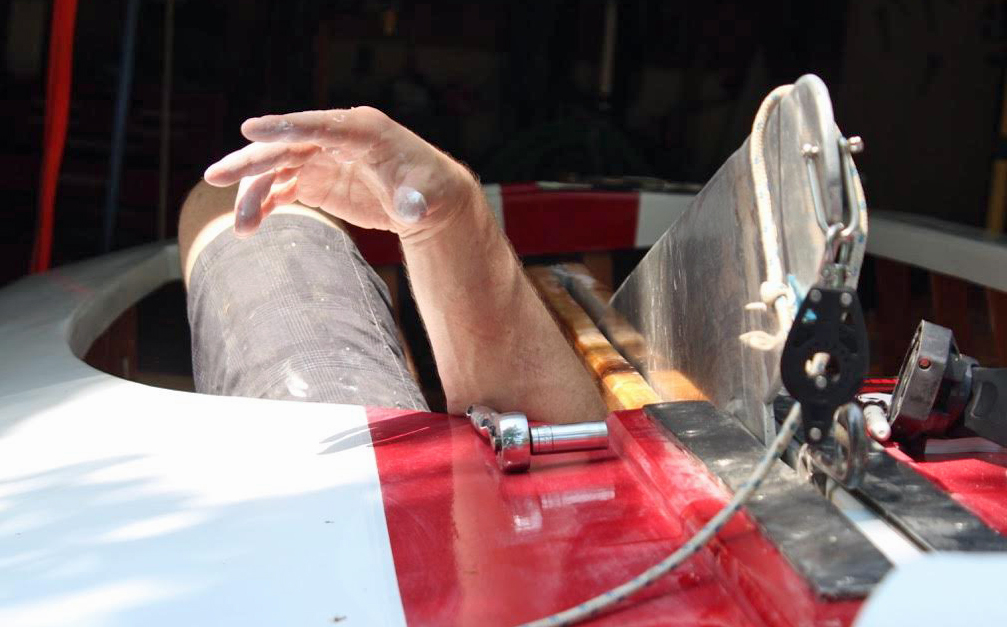
Been there, done that! The blind search for the socket while you hold the nut and washer on underdeck bolt.


Sail up. Fittings still piled about the bow. The classic looking sail was made by The Sail Loft Marine Store in Barrie Ontario.


Given the smile on the face, looks like everything is holding together on the first sail of Pinky Too


First race is this weekend, but now, time for the brother build team, Peter and Scott, to enjoy a glass of bubbly and celebrate a job well done. (One of the features of the scow, at least the larger ones, is that one or more can stand comfortably on the bow.)


Monday, January 5, 2015

Lark Scow Plans: Instructions and Drawings by William Kerr, 1963

As I mentioned in my original post about the 1897 Lark scow, Bill Kerr redrew the plans for the Erieau Y.C. fleet in 1963. All the new Lark builds at Erieau Y.C. follow his plans. Peter Gilbert from the Erieau fleet has kindly sent along the Kerr plans. I chunked them into two PDF files; an instruction manual PDF and a drawing PDF.

Note: Click here for the 1940 Rudder plans.


The instruction booklet: (Click on the upward pointing arrow "pop-out" icon on the top right of the menu bar to open the PDF in another tab. From that tab you will be able to print or download the PDF.)


The Bill Kerr drawings including sections: (Again, use the pop-out icon to open in another tab.)


For Rudder's second DIY scow, the Swallow, click here.

Thursday, November 20, 2014

Crosby "Skimmer" Moth


The original Rudder article with plans for the Skimmer can be found here.


I got an email from Chris Museler mentioning that his friend had picked up an old Classic Moth on Cape Cod. It turned out that his friend, Yarrow Thorne, of Rhode Island, had acquired a very unique find, a Skimmer type Moth designed by William Crosby in 1933. Crosby, the editor at The Rudder magazine, had designed the deep-V Snipe in 1931, which was published and heavily promoted in The Rudder. Now in the heart of the Great Depression, Crosby designed an even cheaper and easy to build sailboat in 1933, this being a catboat to fit the open 11 foot rules of the Mothboat class, a class only a couple of years old but proving to be very popular. Captain Joel Van Sant out of Elizabeth City, North Carolina had built the first Mothboat, Jumping Juniper, in 1929.

As with the Snipe, Crosby published the plans for Skimmer in The Rudder. Unlike the Snipe, the Skimmer was a very shallow-V scow design with no cockpit - a true sit-on-top dinghy. As the publication of the plans for the Lark scow in The Rudder in 1898 would have enormous international impact on small boat sailing, the publishing of the plans for the Mothboat Skimmer would also have a similar international impact. Len Morris, of Australia, had designed an 11-foot scow in 1928, a class he called the Inverloch 11-footer until he saw The Rudder article on the Skimmer and decided to change his class name to the Moth - after all his design was also an 11-foot catboat, a similar scow-type and what was the chance the Australians and American 11-footers would ever get together to race?

The Europeans, particularly the French, started to build Skimmers which formed the beginning of European Moth class. Here is a photo, courtesy of Louis Pillon's Moth article Part 1, of an early French Skimmer, this time built with a cockpit. Click here for Louis Pillon's Moth article Part 2


Considering the historical importance, a Skimmer should definitely be in a museum collection such as Mystic or The Mariners Museum.

Yarrow says his Skimmer Moth was built in plywood which puts the build date as possibly late 1930's or, even more likely, WWII or just after WWII.


Double shrouds, high spreaders, a jumper-strut on a wood mast is very typical of the state of American Mothboat rigging before WWII.


This Skimmer came without a sail, centerboard, or rudder. Yarrow was able to fit a Penquin sail on the spars.


Yarrow was able to cobble together the whole package and race this November in the 2014 Archipelago Rally free-for-all race. In 2014 terms, the lack of cockpit and the low boom position on the Skimmer do not make for comfortable sailing (as we see below with Yarrow painfully kneeling on the deck - wondered what the tacking procedure consisted of - a belly crawl under the boom?). Considering that many builders of The Rudder sailboat plans had no compunction about modifying  the designs, I'm sure many Skimmers were built or modified to have cockpits. (But low freeboard scows like Skimmer were very wet and American Mothboats started evolving with cockpits but also higher, roundish torpedo decks to shed the water before it got to the cockpit.)

Yarrow sent along his impressions on his first sail in the Skimmer.
"The boat was very balanced, the sail was wrong and the tiller was too long, not allowing me to sit far back, I still need to learn how to sail but was very surprised to launch and sail within minutes for 1st time in over 30 yrs. The boat pointed OK in 20 knt's with chop, it liked the center board up a bit and I did not load the orig[inal] rig very much ;). but down wind WOW, it's a surf board and loves to have the nose even with the water, but if you get it wrong it buries the nose to the trunk in a heart beat.
This photo, lifted from the Internet, courtesy of Rufus Van Gruisen.