Friday, April 1, 2022
Music Whenever: Mega Bog "Station to Station"
Found this on my son's playlist. Dreamy. I think it's about a breakup but not totally sure.
Friday, March 11, 2022
Music Whenever: Portugal, The Man "What Me Worry"
I haven't posted a music video for three years but with all the sh%#@t going on, this one seemed most appropriate.
The Alfred E. Neuman Wikipedia page.
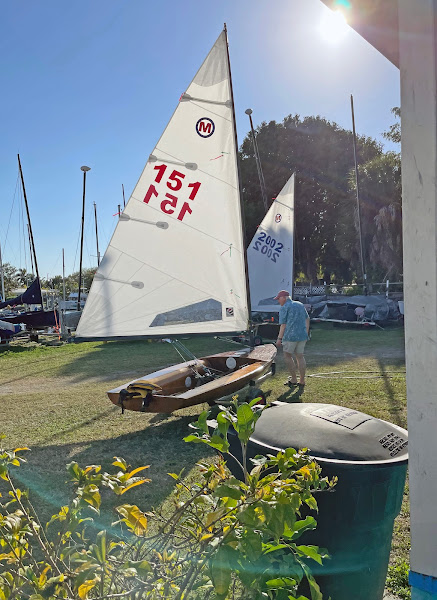
2022 Classic Moth Midwinters
John Z went off down south for the Classic Moth Midwinters and relays the news. Weather was beautiful in Gulfport, Florida; sunny 80F (26C), light winds in the morning with the regular breeze clocking in for the afternoon. Nine Classic Moths showed up with the CMBA resident professional and all-around nice guy, Jeff Linton, again making off with top honors. Shore photos are from John Zseleczky and on-the-water photos from Amy Linton (which I have converted to black and white in my own fashion).
(George Albaugh has his more extensive Midwinter report up on his blog.)
George Albaugh with his wooden Europe on the Gulfport YC dinghy lawn.
Greg Duncan rigging his glass Europe.
Jamey Rabbit with no. 134, his new modified Mistral design. Jamey had teething problems on Saturday but came back strong on Sunday, posting 1st's and 2nd's. Jamey started this project back in 2015, seven years to completion, which is getting into my extended time frame for boat projects. In the photo below, you can definitely see he pinched in the topsides up forward. (Compare to the standard Mistral shape of Joe Bosquet, no. 48, in the background.)
Jamey Rabbit rigging. His new Classic Moth has carbon bits and bobs all over the place. The aft deck looks like you could launch drones off it. Jamey documented his Classic Moth build over at his Blackberry Boatworks blog.
John Z motoring upwind. John would finish 2nd to Jeff in Gen II.
Mark Saunders in his modified wood-redecked Europe giving Jamey Rabbit a run for his money. Mark would win the Gen 1 division.
Mark Saunders in his Europe upwind. From this angle looks very similar to my Maser. I've been looking at film photography recently and somehow I rendered this photo in Photoshop very much in the ethos of Japanese street photographer, Daido Moriyama; very contrasty with bright highlights and darker darks.
A start. Jeff Linton, no.102, has already got a nice jump on the fleet.
Mike Parsons catching up with Rod Koch (the other Rod). Rod, along with Jeff is a past Sunfish champion. Rod raced a modified Europe back around the 2010 time frame.
Joe Bousquet holding a slim lead over Jeff Linton at the reach mark.
Mark Saunders in his Gen 1 Europe holding off the faster Gen II Mistrals of Mike Parsons and Joe Bousquet.
Friday, July 9, 2021
Header Photo: Firefly Upwind
The previous header photo was one of the late 1940's, 1950's hot molded Fairey Marine Fireflys being muscled upwind by a very intense crew. A great photo!
My small legion of dedicated readers may have noticed a distinct disappearance from blogging over the last six months. A major contributor was virtual teaching. After a day of sitting in front of a computer, many times talking to the great void, I had no desire to keep hammering on the keyboard after hours. The second and more important reason is my paucity of sailing over the last two years. It is hard to blog about sailing when you aren't doing much of it.
Some more photos of the 3.65 meter Uffa Fox Firefly collected mostly from FB.
Sunday, February 28, 2021
Prada Cup Over; America's Cup postponed this week.
Before the Prada series started, I wrote a somewhat negative piece about the new AC75 foiling monohulls. Well after watching the Prada Cup, what do I think now. (In no particular order.)
- These foilers are maneuverable. These are the quickest Cup class ever in the tacks, jibes, and mark roundings. Essentially you are spinning around on two, sometimes one narrow pivot point with no boat in the water (if you do it right)..
- These courses are narrow. After the start, the time to the boundary is equivalent to what you would see in a collegiate or frostbite short course. It does help in keeping the boats close, at least in the beginning. The start and the first tack become crucial.
- These boats are mega-complicated. Looking in from the outside, we probably only know about 1/10 of what is going on in getting these boats around the course.
- A key indicator of which team will win is probably the team with the best software integration. How accurate and responsive are your controls, which for the most part depend on computer control. Ineos UK remarkable turnaround from being the dog of the Practice series was attributed to a huge upgrade in her software control.
- It looks to be another blow-out win in this America's Cup. If the Prada Cup competition is any indication.
- Does the 40 kt. speed make for a better viewing experience? For me the jury is out. I'll wait for my wife to chime in.
Sunday, February 7, 2021
Header Photo: The New Zealand "Zeddie"
The previous header photo was of the New Zealand Z class, affectionately known as the "Zeddie". This photo was part of a collection of New Zealand dinghy photos taken by Arthur Victor Buchanan during the 1950's and put online by the Auckland Libraries. This is Z-27 "Dawn" ripping it under the shy kite; the header photo is a cropped version of id 6D-007 in the Auckland Library collection.
"Zeddies... this Dawn Z 27. [The] only known sailing reference [to her] was in the 1953 Auckland Anniversary Regatta sailed on the last Monday in January each year (public holiday to celebrate the founding of the Auckland Province) which certainly was the biggest one day regatta in the world of its type. Everyone who had a yacht sailed on that day; for many it was the only race they competed in every season. Dawn was sailed by a J D McKay and crew and was only giving time to the scratch boats (1%) time allowance in the A division Z class fleet...
"The photo is taken off Devonport on the North Shore side of Auckland harbour and she is heading down towards North Head,... broad reaching in 12 to 15kn south westerly, with gusts up to 18 to 20 kts, which are a feature of Auckland Harbour. She has clearly caught one, screaming, hike-out and hang-on rides in these typical Auckland conditions. The road in the background is the Waterfront drive that goes to the Eastern Suburbs. Incidentally setting and gybing the spinnaker, could be pretty exciting in a fresh breeze as once the nose [of a Zeddie] went down they could be a real handful. (Hence the large "splashboards" running back from bow to aft of the side stays, which saved many a crew from a spectacular capsize.)...
"The dimensions of a Zeddie> Length 12ft 6 in., Beam 5ft 0 in., Depth 1ft 4in., Sail area (originally a gunter main) 110sqft, Spin 60 sq ft single luff, spars solid oregon Mast 11ft 3in Gaff 10ft boom 12ft 3in spinnaker pole 9ft 3in , Hull construction planked Kauri or Kahikatea (white pine) seam batten with sawn frames and canvas covered decks. The Zeddie would have been close to 300lbs hull weight at launching, so to get her up and planing like that shows the power of the rig. Crew two, under 19yrs. Yes girls did sail on them in small numbers too at club level. How many were actually built in Auckland is hard to know but sail numbers reached 200 on the Auckland register, and given number reissues (a common practice) and the fact they were sailed all over NZ, a probable estimate is around 500 NZ wide so they were one of the biggest small boat classes in NZ , until the arrival of the Cherub and the NZ Moth ( MK II) .
"While they were adequate to windward, they were essentially a "down-wind" boat and the stories of John Spencer (who started in Zeddies) of slogging for miles to windward just so they could enjoy a wild ride down wind are legendary. This is part of the heritage that made NZ yachties such great downwind heavy weather sailors.
"Note a couple of things: The skipper has no tiller extension, although they started to appear from 53 onwards, so good skippers developed long arms... The hiking straps were made from rubberised machine belts (discarded or 'borrowed" from machinery factories) and were quiet common.(Canvas ones had a tendency to rot and suddenly give way.) At the bow chain plate what looks like a "horn" sticking out is in fact a piece of folded 'hose" designed to catch wayward spinnaker sheets or even spinnaker pole braces from getting under the boat during setting/dousing or gybing, particularly with the single luff spinnakers... There were separate guys (port and starboard) which were shackled to the sidestay at the deck then run through a snaphook at the end of the spinnaker and back to a horn cleat on the deck aft. Some boats just had cleats others had bullseyes in front of the cleat as well. Spinnaker work was deemed a premium skill for a forward hand and the best could set and gybe a spinnaker in 15secs or less. Bailing out excess water was done with a large tin can and shirts, football shorts, lifejackets (sometimes an oilskin jacket) were the standard crew attire all year round... You had to be fit, hard and tough or you soon learnt to be.
The Zeddie was designed in the 1920's; among a group of flattie dinghy designs born of the Great Depression; including, in the U.S.A; Comet, Lightning, Geary 18, the Australian VeeJay, the French 9m
Wikipedia entry for the Zeddie
Monday, January 18, 2021
Header Photo: Peanut Class, Arnold Johnson, and Boat-Tinkerers
The previous header photo is of the Peanut class singlehander (in this case Peanut #1, Charlie Brown), a plywood DIY dinghy designed by Arnold Johnson in West Islip New York. The class grew to around around 400 and then faded in the 1970's. There is a nascent effort, led by Jeff Moses, to restart the class. I've been posting about the Peanut over here.
The designer of the Peanut, Arnold Johnson, represents the engineer boat-tinkerer, a group that was especially prevalent during the 1960's in the United States. Phillip Johnson, Arnold's son, shares some biographical history of his father, and, as a homage to that era of the 1960's engineer/boat-tinkerer, I re-post it here.
"My dad went to Brown University (born in Hamden CT) and worked at Grumman Aircraft in Bethpage NY while we lived on Long Island. He was an aeronautical engineer and did a lot of wind tunnel work on airplane wing design. After Grumman, he worked at Sanders in Nashua NH for a few years then worked for Boeing and Lockheed and then at Northwind energy designing windmill turbines. He was also an avid photographer, something he passed on to all four of his children. He died in 1993 of colon cancer. He built several Peanuts (#1 and #2) and bought #7 for me and experimented on that boat the most. We raced the Peanuts, the Skylark and later on an Aquarius 23 in the Great South Bay area."A list of Arnold Johnson's projects:
- 1957 - Designed and built a 14' (4.26 meter) modified scow, sloop rigged.
- 1960 - Designed and built Skylark I, at 20.5' planing sloop.
- 1961 - Designed and built a keel with trim-tab for Skylark I. Had boundary layer trips and vortex generators. Later on this heavier keel was modified to a 90 lb retractable keel.
- 1962 - Designed and built the 9.5' (2.9 meter) Peanut singlehander
- 1968 - Redesigned the Narrasketuck sloop for construction in plywood.
- 1970 - Designed a 38' trimaran ketch.
Arnold Johnson's Skylark I, a 20.5' (6.25 meter) 6mm plywood sloop which he constantly modified and raced handicap in a high performance division on the Great South Bay.
Saturday, December 26, 2020
New Plywood Cherub Build
These photos of a plywood Cherub build in New Zealand crossed my Facebook feed. A plywood Cherub is a rare beast. As is the fashion these days, most Cherub's are built of more exotic composite materials. New Zealand, the home of the famous Kiwi designer, John Spencer and his Cherub class, has seen a recent revival of the class; the class being moribund since the 1990's. As I've mentioned, buried in an old post; I raced one weekend in an English Cherub regatta in the 1970's. (Back when the design fashion was a deep V carried all the way to the transom.) I've always had a soft spot for these 12' double-handers (the original single wire, wide Cherub, not the two wire, rack version the English cooked up to compete in their Portsmouth handicap racing).
This blog has sprinkled various Cherub antics throughout posts over the years.
This build uses 4mm plywood throughout. Minimum hull weight is 51 kg.
A modern Cherub upwind in max power conditions.
For a modern day source of Cherub plans, Alan Roper writes:
"In regards to the cherub it depends what you want .Greame Hill has a hull kitset I have designed. ...There is another boat I designed to he built of stitch and tape system and there is another one built of conventional methods. The latter 2 have paper plans.
Header Photo: Design Cartoon for a Bend-em-Up - Classic Moth?
The previous header photo was a design cartoon kicking around the Interwebs. There was no explanation attached but, if I engage in a bit of speculation, it seems to be a developed ply concept for a Classic Moth. Bill Schill did his last Maser conversion very similar to this, a radical looking Moth. Bill's Maser concept was very slow. Unfortunately, I have no photos of Bill's last Maser. It seems to me you could build a credible Classic Moth if you glommed some topsides onto the back half of the boat. It would take some tinkering; should be an easy build, though probably not a racing shape.
George A. has more on Bill Schill over at his Mid-Atlantic Musings blog.
Update: January 18, 2021 - It turns out this design cartoon was actually built. She is a Classic Moth design by Bertrand Warion, a prolific builder of Moths, whose design and building inventiveness has been featured in many posts on Earwigoagin. Bertrand writes of this bend-em-up design;
"The Moth Classique is "Zazou" I designed in 2002/2003? The boat was made from one sheet plywood, 5mm exterior grade. [It] was easy [to build] and quite fast but the mast was not stiff enough. [She] is now destroyed. [There] is only one photo remaining."
Zazou is Moth number 203 to the right of this gaggle of classic Moths running downwind.
Tuesday, November 24, 2020
Header Photo: Jester Dink Racing; Jester Designer/Bulider Identified
Before reading further I suggest you refer to this post for background.
The previous header photo features 8 foot Jester dink racing on Santa Cruz harbor. I particularly like the bare feet draped over the leeward side, a throwback to when I was a young kid and spent my entire summer barefoot.
Now to the other Jester class, the twelve foot, sloop rigged daysailor. In the previous post I couldn't find anything about the origins of this class on the Internet. Now thanks to reader Bob Fujita, the mystery is solved. From Bob's comment on the previous post:
"The Jester was designed and built by Cleveland, OH Sailboat dealer Jack Butte. Jack sold primarily one design daysailers, and saw an opportunity to use the influence of the Thistle, Flying Scot, and Rhodes Bantam to design a 12’ dinghy. My parents sailed with Jack Butte at Edgewater Yacht Club, and I sailed with his daughter as part of the junior sailing program"Bob sends along advertising brochures for the Jester, listing Glas-Tec Enterprises as the builder.
A primo-condition Jester 12 footer somewhere in the Midwest. Nothing racy here, just a capable daysailor with high freeboard and bench seats.
Thursday, November 12, 2020
Flat Pack Composite Kits
Flat pack plywood small boat kits; all pieces CNC cut and shipped to you in a nice long box (or two) have been around since the mid 1990's. The local firm, Chesapeake Light Craft is a world leader in this type of kit, offering a wide array of plywood small boats in kit form; built stitch and glue with epoxy fillets. Back in 2014, Aussie Mark Hughes took the flat pack kit concept one step further and developed a composite carbon/foam flat pack kit for super-techy ultra-lightweight construction. In the photos below the flat pack kit makes a Bunyip scow Moth. Todd Oldfield, posted on Facebook on his build, which I have lifted and re-posted here.
The jig is CNC cut from MDF and is an intricate web of slotted panels designed to hold the frames.
Frames, topsides, and chine panels are cut from prefabricated vacuum-bagged carbon skinned foam. The Perverted Moth blog has the layup schedule for the Bunyip panels.
Jig assembled.
CNC cut frames in place on jig.
Topside and chine panels taped in place.
Fitting the bottom foam panel. The bottom foam panel is not glassed on the outside.This may be because the entire outside of the hull is covered in a wet/layup carbon layer to stick everything together.
Carbon ready to wet out.
Outside of the hull complete on jig.
Hull off jig. I would think there would need to be more gluing area along the gunwhales and maybe along the frames
Fitting the foam deck and foredeck. Note the cuts to help the foam bend around the curves for the nose block. A heat gun is also helpful for this.
Below: the first 2014 carbon/foam Bunyip M-scow with cut-out frames and mast support box. From Longy Oi:
"There are different versions, designs. both composite inspired by the ply Bunyip design. First build was the Mark Hughes M-Scow designed composite flat pack was built as Brian Sherrings 'Carbonara'. Possibly the strongest yet light scow built. Todd's build is to another (?bunyip) digitised design. I don't know the point of having the two designs, but, yes, some differences, there was some Wet lay-up on the latter build, maybe not on the MScow?"
It may be that a scow with it's shallow curves is more suited to this style of flat pack kit-building. Composite panels, being stiffer than plywood panels cannot be expected to twist up as plywood panels can. (Reference Todd Oldfield's comments below.) I could see someone also trying this method on the simple, Benoit Duflos Classic Moth Moth-Pop design.
Todd Oldfield answers some questions about his build:
"in answer to your question I didn't put carbon on both sides of the deck and hull under vac bagging as if i did that I would not have been able to get the desired shape in the panel if i did it on both sides. I went back after the panel was glued done and put a layer of carbon over that panel and relevant join on the chines. All the chines are covered ibn carbon both sides to. It was a good fun build that was quicker to do than expected and wasn't as hard as expected either by using a male jig to form the boat on."
Sunday, November 1, 2020
Hal Wagstaffe's 1962 New Zealand Classic Moth Design
These Classic Moth lines plans popped up on FB. A multi-chine plywood, very much a middle of the road design, "Puriri" looks very worthy of someone building a reproduction. She would definitely fit in the Gen I division of the American Classic Mothboat rules. Puriri is an indigenous New Zealand tree.
More Classic New Zealand Moth designs can be found at this post (from Nedslocker). Includes Bruce Farr's first dinghy designs.
Saturday, October 31, 2020
Header Photo: Start at the 2011 Classic Moth Nationals
>
The previous header photo was from a Sunday start at the 2011 Classic Moth Nationals. Unlike this year's crawling breeze, the 2011 Nationals had some breeze. In the background of the photo is the Museum of the Albemarle (green roof), Elizabeth City, North Carolina, which has some of the more iconic Mothboats from the early years on display.
Friday, October 30, 2020
2020 Classic Moth Nationals
The 2020 Classic Moth Nationals in Elizabeth City was a drift-fest, with racing only on Saturday. The 2020 Nationals were postponed for one month because of concerns over too much wind from the remnants of one hurricane. Ironically the rescheduled Nationals had the wind sucked out of Elizabeth City by the passing of the remanants of another hurricane.
As usual, George A. over at Mid-Atlantic Musings has the complete report.
Results (top twelve) of the 2020 Classic Moth Nationals. Congrats to Mike Parsons, the 2020 champion, George Albaugh, winner of the Gen 1 division, Joe Bousquet, Masters champion, Sam Moncia, junior champion, and Emma Mayer, women's champion.
| Skipper | Races | Hull Design |
| Mike Parsons | 1,1,1,1,[2],1 | Mistral |
| Joe Bousquet | 2,2,2,2,[4],2 | Mistral |
| Parker Purrington | 3,[4],4,3,3,3 | Dunand |
| John Zseleczky | 4,5,3,[7],1,4 | Mistral Y2K-mod |
| George Albaugh | 6,3,[8],4,5,7 | Wooden Europe (Gen1) |
| Zach Balluzo | 5,[7],6,5,6,6 | Mistral Y2KMod |
| Bob Patterson | [8],6,7,8,7,5 | Shelley (Gen 1) |
| Sam Moncia | [9],8,5,6,9,8 | Olympic Europe (Gen 1) |
| Emma Mayer | 7,[10],9,10,10,10 | Olympic Europe (Gen 1) |
| Matthew Panek | 12,11,10,12,8,[DNF] | Olympic Europe (Gen I) |
| Logan Weeks | 10,[13],11,9,13,11 | Olympic Europe (Gen I) |
| Valerie Turbett | 11,[14],14,11,14,9 | Olympic Europe (Gen 1) |
Thursday, October 29, 2020
America's Cup Update; October 2020
As an old codger, I am somewhat ambivalent about the current crop of foiling monohulls. I grew up when the America's Cup had all the stodginess of an English fox hunt. When a bunch of old guys in blazers and straw hats would slowly motor over to your 12 meter and solemnly announce, amid tight smiles and long faces, that you were no longer needed in the defender trials, or conversely, you had been chosen to defend the America's Cup, and the smiles were broad and congratulations poured out. When two leadmines would pirouette, and luff, and yell before the start and then proceed to bash their way upwind at what seemed to be a brisk walking pace. The dominant 12 meter would work out to a half boat length lead after fifteen minutes. But there was a certain charm, albeit far removed to what most of us considered the sport of sailing.
The modern America's Cup is all F1 motor racing. Speed, and more speed from spider-like contraptions. So much speed that serious injury in a major mishap becomes part of the sport, just as in motor racing. I've never been a big fan of watching motor sports on the TV, so I approach today's foilers with a shrug of the shoulders (although I marvel at the technology and recognize the courage and skill of the sailors). When every America's Cup foiler is going about the same speed, the gauge becomes lost except for a massive rooster tail of spray spurting off the main foils. I must admit I have some sailing friends that are very gaga over the speeds of this year's America's Cup monohulls so I may be in the minority opinion in this. As it was with the 12 meters, this sailing is also far removed from what most of us consider the sport of sailing.
From Planet Sail, here is an interesting video on the thinking behind the current technology revealed as the generation 2 of these monohull foilers launch into battle.
Chris Thompson, famed author of the complete small boat racing history over at Sailcraft blog, takes exception at my disparaging remarks about the old America's Cup (the 12 meters, the IAAC leadmines):
"With great respect, Tweezerman, I'll say that for many years the "old" wasn't actually all that far removed from what most of us thought of as sailing. When the Universal Rule was adopted, for example, as you'd know the AC boat were just big versions of the M, N, P, R, S etc classes that were sailed in their dozens at local clubs and regattas. I once calculated that the British AC challengers of the 'tween war period sailed at something like 20% or more of ALL British sailing clubs each year, if I recall correctly. Around the time the 12s were adopted, there were still Metre boats racing in the UK, Europe, USA, Australia, etc at clubs each weekend. The first press releases for the IACC class stressed that they were going to be like sportsboats, although they morphed into skinny leadmines. So the old AC was largely sailed in big versions of fairly common mainstream club and regatta boats, and I know that something like running the bow on a 12 isn't vastly different from running the bow on an IOR boat or Beneteaul from personal experience, you can step onto the pointy end of a 12 in a class race and feel pretty much at home. The foilers, on the other hand, are completely divorced from almost all club and local regatta level racing. There's only about 25 other ballasted full foilers in the world as far as I can make out, all of them on the European lakes. Go to Cowes, Newport, Sydney, Kiel or any other of the centres of our sport (apart perhaps from Garda or Lucerne once in a while) and you'll find nothing like an AC boat - although ironically you'll still often find boats that are small versions of AC boats of many years ago."
Saturday, October 17, 2020
Make a Hole; Plug a Hole
My wife, in her pithy wisdom, has observed that all I seem to do with my Classic Moths is to cut a hole and then fill it up. And she's right in a way. My current Classic Moth project, a Savannah Wedge, is undergoing a side deck modification which entails cutting out holes and then filling them back up. And I want to lower the transom which means cutting more holes, and then filling them up.
I picked up the Savannah Wedge back in 2015 and like many of my projects, the Wedge sat neglected, aging in place, getting dirty, while I figured out what I wanted to do. With Covid-19 I'm back again making holes, plugging holes on the Wedge. When a Savannah Wedge has been raced, back around 2010, she performed miserably. It suffers from too much wetted surface, the bane of slow Classic Moths. Yet I persist. The original idea was the Wedge would be an ideal Moth to take the grandkids out; she does have a grand big cockpit. We shall see; for there are more holes to cut, and more holes to fill.
My boatbuilding philosophy.


