Showing posts sorted by date for query 12 sq m. Sort by relevance Show all posts

Sunday, March 11, 2018

Two different scows at the Inverloch Classic Wooden Dinghy Regatta: Rainbow and A-12


While I'm on a scow kick, mention must be made of two different scow designs that competed in the Australian ICWDR out of the South Gippsland Y.C. One of the kingpins of the Classic Wooden Dinghy event, Andrew Chapman and family, had two restored Rainbows in the regatta. (Correction: Andrew did the restoration of one "Annie", his son-in-law, Jonathan, a fine craftsman in his own right - music instruments - did the restoration of the other one, "Moonraker".The Rainbow is an Australian 3.65 meter design that was popular as a junior trainer in South Australia in the 1960's. Andrew sailed one Rainbow with his grand-daughter and, his daughter Trilby, sailed the second one with Andrew's other grand-daughter. I asked Andrew what he thought of the Rainbow scow as a parent/kid sailing dinghy and he was enthusiastic.
"The Rainbow is lovely small boat to sail. It is very forgiving and a lot faster than a Mirror and Heron without using the trapeze and/or large spinnaker. I think it is an ideal boat for an adult and young kid or young teenagers. Trilby and I sailed with each of her two daughters and we plan to introduce them to using a trapeze on a beat and then the trapeze with spinnaker on reaches. We are also putting them on the helm and they enjoy sailing the quicker boat and they are not overwhelmed by the boats size. When they are comfortable using the trapeze and spinnaker trapeze combination the next stage will be the Gwen 12 then Cherub. I think the Rainbow is a very good small boat and it is one that is very easy for home builders to make.
Andrew Chapman and grand-daughter in "Annie".


Trilby and daughter in "Moonraker"


Three very different Australian scows in one shot. Trilby with the Rainbow on the beach, a modern carbon foiling Moth scow, and, in the background, a Classic wingless Moth scow.


Plans for the Rainbow scow can be found here.


The A-12 scow was Frank Bethwaite's follow-on to his Northbridge Junior scow. Designed to be a higher performance dinghy, the A-12 was longer, 12 feet or 3.65 meters, sported Frank's signature rotating mast and had a trapeze. Neil Kennedy from Nedslocker dug out a November, 1970 issue of the Australian Modern Boating which featured the class when newly introduced. Some photos from that article:


An A-12 scow has shown up at the Inverloch Classic Wooden Dinghy Regatta for the last two years but, as Andrew Chapman writes, in the beginning no-one knew what type of scow it was.
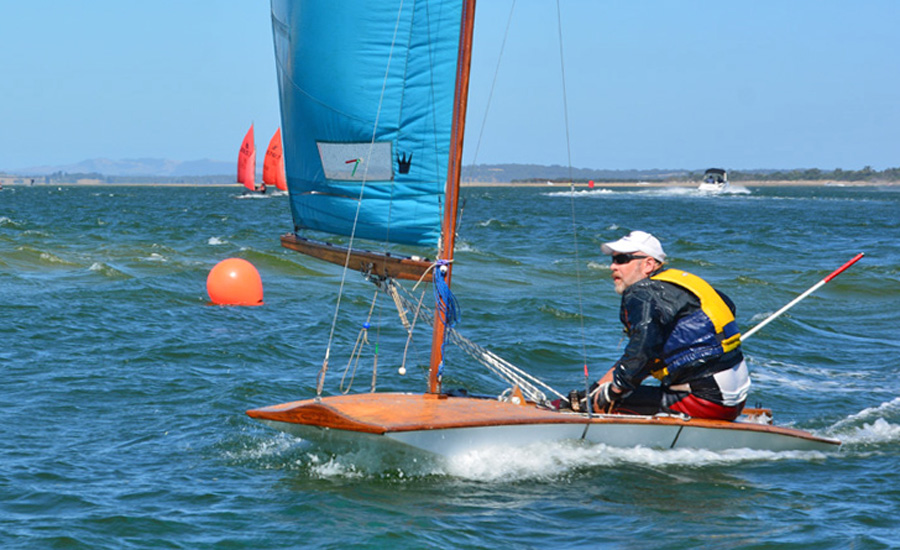
"At the first regatta Andrew Kean sailed the boat as a Moth, with two tone blue sails, because that what it was sold to him as. He did wonder why someone had put a trapeze fitting on the mast. Apparently he never thought to measure the length. He sailed it again in the most recent regatta as an A12 with blue and white sails with a different rig.
From the photos it looks like Andrew was able to find a genuine Bethwaite rotating rig and A-12 sail.

The A-12 with the original Moth rig; a blue sail, wooden spars.

The A-12 on the Inverloch beach next to an Australian Sailfish.


For the 2018 regatta, Andrew was able to plug in the correct rig; aluminum rotating mast with a very big sail.


I'm not sure any plans exist for the A-12. None have come forward yet.


George McGee adds more info on the A12. (From a comment I dragged to the main body.)
"I raced an A12 at Northbridge sailing club in the mid seventies. My boat came from Starbord Products with 2 rigs. The first rig was the 85 sq foot two tone blue sail with the over-rotating wooden mast. The second rig was a 65 sq foot two tone sail with a shorter wooden mast. (Not sure of the 65sq foot size). When the smaller rig was used the boat was classed a J12 rather than A12. NSC had a number of A12s and J12s competing on Sundays in the mid seventies.I spent many a happy afternoon on the A12 redefining the term "screaming reach"
.

Thursday, March 31, 2016

More Vintage Sailing Kit - 1956 Olympics

My previous post on 1970's International 14's provoked a small discussion on vintage sailing fashion by us greybeards. Which prompts me to pull a photo from even further back - the 1956 Olympics in Melbourne. Silver medalists in the 12 sq. m. Sharpie - Australian Rolly Tasker and John Scott. (Photo harvested from the Internet.)


A photo from one of the races of the 12 sq. meter Sharpie class in the 1956 Olympics. Rolly Tasker and John Scott are the left-most Sharpie.


Tuesday, February 16, 2016

Lightweight Sharpie Fleet Turning the Corner


Great fun in videoland when the drone operator is an experienced dinghy sailor and knows the best footage in a breeze is always at the jibe mark.

The Australian Lightweight Sharpies are 19' (5.8 meters) long, crewed by three (one on a trapeze) with a symmetrical spinnaker. The Aussies used the hull from the 12 sq. m Sharpie but redid it in plywood in the 1960's, reducing the weight considerably. The rig was updated from a gunter to a modern full battened main with aluminum mast. One takeaway from the video is how impressive is the wake from a full-on planing dinghy.

TOH to Jim Champ who posted this video to the Yachts and Yachting forum.


Earwigoagin archives has another Lightweight Sharpie video.

From the comments, Mike Scott chimes in with his experiences crewing the Lightweight Sharpie;

"When I emigrated to the Antipodes as a "Ten pound Pom' in 1965, I sought out my local sailing club - Lake Heights Sailing Club. Classes sailed there were OK dinghies, Lightweight Sharpies, and sundry others. "As I had no money to buy a boat in them days, I volunteered my services as crew aboard a Sharpie. What an eye-opener that proved to be for a British kid used to sailing little dinghies on ponds and rivers!! I was sheet-hand (mainsheet trimmer, and spinnaker raiser/trimmer), and those boats could really fly. Faster than a Dutchman, 505, or Fireball, it was a blast, and the thing I most remember being how warm the water was! Very wet boats, one was completely drenched on a planing reach, as you can see from the video. Occasionally we'd be out in the middle of Lake Illawarra, where the club was located, on a hot sunny day, when the clouds would gather on the horizon, and a Southerly Buster would come screaming across the lake, flattening the fleet, and forcing a rapid and hair-raising ride back to the beach!

"I don't think they are the most popular trapeze dinghy in Oz - the skiffs probably have a bigger following 14ft 16ft and of course the 18ft-ers.


Tuesday, August 5, 2014

Dinghy Photo: A Great One of a 12 sq. meter Sharpie

Velajando na Lagoa dos Patos

In my travels around the Net I've grabbed photos that interest me here and there. Every once in a while I'll repost. This black and white photo of the Classic 12 sq. meter Sharpie, the Olympic double-hander of 1956, is one of my favorites. I got it from a Brazilian blogger that was on the blog list of Doryman, but doesn't seem to be on his blog list now. I assume the photo is from the late 1950's - early 1960's (new information says it was actually taken in the 1970's - see below), especially given the split tiller in use which was also popular on Classic Moth's from that time fame. The 12 sq. m. Sharpie is sailing on a large freshwater lagoon behind an ocean barrier island, Lagoa dos Patos - Duck Lagoon, in Southern Brazil. The two names I have attached to the photo are Gabriel Gonzales and Nelson Piccolo, who I assume are the sailors. If I had a larger resolution image this one would definitely be framed and sitting on a wall in my house.

I would be interested in further attribution of the photographer because it is a great sailing photo.

Gustavo Pacheo added this comment on the photo (July 29, 2015) which I've dragged over to the main post. Thanks Gustavo!
"I think it was last year that I [saw] this great picture at the Veleiros do Sul web site. The helsman in the picture is Nelson Piccolo, and this picture is from the 70´s. We had discussed this picture in our [Facebook] group - Velejadores de Classicos - It is a great picture. Perfect light, enough action, it [is] like a poem. The contact [for] Nelson Piccolo [is] his sail loft Piccolo Sails: contato@piccolosails.com.br .. Fair winds !"