Showing posts sorted by date for query New Zealand Moth. Sort by relevance Show all posts

Sunday, February 7, 2021

Header Photo: The New Zealand "Zeddie"


Buchanan Collection Auckland Library

The previous header photo was of the New Zealand Z class, affectionately known as the "Zeddie". This photo was part of a collection of New Zealand dinghy photos taken by Arthur Victor Buchanan during the 1950's and put online by the Auckland Libraries. This is Z-27 "Dawn" ripping it under the shy kite; the header photo is a cropped version of id 6D-007 in the Auckland Library collection.

New Zealand yachtig historian, Neil Kennedy, alerted me to the photo archive online at the Auckland Library and tells the story of the Zeddie below.

"Zeddies... this Dawn Z 27. [The] only known sailing reference [to her] was in the 1953 Auckland Anniversary Regatta sailed on the last Monday in January each year (public holiday to celebrate the founding of the Auckland Province) which certainly was the biggest one day regatta in the world of its type. Everyone who had a yacht sailed on that day; for many it was the only race they competed in every season. Dawn was sailed by a J D McKay and crew and was only giving time to the scratch boats (1%) time allowance in the A division Z class fleet...

"The photo is taken off Devonport on the North Shore side of Auckland harbour and she is heading down towards North Head,... broad reaching in 12 to 15kn south westerly, with gusts up to 18 to 20 kts, which are a feature of Auckland Harbour. She has clearly caught one, screaming, hike-out and hang-on rides in these typical Auckland conditions. The road in the background is the Waterfront drive that goes to the Eastern Suburbs. Incidentally setting and gybing the spinnaker, could be pretty exciting in a fresh breeze as once the nose [of a Zeddie] went down they could be a real handful. (Hence the large "splashboards" running back from bow to aft of the side stays, which saved many a crew from a spectacular capsize.)...

"The dimensions of a Zeddie> Length 12ft 6 in., Beam 5ft 0 in., Depth 1ft 4in., Sail area (originally a gunter main) 110sqft, Spin 60 sq ft single luff, spars solid oregon Mast 11ft 3in Gaff 10ft boom 12ft 3in spinnaker pole 9ft 3in , Hull construction planked Kauri or Kahikatea (white pine) seam batten with sawn frames and canvas covered decks. The Zeddie would have been close to 300lbs hull weight at launching, so to get her up and planing like that shows the power of the rig. Crew two, under 19yrs. Yes girls did sail on them in small numbers too at club level. How many were actually built in Auckland is hard to know but sail numbers reached 200 on the Auckland register, and given number reissues (a common practice) and the fact they were sailed all over NZ, a probable estimate is around 500 NZ wide so they were one of the biggest small boat classes in NZ , until the arrival of the Cherub and the NZ Moth ( MK II) .

"While they were adequate to windward, they were essentially a "down-wind" boat and the stories of John Spencer (who started in Zeddies) of slogging for miles to windward just so they could enjoy a wild ride down wind are legendary. This is part of the heritage that made NZ yachties such great downwind heavy weather sailors.

"Note a couple of things: The skipper has no tiller extension, although they started to appear from 53 onwards, so good skippers developed long arms... The hiking straps were made from rubberised machine belts (discarded or 'borrowed" from machinery factories) and were quiet common.(Canvas ones had a tendency to rot and suddenly give way.) At the bow chain plate what looks like a "horn" sticking out is in fact a piece of folded 'hose" designed to catch wayward spinnaker sheets or even spinnaker pole braces from getting under the boat during setting/dousing or gybing, particularly with the single luff spinnakers... There were separate guys (port and starboard) which were shackled to the sidestay at the deck then run through a snaphook at the end of the spinnaker and back to a horn cleat on the deck aft. Some boats just had cleats others had bullseyes in front of the cleat as well. Spinnaker work was deemed a premium skill for a forward hand and the best could set and gybe a spinnaker in 15secs or less. Bailing out excess water was done with a large tin can and shirts, football shorts, lifejackets (sometimes an oilskin jacket) were the standard crew attire all year round... You had to be fit, hard and tough or you soon learnt to be.

The Zeddie was designed in the 1920's; among a group of flattie dinghy designs born of the Great Depression; including, in the U.S.A; Comet, Lightning, Geary 18, the Australian VeeJay, the French 9m2 Sharpie, in New Zealand alongside the Zeddy, the Idle Along. A modern rendition of the Zeddie with Dacron sails and an aluminum mast is shown below. In searching the Net, it looks like the Zeddie was racing a class championship up to the year 2013.


Wikipedia entry for the Zeddie

Sunday, November 1, 2020

Hal Wagstaffe's 1962 New Zealand Classic Moth Design

Moth Classique

These Classic Moth lines plans popped up on FB. A multi-chine plywood, very much a middle of the road design, "Puriri" looks very worthy of someone building a reproduction. She would definitely fit in the Gen I division of the American Classic Mothboat rules. Puriri is an indigenous New Zealand tree.


More Classic New Zealand Moth designs can be found at this post (from Nedslocker). Includes Bruce Farr's first dinghy designs.

Tuesday, November 26, 2019

Header Photo: Zephyr Dinghy OTP


OTP = On the Plane (This was the name of the U.S. International 14 newsletter - not sure if it still is - probably not since newsletters have gone the way of the Dodo bird.)


The previous photo featured the New Zealand Zephyr class ripping along. The Zephyr is one of four 11-footer conventional racing classes featured in the blog (Classic Moth, Europe Dinghy, British Moth, and the Zephyr).

Sunday, February 25, 2018

New Zealand Scow Moth; Some Deck Layouts


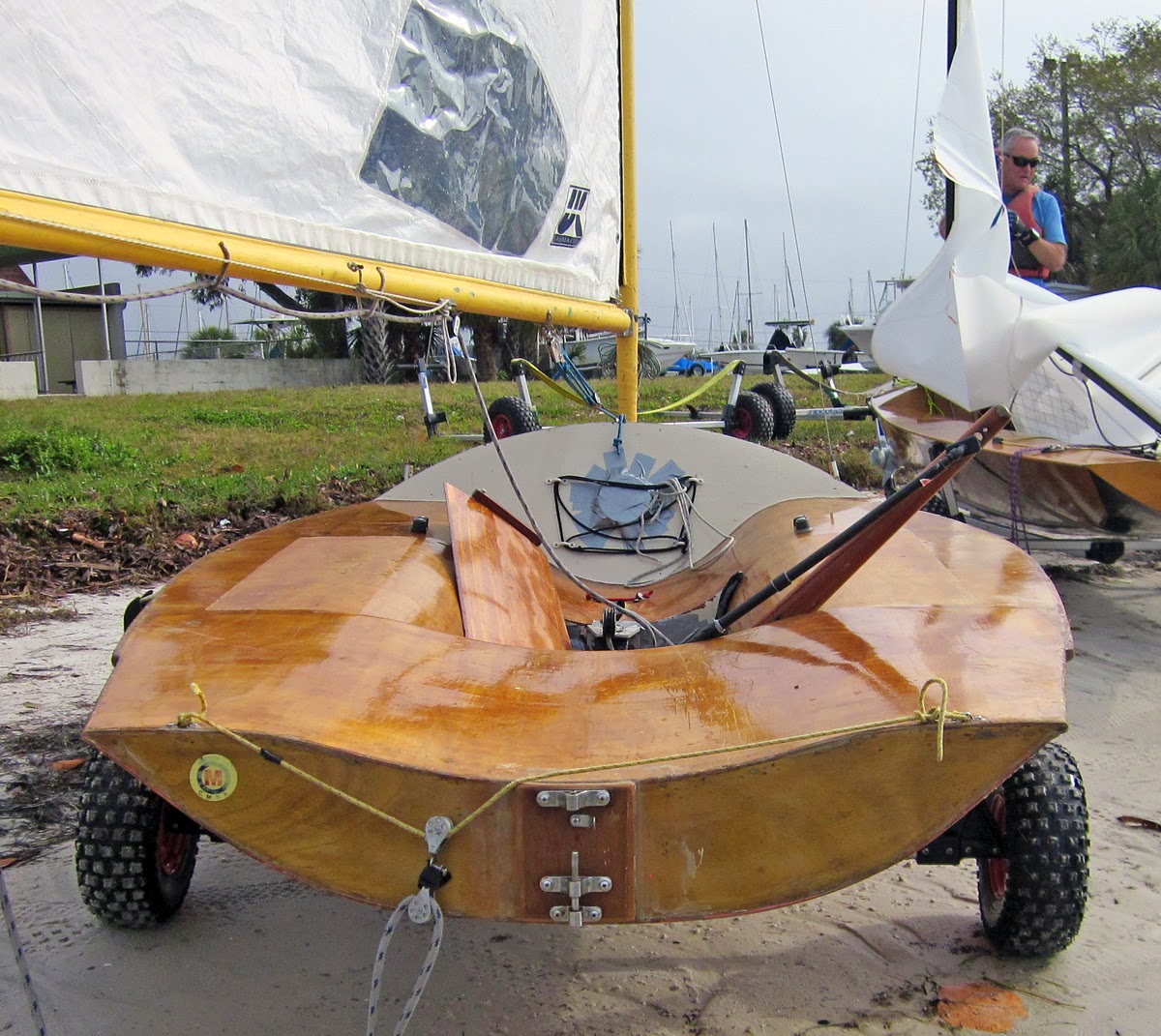
The New Zealand scow Moth is a one-design adaptation of the Len Morris Mk II Moth design though the rules were loose enough that they pushed the original Mk II lines around a bit. (An astute observer could also say that the Bethwaite design, Northbridge Junior, is also another adaptation of the Mk II scow.) Cockpit design on the New Zealand Moth is wide open and I came across these recent photos of the fleet of New Zealand Moths at Stewarts Gully, NZ. Some very inventive hiking arrangements here.

Three New Zealand Moths bow-on. It looks like 958 has shortened the luff of his sail to get a fat-head top.


A concave cockpit with stand-up rounded decks for hiking. The New Zealand Mothies do seem enamored with sticking wind indicators on the foredeck.


Another concave cockpit with semicircular hiking bumps. A nice long lever vang.


This one has narrow side decks just barely raised from the cockpit floor.


A conventional cockpit design with a repair just aft or where the skipper sits. A second layer of ply reinforcing (lightened with circular cut-outs) was supposed to be strong enough but doesn't look like it was up to the task.


Another shallow side-deck. I like the contrasting colors.


A more severe concave deck with shallow raised bumps for hiking.


You really, really have to work hard on the plywood to get this kind of double curve.


John Hanson and son are building a New Zealand Moth in Maine.

Saturday, January 13, 2018

Moth 90th Anniversary: 2018 Australian Classic Wooden Dinghy Regatta

The Australian Moth will be the featured class at this year's Classic Wooden Dinghy Regatta hosted by the South Gippsland Yacht Club. 2018 marks the 90th anniversary of Len Morris introducing his Inverloch 11' scow.  Several years later Len would change the name and logo of his scow when he came across the Rudder article on the Crosby Skimmer Moth. Len's scow became the first of the development Australian Moth class. (The Australian Moth class - actually Antipodean Moth class as New Zealand also had an active class organization - would feature a taller, high aspect rig compared to the U.S. and European Moth and would be mostly scow designs - the two different Moth rules would amalgamate into an International Rule Moth in 1969 .)

The South Gippsland Classic Wooden Dinghy Regatta is over the Australia Day Weekend (Jan 26 - 28). As a kid I was always salivating over the hot-rod Australian plywood dinghies of the 1960's and I always look forward eagerly to see what sailing dinghy restorations and replications the Aussies have unearthed, to be displayed and sailed on the Inverloch Inlet on Australia Day Weekend.

My report on the scow Moths in the 2016 Classic Wooden Dinghy Regatta.

Earwigoagin reports on the South Gippsland Classic Wooden Dinghy Regatta.

Drift Media has put together a Moth video preview for the 2018 Regatta


Inverloch Classic Wooden Dinghy Regatta 2018- 90 years of the Moth from drift media on Vimeo.


Wednesday, April 12, 2017

Header Photo: Dave Porter and crew in the Wooden 18-Footer "Aussie"


Sea Spray Annual

In response to the photo of the extreme hiking on a scow Moth, Kiwi Neil Kennedy sent along the previous header photo of extreme trapezing on an Aussie 18-footer. No idea on the date but my guess is sometime during the 1970's. From the photo caption:
"Most dynamic skipper in eighteens today is without doubt Dave Porter in "Aussie". Here he is demonstrating his extreme trapeze style in which he actually looks ahead underneath his crewmen, Bob Moore and Ted Griffiths. "Aussie" in the past year has chalked up a remarkable series of wins, among them the NSW state title, and second in the Australian title to "Travelodge" (Bob Holmes).

Neil Kennedy fleshes out the history of Dave Porter and "Aussie".
"Aussie was a 1970/71 season Sydney 18 and the first three handed 18 which finally led to the demise in Sydney of the four handers that had dominated the 18's from 63 onwards.

"She was designed by NZ amateur designer John Chapple who was a very successful 12ft skiff sailor and featured a high aspect ratio rig with a short footed jib. She quite straight fore and aft [ed. note: i.e. rocker] but with slack saucer like sections from midships which made her very quick but equally slippery down wind and especially gybing. That season was very much a crossroads design with the Hugh Cook designed Travelodge being the latest refinement of the Sydney four handers, and the powerful Wille B design leading that theme, while in NZ the first really successful Bruce Farr Miss UEB showed a taste of what was to come in the next four years, when Bruce dominated the class. That whole period is a great story in itself.


The Aussies are coming! To Annapolis....

In somewhat related news, the National Sailing Hall of Fame made the announcement that a contingent of Classic Australian 18-Footers is making a trip to Annapolis for the Classic Wooden Boat Regatta. Date is Sept 15-17, 2017. From the NSHOF announcement:
"The "Classic" is an informal opportunity for boats of all different sizes and designs to compete together in a low-key race against other wooden vessels. The event has grown each year, with boats ranging in size from 8-feet to 65-feet and traveling from as far away as Canada to participate. That record will be broken this year, when sailors from the Sydney Flying Squadron, Australia's oldest open boat sailing club, will be visiting Annapolis to participate using their own fleet of historical 18-foot skiffs, which they are shipping here from Australia specifically for this event.

18-foot skiffs, considered by many to be the fastest class of sailing skiffs, began racing on Australia's Sydney Harbor in 1892 and later in New Zealand. Called "Aussie 18s" by their owners, the skiffs will be dockside for public viewing on Friday and Saturday, September 15-16, along with the many other participating classic boats.

"We are very excited to have the 18-footers from Australia here for the Classic Race," said Maria Museler, the event's volunteer organizer. "Anyone who loves wooden sailboats won't want to miss this great opportunity to meet with wooden sailboat owners, take part in a fun race, and show off your classically designed sailboat for everyone in Annapolis, Maryland."


Wowee! HotDawg! Sandbaggers and Classic 18-Footers together. Two over-canvassed, over-crewed vintage battlewagons. Should be quite a sight on Annapolis Harbor.

Saturday, October 29, 2016

Header Photo: Shelley Moth - Side View


The previous header photo is the side-view that John Shelley, ex-pat Kiwi dinghy designer working in England, drew of one of his Moth designs (he had three variations) for a patent he was awarded for tortured ply construction. (There is no indication he ever exercised the patent.) In one of those what-if's, I've always wondered what would have happened if it had been the Shelley Moth that had exploded in Europe, instead of the Europa design, and it was the Shelley Moth that became the Womens Olympic Singlehander. The Shelley is a good example of the 1960's Australian/New Zealand plywood, single-chine dinghy and I've always felt that this design had a little more upside in heavy air performance compared to the Europe Dinghy.

Blog on a home build Shelley Moth over here.

Tuesday, June 21, 2016

New Zealand Classic Skiff Moths

Neil Kennedy of New Zealand sent along some magazine snippets of the New Zealand Classic Skiff Moths, specifically from Seacraft magazine - 1958 and 1959, and Sea Spray magazine - 1965.

Most of the designs look very similar to our CMBA Shelley model. (Not surprising since Shelley was a transplanted Kiwi living in England during the 1960's when he was designing dinghies.)

Some items of interest from the magazine articles:
  • The 1958 cover of Seacraft has a Hawk design skiff with a rotating mast.
  • Bruce Farr got his start mucking around with Moth designs. His Mark III model is shown in the 1965 issue of Sea Spray. I didn't realize he had a brother, Alan, that was also his compatriot in cooking up Moth designs.
  • The Antipodean Moths always had a taller, fully battened sail plan compared to the American Mothboat.


Saturday, May 28, 2016

New Zealand Zephyr Singlehander Dinghy


Here is another 11 foot singlehander, just like the Classic Moth, though it is a one-design class. The Zephyr is a New Zealand only class, designed in 1956 by Des Townson. They celebrated their seventy year anniversary this year with an 80 boat National Championship, which shows the class is doing something right. This is definitely one of those Retro singlehanders surging into a current day renaissance, despite all the online squawking about the need for "modern singlehanders".

Some of the 80 Zephyrs lined up on the beach of the Manly Sailing Club, Auckland, NZ, for the 2016 Nationals.


A classic dinghy shape from 1956, the Zephyr has a Vee'd transom. This one is fully kitted out with modern accoutrements such as a tactical compass, carbon tiller, blades fully protected in their bags.


The class is just in the process of legalizing fiberglass hulls but up to this point, all hulls have been cold-molded (a few have been strip planked) from one class approved mold. The decking, as shown, is substantial and sturdy. Minimum weight of the hull is not super-light, 58 kg (127lbs. - still lighter than a Laser).


The Zephyr has a lowish roach, full battened sail on a stayed aluminium mast that is stepped on the deck.


And, yes, they do look to be quite a lively planing boat when the wind comes up.


Zephyr Class Association.

Kiwi Neil Kennedy emailed me with these observations on the Zephyr dinghy:
"Above 15kn's a Zephyr, which is a quite powerful boat,  would be able match a Classic Moth although the Europe dinghy hulls, with their international moth style rigs and 80 sq ft of SA, would match a Zephyr in the same breeze. By the way the biggest age group at the recent nationals was (50-59) ( Ah! The "silver fleet" is where the action is).

Saturday, March 19, 2016

Updates on Classic Moth Builds: Spring 2016

Springtime and let's see what the makers in the Classic Moth world are cooking up.

I know two Bill's who are boat-builders and both of them are very, very quick at knocking a boat out from scratch. The next couple of photos are from Bill Boyle's blog where he is documenting his cedar strip Europe Dinghy build. He has the hull off the molds and is now fitting the bulkheads and deck reinforcements.

The king-plank for the foredeck and the mast strut connecting down to the hull. This will support the deck-stepped mast.

Repost from http://europedinghymoth.blogspot.com/

The daggerboard trunk.

Repost from http://europedinghymoth.blogspot.com/

How the mast strut is gussetted at both juncture points.

Repost from http://europedinghymoth.blogspot.com/

John Hanson, a Mainer, is starting a New Zealand Moth scow as a father/son project. John is the publisher of Maine Boats, Homes, and Harbors magazine and will be documenting the build in upcoming issues. He did a mock-up of the hull (which is essentially a Len Morris MkII scow) in luan.
Picture clipped from Issue 139 of Maine Boats, Harbors, Homes

Also, about 50 km. from where I live, Victor Stango is reconstructing the rolled deck on a Maser he picked up over the winter. Whoo! Hoo! another Maser in the local fleet.


Meanwhile our Classic Moth friends in Russia are proceeding apace with their construction of the Mistral Moth. They built the hull over full molds and report that there was little issue in getting the plywood to behave when fitting.

Here is one side of the plywood going on.

http://forum.katera.ru/index.php?/topic/51277-classic-moth-boats/


http://forum.katera.ru/index.php?/topic/51277-classic-moth-boats/

Completed shell off the molds. The builder is Serg-IF. Looking good!

http://forum.katera.ru/index.php?/topic/51277-classic-moth-boats/


http://forum.katera.ru/index.php?/topic/51277-classic-moth-boats/


Sunday, April 6, 2014

Scow Moth Plans: Australian Len Morris's MkII

I've chunked the plans for Len Morris's Mk II scow Moth into a loadable PDF format below. Len Morris's Mk II was the post-WWII design that would spread the scow Moth into every corner of Australian dinghy racing. A boxy, flat-bottomed design, hundreds of Mk II's would be built and this design would also spawn the one-design New-Zealand scow Moth, where hundreds more of this class would be built. The Australians from day one favored a high aspect (17-foot luff) sail plan-form compared to the lower aspect (15-foot luff) of the then International Moth (now our U.S. Classic Moth).

Click here to view a Mk II in the flesh.

(If you want to download or print the PDF file, click on the upward pointing arrow icon at the top right of the app bar. This will open the PDF in another tab where you can print or download.)


Tuesday, June 5, 2012

Header Photo: New Zealand Moth


All spring the header photo that has graced the top of this blog has been of a capsized New Zealand Moth, somewhere on the South Island. The New Zealand Moth is a more modern interpretation of the Len Morris Mk II Antipodean scow Moth. (Len did this design post WWII and the Mk II jump started the Moth class in Australia). As with most things in the Classic Moth world, the Laser supplanted the New Zealand Moth, which pre-Laser, in the 1960's, was a very popular class in New Zealand. The New Zealand Moth still has a fleet in Stewarts Gully Sailing Club in New Zealand and can be found for very reasonable prices, as did this fellow yanking on the daggerboard, who bought his Moth for $200.

Wednesday, November 17, 2010

All Paths Lead to Tillerman................

Today marks the second anniversary of this blog. I started Earwigoagin to deliver a response to one of Tillerman's writing assignments....... who would you invite, living or dead, to a dinner party?

I reprint my first post below. Definitely my dinner party is almost entirely populated with sailing technologists and tinkerers. After two years, I've added some more Classic Moth sailors. They're in charge of the beer.

_______________________________________________________________

I've created this blog mainly as a response to another writing assignment from blogger Tillerman. www.propercourse.blogspot.com There may be other uses for this blog but for right now lets dig into Tillerman's assignment .... who would you invite to a very special dinner/party? For this party you can get to mix the living and the dead, the friends and the strangers.

Tillerman's a dinghy sailor, I am also a dinghy sailor. Where Tillerman immerses himself in the one-design Laser class, I am usually found in some class where people design or build their own equipment, whether it's hulls, sails, blades, etc.

So my dinner party would definitely have an abundance of what the English call "boffins", in this case those who like to experiment with sailboats, preferably small racing dinghies.

Large parties work best and hopefully all guests are voluble, completely free with their opinions and willing to listen. Wives/ girlfriends are always welcome and indeed are essential. Unfortunately, I don't know any female sailing boffins so my guest list is definitely sexist.

You must start with your COF (circle of friends) boffins which in this case would be Bill Beaver, John Z, George Saunders, Steve Clark, John Kells, Bob Ames, Bob Blomquist, Paul Miller with some left coast COF boffins such as Erich Chase, Del Olsen, Fran DeFaymoreau (4 Naval Architects in this group and everyone has built, in most cases, multiple racing dinghies). I would also add local acquaintance, Aussie Tony Arends. I'd also invite Classic Mothists, George Albaugh, Mike Parsons, Ed Salva, Greg Duncan and Bill Boyle (but he doesn't seem to do parties very well).

Now onto to the special guests;

Austin Farrar - UK deceased - Austin was the premier designer in the International 14 class in the 1950's, was the first one to put a wing mast on the C-class catamaran "Lady Helmsman" founded the sailmaking firm Seahorse sails and was involved in a myriad of experiments. To use that overused phrase; Austin was always an "out of the box" thinker.

Ben Lexcen - i.e. Bob Miller - Australia deceased - Top designer/sailor in the Australian 18 skiffs. Designed the Contender which won the IYRU singlehanded trials in the early 1960's. Designed the wing keeled Australia II that wrested the America's Cup from the Americans. From everything I read, Ben Lexcen was a larger than life character and you need some of those at a party.


Ian Howlett - UK - designed America's Cup 12 meters, IOR tonners, premier yacht designer. House designer for most of the Topper companies dinghy designs. Final kicker in my book is he races an 11' British Moth. What other big name designer gets his jollies from racing an 11' dinghy?

Bruce Kirby - CAN/US - Top designer in the International 14 in the 1960's and 70's. Designer of the Laser. Designer of the Canadian entry into the America's Cup. Designer of the successful Noank Sharpies shoal draft cruisers. I met him in the early 1980's and came away with the impression of a personable, self effacing fellow with loads of stories to tell.

Tom Shnackenberg - NZ - The boffin in charge of New Zealand's America's Cup dominance. Not sure how forthcoming he would be at a party like this but, if he opened up, the stories he could tell...

Eric Arens - US - Eric is actually in my COF but I rarely get to see him. I crewed for Eric in Int. 14's in the 1970's. Eric still sails Int 14's today as crew - age mid 60's! Eric has been commodore of both Severn Sailing Assoc and Richmond YC, is a senior US sailing judge and loves the give and take with interesting people at a party. He's retired now but was a PHD physicist at NASA Goodard Space Center.

Jeff Linton - US - Jeff is a pro, has won several World Championships, has won US Sailing's sailor of the year award, but also designed, built, and races a Classic Moth. Jeff and his wife, Amy, have a wealth of stories to tell. Jeff is very approachable which is not always a characteristic you find in professional sailors.

Chris Thompson - AUS - Chris has written an unpublished history of dinghy sailing, a superb tome of research and writing. Chris races the original Windsurfer and Lasers. I would need someone to keep Tillerman occupied!

Mystery guest - It's got to be one or two of the Frenchmen involved with the design or building of the Vendee Globe 60 footers. Not sure who? as I don't know the players. Someone with good English as this is a Anglo-centric party. Someone who can bring the wine maybe?? What glorious machines those Vendee Globe 60 footers are and the French need to be recognized for driving these designs to the pinnacle they represent in ocean racing.

Other's on the invite list are all sailing dinghy designers with pages of design accomplishments. (but I 'll spare the details);

Jo Richards - UK
Phil Morrison - UK
Paul Bieker - US
Chris Benedict - US deceased.


Saturday, March 20, 2010

Classic Moth plans

Plans de dériveur classique Moth, Plans de voiliers classiques Moth

Before diving into this very lengthy post, you might want to Click Here To View Classic Moth Images courtesy of Google.

You also might want to Click here for a YouTube video with commentary on some of the various Classic Moths racing at the U.S. Classic Moth Nationals in Elizabeth City.

(Addendum September 2012 - I first wrote this post in 2010. Since then various boatbuilders have popped up, building reproductions of vintage designs. Francois Vivier has also produced a kit Moth. In the two years I have made many more posts about Classic Moths on Earwigoagin and it might be worth the reader to investigate. For more articles on the Classic Moth from this blog, use the Blogger Search Box at the top left  (next to the orange B icon). Type in "Classic Moth" to pull all the articles on the Classic Moth from this blog. Or go to the Labels on the right side of the blog and select "Classic Moth" I keep adding plans and sections for various Classic Moths. Use the following links.)
(editors note - I've dragged the Conclusion to the top of the post - August 2013) CONCLUSION - Let me be clear. The Classic Moth is a short hull and a light hull. At the Gen2 (higher performance racing) level, the Classic Moths are challenging craft to sail but very rewarding at the same time.  A Laser is like an aircraft carrier compared to the more twitchier Gen 2 designs, the Mistral, Energizer, Tweezer or even the Shelly. 

But there are more stable Classic Moths that we classify as Gen 1. I've never sailed a Mint or a Proust design but I would assume that they would be very much the same stability as a Laser or Sunfish. Or, an even older design, a reproduction vintage design such as the Little Mae or Nantais Moth would be the most stable and perfect for kicking around on the lake. 

So there you have it. The Mistral, Shelly and Florida Cates have more or less complete plans. Other designs you would probably need to work off a set of lines drawings and use your builders experience. George Albaugh is our plan librarian. His email is linked from Classic Moth website.  George is also another sailing blogger. You can view his Classic Moth posts over at Mid-Atlantic Musings.


All lines drawings (except the Europe dinghy) were done using MaxSurf's NURBS software.


Quick review of some of the more popular designs and the availability of plans. (Updated September 2012)

(Note; To give a rough idea on the tippiness of a hull, Joe Bousquet developed a scissor-like device he placed over the midsection to visually show the amount of V. I've included his pictures of the various V's from the Mistral, Shelly, Europe, Energizer.)

(Another note: To scroll through hi-res pictures, just click on a picture. Once the hi-res picture comes up, click again in the picture to step through all the pictures on this post.)


MISTRAL - easiest to build. Developable plywood. Stitch and glue. Two 3mm plywood panels are bent up to shape, a centerline piece attached to hold the run flat, a spreader bar at the gunwhales is used to get the correct shape when bending up and glassing. A weekend of work will give you the rough shape. Adding two permanent bulkheads, a temp bulkhead and the transom finalizes the shape. Many people have hacked the hull shape by pushing here or pulling there so we have some semi Mistral hullls out there. Here is a link to a blog post of a local Annapolis Mothist, John Z building a Mistral. A Mistral or some variation of the Mistral has won the Nationals the last umpteen years.

However, the Mistral is a very deep V design. Very floppy and has a tendency to scare newbie Mothists who try to sail her. Many have come ashore and either; 1) rapidly put the boat up for sale or 2) put the Mistral back in the garage for a while and then discreetly sold her. Not all mind you, as we have a core group of about 6-8 who regularly sail a Mistral (or modified Mistral design, i.e. the Mousetrap or Y2K designs) and are able to race them hard in all conditions and win. It helps to have some Laser or Sunfish experience but this is not an ironclad requirement. If you pick a Mistral to build, consider yourself warned. If you decide to proceed, George has the plans (see bottom of article).

The Mistral on the Bousquet V-meter.


Top View of a Mistral Mod Design, the Mousetrap by Jeff Linton.


Picture of the tank framing for Joe Bousquet's Mistral. Note the sistering of insulation foam with the plywood frame to provide gluing surface for the plywood decks.


Not all Mistrals are built in plywood. This one was done in foam core/glass, with the hull splashed using an existing wood hull as a mold. Note the very interesting transom design.


Here are the lines to a modified Mistral, the Y2KBug built by Walt Collins. (Pretty extreme wouldn't you say!)


ENERGIZER -Just a hair more stable than the Mistral is the Energizer design. A modification of the 1970's Stockholm Sprite, it is a full chine design but still very V'd. Two have been built with some success. No plans.

Energizer on the Bousquet V-meter.


The original Energizer was the first Classic Moth I owned. Here I am sailing Energizer at Chester River in Maryland.


The Energizer hull shape from the stern.


A lines drawing of Energizer showing it belongs to the deep-V family of Classic Moths.


TWEEZER - Yep, this is my design. I called this design Tweezer D as it was the fourth generation in what I drew up, but the D version was only one built. A Gen 2 design racing against the Mistral, Energizer designs. Stability somewhere between the Mistral and the Shelly (though some other sailors have told me it is close in stability to a Shelley). Flatter rocker in the Tweezer has proven to be quick in a breeze but suffers against the Mistrals and even the Shelly in the lighter stuff (non-hiking breeze) which, on the East Coast, seems to be the majority of our conditions. I may be biased but it is a hull with little vices and I enjoyed racing this design. Round-bilged and the original was built using cedar strips.
Picture below is of me lollygagging around on Tweezer, before a start at E-City.


And the Tweezer D hull lines:


SHELLEY - A wider, flatter chined design with moderate rocker from the brilliant New Zealand/English dinghy designer of the 1960's, John Shelley. Much more stable and, in the hands of Joe Bousquet, has done very well in the National championships. George has the Mk3 plans.

Shelley on the Bousquet V-meter.


A McCutcheon built Shelley in dinghy park at the Gulfport Midwinters.


The lines for the Shelley Mk III.

Bill Boyle is doing a new build of a Shelley MkIII which he is documenting in a blog. Click here to check out his progress.


MINT - Qualifies for Gen 1 (our Classic Moth division for the more stable, higher wetted surface hulls that are not Vintage). A Bill Lee national championship winner, the Mint is a reasonably docile design from the 1950's. Never built one but the bow sections go very fine and look to present some challenges to the home builder. That being said, 6 hulls were built in Elizabeth City in the 1990's. George has the section lines.

A picture of the beautiful restoration of the first Mint built.....


And John Pugh sailing a Mint at the E-City Nationals.


The hull lines of the Mint showing the concave sections up forward.


FLORIDA CATES

The most successful American design of the 1960's. Florida boatbuilder, Harry Cates, evolved the shape from Warren Bailey's Mach 1. massaging the shape to make it easy to home build in plywood. Charlie Hunt drew up the plans. A Gen 1 design, the Cates is another V'd shape with a distinctive small topside panel with chine. The transom is small, reminding one of a Sunfish transom. The Cates is very beamy at the gunwhales forward. Low freeboard, a wet boat, but most sailors find it reasonably sailable, with plans available. George A. has the plans (see contact info at top of post).

Gary Gowans has built two of them, with slight modifications. He won the Gen1 class at the 2014 Championships over an Olympic Europe.


A topside shot of a Cates. Bill Boyle in 1965.


The lines to the Cates show a considerable V, hollowed bow sections, and a tiny topside panel. Beam is 1.72 meters.


The top down view shows a pinched transom and wide side-decks.


The sideview shows moderate rocker. The tiny topside panel that disappears at the bow is also clearly shown.


The offsets to the Cates design can be found by clicking here.


MODERN FLORIDA -There are two designs by famous Florida MORC designers; OH Rodgers designed the Florida Wedge (a low rocker design, very stable, but slow in waves and squirrely downwind in a breeze). Four hulls were built by the St. Petersburg fleet and Jeff Linton won the 2003 Nationals with one. I'm not sure if any plans exist.

A stern view of the Florida Wedge showing the flattish, low profile, transom and no stern tank:


Paul Lindenberg designed a Classic Moth which has a resemblance to the Windmill hull. Lindenberg will sell his Classic Moth plans for $400. I don't have an address.

Lindenberg's website does show some
Classic Moth building.

A transom photo of a Lindenberg Moth (from George A.'s blog). Note the anti-reflective strips on the transom for safer trailering.


SAVANNAH WEDGE - A Moth copy of the Zuma dinghy built by AMF in the late 1980's, this Classic Moth was designed by Lane Reeves with two built in Savannah, Georgia.  This Wedge design had a wide, flat transom, low freeboard, double-bottom and reverse stern. The Savannah Wedge is not competitive as a Classic Moth racer, too much wetted surface, but with it's double bottom this is a very capable kick-around-the-lake daysailor. No plans existing that I know of.

Briggs Monteith begs to differ with my assessment - I have dragged his comment to the main post:

"I know this is an old post but as for the Savannah Wedge not being competitive, I finished third in a Savannah Wedge in the '99 midwinters sailing one that I borrowed from Jerry Carter. The boat was amazingly quick I thought, It beat Mean Tangerine and Randall Swans Vanilla. in extremely light air conditions. I think the boat has suffered from sailors who didn't understand the boat." -Briggs Monteith


SKOL; The Skol was a British production fiberglass Moth from the early 1970's. The Mk II, the most popular version, was a de-tuned Mistral with very round sections.  The Mk II had a tub cockpit with a back tank. Here are two pictures of a just retrieved, hence dirty, Skol Mk II. The winglets are illegal in the U.S. Classic Moth Association Rules. (We have a 1" hollow rule.). There are no known plans but a used one would make a good re-decking project (see the last photo is this section).


The original ad for the Skol Mk II


Here in the U.S. Joe Bousquet did a decks-off/plywood redeck restoration of a Skol Mk II, shown here sailing in the 2014 CMBA Midwinters.


A transom shot of the same Americanized Skol. A very round transom, equivalent to the Duflos or Mistral shape.


EUROPE Dinghy- The ex-Olympic Europe is based on a 1960's Europa Classic Moth and there is an active section of Classic Mothists who have purchased plastic Europes, modified the sail to fit the Classic Moth and are sailing them mostly as stock (though we do have three modified Europes, Mark Saunders has done a Europe hull lighter with a wooden deck).

Wooden Europa dinghy on the Bousquet V-meter.


Walt Collins with his Olympic Europe.


The lines to the Olympic Europe dinghy.


PROUST DESIGN - In 2009, Jim Young built an old French design he found on the Internet. Despite the name he gave her (Tippy), this Classic Moth was anything but. A stable, buoyant design which Jim built modern, in foam/glass. Details on "Tippy" can be found over at this blog post. I've also put up offsets, both metric and English, for my version of the Proust, the Zippy.Also the Zippy sections are posted here.


Tippy at the 2008 E-City Nationals.


The simple single-chine sections for Zippy. There is no compounding of plywood here. This design has ample flotation forward, which makes for a safer hull, particularly downwind in a blow. (For reference, buttock lines spaced at 150mm and waterlines spaced at 60mm.)


TITAN - The Titan design is another stable design from the 1960's. It is a round-bilged design, a pretty hull, but the original hulls were built very heavy in fiberglass. Reports from Mothists who have sailed them find the Titan well mannered. The design has some similarity to a small Uffa Fox International 14.


RESTORATION - Many of the 60 designs have reappeared as derelict hulls and have been restored rather than homebuilt from scratch. The oldest designs for Vintage (Ventnor, Connecticut, and Dorr Willey designs) must be restored to qualify to race in  the Vintage division (you can still race a reproduction Vintage in the Gen 1 division). 

Here is one of the original ads for the Ventnor Moth.


Bill Boyle has done quite a few Moth restorations and has written about them.


  1. Click here to view his restoration of a Fran Abbott Moth.
  2. Click here to view his restoration of a Fletcher/Cates Moth.
  3. And his latest restoration of a Ventnor copy.


DESIGN YOUR OWN - With the introduction of free hull design software, the more adventurous can design their own Classic Moth. The American rule limits length to 3.3528 meters, beam is limited to 1.524 meters, no concavity greater than .025 meters aft of the daggerboard trunk and hull weight (including fittings) is no lighter than 34 kg.

John Watkins published this set of Classic Moth lines to the WoodenBoat forum in 2015. This design would fit very nicely into the U.S. Gen 1 division.


MARIPOSA

Mariposa is a French Classic Moth three plank design by Bertrand Warion, featuring a flat rocker panel married to developable bow sections, built stitch and tape. The design was one of several new Classic Moth designs built for the "concours de plans Moth Classique" sponsored by the French traditional boating magazine, Chasse-Marée in 2001.


RAZMOTH - another French design by Bertrand Warion. This one is patterned after the Fireball and has a flat rocker panel. RazMoth is another simple flat, two chine, easy-to-build plywood shape, ending in a scow bow. The RazMoth design is on it's second iteration.


BILBON - was another French design built for the "concours de plans Moth Classique" sponsored by Chassse_Marée magazine in 2001. Designed by Christophe Couton, a professional draftsman, it is a simple flat V, easy-to-build plywood shape, ending in a pram bow. Bilbon was one of the faster new designs that appeared at the 2001 design competition.


Here is a middle-of-the-road round bilge design I drew up. A very conventional dinghy hull shape. For reference the waterlines are drawn spaced every 60 mm. and the buttocks are drawn at 150 mm. spacing

Click here for the DXF file of this round bilged Classic Moth design.


I've also pushed around the lines to the Fragniere design by adding a flat rocker panel.

Click here for the offsets for a three plank modified Fragniere Classic Moth design.


William Crosby's SKIMMER - A very early Moth design, published in The Rudder in 1933. According to Crosby, hundreds were built but very few have surfaced in modern times. A scow type, this would make a good off-the-beach boat but is not competitive in the Vintage Divsion when compared to the deeper V vintage designs like the Dorr-Willey or Ventnor.

Skimmer Plans can be found here.

A Skimmer found in a barn in Cape Cod. Note the lack of cockpit.


MASER - And for those with the true hacker spirit - there is the Classic Moth that uses a sliced and diced Laser hull - deemed a Maser.

A Maser at the 2011 Midwinters. You can sort of see the Laser transom, still intact.


MOTH CLASSIQUE: The French have a rich tradition with the Classic Moths and their designs. The French Duflos was the fastest Classic Moth before the arrival of wings. Click here to view Part 1 of Louis Pillon's fascinating history of the French Moth class. I have come across two small jpeg's of French Moth designs on the Internet.

The first is the vintage, scow bow Nantais design which has been mentioned before in this post.


The second is the Fragniere design, a unique transom bow design which was most popular in France before the appearance of the very narrow Duflos and similar designs. Click here for the offsets for the Fragniere.


Here are some photos of a recent build of the Fragniere design. Following the plans, the Fragniere has a full length cockpit.


French designer Francois Vivier has designed a Moth Classique to be built in kit form. Here is the side view of his Moth Grand Largue.


Benoit Duflos, who pioneered the very fast, very Vee'd, very tippy racing Moths of the 1960's also designed a more stable, flat-bottom Moth for the home-builder. Called the Moth-Pop, plans for the Moth-Pop can be found in the links at the top of this post. Here is Benoit's iso-view of the Moth-Pop


The lines plan for the Moth-Pop.


The 505 Moth - John Westell, the designer of the 505, also did a 505 type Moth. I haven't come across any that have survived to the modern day.


Image courtesy of David Henshall


SCOW Moth - The scow Moth was THE Moth of Australia and New Zealand until the narrow waterline winged Moths proved faster in the mid 1980's. Len Morris was the founder of the Australian scow Moths with his Flutterby design which he built in 1928. His post World War II MK II design was very popular and is still an easy-build proposition out of plywood. Plans for the MK II can be found by clicking here.

The sections for the MK II show a simple flat-bottom scow with vertical sides.


A double bottom MKII built in the 1950's.


Classic Moth Sailplan

All dimensions in mm. For the original post on the Classic Moth sailplan, click here.


Where to put the mast and daggerboard in a Classic Moth?

Luckily, John Shelley's construction drawings for the Shelley Mk 1, which he used in a patent application, have now surfaced on the internet. His mast and daggerboard placement as indicated in the drawings below are good placements, though, if you went around the fleet with a measuring tape, you would find this might vary by up to 75 mm from boat to boat. 


Center of mast back from stem - 695 mm.


Leading edge of daggerboard back from stem - 1453 mm.


What constitutes a Gen I Classic Moth design?

"What constitutes a Gen I Classic Moth?" As of now, and for the foreseeable future, the good old eyeball. Among the class, we have discussed various parametrics, but the difficulty of measurement, and the almost certain chance of designers trying to skirt any numbers written down (bumps, lumps and so on), have kept us to a subjective division. Most of the designs featured on the this design page are Gen 1 designs. They include the Europe dinghy, the Proust (Tippy or Zippy), the Shelley, the Florida and Savannah Wedge, the Maser, the scows, the Cates, the Mint, the Nantais, the Little Mae, and the Titan. The age of the design does not matter for Gen 1. The primary determinant is waterline beam. If it looks narrow, it doesn't fit Gen 1. Sailing a Gen 1 design should be relatively straightforward for anyone with dinghy experience.

The Gen II designs (narrow waterline) on the Earwigoagin design page are the Mistral, the hard-chine Energizer, the Tweezer, and the wood-decked, modified Skol. They are definitely a tippier proposition to sail and race, but rewarding for those who like a small boat challenge.


Other links to other Classic Moth design posts from Earwigoagin..........

  1. My answer to my first email inquiry about Classic Moths..... Classic Moth Designs Part 1 
  2. And also a good read.......Why a Classic Moth is Better than a Laser.