Showing posts sorted by date for query Maser. Sort by relevance Show all posts

Friday, March 11, 2022

2022 Classic Moth Midwinters

Back again, at least for the moment. Been off keeping myself amused with various non-sailing, non-social larks during COVID-time. I'll try to post to Earwigoagin irregularly, particularly if it is easy; if stuff lands in my lap.

John Z went off down south for the Classic Moth Midwinters and relays the news. Weather was beautiful in Gulfport, Florida; sunny 80F (26C), light winds in the morning with the regular breeze clocking in for the afternoon. Nine Classic Moths showed up with the CMBA resident professional and all-around nice guy, Jeff Linton, again making off with top honors. Shore photos are from John Zseleczky and on-the-water photos from Amy Linton (which I have converted to black and white in my own fashion).

(George Albaugh has his more extensive Midwinter report up on his blog.)

George Albaugh with his wooden Europe on the Gulfport YC dinghy lawn.
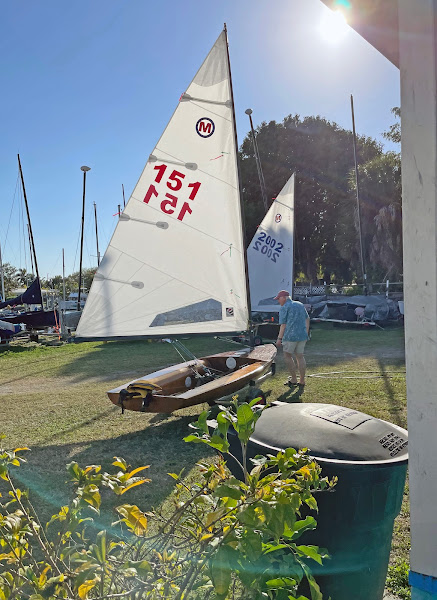

Greg Duncan rigging his glass Europe.


Jamey Rabbit with no. 134, his new modified Mistral design. Jamey had teething problems on Saturday but came back strong on Sunday, posting 1st's and 2nd's. Jamey started this project back in 2015, seven years to completion, which is getting into my extended time frame for boat projects. In the photo below, you can definitely see he pinched in the topsides up forward. (Compare to the standard Mistral shape of Joe Bosquet, no. 48, in the background.)


Jamey Rabbit rigging. His new Classic Moth has carbon bits and bobs all over the place. The aft deck looks like you could launch drones off it. Jamey documented his Classic Moth build over at his Blackberry Boatworks blog.


John Z motoring upwind. John would finish 2nd to Jeff in Gen II.


Mark Saunders in his modified wood-redecked Europe giving Jamey Rabbit a run for his money. Mark would win the Gen 1 division.


Mark Saunders in his Europe upwind. From this angle looks very similar to my Maser. I've been looking at film photography recently and somehow I rendered this photo in Photoshop very much in the ethos of Japanese street photographer, Daido Moriyama; very contrasty with bright highlights and darker darks.


A start. Jeff Linton, no.102, has already got a nice jump on the fleet.


Mike Parsons catching up with Rod Koch (the other Rod). Rod, along with Jeff is a past Sunfish champion. Rod raced a modified Europe back around the 2010 time frame.


Joe Bousquet holding a slim lead over Jeff Linton at the reach mark.


Mark Saunders in his Gen 1 Europe holding off the faster Gen II Mistrals of Mike Parsons and Joe Bousquet.


Saturday, December 26, 2020

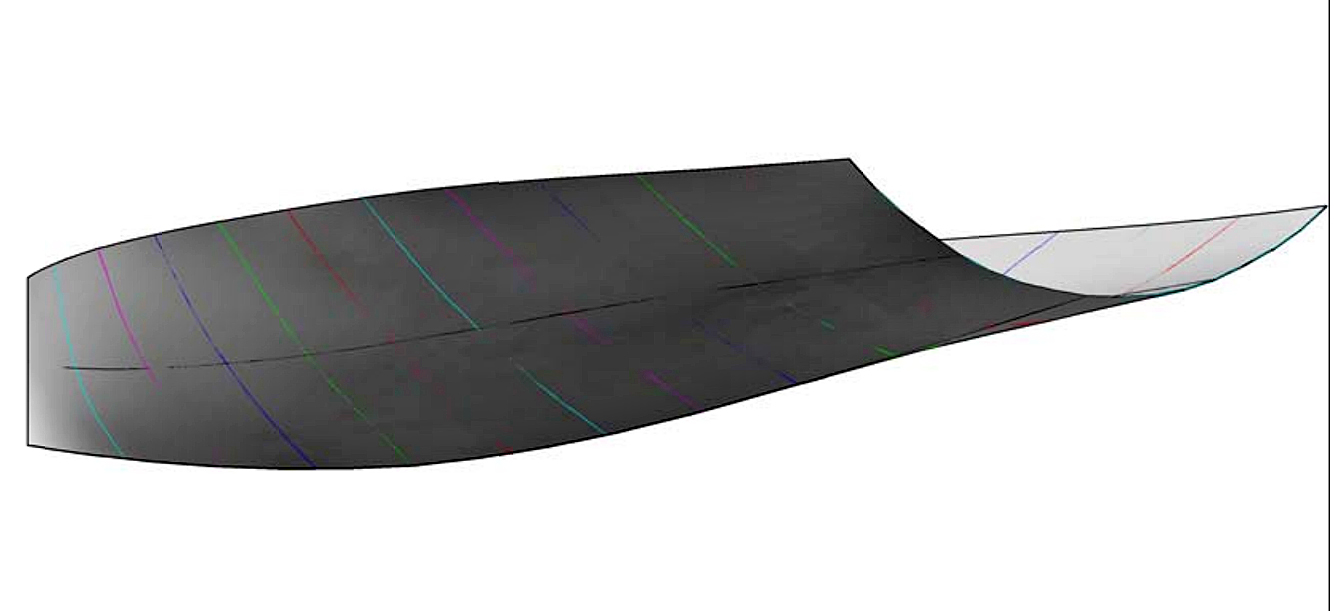
Header Photo: Design Cartoon for a Bend-em-Up - Classic Moth?


The previous header photo was a design cartoon kicking around the Interwebs. There was no explanation attached but, if I engage in a bit of speculation, it seems to be a developed ply concept for a Classic Moth. Bill Schill did his last Maser conversion very similar to this, a radical looking Moth. Bill's Maser concept was very slow. Unfortunately, I have no photos of Bill's last Maser. It seems to me you could build a credible Classic Moth if you glommed some topsides onto the back half of the boat. It would take some tinkering; should be an easy build, though probably not a racing shape.

George A. has more on Bill Schill over at his Mid-Atlantic Musings blog.


Update: January 18, 2021 - It turns out this design cartoon was actually built. She is a Classic Moth design by Bertrand Warion, a prolific builder of Moths, whose design and building inventiveness has been featured in many posts on Earwigoagin. Bertrand writes of this bend-em-up design;
"The Moth Classique is "Zazou" I designed in 2002/2003? The boat was made from one sheet plywood, 5mm exterior grade. [It] was easy [to build] and quite fast but the mast was not stiff enough. [She] is now destroyed. [There] is only one photo remaining."

Zazou is Moth number 203 to the right of this gaggle of classic Moths running downwind.


Sunday, March 31, 2019

Header Photo: Laser blown over


I think this is the first time in my blogging history that I have put up some random header photo and it turned out that it presaged a momentous news announcement - in this case the International Laser Class Association announcing that Laser Performance Europe was in violation of contract and couldn't build any more class legal Lasers. The Laser class, after suffering several years of legal wrangling over who owned the class, now seems set for another round of lawsuits. A shame. If you can stomach online forums with their endless drivel (and occasional nugget of wisdom), click here to go to Sailing Anarchy's thread.

And from the Earwigoagin archives, here is the blogmeister in a bit of a pickle with his Maser, Starkers.


Saturday, February 2, 2019

Brewsabee: Another Narrow Waterline Classic Moth Design


Brewsabee is my own design, done in 2005 as a follow on to my original Tweezer design. The design brief was to better compete with the Mistral in lighter air so the waterline beam and wetted surface was pared down compared with the original Tweezer. I never built Brewsabee because:
  • After Tweezer, I was getting at the age where I wasn't sure I wanted to continue to flop around in a narrow waterline Moth. Plus winning races now wasn't the end-all/be-all of my sailing existence.
  • Building would be more complicated. Brewsabee would be best done in foam/glass, something I wasn't too familiar with.
  • I wasn't sure, given the generally light conditions we sail in here in the Mid-Atlantic, that Brewsabee would offer any significant performance advantages over the Mistral.
So I decided to put together a Maser, a flatter Gen I design, which was an entirely enjoyable Mothboat sailing experience.

I don't consider Brewsabee to be an extreme V design, but she is a narrow waterline design.

The Brewsabee has forward flares at the gunwhale, legal in the American Classic Moth Rules since the 1 inch concavity rule doesn't kick in until after the daggerboard trunk. Sections below the waterline were a very hard U forward translating to flattened semicircular at the back.

Again, for printing or downloading, use the upper right icon to pop it into another browser tab.


Couldn't help myself - a video of Tweezer (no. 92) when she and the blogmeister were able to get to the weather mark first in light air in one race of the Nationals. But, dog-gurn-it, the Mistrals were still able to run us down over the course of the race.


Saturday, November 17, 2018

Header Photo: Starkers... Gone!


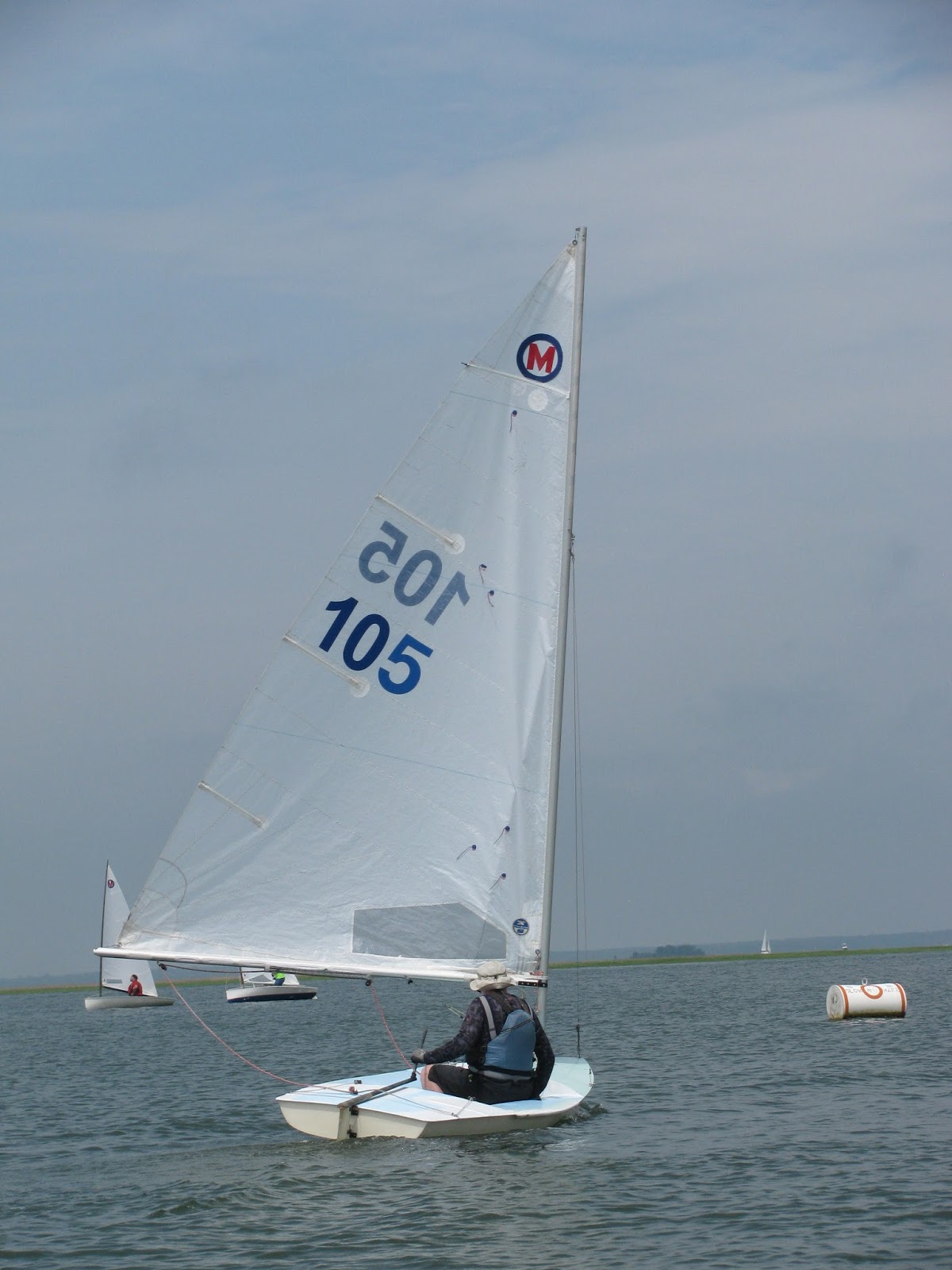
The previous header photo was the blogmeister idling around in his Maser before one of the starts of the 2015 Classic Moth Nationals. This fall I donated my Maser, number 105, (named Starkers as a Tip-of-the-Hat to her designer/builder, Randy Starks) to Joe Bousquet's expanding Classic Moth outreach to junior sailors. I haven't been racing much and felt Starkers would be better off with a younger skipper. Moth no. 105 was a good Moth. I treat my racing boats as anthropomorphic entities; they have human personalities and there was no doubt Starkers had a will to win. (Don't most singlehander's talk to their boats when racing? I even apologize to my boat if I do poorly in a race.). I like to think she was thankful at being granted another life, like a rescue dog, except in this case Starkers was brought back from an abandoned Laser hull and had a second life as a full-on racing Classic Moth. As a team, we won the trifecta of Gen 1 trophies, the Nationals, the Midwinters, and the Brigantine regatta. Great memories and I will forever have a soft spot in my heart for Starkers, this endearing mutt of a Classic Moth.


Ingrid Albaugh


Ingrid Albaugh


Sunday, November 19, 2017

Classic Moth News: Fall 2017


For you design geeks...

Andrew Slavinskas is continuing a discussion of Classic Moth design over at Woodenboat Forums. Lots of hydrostatic analysis including some of the Tweezer design.


New England News...

New Englander Yarrow Thorne has refurbished his Crosby Skimmer Moth and also picked up an Etchell's Connecticut Moth that was languishing up in the Northeast. Both were entered in the Archipelago Rally pursuit race in Rhode Island at the end of October. Unfortunately the Connecticut swamped and couldn't be self rescued, a bad habit of the vintage Moths since many had no built-in flotation. (Why would you worry about getting the Moth up quickly since the sailing season back then was Memorial Day to Labor Day and the water was warm.)

Yarrow racing his Skimmer Moth in the Archipelago Rally.

Photo by Rufus Van Gruisen

The Skimmer on the dock at the Rally.

Photo by Rufus Van Gruisen

The advantage of vintage Classic Moths is they float upright when moored out. Yarrow's fleet; the Connecticut is in the backgroud.


Meanwhile over in Merrie Old England...

Over at the Boat Building Academy at Lyme Regis, Jake Stow is building a Mistral.

The English are busy digging 1960's Rondar Skols and mint condition Shelleys out of backyards and putting them back on the water .

Stuart Mander's barn find, a beautiful double-bottom wooden Shelley.

.
A glass Skol


A Skol getting the longboard treatment.


Jim Champ has launched his UnSkol with the new hull sections he designed.


Ian Marshall has had a successful run in the English CVRDA (Classic/Vintage Racing Dinghy Association) events, sailing a Classic Moth Shelley Mk I with a tall rig.


The Classic Moth class has a good number of one-off designs. It was a easy class (inexpensive, un-complicated, with the freedom to build in wood) to show that you had invented a better mouse-trap.  English helms-woman Vanessa Weedon Jones owns this interesting double chine plywood Moth, Yellow Peril, that was professionally built in Derby. I like the free-standing wood mast.


The Chesapeake Bay Classic Moth Fleet...

The Chesapeake Bay wrapped up the season at Chestertown with the Patterson Regatta in mid-October where we had 11 Classic Moths. Even the blogmeister was finally able to get his Maser together for that regatta. (The last two years, this is the only Classic Moth regatta I've been able to make.) Mike Parsons, this year's National Champ, continued his run at the top of the podium with a clear win in the Patterson.

An indistinct I-Phone photo of the fleet on Chester River in gentle breezes for the 2017 Patterson Cup.


Here is a photo from Earwigoagin's archives of the blogmeister with two of his Classic Moth's, a modified Stockholm Sprite and the Tweezer at the 2009 Chestertown/Patterson Regatta. (Both no longer in my fleet.) Joe Bousquet is adding some welcome informed advice. I always liked the yellow painted spar of Energizer (the Stockholm Sprite on the left, the spar was a cut down Finn spar.)


Post about Classic Moth plans over here.

Saturday, November 11, 2017

Time Capsule 2009

In poking around my hard drive I came across this video I made in 2009. On a summer Sunday morning eight years ago I had my small boat fleet gathered in the front yard so I got out the digital camera and proceeded to document all of them.

Eight years later;

Gone: the Tweezer to Maine, the Surf Ski to a local paddler and the stitch and glue canoe to Bill Boyle.

Kept: Maser, the PK Dinghy which hasn't progressed any since 2009, and the City Island kayak.

Added: Two other projects, both Classic Moths.

Projects on top of projects. And the beat goes on.


Thursday, March 23, 2017

Why is a Laser Faster than the Classic Moth - Or Is It?

Over at the WoodenBoat Forums there is this thread that recently popped up that was started with this question by "cmjns":
"I've spent a lot of time ogling classic moth designs, from the Gen II mistrals to the Gen I Mint, and I'm a bit smitten by the Farr 3.7 and the Contender (very different boats, I know). So I'm curious: among all the shapes swirling around in my head, some of them reportedly are much faster than others. And the moths in particular *look* fast but aren't nearly as fast as a laser, which nevertheless "sails like an aircraft carrier" in comparison.

"So my question: how do I evaluate a hull shape? What characteristics are associated with downwind vs. upwind performance, and what equates to overall speed? And why is a laser faster than a moth? Is it the sail? Is it the length? Is it the shape? What happens to a laser when you cut it down and put a moth sail on it (maser)? Does it slooooooow down?

The answer in a nutshell. A Laser is faster than the Classic Moth because it is longer (as several of the commenters to this thread noted - see "Chris249" comments for a more detailed hydrodynamic explanation). The Laser also has more sail area - the Classic Moth rig is more-or-less equivalent to the area of the Laser Radial. And No... making a Laser into a Maser doesn't make it faster than a Laser. (It does make it more fun in my opinion.)

I think the crux of "cmjns" question deals with hull shape and, specifically, why the flat Laser shape is so different from our fastest Classic Moth hull shape, the Mistral or Duflos designs which have low wetted area, narrow waterline beam, rocker forward, with a large amount of flare to the gunwhale. Does that mean the flat Laser shape is inherently "faster". Are the fastest Classic Moth hull shapes an anomaly?

First up is the Laser shape:


For a comparison is the following four views of the Mistral hull shape as modeled by Andrew Slavinskas. Not a flat area to be found. The transom is a very circular shape.
Andrew Slavinskas


Andrew Slavinskas


Andrew Slavinskas


Andrew Slavinskas

What gives? It turns out the characteristics of a Classic Moth Gen II fast hull (low wetted surface, narrow waterline beam, high flare to support hiking power) translates very well into a longer, very fast conventional hiking singlehander - in fact the fastest conventional hiking singlehander. It is the RS300 and it was designed by Mothist Clive Everest back in 1998. It is not length that gives the RS300 an advantage. (It is only slightly longer than the Laser - +.07 meter, giving the RS300 the same length as a Melges 14.) It is a hull with very little flats anywhere, where wetted surface is pared back ruthlessly, where the waterline beam is as narrow you can get away. The dirty little truth! For a design close to twenty years old the RS300 is faster than the latest, much ballyhooed RS Aero and the D Zero. Some RYA Portsmouth numbers:
  • RS300 - 973
  • RS Aero - 1024
  • D Zero - 1029
  • Farr 3.7 - 1039 (Yes, I know the Farr is a trapeze singlehander.)
  • Laser - 1097
  • Europe Dinghy - 1145 (I would expect our Classic Moth Mistrals to be slightly faster than this number.)
The downside to this hull shape. As with our Mistral design, the RS300 is very tippy and has a tendency to trip up her skipper with regularity. The RS300 is worse than our Gen II Classic Moths in that respect because the RS300's modern rig is much more powerful than our vintage low-aspect rig. As such the RS300 has carved out a small niche among those singlehanders who want an athletic, challenging, conventional (no-foils) full-on racing dinghy. The market for the RS300 is small enough that RS has given the RS300 production over to another low-volume builder.

So our fast shapes in the Gen II Classic Moth fleet are not an anomaly. There are exactly the shapes you would design if you want the fastest hiking, non-trapeze, non-sliding seat, non-foiling singlehander. However, if  you are trying to sell a lot of dinghies, you just might not find a large enough crowd that would enjoy all that wind-swimming.

From the Earwigoagin archives, you can find other RS300 posts.

A very well done RS300 promotional video:


Saturday, March 19, 2016

Updates on Classic Moth Builds: Spring 2016

Springtime and let's see what the makers in the Classic Moth world are cooking up.

I know two Bill's who are boat-builders and both of them are very, very quick at knocking a boat out from scratch. The next couple of photos are from Bill Boyle's blog where he is documenting his cedar strip Europe Dinghy build. He has the hull off the molds and is now fitting the bulkheads and deck reinforcements.

The king-plank for the foredeck and the mast strut connecting down to the hull. This will support the deck-stepped mast.

Repost from http://europedinghymoth.blogspot.com/

The daggerboard trunk.

Repost from http://europedinghymoth.blogspot.com/

How the mast strut is gussetted at both juncture points.

Repost from http://europedinghymoth.blogspot.com/

John Hanson, a Mainer, is starting a New Zealand Moth scow as a father/son project. John is the publisher of Maine Boats, Homes, and Harbors magazine and will be documenting the build in upcoming issues. He did a mock-up of the hull (which is essentially a Len Morris MkII scow) in luan.
Picture clipped from Issue 139 of Maine Boats, Harbors, Homes

Also, about 50 km. from where I live, Victor Stango is reconstructing the rolled deck on a Maser he picked up over the winter. Whoo! Hoo! another Maser in the local fleet.


Meanwhile our Classic Moth friends in Russia are proceeding apace with their construction of the Mistral Moth. They built the hull over full molds and report that there was little issue in getting the plywood to behave when fitting.

Here is one side of the plywood going on.

http://forum.katera.ru/index.php?/topic/51277-classic-moth-boats/


http://forum.katera.ru/index.php?/topic/51277-classic-moth-boats/

Completed shell off the molds. The builder is Serg-IF. Looking good!

http://forum.katera.ru/index.php?/topic/51277-classic-moth-boats/


http://forum.katera.ru/index.php?/topic/51277-classic-moth-boats/