Showing posts sorted by relevance for query Skimmer Moth. Sort by date Show all posts

Thursday, November 20, 2014

Crosby "Skimmer" Moth


The original Rudder article with plans for the Skimmer can be found here.


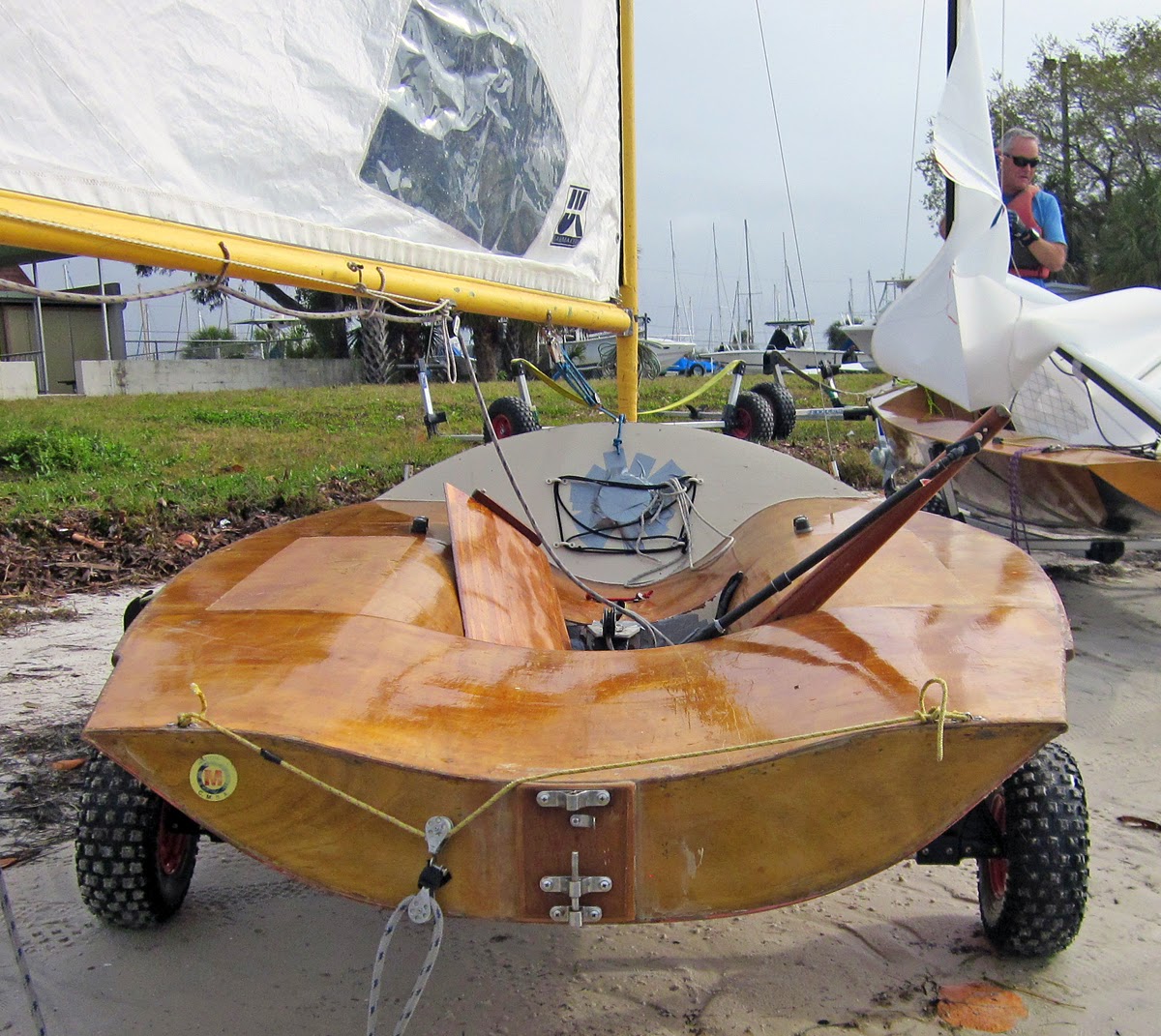
I got an email from Chris Museler mentioning that his friend had picked up an old Classic Moth on Cape Cod. It turned out that his friend, Yarrow Thorne, of Rhode Island, had acquired a very unique find, a Skimmer type Moth designed by William Crosby in 1933. Crosby, the editor at The Rudder magazine, had designed the deep-V Snipe in 1931, which was published and heavily promoted in The Rudder. Now in the heart of the Great Depression, Crosby designed an even cheaper and easy to build sailboat in 1933, this being a catboat to fit the open 11 foot rules of the Mothboat class, a class only a couple of years old but proving to be very popular. Captain Joel Van Sant out of Elizabeth City, North Carolina had built the first Mothboat, Jumping Juniper, in 1929.

As with the Snipe, Crosby published the plans for Skimmer in The Rudder. Unlike the Snipe, the Skimmer was a very shallow-V scow design with no cockpit - a true sit-on-top dinghy. As the publication of the plans for the Lark scow in The Rudder in 1898 would have enormous international impact on small boat sailing, the publishing of the plans for the Mothboat Skimmer would also have a similar international impact. Len Morris, of Australia, had designed an 11-foot scow in 1928, a class he called the Inverloch 11-footer until he saw The Rudder article on the Skimmer and decided to change his class name to the Moth - after all his design was also an 11-foot catboat, a similar scow-type and what was the chance the Australians and American 11-footers would ever get together to race?

The Europeans, particularly the French, started to build Skimmers which formed the beginning of European Moth class. Here is a photo, courtesy of Louis Pillon's Moth article Part 1, of an early French Skimmer, this time built with a cockpit. Click here for Louis Pillon's Moth article Part 2


Considering the historical importance, a Skimmer should definitely be in a museum collection such as Mystic or The Mariners Museum.

Yarrow says his Skimmer Moth was built in plywood which puts the build date as possibly late 1930's or, even more likely, WWII or just after WWII.


Double shrouds, high spreaders, a jumper-strut on a wood mast is very typical of the state of American Mothboat rigging before WWII.


This Skimmer came without a sail, centerboard, or rudder. Yarrow was able to fit a Penquin sail on the spars.


Yarrow was able to cobble together the whole package and race this November in the 2014 Archipelago Rally free-for-all race. In 2014 terms, the lack of cockpit and the low boom position on the Skimmer do not make for comfortable sailing (as we see below with Yarrow painfully kneeling on the deck - wondered what the tacking procedure consisted of - a belly crawl under the boom?). Considering that many builders of The Rudder sailboat plans had no compunction about modifying  the designs, I'm sure many Skimmers were built or modified to have cockpits. (But low freeboard scows like Skimmer were very wet and American Mothboats started evolving with cockpits but also higher, roundish torpedo decks to shed the water before it got to the cockpit.)

Yarrow sent along his impressions on his first sail in the Skimmer.
"The boat was very balanced, the sail was wrong and the tiller was too long, not allowing me to sit far back, I still need to learn how to sail but was very surprised to launch and sail within minutes for 1st time in over 30 yrs. The boat pointed OK in 20 knt's with chop, it liked the center board up a bit and I did not load the orig[inal] rig very much ;). but down wind WOW, it's a surf board and loves to have the nose even with the water, but if you get it wrong it buries the nose to the trunk in a heart beat.
This photo, lifted from the Internet, courtesy of Rufus Van Gruisen.


Sunday, November 19, 2017

Classic Moth News: Fall 2017


For you design geeks...

Andrew Slavinskas is continuing a discussion of Classic Moth design over at Woodenboat Forums. Lots of hydrostatic analysis including some of the Tweezer design.


New England News...

New Englander Yarrow Thorne has refurbished his Crosby Skimmer Moth and also picked up an Etchell's Connecticut Moth that was languishing up in the Northeast. Both were entered in the Archipelago Rally pursuit race in Rhode Island at the end of October. Unfortunately the Connecticut swamped and couldn't be self rescued, a bad habit of the vintage Moths since many had no built-in flotation. (Why would you worry about getting the Moth up quickly since the sailing season back then was Memorial Day to Labor Day and the water was warm.)

Yarrow racing his Skimmer Moth in the Archipelago Rally.

Photo by Rufus Van Gruisen

The Skimmer on the dock at the Rally.

Photo by Rufus Van Gruisen

The advantage of vintage Classic Moths is they float upright when moored out. Yarrow's fleet; the Connecticut is in the backgroud.


Meanwhile over in Merrie Old England...

Over at the Boat Building Academy at Lyme Regis, Jake Stow is building a Mistral.

The English are busy digging 1960's Rondar Skols and mint condition Shelleys out of backyards and putting them back on the water .

Stuart Mander's barn find, a beautiful double-bottom wooden Shelley.

.
A glass Skol


A Skol getting the longboard treatment.


Jim Champ has launched his UnSkol with the new hull sections he designed.


Ian Marshall has had a successful run in the English CVRDA (Classic/Vintage Racing Dinghy Association) events, sailing a Classic Moth Shelley Mk I with a tall rig.


The Classic Moth class has a good number of one-off designs. It was a easy class (inexpensive, un-complicated, with the freedom to build in wood) to show that you had invented a better mouse-trap.  English helms-woman Vanessa Weedon Jones owns this interesting double chine plywood Moth, Yellow Peril, that was professionally built in Derby. I like the free-standing wood mast.


The Chesapeake Bay Classic Moth Fleet...

The Chesapeake Bay wrapped up the season at Chestertown with the Patterson Regatta in mid-October where we had 11 Classic Moths. Even the blogmeister was finally able to get his Maser together for that regatta. (The last two years, this is the only Classic Moth regatta I've been able to make.) Mike Parsons, this year's National Champ, continued his run at the top of the podium with a clear win in the Patterson.

An indistinct I-Phone photo of the fleet on Chester River in gentle breezes for the 2017 Patterson Cup.


Here is a photo from Earwigoagin's archives of the blogmeister with two of his Classic Moth's, a modified Stockholm Sprite and the Tweezer at the 2009 Chestertown/Patterson Regatta. (Both no longer in my fleet.) Joe Bousquet is adding some welcome informed advice. I always liked the yellow painted spar of Energizer (the Stockholm Sprite on the left, the spar was a cut down Finn spar.)


Post about Classic Moth plans over here.

Saturday, March 20, 2010

Classic Moth plans

Plans de dériveur classique Moth, Plans de voiliers classiques Moth

Before diving into this very lengthy post, you might want to Click Here To View Classic Moth Images courtesy of Google.

You also might want to Click here for a YouTube video with commentary on some of the various Classic Moths racing at the U.S. Classic Moth Nationals in Elizabeth City.

(Addendum September 2012 - I first wrote this post in 2010. Since then various boatbuilders have popped up, building reproductions of vintage designs. Francois Vivier has also produced a kit Moth. In the two years I have made many more posts about Classic Moths on Earwigoagin and it might be worth the reader to investigate. For more articles on the Classic Moth from this blog, use the Blogger Search Box at the top left  (next to the orange B icon). Type in "Classic Moth" to pull all the articles on the Classic Moth from this blog. Or go to the Labels on the right side of the blog and select "Classic Moth" I keep adding plans and sections for various Classic Moths. Use the following links.)
(editors note - I've dragged the Conclusion to the top of the post - August 2013) CONCLUSION - Let me be clear. The Classic Moth is a short hull and a light hull. At the Gen2 (higher performance racing) level, the Classic Moths are challenging craft to sail but very rewarding at the same time.  A Laser is like an aircraft carrier compared to the more twitchier Gen 2 designs, the MistralEnergizer, Tweezer or even the Shelly. 

But there are more stable Classic Moths that we classify as Gen 1. I've never sailed a Mint or a Proust design but I would assume that they would be very much the same stability as a Laser or Sunfish. Or, an even older design, a reproduction vintage design such as the Little Mae or Nantais Moth would be the most stable and perfect for kicking around on the lake. 

So there you have it. The Mistral, Shelly and Florida Cates have more or less complete plans. Other designs you would probably need to work off a set of lines drawings and use your builders experience. George Albaugh is our plan librarian. His email is linked from Classic Moth website.  George is also another sailing blogger. You can view his Classic Moth posts over at Mid-Atlantic Musings.


All lines drawings (except the Europe dinghy) were done using MaxSurf's NURBS software.


Quick review of some of the more popular designs and the availability of plans. (Updated September 2012)

(Note; To give a rough idea on the tippiness of a hull, Joe Bousquet developed a scissor-like device he placed over the midsection to visually show the amount of V. I've included his pictures of the various V's from the Mistral, Shelly, Europe, Energizer.)

(Another note: To scroll through hi-res pictures, just click on a picture. Once the hi-res picture comes up, click again in the picture to step through all the pictures on this post.)


MISTRAL - easiest to build. Developable plywood. Stitch and glue. Two 3mm plywood panels are bent up to shape, a centerline piece attached to hold the run flat, a spreader bar at the gunwhales is used to get the correct shape when bending up and glassing. A weekend of work will give you the rough shape. Adding two permanent bulkheads, a temp bulkhead and the transom finalizes the shape. Many people have hacked the hull shape by pushing here or pulling there so we have some semi Mistral hullls out there. Here is a link to a blog post of a local Annapolis Mothist, John Z building a Mistral. A Mistral or some variation of the Mistral has won the Nationals the last umpteen years.

However, the Mistral is a very deep V design. Very floppy and has a tendency to scare newbie Mothists who try to sail her. Many have come ashore and either; 1) rapidly put the boat up for sale or 2) put the Mistral back in the garage for a while and then discreetly sold her. Not all mind you, as we have a core group of about 6-8 who regularly sail a Mistral (or modified Mistral design, i.e. the Mousetrap or Y2K designs) and are able to race them hard in all conditions and win. It helps to have some Laser or Sunfish experience but this is not an ironclad requirement. If you pick a Mistral to build, consider yourself warned. If you decide to proceed, George has the plans (see bottom of article).

The Mistral on the Bousquet V-meter.


Top View of a Mistral Mod Design, the Mousetrap by Jeff Linton.


Picture of the tank framing for Joe Bousquet's Mistral. Note the sistering of insulation foam with the plywood frame to provide gluing surface for the plywood decks.


Not all Mistrals are built in plywood. This one was done in foam core/glass, with the hull splashed using an existing wood hull as a mold. Note the very interesting transom design.


Here are the lines to a modified Mistral, the Y2KBug built by Walt Collins. (Pretty extreme wouldn't you say!)


ENERGIZER -Just a hair more stable than the Mistral is the Energizer design. A modification of the 1970's Stockholm Sprite, it is a full chine design but still very V'd. Two have been built with some success. No plans.

Energizer on the Bousquet V-meter.


The original Energizer was the first Classic Moth I owned. Here I am sailing Energizer at Chester River in Maryland.


The Energizer hull shape from the stern.


A lines drawing of Energizer showing it belongs to the deep-V family of Classic Moths.


TWEEZER - Yep, this is my design. I called this design Tweezer D as it was the fourth generation in what I drew up, but the D version was only one built. A Gen 2 design racing against the Mistral, Energizer designs. Stability somewhere between the Mistral and the Shelly (though some other sailors have told me it is close in stability to a Shelley). Flatter rocker in the Tweezer has proven to be quick in a breeze but suffers against the Mistrals and even the Shelly in the lighter stuff (non-hiking breeze) which, on the East Coast, seems to be the majority of our conditions. I may be biased but it is a hull with little vices and I enjoyed racing this design. Round-bilged and the original was built using cedar strips.
Picture below is of me lollygagging around on Tweezer, before a start at E-City.


And the Tweezer D hull lines:


SHELLEY - A wider, flatter chined design with moderate rocker from the brilliant New Zealand/English dinghy designer of the 1960's, John Shelley. Much more stable and, in the hands of Joe Bousquet, has done very well in the National championships. George has the Mk3 plans.

Shelley on the Bousquet V-meter.


A McCutcheon built Shelley in dinghy park at the Gulfport Midwinters.


The lines for the Shelley Mk III.

Bill Boyle is doing a new build of a Shelley MkIII which he is documenting in a blog. Click here to check out his progress.


MINT - Qualifies for Gen 1 (our Classic Moth division for the more stable, higher wetted surface hulls that are not Vintage). A Bill Lee national championship winner, the Mint is a reasonably docile design from the 1950's. Never built one but the bow sections go very fine and look to present some challenges to the home builder. That being said, 6 hulls were built in Elizabeth City in the 1990's. George has the section lines.

A picture of the beautiful restoration of the first Mint built.....


And John Pugh sailing a Mint at the E-City Nationals.


The hull lines of the Mint showing the concave sections up forward.


FLORIDA CATES

The most successful American design of the 1960's. Florida boatbuilder, Harry Cates, evolved the shape from Warren Bailey's Mach 1. massaging the shape to make it easy to home build in plywood. Charlie Hunt drew up the plans. A Gen 1 design, the Cates is another V'd shape with a distinctive small topside panel with chine. The transom is small, reminding one of a Sunfish transom. The Cates is very beamy at the gunwhales forward. Low freeboard, a wet boat, but most sailors find it reasonably sailable, with plans available. George A. has the plans (see contact info at top of post).

Gary Gowans has built two of them, with slight modifications. He won the Gen1 class at the 2014 Championships over an Olympic Europe.


A topside shot of a Cates. Bill Boyle in 1965.


The lines to the Cates show a considerable V, hollowed bow sections, and a tiny topside panel. Beam is 1.72 meters.


The top down view shows a pinched transom and wide side-decks.


The sideview shows moderate rocker. The tiny topside panel that disappears at the bow is also clearly shown.


The offsets to the Cates design can be found by clicking here.


MODERN FLORIDA -There are two designs by famous Florida MORC designers; OH Rodgers designed the Florida Wedge (a low rocker design, very stable, but slow in waves and squirrely downwind in a breeze). Four hulls were built by the St. Petersburg fleet and Jeff Linton won the 2003 Nationals with one. I'm not sure if any plans exist.

A stern view of the Florida Wedge showing the flattish, low profile, transom and no stern tank:


Paul Lindenberg designed a Classic Moth which has a resemblance to the Windmill hull. Lindenberg will sell his Classic Moth plans for $400. I don't have an address.

Lindenberg's website does show some
Classic Moth building.

A transom photo of a Lindenberg Moth (from George A.'s blog). Note the anti-reflective strips on the transom for safer trailering.


SAVANNAH WEDGE - A Moth copy of the Zuma dinghy built by AMF in the late 1980's, this Classic Moth was designed by Lane Reeves with two built in Savannah, Georgia.  This Wedge design had a wide, flat transom, low freeboard, double-bottom and reverse stern. The Savannah Wedge is not competitive as a Classic Moth racer, too much wetted surface, but with it's double bottom this is a very capable kick-around-the-lake daysailor. No plans existing that I know of.

Briggs Monteith begs to differ with my assessment - I have dragged his comment to the main post:

"I know this is an old post but as for the Savannah Wedge not being competitive, I finished third in a Savannah Wedge in the '99 midwinters sailing one that I borrowed from Jerry Carter. The boat was amazingly quick I thought, It beat Mean Tangerine and Randall Swans Vanilla. in extremely light air conditions. I think the boat has suffered from sailors who didn't understand the boat." -Briggs Monteith


SKOL; The Skol was a British production fiberglass Moth from the early 1970's. The Mk II, the most popular version, was a de-tuned Mistral with very round sections.  The Mk II had a tub cockpit with a back tank. Here are two pictures of a just retrieved, hence dirty, Skol Mk II. The winglets are illegal in the U.S. Classic Moth Association Rules. (We have a 1" hollow rule.). There are no known plans but a used one would make a good re-decking project (see the last photo is this section).


The original ad for the Skol Mk II


Here in the U.S. Joe Bousquet did a decks-off/plywood redeck restoration of a Skol Mk II, shown here sailing in the 2014 CMBA Midwinters.


A transom shot of the same Americanized Skol. A very round transom, equivalent to the Duflos or Mistral shape.


EUROPE Dinghy- The ex-Olympic Europe is based on a 1960's Europa Classic Moth and there is an active section of Classic Mothists who have purchased plastic Europes, modified the sail to fit the Classic Moth and are sailing them mostly as stock (though we do have three modified Europes, Mark Saunders has done a Europe hull lighter with a wooden deck).

Wooden Europa dinghy on the Bousquet V-meter.


Walt Collins with his Olympic Europe.


The lines to the Olympic Europe dinghy.


PROUST DESIGN - In 2009, Jim Young built an old French design he found on the Internet. Despite the name he gave her (Tippy), this Classic Moth was anything but. A stable, buoyant design which Jim built modern, in foam/glass. Details on "Tippy" can be found over at this blog post. I've also put up offsets, both metric and English, for my version of the Proust, the Zippy.Also the Zippy sections are posted here.


Tippy at the 2008 E-City Nationals.


The simple single-chine sections for Zippy. There is no compounding of plywood here. This design has ample flotation forward, which makes for a safer hull, particularly downwind in a blow. (For reference, buttock lines spaced at 150mm and waterlines spaced at 60mm.)


TITAN - The Titan design is another stable design from the 1960's. It is a round-bilged design, a pretty hull, but the original hulls were built very heavy in fiberglass. Reports from Mothists who have sailed them find the Titan well mannered. The design has some similarity to a small Uffa Fox International 14.


RESTORATION - Many of the 60 designs have reappeared as derelict hulls and have been restored rather than homebuilt from scratch. The oldest designs for Vintage (Ventnor, Connecticut, and Dorr Willey designs) must be restored to qualify to race in  the Vintage division (you can still race a reproduction Vintage in the Gen 1 division). 

Here is one of the original ads for the Ventnor Moth.


Bill Boyle has done quite a few Moth restorations and has written about them.


  1. Click here to view his restoration of a Fran Abbott Moth.
  2. Click here to view his restoration of a Fletcher/Cates Moth.
  3. And his latest restoration of a Ventnor copy.


DESIGN YOUR OWN - With the introduction of free hull design software, the more adventurous can design their own Classic Moth. The American rule limits length to 3.3528 meters, beam is limited to 1.524 meters, no concavity greater than .025 meters aft of the daggerboard trunk and hull weight (including fittings) is no lighter than 34 kg.

John Watkins published this set of Classic Moth lines to the WoodenBoat forum in 2015. This design would fit very nicely into the U.S. Gen 1 division.


MARIPOSA

Mariposa is a French Classic Moth three plank design by Bertrand Warion, featuring a flat rocker panel married to developable bow sections, built stitch and tape. The design was one of several new Classic Moth designs built for the "concours de plans Moth Classique" sponsored by the French traditional boating magazine, Chasse-Marée in 2001.


RAZMOTH - another French design by Bertrand Warion. This one is patterned after the Fireball and has a flat rocker panel. RazMoth is another simple flat, two chine, easy-to-build plywood shape, ending in a scow bow. The RazMoth design is on it's second iteration.


BILBON - was another French design built for the "concours de plans Moth Classique" sponsored by Chassse_Marée magazine in 2001. Designed by Christophe Couton, a professional draftsman, it is a simple flat V, easy-to-build plywood shape, ending in a pram bow. Bilbon was one of the faster new designs that appeared at the 2001 design competition.


Here is a middle-of-the-road round bilge design I drew up. A very conventional dinghy hull shape. For reference the waterlines are drawn spaced every 60 mm. and the buttocks are drawn at 150 mm. spacing

Click here for the DXF file of this round bilged Classic Moth design.


I've also pushed around the lines to the Fragniere design by adding a flat rocker panel.

Click here for the offsets for a three plank modified Fragniere Classic Moth design.


William Crosby's SKIMMER - A very early Moth design, published in The Rudder in 1933. According to Crosby, hundreds were built but very few have surfaced in modern times. A scow type, this would make a good off-the-beach boat but is not competitive in the Vintage Divsion when compared to the deeper V vintage designs like the Dorr-Willey or Ventnor.

Skimmer Plans can be found here.

A Skimmer found in a barn in Cape Cod. Note the lack of cockpit.


MASER - And for those with the true hacker spirit - there is the Classic Moth that uses a sliced and diced Laser hull - deemed a Maser.

A Maser at the 2011 Midwinters. You can sort of see the Laser transom, still intact.


MOTH CLASSIQUE: The French have a rich tradition with the Classic Moths and their designs. The French Duflos was the fastest Classic Moth before the arrival of wings. Click here to view Part 1 of Louis Pillon's fascinating history of the French Moth class. I have come across two small jpeg's of French Moth designs on the Internet.

The first is the vintage, scow bow Nantais design which has been mentioned before in this post.


The second is the Fragniere design, a unique transom bow design which was most popular in France before the appearance of the very narrow Duflos and similar designs. Click here for the offsets for the Fragniere.


Here are some photos of a recent build of the Fragniere design. Following the plans, the Fragniere has a full length cockpit.


French designer Francois Vivier has designed a Moth Classique to be built in kit form. Here is the side view of his Moth Grand Largue.


Benoit Duflos, who pioneered the very fast, very Vee'd, very tippy racing Moths of the 1960's also designed a more stable, flat-bottom Moth for the home-builder. Called the Moth-Pop, plans for the Moth-Pop can be found in the links at the top of this post. Here is Benoit's iso-view of the Moth-Pop


The lines plan for the Moth-Pop.


The 505 Moth - John Westell, the designer of the 505, also did a 505 type Moth. I haven't come across any that have survived to the modern day.


Image courtesy of David Henshall


SCOW Moth - The scow Moth was THE Moth of Australia and New Zealand until the narrow waterline winged Moths proved faster in the mid 1980's. Len Morris was the founder of the Australian scow Moths with his Flutterby design which he built in 1928. His post World War II MK II design was very popular and is still an easy-build proposition out of plywood. Plans for the MK II can be found by clicking here.

The sections for the MK II show a simple flat-bottom scow with vertical sides.


A double bottom MKII built in the 1950's.


Classic Moth Sailplan

All dimensions in mm. For the original post on the Classic Moth sailplan, click here.


Where to put the mast and daggerboard in a Classic Moth?

Luckily, John Shelley's construction drawings for the Shelley Mk 1, which he used in a patent application, have now surfaced on the internet. His mast and daggerboard placement as indicated in the drawings below are good placements, though, if you went around the fleet with a measuring tape, you would find this might vary by up to 75 mm from boat to boat. 


Center of mast back from stem - 695 mm.


Leading edge of daggerboard back from stem - 1453 mm.


What constitutes a Gen I Classic Moth design?

"What constitutes a Gen I Classic Moth?" As of now, and for the foreseeable future, the good old eyeball. Among the class, we have discussed various parametrics, but the difficulty of measurement, and the almost certain chance of designers trying to skirt any numbers written down (bumps, lumps and so on), have kept us to a subjective division. Most of the designs featured on the this design page are Gen 1 designs. They include the Europe dinghy, the Proust (Tippy or Zippy), the Shelley, the Florida and Savannah Wedge, the Maser, the scows, the Cates, the Mint, the Nantais, the Little Mae, and the Titan. The age of the design does not matter for Gen 1. The primary determinant is waterline beam. If it looks narrow, it doesn't fit Gen 1. Sailing a Gen 1 design should be relatively straightforward for anyone with dinghy experience.

The Gen II designs (narrow waterline) on the Earwigoagin design page are the Mistral, the hard-chine Energizer, the Tweezer, and the wood-decked, modified Skol. They are definitely a tippier proposition to sail and race, but rewarding for those who like a small boat challenge.


Other links to other Classic Moth design posts from Earwigoagin..........

  1. My answer to my first email inquiry about Classic Moths..... Classic Moth Designs Part 1 
  2. And also a good read.......Why a Classic Moth is Better than a Laser.